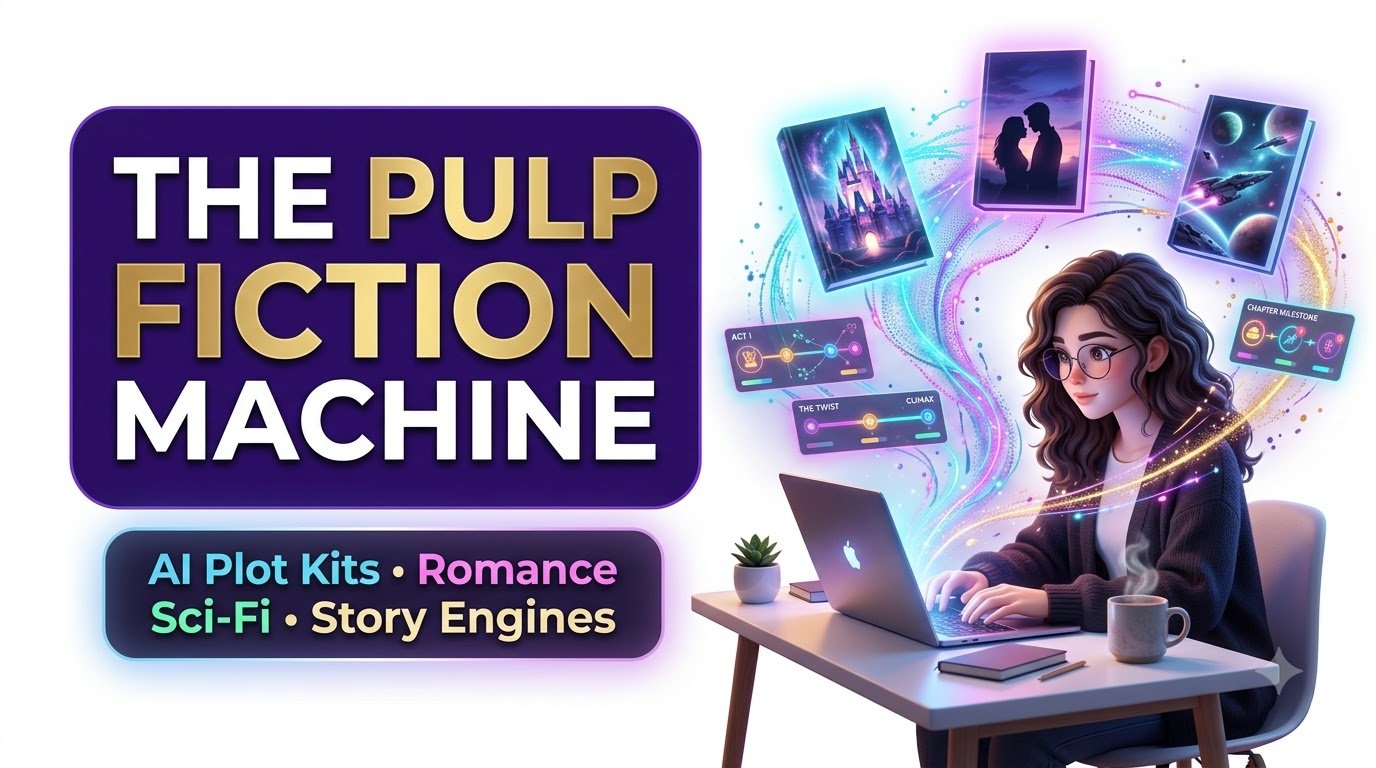
Discover how to create and sell AI fiction plot kits, romance beat sheets, character bibles, and sci-fi story outlines for indie authors.
The Pulp Fiction Machine: Selling Turnkey Romance & Sci-Fi Novel Beat Sheets with AI Scene Outlines
Discover how to turn structured storytelling systems, character development templates, fantasy worldbuilding bibles, and AI-assisted plotting workflows into valuable digital products for independent authors.
For fiction writers, publishing entrepreneurs, story consultants, and digital product creators.
Imagine an independent romance author sitting at a laptop on Sunday evening. Her previous novel is finally published. Readers are asking for the next book. Her newsletter needs an update, her cover designer wants a title, and she still has no convincing reason for her next two characters to fall in love.
She has plenty of ideas. What she lacks is a reliable structure that can turn those ideas into a complete, emotionally satisfying novel.
That problem creates an interesting opportunity for digital product sellers.
Instead of selling another collection of generic AI writing prompts, you can build something more useful: a ready-to-use fiction planning system that helps authors develop characters, design conflicts, structure chapters, and maintain continuity across an entire series.
Think romance novel beat sheets, science-fiction plot engines, psychological character dossiers, fantasy worldbuilding bibles, and chapter-by-chapter AI scene outlines.
A fiction planning kit is not a finished novel. It is the creative architecture that helps an author develop one. The buyer pays for organization, genre expertise, consistency, and a clearer path from concept to manuscript.
For authors publishing on Amazon Kindle Direct Publishing (KDP), these tools can help make a complex writing project more manageable.
But the real commercial opportunity is not automating imagination. It is designing a repeatable creative workflow that lets authors spend more time on the storytelling decisions only they can make.
1. Why Indie Authors Are Interested in Ready-Made Story Architecture
Self-publishing gives writers remarkable creative freedom, but it also makes them responsible for much of the publishing process.
They may handle plotting, drafting, revisions, formatting, cover coordination, marketing, reader communication, and launch planning.
Some commercially focused authors aim for 30-to-60-day production cycles, particularly for shorter genre fiction or established series. That is an individual business strategy, not an industry-wide requirement or guaranteed publishing schedule.
The difficulty is that creativity does not always follow a calendar.
The Hidden Cost of an Unstructured Manuscript
- Weak opening chapters: A promising concept begins without enough immediate tension.
- Character inconsistency: Motivations, histories, and personality traits change unintentionally.
- Middle-book slowdown: Events happen, but the protagonist’s central conflict barely develops.
- Romance pacing problems: Attraction appears too suddenly or emotional payoffs arrive without preparation.
- Worldbuilding contradictions: A fantasy magic system or science-fiction technology operates differently between chapters.
- Series continuity errors: Details from previous installments disappear or conflict with new revelations.
A well-designed AI fiction plot outline can help writers detect many of these issues before they invest weeks in a manuscript.
That is why a thoughtfully constructed fiction template can be more valuable than a large, unorganized prompt collection.
“250 AI fiction prompts” describes quantity.
“Plan an emotionally convincing 25-chapter small-town romance with character arcs, escalating conflicts, and continuity checks” describes a useful outcome.
2. What Exactly Is a Ready-to-Publish AI Fiction Series Kit?
A fiction series kit is a collection of structured creative resources designed to support the development of one book or multiple related books.
The phrase “ready-to-publish” refers to the commercially packaged planning resources. It should not imply that the included prompts or outlines automatically produce publication-ready novels.
A strong kit combines storytelling knowledge, editable planning documents, example outlines, and controlled AI drafting instructions.
Story Beat Sheets
Major plot milestones, turning points, reveals, climaxes, and resolutions organized around a specific fiction genre.
Character Dossiers
Psychological profiles covering motivations, fears, internal wounds, relationships, contradictions, and transformational arcs.
Conflict Matrices
Tools that connect competing goals, secrets, stakes, obstacles, and escalating consequences.
Worldbuilding Bibles
Consistent rules for settings, cultures, politics, technologies, magic systems, and historical events.
Chapter Scene Engines
Adaptable prompts with scene objectives, conflict requirements, emotional shifts, and continuity reminders.
Series Continuity Trackers
Recurring character details, unresolved story threads, locations, timelines, and future-book setup.
For digital product businesses, the important distinction is usability.
A buyer should immediately understand which file to open, what information to enter, and how the completed worksheet supports the next stage of the manuscript.
3. Romance Novel Beat Sheets: A High-Intent Fiction Product Concept
Romance fiction offers a particularly useful example because reader satisfaction depends heavily on emotional progression.
A romance novel cannot rely on two attractive characters repeatedly arguing until the final chapter.
The developing relationship needs a believable sequence of choices, vulnerabilities, setbacks, and earned changes.
A quality romance novel beat sheet helps the author plan that progression without dictating every conversation or scene.
Example: A 12-Beat Small-Town Romance Framework
| Beat | Story Function | Planning Question |
|---|---|---|
| 1. Ordinary Life | Establish the protagonist’s emotional world. | What feels missing? |
| 2. Meet-Cute | Introduce the romantic counterpart. | Why is this meeting memorable? |
| 3. Immediate Friction | Create a believable incompatibility. | Why do they resist each other? |
| 4. Forced Proximity | Give them a reason to interact. | What keeps them together? |
| 5. Unexpected Connection | Reveal compatibility or shared vulnerability. | What changes their assumptions? |
| 6. Emotional Resistance | Expose internal wounds and fears. | What prevents trust? |
| 7. Midpoint Shift | Deepen the relationship. | What can no longer be ignored? |
| 8. Rising Stakes | Increase emotional and external pressure. | What could each character lose? |
| 9. Relationship Crisis | Force a difficult choice. | Which belief or behavior causes harm? |
| 10. Personal Realization | Confront the underlying flaw. | What must change internally? |
| 11. Meaningful Action | Demonstrate growth through behavior. | How is love proven rather than promised? |
| 12. Emotional Resolution | Deliver the intended romantic payoff. | How is the relationship now sustainable? |
This framework is an illustrative planning model, not a mandatory formula for every romance subgenre.
Different stories require different levels of sensuality, emotional intensity, external conflict, and narrative complexity.
Turning the Beat Sheet into a Sellable Kit
Instead of offering a single worksheet, build a coordinated set containing:
- A blank 12-beat romance planning sheet.
- A completed example using original characters.
- A character chemistry worksheet.
- An internal-wound and emotional-growth map.
- A relationship tension escalation chart.
- A 20-to-30-chapter planning template.
- Scene expansion prompts with revision checks.
- A reader-expectation checklist for the chosen subgenre.
The buyer receives both a method and an example of how to apply it.
The Small-Town Romance Architect: A customizable novel planning workbook with 12 essential relationship beats, 25 editable chapter cards, character psychology worksheets, and AI-assisted scene-planning prompts.
Use the kit to develop an original manuscript, not to reproduce its demonstration story word for word.
4. Sci-Fi Plot Engines: Selling Worlds That Stay Consistent
Science-fiction writers often face a different planning problem.
Their stories may involve speculative technology, futuristic societies, unusual environments, political systems, scientific constraints, and complicated timelines.
A fascinating premise can fall apart when its fictional rules change whenever the protagonist needs an easy escape.
This is where an AI-assisted sci-fi plot engine can become especially useful.
Build the Engine Around Five Connected Systems
🚀 System 1: The Speculative Premise
Define a fictional breakthrough, discovery, or scientific possibility. Then identify its limitations, unintended consequences, and potential social impact.
Example: A company can temporarily transfer memories between people, but each transfer permanently removes one emotional association from the original owner.
🌍 System 2: World Rules
Document geography, technology, institutions, power structures, scarce resources, and everyday life.
Every major speculative element should have understandable boundaries and consequences.
⚔️ System 3: Conflict Generator
Combine a character goal with an opposing institution, scarce resource, dangerous discovery, or incompatible moral obligation.
The strongest conflicts emerge naturally from the world’s established rules.
🧬 System 4: Character Transformation
Connect the protagonist’s personal fear or flawed belief to the external science-fiction dilemma.
The climax should test both the character’s values and the rules of the fictional world.
🪐 System 5: Series Expansion
Track unanswered questions, secondary characters, emerging factions, and unresolved worldwide consequences that may support future installments.
Resolve the primary book conflict while leaving appropriate room for a larger narrative.
These systems create flexibility without forcing every science-fiction writer into the same storyline.
A strong product provides expandable frameworks, not hundreds of nearly identical prewritten plots.
5. Fantasy Worldbuilding Bibles: The Premium Product Opportunity
When a buyer searches for a fantasy worldbuilding bible, they may be looking for considerably more than a list of invented kingdoms.
They want an organized way to remember how their fictional universe works.
This creates an opportunity for premium templates that support complex fantasy projects.
The Worldbuilding Bible Checklist
- Geography: Kingdoms, trade routes, climates, borders, and significant locations.
- History: Wars, migrations, dynastic changes, myths, and timelines.
- Magic: Sources of power, limitations, costs, and prohibited uses.
- Politics: Governments, factions, alliances, succession disputes, and institutional conflicts.
- Culture: Social customs, languages, celebrations, taboos, and belief systems.
- Economics: Valuable resources, labor, transportation, markets, and material constraints.
- Character Connections: Family trees, loyalties, rivalries, and inherited obligations.
- Continuity: Ages, distances, dates, established rules, and unresolved mysteries.
Sell a modular worldbuilding system with editable templates, fictional sample data, relationship diagrams, a timeline tracker, and instructions for moving the information into the buyer’s preferred writing application.
The product is especially useful when it helps the author spot contradictions.
For example, a timeline audit might reveal that a character travels between two cities in one afternoon even though an earlier chapter established that the journey requires six days.
That kind of practical quality control is a stronger selling point than simply generating imaginative names.
6. Character Psychological Dossiers: The Difference Between a Character and a Name
Characters become memorable through choices, contradictions, emotional needs, and consequences.
A surface-level AI prompt might generate a description such as:
That description offers little direction for plotting.
A psychological dossier asks more useful questions:
| Profile Element | Example: Elena |
|---|---|
| External Goal | Find her missing brother. |
| Internal Need | Learn that trust does not require certainty. |
| Core Wound | A former partner betrayed her confidence. |
| False Belief | Depending on others guarantees loss. |
| Biggest Fear | Being responsible for another person’s suffering. |
| Contradiction | She protects strangers while rejecting help. |
| Moral Dilemma | Save one loved person or expose a threat that endangers an entire community. |
| Potential Transformation | Accept vulnerability without abandoning her judgment. |
Now the author has material that can influence dialogue, pacing, scene selection, and the ending.
A valuable character dossier template does not merely record information. It demonstrates how each attribute can create meaningful story consequences.
7. The Conflict Matrix: A Reusable Plot Engine
One of the most commercially attractive components of a fiction kit is a structured conflict generator.
The goal is to help authors develop new story possibilities without repeatedly recycling the same plot.
A Five-Part Conflict Formula
Consider a romantic fantasy example.
| Component | Illustrative Entry |
|---|---|
| Character Goal | A healer must protect an enchanted village. |
| Obstacle | The only available spell requires royal authorization. |
| Hidden Pressure | The prince granting permission secretly caused the magical disaster. |
| Hard Choice | Reveal the truth and lose the spell, or remain silent and protect the villagers. |
| Consequence | Either decision threatens the developing relationship and the kingdom’s stability. |
A well-built conflict worksheet can generate dozens of distinct possibilities when the creator varies character values, world constraints, stakes, and consequences.
However, novelty still requires human judgment. The author should select, combine, discard, and revise ideas based on the story’s actual emotional logic.
8. Turning AI Prompts Into a Chapter-by-Chapter Story System
Random AI prompts often generate disconnected scenes because they lack context.
One chapter introduces a relationship. The next suddenly changes the character’s motivation. A later scene forgets an important worldbuilding rule.
The solution is a staged prompt workflow.
Stage One: Develop the Story Foundation
Stage Two: Create the Chapter Architecture
Stage Three: Generate a Scene Brief
Stage Four: Run a Continuity and Quality Audit
These four prompts can become the foundation of a reusable AI fiction planning pack.
Make the Toolkit More Valuable Than a Prompt List
Bundle each prompt with example inputs, sample outputs, editable worksheets, quality-control instructions, and an explanation of when to use it.
Explore the Complete Bundle Structure ↓9. How to Use Sudowrite Story Templates Without Losing Creative Control
Sudowrite story templates are a relevant product angle because authors may want planning resources that fit AI-assisted fiction workflows.
Sudowrite’s Story Bible includes areas for synopsis, characters, worldbuilding, outlines, scenes, and prose development.
Its outline workflow can be informed by previously defined story details, helping users maintain a more connected planning process.
That means a useful third-party template could help authors prepare structured information before entering it into their writing software.
A Practical Workflow
- Complete the genre and reader expectation worksheet.
- Define the original story premise.
- Complete character psychology profiles.
- Establish relevant worldbuilding facts.
- Build and refine the chapter outline.
- Transfer the approved details into compatible fields in the writing tool.
- Generate or manually develop scene-level material.
- Review the narrative for continuity, originality, pacing, and voice.
A Word, PDF, or Notion planning template is not automatically a native Sudowrite import file. Only advertise native integration when you have tested the relevant functionality.
Unless authorized, describe your product as an independent companion resource, not as an official Sudowrite product.
10. How to Package an AI Fiction Kit Buyers Can Actually Use
Good digital product packaging reduces the buyer’s setup time.
Imagine purchasing a kit and receiving 40 unidentified files with names such as “Template_Final_New_3”.
That creates unnecessary friction.
A professional fiction product should provide a clear starting point and a consistent file structure.
Recommended Product Bundle
| File | Contents | Suggested Format |
|---|---|---|
| START HERE | Setup instructions and workflow map. | |
| Story Blueprint | Premise, theme, reader promise, and genre expectations. | DOCX / PDF |
| Beat Sheet | Structural milestones and turning points. | DOCX / XLSX |
| Character Dossiers | Internal and external character arcs. | DOCX / PDF |
| Conflict Engine | Variables and decision matrices. | XLSX |
| Chapter Planner | Editable chapter and scene summaries. | DOCX |
| Worldbuilding Bible | Rules, places, history, and continuity. | DOCX / PDF |
| AI Prompt Workbook | Staged planning and editing prompts. | TXT / DOCX |
| Series Tracker | Timeline, cast, and unresolved story threads. | XLSX |
| License & FAQ | Rights, permitted uses, and support scope. |
Editable files are important because authors need to adapt each resource to their own story.
A protected, noneditable PDF may work well for instructions, but it is often less convenient for active story planning.
11. Pricing AI Fiction Templates: From Small Downloads to Premium Bundles
There is no universal market price for fiction planning resources.
Pricing depends on the depth of the material, its originality, actual buyer demand, the level of support, and the license offered.
The following figures are illustrative testing ranges, not verified market averages or projected earnings.
| Product Tier | Test Price (USD) | Value Proposition |
|---|---|---|
| Starter Template | $7–$15 | One genre-specific beat sheet with an example and instructions. |
| Focused Toolkit | $19–$39 | Character profiles, scene planning, conflict matrices, and AI prompts. |
| Complete Genre Bundle | $49–$99 | Multiple coordinated tools, sample projects, and series trackers. |
| Professional Planning System | $129–$249 | Extended templates, substantial training materials, and documented workflows. |
| Custom Story Architecture | Custom quote | Individualized planning support, editorial feedback, or consulting. |
A higher price should reflect real additional value.
Simply putting hundreds of automatically generated prompts into a folder does not make the bundle a premium product.
Understanding the Unit Economics
Suppose a creator tests a $29 fiction kit.
If 40 buyers purchase it in one month, gross revenue would be $1,160.
That is a mathematical illustration, not a forecast.
Platform fees, payment processing, refunds, advertising, taxes, development time, and support costs must be considered before estimating profit.
Test a small, complete product first. Measure visits, purchases, refunds, support questions, and buyer feedback before expanding into a larger bundle.
12. Where to Sell Fiction Plot Kits and Story Planning Templates
You do not need a complicated software business to begin.
A straightforward digital storefront can handle delivery of PDFs, editable documents, and workbook files.
Potential Sales Channels
- Gumroad: A potential storefront for downloadable writing tools and bundles.
- Payhip: Useful for creators selling organized digital download products.
- Etsy: May suit certain writing worksheets or planning templates, subject to marketplace rules.
- WordPress + WooCommerce: Offers more control over product pages, branding, content, and customer experience.
- Direct author communities: Writing newsletters, workshops, and relevant creator audiences can provide targeted exposure.
Review each platform’s current product policies, fees, tax handling, and permitted uses before listing.
Do not assume that the best marketplace for printable planners will necessarily be the best marketplace for an advanced science-fiction story engine.
13. A 30-Day Product Launch Blueprint
Rather than launching ten shallow products at once, begin with one well-defined fiction genre and one clear buyer problem.
| Phase | Key Tasks | Deliverable |
|---|---|---|
| Days 1–5 | Study genre conventions, competing products, and author pain points. | Focused product brief. |
| Days 6–10 | Develop the story framework, character worksheets, and beat sheets. | Core template collection. |
| Days 11–15 | Create AI prompts, examples, and continuity checks. | Functional prototype. |
| Days 16–20 | Test using an original sample story; revise confusing instructions. | Validated working kit. |
| Days 21–25 | Design files, write product documentation, and prepare a storefront. | Sales-ready package. |
| Days 26–30 | Publish educational content, collect permitted feedback, and launch a measured promotion. | Initial market test. |
This schedule is a planning framework. Complex products, user research, and detailed editorial testing may require more time.
14. How to Build an SEO Content Funnel Around Fiction Planning Products
Publishing a digital product is only one part of the business.
Potential buyers need to discover the product, understand its practical benefits, and develop enough confidence to purchase.
Educational content can create that path.
Start With Search Problems Authors Already Have
- How to outline a romance novel without making it predictable.
- How to plan a 25-chapter fantasy novel.
- Best character development worksheets for fiction writers.
- How to maintain continuity across a science-fiction trilogy.
- Sudowrite story templates: what to include in a planning workflow.
- How to turn a novel idea into a chapter-by-chapter story outline.
Each article should deliver genuine standalone value rather than serving only as a product advertisement.
Create a Simple Reader Journey
For example, publish a detailed tutorial on developing character conflict.
Offer a free one-page worksheet readers can use immediately.
With appropriate consent, invite them to receive additional writing resources by email.
Then introduce the complete character-development and plotting kit when it directly addresses their needs.
This approach supports both new visitors and returning readers.
Encouraging Repeat Visits
Build a recurring educational series, such as:
- Plot Fix Friday: A practical solution to a common fiction structure problem.
- Character Lab: Exercises for creating believable motivations and relationships.
- Worldbuilding Workshop: Tools for maintaining consistent fictional environments.
- Publishing Workflow Notes: Responsible ways to organize drafting, revision, and quality checks.
Consistent, useful editorial content provides a reason for authors to revisit the website beyond a single purchase.
15. Buyer Intent: How to Write Product Pages That Convert
People rarely buy fiction templates because they love spreadsheets.
They buy them because they want to reduce uncertainty in a difficult creative process.
Your product page should make that benefit concrete.
A Strong Product Page Should Answer Six Questions
- Who is this fiction kit designed for?
- Which specific plotting problems does it help solve?
- What exactly is included?
- Can customers edit and reuse the files for their own projects?
- Does it work independently, or require paid writing software?
- What rights, support, and refund conditions apply?
Example Conversion Copy
Build Your Next Novel With a Clearer Plan
Spend less time untangling disconnected ideas and more time developing the story you want to tell.
Explore a structured fiction planning workflow featuring editable beat sheets, psychological character profiles, chapter maps, and practical AI-assisted outlining prompts.
Designed for your original stories. Your creative decisions stay yours.
Explore More Digital Creator ResourcesThe strongest product demonstrations show actual screenshots or previews of the worksheets rather than making vague promises of instant bestsellers or effortless income.
16. How to Differentiate Your Fiction Kit From Generic AI Content
The biggest weakness of mass-produced prompt collections is interchangeability.
Many contain slightly different versions of the same request:
“Generate a plot.”
“Write an interesting plot.”
“Create a bestselling plot.”
Those instructions provide little distinctive value.
To create a more competitive product, incorporate several layers of expertise.
- Genre understanding: Account for the expectations of the specific fiction audience.
- Decision frameworks: Help the writer compare alternatives, not just generate ideas.
- Cause-and-effect structure: Show how one character choice creates the next complication.
- Editorial quality control: Include revision and continuity audits.
- Usable examples: Provide original demonstrations with completed worksheets.
- Clear documentation: Explain when and how each tool should be used.
A polished 20-page workbook that solves a specific planning problem can be more useful than a 200-page document filled with repetitive AI outputs.
17. How to Use Customer Reviews Responsibly
Reviews can help improve the product and build buyer confidence, but they should be genuine.
Invite buyers to evaluate specific aspects of the experience.
Useful Post-Purchase Feedback Questions
- Which worksheet was most helpful?
- Were any instructions confusing?
- Did the story framework help you spot a planning problem?
- Which additional genre or format would you find valuable?
- Would you recommend the kit to another writer, and why?
Do not create fictional testimonials, fabricate earnings claims, or offer undisclosed incentives for positive reviews.
Real criticism can reveal which features need improvement before the next product version.
18. Scaling the Business Into a Fiction Planning Library
Once one product demonstrates demand, you can build related kits that serve different writer needs.
Romance Plot Library
Small-town, second-chance, enemies-to-lovers, and romantic suspense planning variations.
Science-Fiction Engine
Space opera, first contact, dystopian, and speculative mystery frameworks.
Fantasy World Builder
Magic systems, political conflicts, kingdom histories, and multi-book continuity tools.
Mystery Plot Architect
Clue placement, suspect motivations, red herrings, and revelation timelines.
You can also build advanced products around common cross-genre problems.
Examples include unreliable narrators, dual timelines, multi-perspective storytelling, pacing audits, and sequel planning.
Consider selling individual resources, genre bundles, and a broader story-planning library.
Only introduce memberships, subscriptions, or ongoing update promises when you can reliably deliver them.
19. Compliance Note: AI, Copyright, Amazon KDP, and Commercial Use
AI disclosure: Amazon KDP currently requires publishers to disclose AI-generated book text, images, and translations when publishing or republishing applicable content. KDP distinguishes this from AI-assisted work, where authors create the content themselves and use AI for brainstorming, editing, or refinement.
Rights and originality: Do not copy copyrighted plot summaries, proprietary templates, recognizable fictional characters, or protected elements from existing works without authorization. Review the commercial-use terms of every AI and design tool used.
Author responsibility: A planning kit does not guarantee copyright protection, publication approval, book sales, bestseller status, or legal compliance. The final publisher remains responsible for the submitted work.
KDP content quality: Avoid misleading descriptions, excessive duplication, repetitive books, and poor-quality manuscripts. KDP may reject or remove content that violates its requirements.
Trademark and affiliation: Sudowrite and Amazon KDP are third-party services. Do not suggest official sponsorship, partnership, certification, or endorsement without authorization.
Digital product licensing: Clearly specify whether buyers receive personal-use rights, commercial-use rights, team access, or redistribution rights. Purchasing a template does not automatically grant the right to resell the original template package.
Privacy: Do not upload confidential manuscripts, private client materials, or licensed content to third-party AI systems without appropriate authorization.
Income transparency: All product pricing and revenue illustrations in this article are hypothetical. Sales results depend on demand, product quality, marketing, costs, and execution.
Professional advice: This article provides educational business and publishing information, not legal, tax, or financial advice. Rules can change and jurisdiction matters.
Before publishing a manuscript or selling a toolkit, check the current official documentation:
20. Frequently Asked Questions
1. Can I legally sell AI-generated fiction plot outlines?
Potentially, yes. You can sell original fiction planning resources when you have the necessary rights and comply with applicable laws, tool licenses, and marketplace policies. However, AI-generated output is not automatically guaranteed copyright protection. Human creative contributions, ownership terms, and local law matter. Avoid selling copied or infringing story material.
2. Are Sudowrite story templates useful for beginners?
Yes, a beginner may benefit from a structured workbook that explains how to define a premise, build characters, map chapters, and develop scenes. A generic workbook can support a Sudowrite workflow, but compatibility should not be confused with native integration. Beginners should also learn basic storytelling principles rather than depending entirely on AI output.
3. What should a romance novel beat sheet include?
A useful beat sheet typically includes the initial relationship setup, attraction, meaningful obstacles, increasing intimacy or emotional connection, major turning points, a relationship crisis, personal growth, and a satisfying ending. The exact structure should reflect the story’s subgenre and intended reader experience.
4. Can an author use an AI fiction plot outline for Amazon KDP?
Authors can use AI-assisted planning resources, provided the final book complies with KDP rules and applicable rights requirements. KDP distinguishes AI-generated content from AI-assisted content and requires disclosure for AI-generated book content. An outline does not guarantee that a completed manuscript will be accepted.
5. What is the best AI fiction digital product to sell first?
For a beginner, a focused, genre-specific planning toolkit is often a practical starting point. For example, a romance beat sheet with character profiles, chapter cards, and worked examples may be easier to test than a very large multi-genre library. The best choice depends on your expertise and evidence of buyer demand.
21. Build the Story System That Authors Wish They Had Earlier
The most valuable digital writing products do not promise to replace an author’s imagination.
They help writers organize it.
A compelling romance novel still needs believable chemistry. A science-fiction adventure still needs meaningful consequences. A fantasy trilogy still needs an original, coherent world.
But creating those elements becomes more manageable when authors have a system for capturing decisions, checking contradictions, and building scenes around clear narrative objectives.
That is the opportunity behind ready-to-use fiction beat sheets, worldbuilding bibles, character dossiers, and AI scene-planning workflows.
Start with one genre. Solve one specific writing problem. Create resources that authors can genuinely use. Then improve the product using real customer feedback.
Your Next Digital Product Could Begin With One Story Problem
Choose a genre, design a useful plotting framework, and turn your storytelling expertise into a carefully packaged digital resource.
Build practical tools. Support original creativity. Sell clarity instead of shortcuts.
Explore More AI Digital Product Ideas Return to Article Start ↑Editorial note: The prices, sales scenarios, story examples, and launch plans above are illustrative. The information does not guarantee earnings, publication, search visibility, or legal outcomes.
Stay ahead with exclusive updates
Join our community. Get curated industry trends, actionable guides, and fresh resources delivered straight to your inbox.