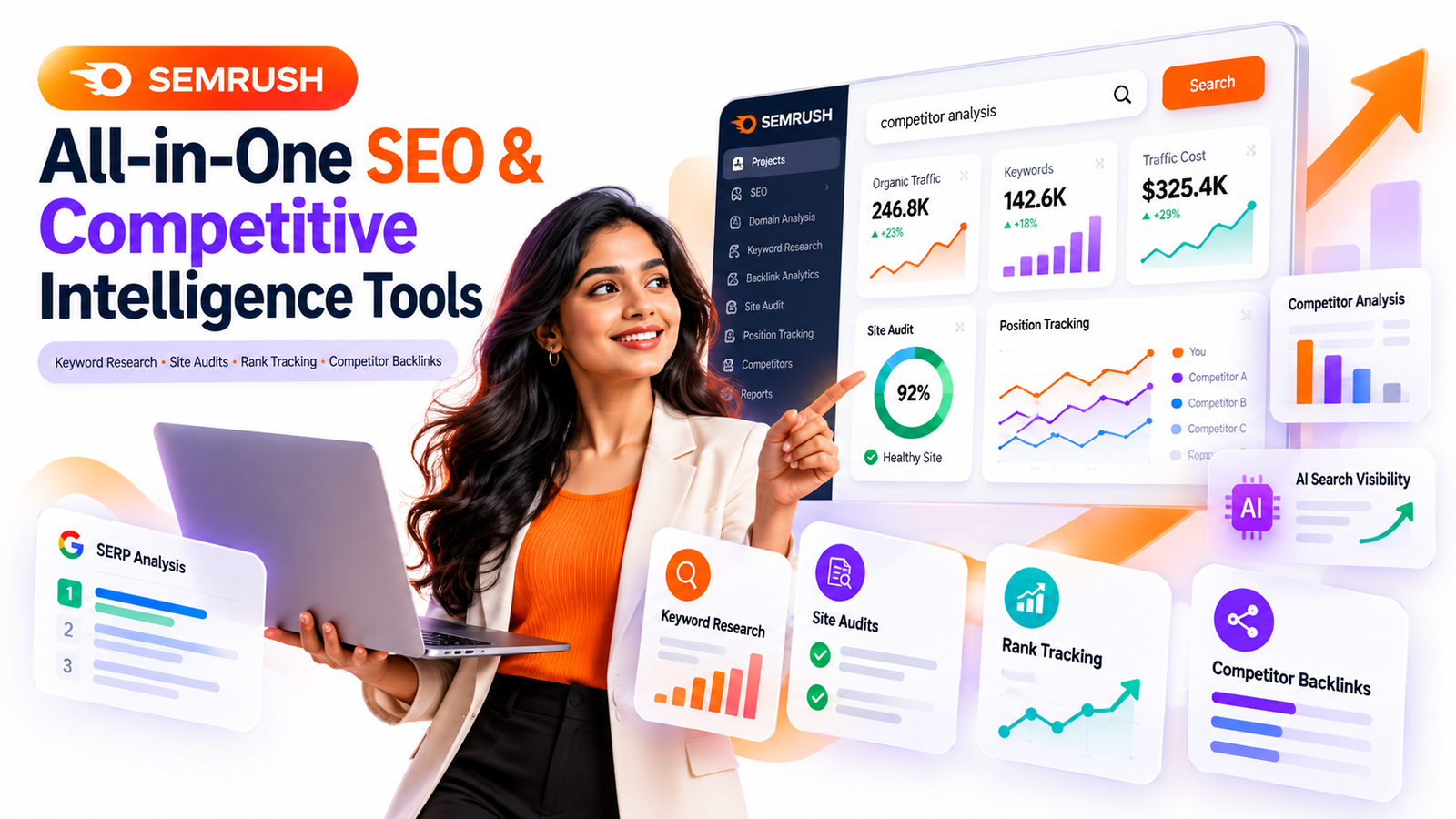
Discover how all-in-one SEO and competitive intelligence tools like Semrush help marketers research keywords, audit websites, track rankings, analyze backlinks, monitor competitors, and improve visibility across search and AI platforms.
Search marketing used to be relatively straightforward: find keywords, optimize a page, build links, and watch rankings.
That model is no longer enough.
Today, marketers need to understand not only what people search for but also which competitors dominate those searches, why certain pages perform better, where backlinks come from, which technical problems are holding a website back, what SERP features are appearing, and increasingly, how brands are being represented inside AI-generated answers.
That is why all-in-one SEO and competitive intelligence tools have become essential software for content creators, SEO professionals, affiliate publishers, e-commerce businesses, consultants, startups, and digital marketing agencies.
Instead of switching between separate applications for keyword research, technical SEO, rank tracking, backlinks, content research, and competitor analysis, an integrated platform can bring those activities into a single workflow.
One of the best-known platforms in this category is Semrush.
Semrush currently combines traditional search tools such as keyword research, technical site auditing, backlink analysis, competitor research, and daily rank tracking with newer capabilities focused on AI visibility, prompt research, and brand performance across AI-powered discovery environments.
The real value, however, is not simply having more data.
The value comes from turning that data into better decisions.
What Is an All-in-One SEO and Competitive Intelligence Tool?
An all-in-one SEO platform is software designed to bring multiple search-marketing functions together under one system.
Instead of researching keywords in one application, checking backlinks in another, running website crawls somewhere else, and manually recording rankings in spreadsheets, marketers can manage much of the process from one dashboard.
Competitive intelligence adds another layer.
It asks questions such as:
What keywords are competing websites ranking for?
Which competitors are gaining organic visibility?
Where are their strongest backlinks coming from?
What content topics are driving traffic?
Which search terms do competitors rank for that your website does not?
Which pages have recently gained or lost visibility?
Where are competitors appearing in AI-generated search experiences?
The combination of SEO data and competitive intelligence turns an optimization tool into something closer to a digital market-research system.
Why SEO Tools Are Becoming More Important
Search behavior is becoming fragmented.
Traditional Google results still matter enormously, but users may now encounter brands through AI Overviews, local results, video results, featured snippets, shopping results, social platforms, ChatGPT-style search experiences, and other discovery environments.
For marketers, that creates a measurement problem.
Ranking number three for a keyword tells only part of the story.
You also want to understand the search intent behind that keyword, whether the SERP contains an AI Overview, which competitors dominate the topic, whether your page has enough authority, what related questions people ask, and whether your brand is visible across multiple discovery channels.
Modern SEO therefore increasingly resembles search intelligence rather than simple keyword optimization.
This shift is one reason platforms such as Semrush continue expanding beyond conventional ranking reports.
Semrush as an All-in-One SEO Platform
Semrush has developed into a broad digital marketing and competitive intelligence ecosystem.
Its current SEO capabilities include keyword discovery, competitor research, domain analysis, technical auditing, backlink intelligence, position tracking, content optimization, local visibility tools, reporting, AI visibility analysis, and prompt research.
Its keyword platform currently advertises a database exceeding 28 billion keywords across more than 140 regional databases, while its backlink tools describe an index containing tens of trillions of backlinks. These figures naturally change as databases are updated, but they demonstrate the scale on which the platform operates.
For an individual blogger, that data can reveal new article opportunities.
For an SEO agency, it can support client research and reporting.
For an e-commerce business, it can uncover commercial keywords and competitors.
For a SaaS company, it can help identify gaps in content, links, organic visibility, and increasingly AI-search visibility.
The same platform serves different purposes depending on the business using it.
Keyword Research: Finding Searches With Business Potential
Keyword research remains one of the foundations of SEO.
But effective research goes far beyond collecting high-volume search phrases.
Suppose you operate a website selling project-management templates.
A broad keyword such as “project management” may receive substantial search interest, but ranking for it could be extremely competitive and the searcher’s intention may be unclear.
Longer searches such as “project management template for small marketing agency” may have lower search volume but much clearer commercial relevance.
That is where sophisticated keyword tools become useful.
Semrush’s keyword research tools can surface search volume, keyword difficulty, intent signals, related terms, competitive results, and SERP opportunities. Its tools can also group related keywords into topic clusters and help marketers examine keyword gaps between their website and competitors.
A smarter content strategy therefore asks not simply:
“What keyword has the most searches?”
It asks:
“What search represents a problem I can solve better than the existing results?”
That small change in thinking can make keyword research significantly more valuable.
Competitive Keyword Intelligence: Discovering What You Are Missing
One of the fastest ways to generate an SEO roadmap is to analyze businesses already competing for your audience.
Imagine that three competing websites receive organic traffic from hundreds of keywords that your website does not rank for.
That gap represents potential market demand.
Some terms may not be relevant.
Others may reveal entire content categories you have overlooked.
For example, an accounting-software company might discover that competitors receive substantial traffic from searches involving invoice templates, freelancer tax calculators, bookkeeping checklists, cash-flow forecasting, and small-business expense tracking.
Those topics are more than keywords.
They reveal customer needs.
Competitive keyword analysis can therefore serve as a lightweight form of market research.
Instead of guessing what the audience wants, you can observe where search demand and competitor visibility already exist.
Technical Site Audits: Finding Problems Content Alone Cannot Fix
Excellent content can still struggle when a website has technical problems.
Broken internal links, crawling issues, duplicate pages, incorrect canonical tags, missing metadata, slow pages, redirect problems, poor mobile usability, or other technical errors can weaken search performance.
A technical SEO audit crawls the website and attempts to identify those problems systematically.
Semrush’s Site Audit tools are designed to surface technical and on-page issues and prioritize problems that may affect visibility. Its current auditing products examine areas such as crawlability, broken links, page performance, mobile considerations, metadata, and other site-health factors.
The important part is prioritization.
A website containing thousands of warnings does not necessarily require thousands of immediate fixes.
Marketers should concentrate first on problems affecting important pages, indexing, crawlability, revenue-generating URLs, user experience, and organic traffic.
SEO audits should create an action plan rather than a collection of intimidating error messages.
Rank Tracking: Measuring Whether SEO Work Is Actually Working
Publishing a page is not the end of SEO.
It is the beginning of measurement.
Rank tracking helps marketers understand whether pages are moving upward, falling, remaining stable, or triggering different search features.
Semrush’s Position Tracking currently supports daily monitoring across locations and devices and allows users to compare their own visibility with competitors. It can also identify SERP features and monitor elements such as AI Overviews.
Consider a page that moves from position 37 to position 14.
It still receives relatively little search traffic, but the change is strategically important.
The page is approaching the first page of results.
Rather than abandoning it, the marketer could update the content, improve internal links, answer additional search questions, strengthen supporting pages, or earn relevant backlinks.
Good rank tracking helps identify these almost-winning pages.
They can sometimes produce faster gains than creating completely new content.
Backlink Analysis: Understanding Authority Beyond Your Website
Search visibility is influenced not only by what exists on your website but also by how the wider web connects to it.
That makes backlink intelligence an important component of competitive research.
A backlink analysis platform can help identify which websites link to a competitor, which pages receive the most links, what anchor text is being used, where your own backlink profile may have gaps, and which publications or industry websites may represent legitimate outreach opportunities.
Semrush’s backlink tools allow marketers to compare backlink profiles and identify domains linking to competitors but not to their own website.
The goal should not be to collect as many links as possible.
A smaller number of relevant, editorially earned links from credible websites can be far more useful than hundreds of low-quality links created simply to manipulate rankings.
Competitive backlink analysis is therefore most valuable when treated as relationship and authority research, not as a shortcut.
SEO Competitive Intelligence Goes Beyond Backlinks
Competitor intelligence becomes especially useful when several data points are combined.
Imagine discovering that a competitor has recently gained visibility.
Keyword data reveals which queries improved.
Page analysis identifies which URLs are responsible.
Backlink research shows which publications recently linked to those pages.
SERP analysis reveals that the competitor captured several featured results.
Content research shows that those pages were recently updated.
Suddenly, a ranking change becomes understandable.
That is the real advantage of an integrated SEO platform: different datasets can help explain each other.
Instead of simply knowing that a competitor is winning, you can investigate why.
The New Layer: AI Visibility and Generative Search
One of the most significant changes in search marketing is the growing importance of AI-generated answers.
Brands increasingly want to know whether they appear when people ask conversational questions in systems such as ChatGPT, Google AI experiences, Gemini, Perplexity, and similar platforms.
Traditional rank tracking cannot fully answer that question.
This has created a new category often described as GEO, generative engine optimization, AI visibility optimization, or AI search optimization.
Semrush has been expanding into this area with features for monitoring AI visibility, researching prompts, analyzing brand mentions, and examining how brands and competitors appear in AI-generated answers.
The fundamentals still overlap heavily with good SEO.
Clear expertise, useful information, credible sources, strong brand signals, accessible website architecture, relevant citations, accurate entity information, and content that answers real questions remain valuable.
The difference is that marketers are now watching more discovery surfaces.
How AEO Fits Into the Strategy
Answer Engine Optimization, or AEO, focuses on making information easy for search engines and answer systems to understand and retrieve.
This does not mean converting every article into robotic question-and-answer text.
Instead, strong AEO content usually provides concise answers where appropriate, defines important terms clearly, organizes information logically, uses descriptive headings, supports claims with evidence, and covers the questions naturally surrounding a topic.
For example, a user asking:
“What is the best SEO tool for competitor research?”
may not want a 3,000-word history of SEO software before receiving an answer.
A useful page should address the question quickly, then provide enough detail for the reader to evaluate the recommendation.
That improves both human usability and machine understanding.
A Practical Semrush Workflow for a New Website
Consider a new website selling digital marketing templates.
The business could begin by researching commercial and informational keywords connected with marketing plans, content calendars, social-media templates, SEO checklists, email marketing, client reporting, and agency workflows.
Next, competitor research could reveal which topics successful template stores already rank for.
Keyword-gap analysis could identify subjects competitors cover but the new website does not.
A technical audit could then verify that the site can be crawled efficiently and that important product and content pages do not contain major technical problems.
Backlink research could reveal industry publications, resource pages, bloggers, communities, and partners mentioning similar products.
Position Tracking could monitor the most important search terms after publication.
Over time, AI visibility tools could provide an additional view of whether the brand begins appearing in conversational search and generative discovery environments.
The result is a continuous cycle:
research, publish, measure, learn, improve.
That process is far more valuable than opening an SEO tool once a month and staring at a dashboard.
How Content Creators Can Use Competitive Intelligence Without Copying Competitors
Competitor research should produce insight, not imitation.
If a competing website publishes an article called “50 Email Marketing Templates,” copying the same structure and rewriting its paragraphs is not a sustainable strategy.
Instead, investigate why the page performs well.
Perhaps users want templates organized by situation.
Perhaps the competitor provides downloadable examples.
Perhaps the article answers questions that other pages ignore.
Perhaps strong industry websites reference it.
Your opportunity is to understand the demand and then create something genuinely more useful.
You might build an interactive template selector, provide industry-specific examples, explain when each template should be used, add original data, include practical screenshots, or create downloadable resources.
Competitive intelligence tells you where an opportunity may exist.
Original expertise determines whether you deserve to win it.
Why Digital Marketing Agencies Benefit From All-in-One Platforms
Agencies frequently manage multiple websites, industries, competitors, keyword sets, and reporting requirements.
That makes fragmented workflows expensive.
An integrated platform can allow an agency to research a prospect before a sales call, benchmark competitors, audit a new client’s website, build keyword strategies, track rankings, monitor backlinks, and create reports from related datasets.
Semrush also offers reporting functionality that can combine information from different marketing sources into client-facing reports.
For agencies, however, automation should not replace interpretation.
Clients rarely need another spreadsheet containing 5,000 keywords.
They need answers such as:
Where are we losing visibility?
Which opportunity is most valuable?
What changed this month?
What should we do next?
What business result are we trying to influence?
The tool provides evidence.
The marketer provides judgment.
Is Semrush Suitable for Beginners?
It can be, but beginners should resist the temptation to use everything at once.
A large SEO platform can initially feel overwhelming because dozens of metrics, reports, filters, dashboards, and tools are available.
A new user will usually get more value by mastering a small workflow first.
Start with understanding a domain.
Research a focused keyword set.
Identify several realistic competitors.
Run a technical audit.
Track a manageable number of important keywords.
Study backlink differences.
Then expand.
The goal is not to become an expert in every dashboard.
The goal is to use the available information to make better marketing decisions.
When an All-in-One SEO Platform May Be More Than You Need
Comprehensive SEO software is not automatically the right choice for every business.
A hobby blogger publishing occasionally may not require enterprise-style competitive research.
A small local company may receive more immediate value from improving its Google Business Profile, website fundamentals, customer reviews, and local landing pages before investing heavily in advanced competitive analytics.
Similarly, a business with no capacity to publish content, fix technical problems, or conduct outreach will gain limited value from discovering hundreds of opportunities it cannot act on.
Before subscribing to any SEO platform, ask one commercial question:
Will we regularly use the data to make decisions and take action?
If the answer is yes, an integrated platform can save substantial research time.
If the answer is no, a smaller toolset may be sufficient.
Available features, usage limits, trials, and pricing can also change, so businesses should verify the current plan before purchasing.
What Makes a Good All-in-One SEO Tool?
The best platform is not necessarily the one containing the highest number of features.
It is the one that reliably supports your workflow.
For a content-led business, strong keyword discovery and competitor analysis may matter most.
For an agency, reporting and project management may be critical.
For an e-commerce company, technical auditing and large-scale keyword tracking could be more important.
For a brand investing heavily in generative search, AI visibility and prompt intelligence may increasingly influence the decision.
Data coverage matters, but usability, workflow, reporting, integrations, geographic coverage, update frequency, and the ability to turn information into action matter just as much.
Turning SEO Data Into Revenue
SEO metrics can become distracting when disconnected from business outcomes.
Ranking for 10,000 keywords sounds impressive.
It means little if none of those searches attract potential customers.
A commercially useful SEO strategy connects search data with customer intent.
Informational content can attract prospects early in their research.
Comparison content can assist evaluation.
Product and service pages can target transaction-oriented searches.
Case studies can build trust.
Templates and calculators can attract links and qualified traffic.
Email capture can convert anonymous visitors into an owned audience.
Strong internal linking can then guide readers toward the next logical step.
SEO therefore becomes more valuable when integrated with the entire customer journey.
Use CTAs That Match Search Intent
Calls to action should feel like the natural next step rather than interruptions.
Someone reading an introductory SEO guide may respond better to a free checklist or audit than to an immediate enterprise-software pitch.
A reader researching SEO platforms is much closer to a commercial decision and may be ready to compare features, view a demonstration, or test a product.
For a Semrush-focused article, a natural CTA might be:
Want to see what your competitors are ranking for? Start by analyzing your domain and several competing websites, then compare their keyword, backlink, and visibility gaps before deciding where to invest your next SEO effort.
The CTA works because it continues the reader’s task.
It does not merely say “Buy now.”
Building Content for Google Search, Discover, AEO, and GEO
There is no legitimate button that guarantees a page will rank in Google Search or appear in Google Discover.
Instead, publishers can increase their chances by producing useful, original content and presenting it properly.
Google’s current Discover documentation recommends compelling, relevant, high-quality images, including large images at least 1,200 pixels wide and more than 300,000 total pixels. Google also recommends enabling max-image-preview:large and says schema.org markup or og:image can help specify the representative image used for a page.
For this article, an effective featured image would show an SEO professional or marketer studying a modern analytics dashboard with visual representations of keyword research, rankings, backlinks, competitor intelligence, site health, and AI-search visibility.
The image should look like an editorial illustration or authentic professional marketing scene rather than a banner overloaded with promotional text.
A strong 16:9 version at 1280×720 or larger would satisfy the dimensions described in Google’s current Discover image guidance. Additional 4:3 and 1:1 crops can also make the asset more adaptable across publishing surfaces.
Google also supports Article, NewsArticle, and BlogPosting structured data. Relevant properties can communicate details such as the headline, images, publishing dates, modification dates, and author information.
Structured data can help Google understand a page, but correctly implementing it does not guarantee a particular search appearance or ranking.
For GEO and AEO, the same article should clearly define important concepts, directly answer important questions, maintain accurate authorship and update information, cite trustworthy sources when appropriate, and provide information substantial enough that both people and answer systems can understand the subject without relying on vague marketing language.
Why Semrush Remains Relevant in a Changing Search Market
The strongest reason to consider Semrush is not simply that it contains keyword tools.
Many products can research keywords.
Its broader appeal comes from combining different layers of search intelligence.
A marketer can investigate a market, examine competitors, discover keywords, audit a website, study backlinks, monitor rankings, evaluate SERP features, create reports, and increasingly analyze visibility across AI-powered discovery environments from the same ecosystem.
That does not remove the need for Google Search Console, analytics platforms, customer research, editorial judgment, or specialist tools.
Nor does software create a winning marketing strategy automatically.
What it can do is reduce uncertainty.
And in competitive digital markets, better information can lead to better decisions.
Build a Search Intelligence System, Not a Tool Collection
Successful SEO rarely comes from owning the largest collection of software subscriptions.
It comes from developing a repeatable system.
Understand what your audience wants.
Study the competitive landscape.
Find realistic opportunities.
Build genuinely useful content.
Keep the website technically healthy.
Earn credible authority.
Measure visibility.
Watch how search behavior changes.
Improve what works.
Remove what does not.
All-in-one SEO and competitive intelligence platforms such as Semrush make that process easier to manage by bringing many of the required datasets into one environment.
For content creators, that can mean finding subjects people actually want.
For agencies, it can mean delivering better competitive insights.
For growing businesses, it can mean discovering market opportunities before investing heavily in campaigns.
And as search expands from traditional results into AI-generated discovery, the ability to understand visibility across multiple surfaces may become even more valuable.
Ready to put competitive intelligence into practice? Begin with one domain, three meaningful competitors, a focused group of commercially relevant keywords, and one measurable goal. Use the data to choose your next action rather than simply collecting another report.
Frequently Asked Questions
1. What is an all-in-one SEO and competitive intelligence tool?
An all-in-one SEO and competitive intelligence tool combines several marketing functions within one platform. These can include keyword research, competitor analysis, technical SEO audits, backlink research, rank tracking, SERP analysis, content research, reporting, and increasingly AI-search visibility monitoring. The main benefit is being able to connect multiple datasets rather than managing each task through an unrelated application.
2. Is Semrush good for competitor research?
Semrush is designed extensively around competitive research. Marketers can use it to investigate competitor keywords, organic visibility, backlinks, ranking changes, keyword gaps, backlink gaps, and other search-performance signals. The information is most valuable when it is used to identify opportunities rather than simply copying competing websites.
3. Can Semrush help with keyword research?
Yes. Semrush provides keyword discovery tools that show metrics and signals such as search demand, difficulty, intent, related terms, competitive results, and potential topic opportunities. Its keyword ecosystem can also support keyword-gap research and topic planning.
4. Can Semrush track Google rankings and AI visibility?
Semrush’s current Position Tracking tools can monitor keyword performance across locations and devices while also reporting on SERP features. The broader Semrush platform has also introduced tools for AI visibility and prompt research, reflecting the growing importance of generative search alongside conventional rankings.
5. Is an all-in-one SEO tool worth paying for?
It can be worthwhile for businesses, publishers, SEO professionals, and agencies that regularly perform keyword research, competitor analysis, technical auditing, backlink research, reporting, or rank tracking. The value depends on whether the organization has enough SEO activity to act on the insights. Smaller websites with basic needs may prefer a simpler toolset until their search strategy becomes more advanced.
all-in-one SEO and competitive intelligence tools
Semrush SEO tool, SEO competitive analysis, competitor keyword research, SEO software, keyword research tool, website SEO audit, rank tracking software, backlink analysis tool, competitor backlink analysis, SEO intelligence platform, digital marketing tools
best all-in-one SEO tool for marketers, how to use Semrush for competitor research, best SEO competitive intelligence software, how to analyze competitor backlinks, SEO tools for digital marketing agencies, how to track keyword rankings, how to perform an SEO site audit, Semrush for content creators, SEO and AI visibility tools, best SEO tools for competitor analysis
Generative engine optimization, GEO, answer engine optimization, AEO, AI search visibility, AI Overviews, search intelligence, organic visibility, SERP features, topical authority, search intent, domain authority, referring domains, technical SEO, content gap analysis, prompt research, AI brand visibility
Stay ahead with exclusive updates
Join our community. Get curated industry trends, actionable guides, and fresh resources delivered straight to your inbox.