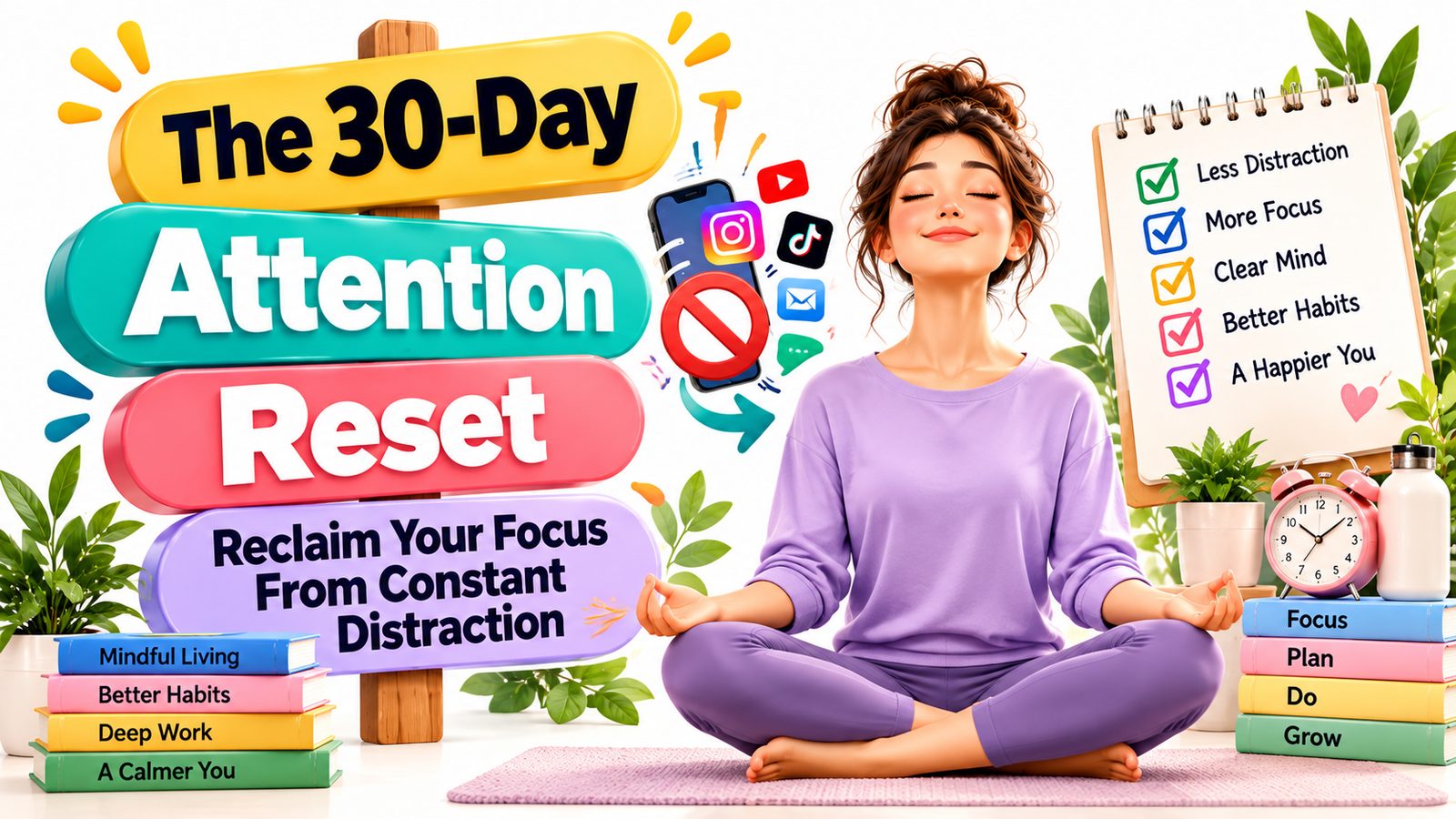
Reclaim Your Focus From Constant Distraction
Your phone lights up.
You check one notification.
Then another.
A message leads to an email. The email reminds you of something you wanted to search. The search leads to a video. Ten minutes later, you are looking at something completely unrelated to what you intended to do.
Meanwhile, the task that actually mattered is still waiting.
For millions of people, this is not an unusual day. It is the normal rhythm of modern life.
Our attention is constantly being invited somewhere else: notifications, messages, short-form videos, breaking news, emails, recommendations, advertisements, endless feeds and the uncomfortable feeling that something more interesting may be happening on another screen.
The result is not simply “too much screen time.”
It is fragmented attention.
You may sit at your desk for eight hours yet struggle to spend 30 uninterrupted minutes on the work that matters most. You may open a book and feel an urge to check your phone after two pages. You may watch a movie while scrolling through another screen. Even conversations can become divided between the person in front of you and whatever is happening online.
This is why an attention reset can be more useful than another complicated productivity system.
You do not need to become anti-technology.
You do not need to delete every app.
You do not need to disappear into the mountains for a month.
You need to rebuild your ability to decide what deserves your attention and when.
That is what this 30-day attention reset is designed to help you do.
Why Attention Has Become One of the Most Valuable Personal Resources
Money can sometimes be recovered.
Time cannot.
But attention determines what you actually do with the time you have.
When attention becomes fragmented, even generous amounts of free time can feel strangely unproductive. You move between tasks, consume information, answer messages and stay busy, yet important projects remain unfinished.
That helps explain why focus, overwhelm and personal effectiveness continue to attract significant interest in nonfiction. U.S. print self-help sales rose 14.7% in 2025, and publishing coverage that year specifically highlighted attention, technological noise and overwhelm among prominent self-help themes.
This interest reflects a practical problem: modern technology makes distraction extraordinarily convenient.
A distraction no longer requires leaving your desk.
It is already in your pocket.
What Digital Distraction Actually Does to Your Focus
Digital distraction is often discussed as if the only problem were the number of hours people spend looking at screens.
The reality is more subtle.
Frequency of interruption matters too.
A recent experiment examining smartphone-style social-media notifications found that notifications produced a temporary slowdown in cognitive processing lasting roughly seven seconds. Importantly, the researchers found that disruption was associated with notification frequency and checking behavior, suggesting that the pattern of interruption matters—not merely total screen time.
Seven seconds sounds insignificant.
But imagine repeatedly interrupting your concentration throughout an entire working day.
Every alert creates a tiny invitation:
Should I look?
Even when you resist, part of your attention may momentarily shift toward the notification.
This is why improving focus is not simply a matter of developing stronger willpower.
Your environment matters.
Your habits matter.
Your defaults matter.
And that is encouraging, because all three can be changed.
The Real Goal of a 30-Day Attention Reset
The goal is not to achieve perfect concentration.
Nobody maintains perfect focus all day.
The goal is to become less automatically distractible.
By the end of this challenge, you want to notice several changes:
You begin tasks with greater intention.
You check your phone because you choose to, rather than because you felt an unexplained urge.
You can read, write, study or create for longer periods without reaching for stimulation.
You become more comfortable with quiet moments.
You recognize which apps genuinely improve your life and which simply consume attention.
Most importantly, you regain a sense of control.
Think of the next 30 days as training rather than punishment.
Before Day 1: Measure Your Current Attention
Before changing anything, observe your existing behavior for one ordinary day.
Do not judge it.
Collect information.
Check your phone’s screen-time or digital-wellbeing dashboard. Notice which applications receive the most attention. Pay attention to how frequently you unlock your phone. Observe when you become distracted during work.
Then answer four questions:
What distracts me most often?
When am I easiest to distract?
Which activities deserve more of my attention?
What would improve if I became 20% more focused?
That final question is important.
Maybe you would finish work earlier.
Maybe you would finally read consistently.
Maybe you would study with less anxiety.
Maybe you would spend more present time with your family.
Maybe you could build the business you keep postponing.
Your attention reset needs a reason stronger than “I should use my phone less.”
Give it a purpose.
The 30-Day Attention Reset Plan
The program gradually moves from awareness to environmental change, stronger concentration and long-term attention management.
Do not worry if you miss a day. Continue with the next one rather than turning an imperfect streak into an abandoned goal.
- Day 1 — Track Every Distraction. Keep a simple note nearby. Whenever you leave an important task without intentionally deciding to stop, write down what distracted you. Do not try to eliminate anything yet. Your job is to discover your patterns.
- Day 2 — Turn Off Nonessential Notifications. Disable alerts that do not require immediate action: shopping apps, social media, entertainment platforms, promotional emails, games and unnecessary news notifications. Keep genuinely important communication available.
- Day 3 — Remove Your Phone From One Focus Session. Choose one 25-minute work period and place your phone somewhere you cannot casually reach it. A drawer, shelf or another room works better than placing it face-down beside your keyboard.
- Day 4 — Create a Distraction List. When unrelated ideas appear while you are working—“check that price,” “reply to Sam,” “search that article”—write them down instead of immediately acting on them. Review the list after your session.
- Day 5 — Stop Starting the Morning With a Feed. Give yourself at least the first 30 minutes after waking without social media, short-form video or news feeds. Replace passive consumption with breakfast, walking, stretching, journaling or preparing for the day.
- Day 6 — Practice 20 Minutes of Single-Tasking. Choose one activity. Reading. Writing. Studying. Cooking. Planning. Work on only that activity. Whenever you feel the urge to switch, notice the urge without obeying it.
- Day 7 — Review Your First Week. Identify your three biggest sources of distraction. Ask which can be removed, which can be scheduled and which must simply be managed more intentionally.
- Day 8 — Redesign Your Home Screen. Remove highly distracting apps from the first screen of your phone. You do not necessarily need to delete them. Adding a little friction can interrupt automatic checking.
- Day 9 — Create Communication Windows. Instead of continuously checking email and messages, establish specific periods for routine communication whenever your responsibilities allow it.
- Day 10 — Build a Focus Zone. Choose one physical location associated with concentrated work. Keep it as clean and simple as practical. Remove unrelated devices, open tabs and visual clutter.
- Day 11 — Work With One Browser Tab When Possible. Multiple open tabs are unfinished invitations. For one major task today, close everything unrelated and work from only the resources required.
- Day 12 — Replace One Scroll Session With Reading. When you would normally open a social feed, spend 15 minutes with a book, long-form article or other intentional reading instead.
- Day 13 — Practice Boredom. Stand in a queue, drink tea or take a short break without automatically reaching for your phone. Learning to tolerate unstimulated moments is an underrated attention skill.
- Day 14 — Take a Half-Day Social Media Break. Choose a realistic half-day period. Observe how often you instinctively reach for an app that is unavailable. The exercise reveals automatic habits that are normally invisible.
- Day 15 — Choose Your Most Important Task Before Opening Messages. Decide what deserves your best concentration before other people’s requests begin setting your priorities.
- Day 16 — Try a 45-Minute Focus Block. Work on one meaningful task for 45 minutes. Remove unnecessary alerts and keep a distraction list beside you. Afterwards, take a deliberate break.
- Day 17 — Separate Work and Entertainment Devices Where Possible. Even partial separation helps. For example, avoid watching entertainment on your work computer during your focus hours.
- Day 18 — Protect One Meal From Screens. Eat without a phone, laptop or television. Pay attention to the food, people around you and your own thoughts.
- Day 19 — Audit Your Information Diet. Unfollow or unsubscribe from sources that regularly generate anxiety, outrage or low-value consumption without giving you meaningful knowledge.
- Day 20 — Create an Evening Digital Boundary. Select a reasonable period before sleep when stimulating digital activity stops. It does not need to be extreme. Consistency matters more than ambition.
- Day 21 — Review What Has Changed. Compare your current behavior with Day 1. Which triggers have weakened? Which distractions remain powerful? Modify your environment accordingly.
- Day 22 — Schedule Deep Work Before Shallow Work. When possible, place demanding thinking, writing, studying or creative work during the part of your day when your energy is strongest.
- Day 23 — Increase Your Focus Block to 60 Minutes. Do not force yourself to reach an artificial productivity record. The challenge is simply to stay with one meaningful objective for longer than usual.
- Day 24 — Have One Conversation With Your Phone Out of Sight. Give another person your undivided attention. Notice whether the conversation feels different.
- Day 25 — Practice Intentional Internet Use. Before opening a browser, state what you are going online to accomplish. When that task is finished, close the browser instead of drifting into unrelated consumption.
- Day 26 — Create a “Not Now” Habit. When an impulse appears—check social media, search something random, open a video—mentally say, “Not now.” You are not permanently denying the impulse. You are choosing when it deserves attention.
- Day 27 — Spend One Hour Creating Before Consuming. Write, design, study, exercise, build, photograph, draw, plan or solve something before entertainment consumption begins.
- Day 28 — Take a Longer Low-Stimulation Break. Spend 60 to 90 minutes walking, reading, cooking, organizing or engaging in a hobby without rapid digital stimulation.
- Day 29 — Build Your Personal Attention Rules. Decide what should continue beyond this challenge. Examples could include no phone during meals, no social feeds before breakfast, notifications disabled, two daily email windows or a protected morning focus block.
- Day 30 — Design Your Next 90 Days. Your reset ends, but your attention system should continue. Choose three habits you can realistically maintain for the next three months. Sustainable rules beat dramatic restrictions that disappear after a week.
Why Removing Distraction Works Better Than Fighting It
Imagine placing a bowl of sweets beside your laptop and spending eight hours telling yourself not to eat one.
You might succeed.
But you have created unnecessary mental work.
Moving the bowl to another room makes the decision easier.
Digital distraction works similarly.
Many people try to improve focus while leaving every distraction immediately available:
Phone beside the keyboard.
Email permanently open.
Notifications active.
Social media one tap away.
Twenty browser tabs waiting.
Then they blame themselves for lacking discipline.
A better strategy is to make distraction slightly harder and concentration slightly easier.
Move the phone.
Close the tabs.
Silence the alerts.
Schedule communication.
Prepare your workspace.
Open the document before your focus session begins.
Good attention management depends less on heroic self-control than on sensible design.
Do Not Confuse Focus With Working Longer
The goal of improving focus is not to transform every minute into productive labor.
Attention also matters when you rest.
A walk deserves attention.
Music deserves attention.
Your children deserve attention.
Food deserves attention.
A conversation deserves attention.
Even doing absolutely nothing can deserve attention.
The deeper problem with constant digital distraction is not merely that it interferes with work.
It can interfere with experience itself.
You can visit somewhere beautiful and spend most of your time producing evidence that you visited it.
You can sit with someone you care about while mentally following five online conversations.
You can finish a television series without remembering much of it because you watched half of it while scrolling.
An attention reset is therefore not simply a productivity challenge.
It is an invitation to participate more fully in your own life.
How to Improve Focus When You Work Online
Some people can simply put their phones away.
Others cannot.
Designers, marketers, entrepreneurs, virtual assistants, creators, programmers, students and remote employees may spend most of their day online.
For them, digital minimalism has to be practical.
The solution is separation by purpose.
Create different browser profiles for work and personal use.
Keep recreational bookmarks outside the work profile.
Log out of distracting websites when you do not need them.
Use full-screen mode when writing.
Keep communication tools closed during focused work if your responsibilities permit it.
Batch research separately from writing.
For example, instead of researching a sentence, writing two paragraphs, checking social media and returning to research, divide the project:
Research first.
Organize information.
Then write.
Then edit.
The fewer times you change mental context, the easier sustained concentration becomes.
The Two-Minute Rule for Digital Temptation
When you feel an urge to check something unrelated, wait two minutes.
Do nothing dramatic.
Simply postpone the decision.
Many digital impulses disappear remarkably quickly when they are not immediately rewarded.
If the urge remains important after two minutes, decide intentionally whether to act on it.
This creates a small but powerful psychological distinction:
You are no longer automatically responding.
You are choosing.
That is the heart of attention control.
What to Do When Your Mind Keeps Wandering
Removing your phone does not remove distraction entirely.
The brain can distract itself perfectly well.
You may start writing and suddenly remember an embarrassing conversation from seven years ago.
You may begin reading and start planning dinner.
That is normal.
Focus is not the absence of wandering thoughts.
Focus is the ability to notice that your mind has wandered and gently return it to the intended activity.
That return is the repetition that strengthens the habit.
Notice.
Return.
Notice.
Return.
You do not need to become frustrated each time.
The return is the training.
Can Mindfulness Help With Digital Distraction?
Mindfulness is not a magical solution, but there is evidence suggesting it may help people handle attention shifts.
A 2024 study examining smartphone notifications and cognitive control found differences following a brief mindfulness induction, with researchers reporting evidence that mindfulness buffered aspects of cognitive control after notification exposure.
You do not need a complicated meditation practice to apply the underlying principle.
Try spending five minutes focusing on your breathing.
When thoughts arise, notice them.
Then return your attention to the breath.
The exercise teaches the same fundamental movement needed during focused work: recognizing distraction without automatically following it.
The Difference Between Rest and Digital Stimulation
After demanding work, people frequently tell themselves they need a break.
They open social media.
Twenty minutes later they feel more mentally scattered than before.
Why?
Because stimulation and restoration are not necessarily the same thing.
Rapidly changing videos, comments, headlines and recommendations continue asking the brain to process new information.
When you genuinely want a break, experiment with lower-stimulation alternatives:
Walk around the room.
Stretch.
Look outside.
Make coffee.
Talk to someone.
Listen to music without simultaneously scrolling.
Sit quietly for five minutes.
You may discover that real rest feels slower than entertainment.
That is precisely why it can be restorative.
Stop Measuring Your Success Only by Screen Time
Screen-time statistics can be useful, but they can also be misleading.
Three hours spent designing a business presentation is not psychologically identical to three hours spent jumping between algorithmic feeds.
Instead of asking only:
“How many hours did I use my phone?”
Ask:
“Was my digital behavior intentional?”
Two hours deliberately spent learning a skill may support your goals.
Twenty minutes compulsively checking the same applications may leave you feeling scattered.
The purpose of an attention reset is not to produce the smallest possible screen-time number.
It is to increase the percentage of your digital life that happens on purpose.
Build a Personal Attention Budget
You already budget money because money is limited.
Attention is limited too.
Imagine beginning each morning with a finite amount of high-quality concentration.
Where should it go first?
Your most important work?
Learning?
Family?
Exercise?
Creative projects?
Or an endless stream of information selected by algorithms?
This does not require rejecting entertainment.
Entertainment can be valuable.
The key is deciding deliberately rather than allowing whatever is most stimulating to repeatedly win the competition for your attention.
The “One Important Thing” Practice
At the beginning of each day, ask:
If I complete only one meaningful thing today, what should it be?
Write your answer somewhere visible.
This creates an anchor.
When your attention becomes fragmented, return to that priority.
The question is especially useful for people with overwhelming task lists because it replaces vague busyness with intentional progress.
What If Your Job Requires Constant Communication?
Some jobs genuinely demand responsiveness.
In that case, do not copy someone else’s rigid focus routine.
Adapt the reset.
Perhaps you cannot disappear for two hours, but you can protect 20 minutes.
Perhaps you cannot disable messaging software, but you can silence social-media alerts.
Perhaps you cannot stop checking email, but you can reduce unrelated phone checking.
Attention management is not all-or-nothing.
Small improvements repeated daily can change the texture of your work.
How to Know Whether Your Attention Is Improving
Do not measure progress only by how disciplined you feel.
Look for behavioral evidence.
Can you read longer before reaching for your phone?
Can you finish a work block with fewer interruptions?
Are you opening social apps intentionally rather than automatically?
Are you more present during conversations?
Can you tolerate waiting without immediately seeking stimulation?
Do important projects move forward more consistently?
These changes matter more than achieving some imaginary state of perfect focus.
What Happens After the 30 Days?
Do not maintain every experiment.
That is not the objective.
Your job is to identify the habits that produced the biggest improvement for the least effort.
You might discover that disabling notifications changed everything.
Someone else may benefit most from phone-free mornings.
Another person may find that scheduled focus blocks are transformational.
Keep what works.
Discard what does not.
Then review your attention rules once a month.
Technology will continue changing.
Your responsibilities will change.
Your attention system should evolve with them.
A Simple Long-Term Attention System
After completing the reset, your permanent strategy can be remarkably simple.
Protect your first important task.
Reduce unnecessary notifications.
Keep distracting devices away during deep concentration.
Create deliberate times for communication and entertainment.
Spend part of every day consuming information slowly.
Maintain some periods with no digital stimulation.
Choose what receives your attention before something else chooses for you.
You do not need a perfect routine.
You need dependable defaults.
Why Reclaiming Your Focus Matters More Than Becoming “More Productive”
There will always be another productivity technique.
Another app.
Another planner.
Another AI tool.
Another system promising to save time.
But saving time means very little if the saved time immediately disappears into distraction.
The deeper advantage of attention is agency.
When you can direct your attention, you become better able to direct your days.
You can finish meaningful work.
You can learn difficult things.
You can listen more deeply.
You can create instead of endlessly consume.
You can spend an evening without feeling that your mind is being pulled in six directions.
You can decide what matters and remain with it long enough for something valuable to happen.
That is a powerful form of freedom.
Start Your Attention Reset Today
Do not wait for Monday.
Do not wait until next month.
Do not spend three hours researching the perfect focus system before beginning.
Start with one small change:
Turn off one unnecessary notification.
Put your phone outside reach for 25 minutes.
Close the tabs you are not using.
Read ten pages without switching apps.
Eat one meal without a screen.
Complete one meaningful task before opening social media.
Then repeat tomorrow.
Thirty days from now, your devices will still exist.
Messages will still arrive.
There will still be more videos, articles, notifications and updates than you could possibly consume.
The difference is that you can become much better at deciding which ones deserve access to your mind.
Your attention is too valuable to surrender by default.
Start Day 1 today: identify your biggest distraction, remove one unnecessary trigger and protect your first uninterrupted focus session.
Frequently Asked Questions
1. What is a 30-day attention reset?
A 30-day attention reset is a structured period for reducing unnecessary distractions and rebuilding intentional focus. Instead of completely eliminating technology, you gradually change habits involving notifications, smartphones, social media, multitasking, digital consumption and focused work. The goal is to develop sustainable attention habits you can continue after the 30 days.
2. How can I improve focus when I am constantly distracted?
Begin by reducing environmental triggers rather than relying entirely on willpower. Turn off unnecessary notifications, keep your phone away from your workspace, close unrelated browser tabs and work on one clearly defined task for a short period. Gradually increase your uninterrupted focus time as the habit becomes easier.
3. Do I need to quit social media to complete an attention reset?
No. For many people, scheduled and intentional social-media use is more sustainable than complete elimination. The important question is whether you decide when to use a platform or repeatedly open it automatically. Creating specific usage windows and removing unnecessary notifications can significantly reduce unplanned checking.
4. How long does it take to improve concentration?
There is no universal timetable because concentration is influenced by habits, environment, sleep, stress, responsibilities and individual differences. Rather than expecting a dramatic transformation on a particular day, measure practical improvements across several weeks: fewer interruptions, longer reading sessions, less automatic phone checking and greater consistency on important tasks.
5. What is the best first step for reducing digital distraction?
Turn off nonessential notifications and move your phone out of immediate reach during one important task. This combination reduces external interruptions and adds friction to automatic checking. Once that becomes comfortable, introduce longer focus blocks, communication windows and phone-free periods.
Your 30-Day Challenge Begins With One Decision
The internet is not going to become less interesting.
Apps are not going to stop competing for engagement.
There will always be another headline, notification, recommendation, message or video waiting for you.
So waiting for the world to become less distracting is not a strategy.
Building stronger attention is.
You do not have to regain your entire day at once.
Regain 20 minutes.
Then 30.
Then an hour.
Protect a conversation.
Protect a morning.
Protect a piece of creative work.
Protect enough of those moments, and something larger begins to change.
You stop experiencing your attention as something the outside world constantly takes from you.
You begin treating it as something you decide where to invest.
That is the real promise of the 30-day attention reset: not perfect concentration, but greater ownership of your time, your choices and the life happening in front of you.
Ready to begin? Save this 30-day attention reset, complete Day 1 today, and return tomorrow for the next step toward calmer, stronger and more intentional focus.
Stay ahead with exclusive updates
Join our community. Get curated industry trends, actionable guides, and fresh resources delivered straight to your inbox.