Writing knowledge does not have to live only inside books, blog posts, newsletters, or client projects.
If you know how to develop characters, organize a novel, plan chapters, improve dialogue, track a manuscript, prepare a book launch, or navigate the publishing process, you already possess knowledge that can be transformed into practical digital resources.
That is where digital products for writers become interesting.
A novelist might turn a personal plotting method into a story-planning workbook. A freelance writer could package a client workflow into templates. An experienced self-published author might create publishing checklists, launch organizers, manuscript trackers, or author-business systems.
You do not necessarily need to invent an entirely new idea. Often, the best digital product begins with a process you already use.
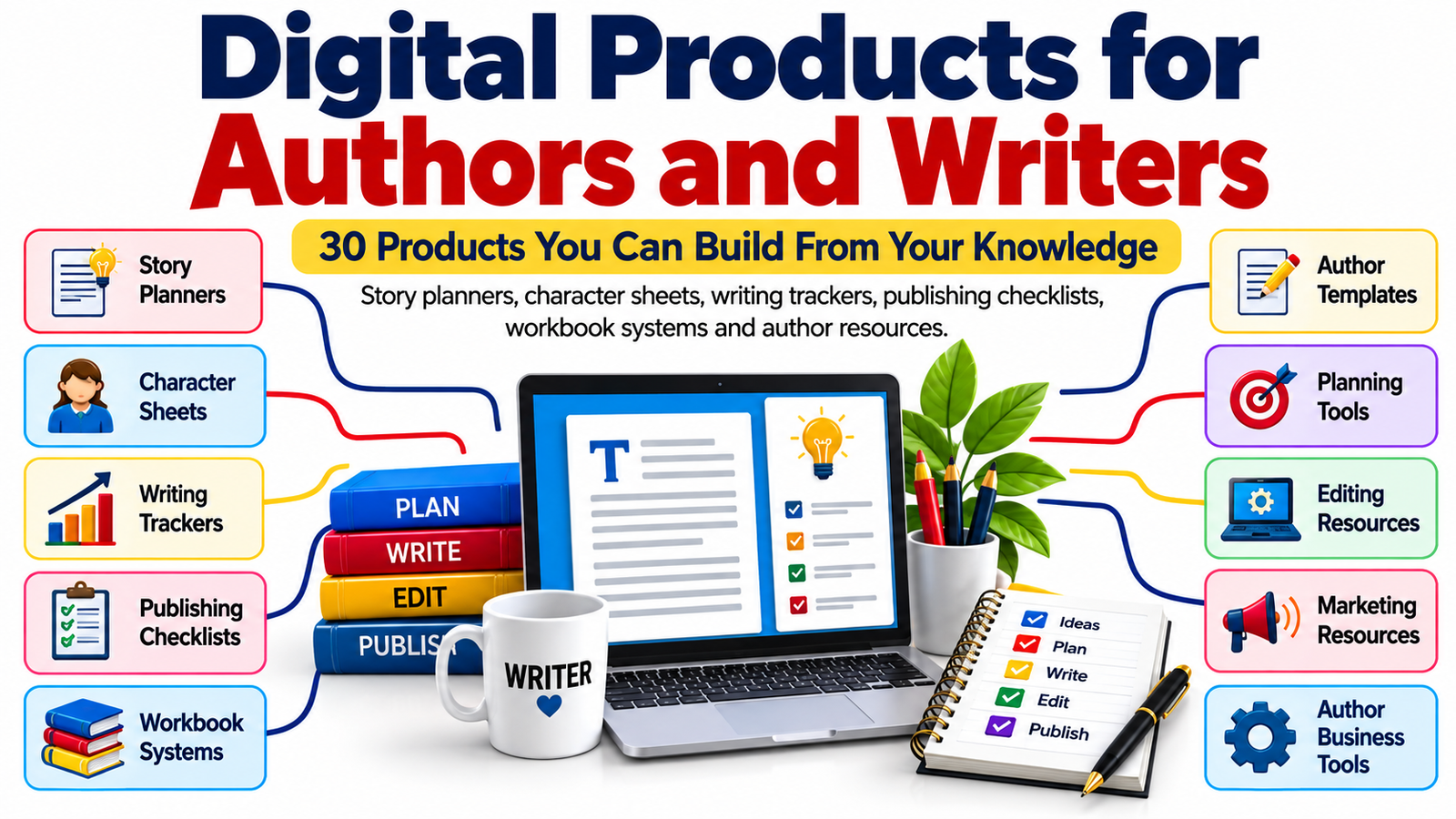
This guide explores 30 digital products authors and writers can create, including story planners, character sheets, writing trackers, publishing checklists, workbook systems, author templates, and downloadable writing resources.
What Are Digital Products for Writers?
Digital products for writers are downloadable or online resources designed to help authors, bloggers, copywriters, screenwriters, poets, journalists, students, or other creators complete a specific writing-related task.
They may be delivered as PDFs, editable documents, spreadsheets, Notion-style systems, printable worksheets, presentation files, template packs, video lessons, or combinations of several formats.
Common examples include:
story planners, character development worksheets, writing trackers, book-outline templates, editing checklists, publishing planners, author-business resources, marketing worksheets and writing workbook systems.
The strongest products usually solve a clearly defined problem.
Instead of creating a generic product called “Writer Planner,” for example, a creator might develop a more specific 90-Day Novel Writing Planner for First-Time Fiction Authors.
Specificity makes it easier for potential customers to understand what the product is for and whether it fits their needs.
Why Writers Are Well Positioned to Create Digital Products
Writers routinely create systems without realizing it.
You may already have your own method for organizing research, planning chapters, tracking word counts, interviewing clients, outlining nonfiction books or reviewing a manuscript before publication.
Those systems can often be converted into author templates and writing planner digital downloads.
Digital products can also complement other parts of an author business. A nonfiction author might sell a workbook connected to a book. A writing coach could offer planning templates before selling a larger course. A novelist might create resources for other fiction writers while continuing to publish novels.
The key is to package useful knowledge rather than simply filling pages.
A good question to ask is:
“What writing task do people repeatedly struggle with that I already know how to organize?”
Your answer may reveal your first product.
30 Digital Products Authors and Writers Can Create
1. Complete Story Planner
A comprehensive story planner can guide fiction writers from an initial idea to a workable manuscript outline.
It could include sections for premise, genre, target reader, protagonist, antagonist, central conflict, stakes, setting, theme, major turning points, climax and resolution.
Instead of giving users hundreds of empty pages, structure the planner around decisions they actually need to make.
A premium version could contain both a printable PDF and an editable digital edition.
Ideal audience: novelists, aspiring fiction writers and creative-writing students.
2. Character Development Workbook
Character creation is one of the most natural categories for digital products for writers.
Create worksheets that move beyond basic questions such as eye color or favorite food.
Useful sections might explore motivation, internal conflict, fears, values, backstory, relationships, strengths, weaknesses, contradictions, secrets, emotional wounds and character transformation.
You could create separate editions for protagonists, villains, supporting characters or romance characters.
3. Character Relationship Map
Stories become complicated when dozens of characters interact.
A character relationship map gives writers a visual way to record friendships, rivalries, family ties, romantic relationships, alliances, secrets and conflicts.
Include editable relationship boxes, connection lines, notes and a legend users can customize.
Fantasy writers, mystery writers and family-saga authors may find this especially useful.
4. Novel Outline Template
Create a streamlined novel outline template that converts a story idea into chapters or scenes.
Offer sections such as:
opening situation, inciting incident, rising conflict, midpoint, major setback, climax and resolution.
You could also produce different versions built around three-act structure, five-act structure, mystery plotting, romance plotting or another clearly explained framework.
Avoid presenting one structure as the only correct way to write. The product should function as a planning tool rather than a rigid formula.
5. Scene Planning Cards
Scene cards allow writers to plan individual scenes before drafting.
Each card might include:
point-of-view character, location, objective, obstacle, conflict, emotional shift, new information, scene outcome and connection to the next scene.
Create printable cards alongside a digital version.
A writer could arrange the cards on a desk, wall or digital workspace and quickly see how the manuscript flows.
6. Writing Tracker Digital Download
A writing tracker digital download is simple but genuinely useful when designed carefully.
Allow users to record writing date, starting word count, ending word count, words added, writing time, project stage and short notes.
A spreadsheet version could automatically calculate weekly and monthly totals.
You might create dedicated trackers for novels, nonfiction books, short stories, scripts or academic writing.
7. 30-Day Writing Challenge Planner
Build a guided 30-day writing system that gives writers a manageable task each day.
For example, the first week could focus on planning, the next two weeks on consistent drafting, and the final days on reviewing progress and deciding what happens next.
Include reflection prompts instead of promising that every participant will finish a book in 30 days.
The value comes from structured practice and accountability.
8. 90-Day Book Writing Planner
A longer planning system works well for writers undertaking substantial projects.
Break 90 days into stages such as:
concept development, research, outlining, first-draft milestones, revision planning and project review.
Provide weekly objectives, daily writing spaces and progress checkpoints.
The product can become a substantial writing planner digital download rather than a basic calendar.
9. Worldbuilding Workbook
Fantasy, science-fiction and speculative-fiction writers often need systems for managing complex fictional worlds.
A worldbuilding workbook could cover geography, climate, governments, economies, religions, languages, technology, transportation, social customs, education, laws, warfare and historical events.
Include prompts that encourage writers to connect worldbuilding decisions to the actual story.
That distinction is important: worldbuilding should support narrative rather than simply produce pages of background information.
10. Fictional Location Planner
A focused location planner can help writers construct memorable places.
Include sections for physical appearance, atmosphere, sounds, smells, cultural meaning, history, weather, population, important buildings, local conflicts and how different characters perceive the place.
Writers can use individual sheets for cities, villages, houses, schools, planets or imaginary kingdoms.
11. Mystery Writing Planner
A genre-specific product can be more valuable than a generic writing template.
A mystery planner might help authors organize the crime, suspects, motives, evidence, red herrings, timelines, witness information, discoveries and final reveal.
Include a clue tracker that lets the writer see when information is introduced and when its significance becomes clear.
This can help writers manage complicated mystery structures.
12. Romance Story Planner
Create a planner specifically for romance writers.
Sections might cover protagonist goals, relationship expectations, attraction, emotional obstacles, external obstacles, relationship progression, conflict, turning points and resolution.
Different versions could serve contemporary romance, historical romance or romantic comedy writers.
The goal is not to prescribe a formula but to help authors visualize the emotional progression of the relationship.
13. Nonfiction Book Planner
Many prospective authors have expertise but struggle to organize it into a coherent book.
A nonfiction book planner can guide them through:
reader problem, book promise, scope, core argument, chapter sequence, supporting examples, research requirements, case studies and reader action steps.
This type of product can work particularly well for coaches, consultants, educators and professionals writing expertise-based books.
14. Chapter Planning Workbook
Create individual chapter worksheets that help writers answer:
What is this chapter supposed to accomplish?
What does the reader need to understand?
What examples or evidence belong here?
How does the chapter connect with the previous one?
What should the reader know or feel before moving forward?
Offer separate fiction and nonfiction versions because the planning needs are different.
15. Research Organizer for Authors
Research can quickly become chaotic.
Build an author research system with spaces for sources, quotations, interview notes, factual claims requiring verification, links, publication details, research questions and chapter connections.
You could also include a simple source-verification checklist.
Such a resource is especially useful for nonfiction writers, historical novelists, journalists and content creators.
16. Manuscript Revision Planner
Finishing a first draft creates another challenge: figuring out what to revise.
A revision planner can break the process into manageable stages.
Instead of trying to fix everything simultaneously, users might review:
story structure, character consistency, pacing, point of view, continuity, dialogue, description, clarity and sentence-level issues.
Include a revision log where writers record problems, proposed changes and completion status.
17. Self-Editing Checklist
A practical editing checklist is one of the easiest author resources to understand.
Create several passes instead of one enormous checklist.
For example:
Pass 1: structure and argument
Pass 2: consistency and clarity
Pass 3: paragraphs and transitions
Pass 4: sentences and word choice
Pass 5: proofreading and formatting
Make it clear that a checklist is a self-review tool and does not automatically replace professional editing when professional editing is appropriate.
18. Beta Reader Feedback Kit
Writers often send manuscripts to beta readers without explaining what kind of feedback they need.
Create a beta reader kit containing instructions, questionnaires and feedback forms.
Questions could cover:
opening engagement, confusing sections, pacing, character reactions, emotional impact, unanswered questions and satisfaction with the ending.
Add a separate author summary sheet so users can compare comments from multiple readers without reacting to every suggestion individually.
19. Manuscript Submission Tracker
Writers submitting stories, articles, essays or books need to keep track of where material has been sent.
An editable spreadsheet could contain:
project title, publication or agent name, submission date, response deadline, submission status, follow-up date, outcome and notes.
Optional dashboard elements could summarize active, rejected, accepted or withdrawn submissions.
Keep the system simple enough that maintaining it does not become another job.
20. Literary Agent Research Organizer
Authors pursuing traditional publishing often gather information about agents from many sources.
Create an organizer for recording agency details, represented genres, submission requirements, comparable authors, reasons for querying and submission status.
The template itself should remain general because individual agency requirements can change.
Encourage customers to verify current requirements directly with the relevant agency before submitting.
21. Query Preparation Workbook
A query preparation workbook can help authors assemble the information needed before drafting outreach materials.
Sections might include:
book title, genre, word count, target readership, central premise, short pitch, protagonist goal, conflict, comparable titles, author background and submission requirements.
You could combine this workbook with a submission tracker as a larger author-resource bundle.
22. Self-Publishing Checklist
Publishing contains many small tasks, which makes a checklist particularly useful.
Build a customizable publishing checklist covering stages such as:
manuscript preparation, editing, proofreading, formatting, cover preparation, metadata, book description, ISBN considerations, upload preparation, proof review, publication and post-publication checks.
Because platform requirements can change, date your product and clearly tell buyers to verify current rules on the publishing platforms they use.
That small step increases trust.
23. Book Launch Planner
A book launch planner can organize the weeks surrounding publication.
Include spaces for launch date, assets, advance-reader activities, newsletter content, website updates, social content, promotional opportunities, retailer links and post-launch review.
A timeline format can make the planner particularly useful.
For example, organize actions into:
eight weeks before launch, four weeks before launch, launch week and the weeks afterward.
24. Author Content Calendar
Authors often know they should communicate with readers but struggle with what to publish.
Create a content planning system specifically for authors.
Possible content categories include:
behind-the-scenes writing updates, research insights, character introductions, book excerpts, reader questions, recommendations, publication news and evergreen articles.
The calendar should help users vary content rather than post continuous sales messages.
25. Author Newsletter Planner
An email-planning template can help writers communicate consistently with subscribers.
Sections could include:
newsletter objective, opening note, primary story, useful resource, book update, recommendation, CTA and next-send date.
You can also include a yearly newsletter calendar and an idea bank.
A specialized product like this can appeal to authors who already have books but need a manageable audience-building system.
26. Author Brand Workbook
Writers often hear that they need an “author brand” without knowing what that means in practical terms.
A workbook can help them define:
writing themes, genres, intended audience, author positioning, visual direction, communication style, recurring topics, reader expectations and boundaries.
The product should focus on consistency rather than forcing writers into an artificial online personality.
27. Book Marketing Asset Planner
Create one organized place for the marketing materials connected to a book.
Include sections for:
book description, short description, author bio, keywords, categories, retailer information, review excerpts, promotional graphics, newsletter copy, social captions and campaign notes.
Writers can use the planner as a central reference whenever they need to prepare promotional material.
28. Writing Business Income and Expense Tracker
Professional writers and independent authors need business organization as well as creative organization.
A spreadsheet can track income sources such as:
book royalties, freelance writing, editing, workshops, courses, speaking, affiliate income or digital product sales.
Expense categories could include software, advertising, contractors, subscriptions, research and professional services.
Include a clear note that the spreadsheet is an organizational tool, not tax or accounting advice.
29. Freelance Writer Client Workflow Kit
Authors are not the only potential audience.
Freelance writers could use a bundle containing:
client inquiry forms, project questionnaires, content briefs, research sheets, revision trackers, project timelines, delivery checklists and testimonial request templates.
This is an excellent example of turning a professional process into a reusable digital resource.
Avoid copying documents from employers, agencies or previous clients. Build resources from your own knowledge and original workflow.
30. Complete Writer’s Resource Library
Once you have several related products, combine them into a structured system.
For example, a Writer’s Resource Library might contain:
a story planner, character workbook, scene planner, writing tracker, revision planner, editing checklist, publishing checklist and launch planner.
Organization matters enormously in a large bundle.
Use clearly labeled folders, a quick-start document and an index explaining when each resource should be used.
A large collection feels valuable only when customers can find what they need.
How to Choose the Right Digital Product to Create
Do not begin with the product that requires the most pages.
Begin with a clear problem.
Ask yourself three questions:
What do I already know how to do?
Your strongest starting point is usually based on genuine experience.
Who specifically needs that knowledge?
“Writers” is broad. “First-time fantasy novelists struggling to organize worldbuilding” is much clearer.
What is the smallest useful transformation I can provide?
Perhaps customers do not need a 150-page writing system.
They may need a 12-page character workbook that finally helps them understand their protagonist.
Useful beats enormous.
Turn Your Existing Writing Process Into a Product
You may already have the raw material.
Look through your personal systems.
Perhaps you have a spreadsheet for tracking chapters.
Maybe you created a checklist before publishing your last book.
Perhaps you have developed a set of questions that helps you create characters.
Maybe freelance clients repeatedly ask you the same questions about preparing a writing brief.
Those patterns are potential products.
The process is straightforward:
Knowledge → Framework → Template → Instructions → Finished Digital Product
The difference between personal notes and a sellable resource is usually clarity.
Someone who has never met you should be able to open the product, understand its purpose and begin using it without needing a private explanation.
What Makes an Author Template Worth Buying?
A template does not become useful simply because it looks attractive.
Strong author templates generally have five characteristics.
They have a specific purpose.
They reduce uncertainty.
They are easy to navigate.
They provide enough guidance to help the user think.
And they remain flexible enough to accommodate different projects.
Suppose you sell a character sheet.
A weak version may contain fifty disconnected questions.
A stronger version groups questions around meaningful areas such as identity, motivation, conflict, relationships, behavior and development.
The second product creates a system.
That system is what customers are really buying.
Printable, Editable or Both?
Format should follow the way customers will actually use the resource.
Printable PDFs work well for people who enjoy handwriting and physical planning.
Fillable PDFs allow buyers to type directly into a document.
Editable documents are useful for worksheets that require significant writing.
Spreadsheets are ideal for calculations, tracking and status management.
Digital workspace templates work well for interconnected databases and project dashboards.
Many products benefit from offering two formats.
For example:
Printable PDF + editable spreadsheet
or
Printable workbook + fillable digital version
Do not add formats simply to make the product bundle look larger. Each version should provide a practical benefit.
Create Products Around a System, Not Random Pages
One of the strongest ways to differentiate a writing product is to give it a logical workflow.
Imagine a fiction system organized into six stages:
Idea → Character → Plot → Scene → Draft → Revision
Each section naturally leads to the next.
A nonfiction product might use:
Reader → Problem → Promise → Research → Outline → Draft → Edit → Publish
Systems make products easier to understand and can eventually become foundations for larger bundles, courses or memberships.
How to Package Digital Products for Writers
Presentation begins before the customer downloads the files.
Give the product a descriptive name.
Instead of:
Ultimate Writer Bundle
consider:
Novel Planning Workbook: Character, Plot, Scene and Chapter Templates for Fiction Writers
The second title immediately explains what the buyer receives.
Inside the download, use descriptive filenames such as:
Novel-Planning-Workbook.pdf
Character-Development-Sheets.pdf
Scene-Planning-Cards.pdf
Writing-Progress-Tracker.xlsx
Also include a short “Start Here” guide.
Explain what each file contains, what software may be required, whether the files can be edited and how customers should begin.
Good organization reduces unnecessary confusion.
How to Create More Value Without Adding Filler
More pages do not automatically create more value.
Improve the product through usability.
You might add:
examples of completed worksheets, quick-start instructions, editable versions, printer-friendly versions, checklists, progress dashboards, idea banks or complementary mini-guides.
For instance, instead of selling only a blank story planner, include one fictional sample showing how a writer might complete several pages.
That demonstration can make the system much easier to understand.
Build a Digital Product Ladder for Your Author Business
One resource can lead naturally to another.
A simple character sheet could become the entry-level product.
A larger character-development workbook could become the next product.
A complete novel planning system could combine character, plot, worldbuilding and scene tools.
A premium educational product might eventually teach customers how to use the entire method.
This creates a logical product ecosystem instead of a store full of unrelated downloads.
For example:
Entry product: Character Development Sheets
Core product: Complete Fiction Planning Workbook
Bundle: Novel Writing Toolkit
Educational offer: Guided Novel Planning Workshop
Every level serves a different need.
Avoid These Common Mistakes
Do not create a product only because you see someone else selling one.
Your experience, framework, organization and examples should contribute original value.
Do not overload templates with decorative elements that reduce usability.
Do not describe a resource as suitable for “everyone.”
Do not promise that a planner will make someone a bestselling author or guarantee publication.
Do not bury important information about file types, software requirements or licensing.
Do not copy worksheets, prompts or proprietary frameworks from books, courses or competing digital products.
And do not forget to test the finished download yourself.
Open every file.
Check every page.
Test every link.
Review spelling.
Print sample pages.
Open editable files on the software you say they support.
Professional presentation starts with quality control.
SEO Strategy for Selling Digital Products for Writers
If you publish a product page or supporting article, write for the person searching first.
Primary keyword themes can include:
digital products for writers, author templates, and writing planner digital download.
Related search terms may include:
story planner template, novel writing planner, character development worksheet, author business templates, writing tracker printable, publishing checklist for authors, self-publishing planner, book launch planner, creative writing worksheets, fiction writing templates, manuscript tracker and writer resource bundle.
Use these phrases where they naturally help explain the content.
Do not force the same phrase into every heading.
A useful page should answer the searcher’s questions even if the search engine did not exist.
GEO and Answer-Engine Optimization
Search behavior increasingly includes conversational questions.
That makes clear, direct answers valuable.
Instead of writing vague sections, address questions such as:
What digital products can authors sell?
Authors can create downloadable resources based on writing and publishing processes, including planners, worksheets, trackers, checklists, templates, workbooks and educational resources.
What is a writing planner digital download?
It is a downloadable planning resource that helps a writer organize elements such as goals, characters, chapters, scenes, word counts, revisions or publishing tasks.
Clear definitions make content easier for readers—and machine-based search systems—to interpret.
Use descriptive headings, concise explanations, real examples and logical information architecture throughout the page.
How to Use Content Marketing to Sell Writer Resources
Do not publish only product pages.
Create useful articles that answer the problems surrounding your products.
If you sell character sheets, you could publish:
How to Create a Character Who Changes During a Novel
If you sell a revision planner:
How to Organize Your First Novel Revision
If you sell a publishing checklist:
What to Check Before Uploading a Self-Published Book
The educational content attracts people with the exact problem your resource helps organize.
The transition into your CTA then feels natural.
For example:
Planning your first novel? Use our Character, Plot and Scene Planning Workbook to turn scattered ideas into an organized writing plan.
A good CTA continues the reader’s task rather than interrupting it.
Think Beyond a Single Download
Your expertise can support an entire product catalog.
A fiction writer might eventually create separate collections for character development, plotting, worldbuilding, revision and publication.
A nonfiction author could build book-planning systems, research organizers, chapter templates and authority-building resources.
A freelance writer could produce client systems, briefing templates, editorial calendars and workflow tools.
The opportunity is not to manufacture hundreds of files.
It is to identify repeatable problems and create resources that make those problems easier to manage.
Five Frequently Asked Questions
1. What digital products can writers sell?
Writers can create story planners, writing trackers, character worksheets, novel outlines, editing checklists, research organizers, self-publishing planners, author marketing templates, freelance-writing systems, workbooks and educational resources. The strongest idea usually comes from a writing process the creator genuinely understands.
2. Do I need to be a bestselling author to sell author templates?
No specific sales status automatically determines whether someone can create a useful writing resource. What matters is whether you have relevant knowledge, present it accurately and create a product that genuinely helps the intended user. Be transparent about your experience and avoid making claims that exceed it.
3. What is the best format for a writing planner digital download?
It depends on how the resource will be used. Printable PDFs work well for handwriting, fillable PDFs for digital worksheets, spreadsheets for tracking and calculations, and editable documents or workspace templates for longer project management. Offering complementary formats can improve usability when each format serves a genuine purpose.
4. Can I bundle several writing templates together?
Yes. Related products often work well as a bundle when they form a logical workflow. A fiction-writing bundle, for example, might contain character sheets, plot planning, scene cards, a word-count tracker and a revision checklist. Include an index or quick-start guide so buyers know how the pieces work together.
5. How do I make my writing templates different from free resources online?
Focus on organization, depth, usability and your original framework. Instead of producing another generic worksheet, create a resource for a clearly defined user and problem. Add thoughtful prompts, instructions, examples, editable formats and a logical workflow. Buyers are often looking for a usable system, not simply another blank page.
Build From What You Already Know
Writers frequently underestimate the value hidden inside their own processes.
The spreadsheet you created to manage a manuscript, the questions you ask before writing a chapter, the checklist you use before publication or the framework you follow when developing a character may seem ordinary because you use it repeatedly.
To someone struggling with the same task, that organization can be extremely useful.
Start with one problem.
Create one practical resource.
Test it.
Improve it from real customer questions.
Then build the next product around the next logical need.
That approach can turn writing experience into a growing collection of useful, focused digital products for writers—without sacrificing the craft that gave you the knowledge in the first place.
CTA: Turn one writing process you already use into your first downloadable resource. Start with a single planner, tracker, checklist or workbook that solves one clearly defined problem, then expand only after you know what your audience needs.
Digital Products for Writers, Author Templates, Writing Planner Digital Download, Writer Resources, Novel Writing Planner, Story Planner Template, Character Development Worksheet, Writing Tracker, Creative Writing Templates, Fiction Writing Resources, Author Business Templates, Self-Publishing Checklist, Book Launch Planner, Publishing Planner, Manuscript Tracker, Novel Outline Template, Writer Workbook, Writing Worksheets, Book Planning Template, Digital Downloads for Authors, Self-Publishing Resources, Writing Business, Author Resources, Book Marketing Templates, Freelance Writer Templates
Stay ahead with exclusive updates
Join our community. Get curated industry trends, actionable guides, and fresh resources delivered straight to your inbox.