Imagine publishing a helpful YouTube video today and having that same video introduce products, attract potential buyers, generate affiliate link clicks, and produce commissions months—or even years—later.
You do not need to upload a new video every day to make this possible. Sometimes, the most overlooked part of your YouTube marketing strategy is sitting directly underneath your videos: the description box.
Most creators treat YouTube descriptions as a place for a short summary, social media links, and a handful of hashtags. But a thoughtfully structured description can become something more valuable: an automated affiliate marketing funnel that connects interested viewers with solutions they are already considering.
The opportunity is not simply to add more links. It is to guide viewers from curiosity to confidence, from confidence to action, and from action to a purchasing decision.
Whether you run a technology review channel, teach digital marketing, create tutorials, or publish educational videos, learning how to turn YouTube video descriptions into automated affiliate funnels can help you generate more value from content you have already created.
In this guide, you will discover how to structure descriptions for affiliate conversions, select relevant offers, automate follow-up sequences, track performance, and build a sustainable system for earning commissions without relying entirely on daily uploads.
What Is a YouTube Video Description Affiliate Funnel?
A YouTube video description affiliate funnel is a structured marketing process that uses links and persuasive copy within a video’s description to direct interested viewers toward relevant products, resources, email subscriptions, or affiliate offers.
Unlike traditional advertising, this strategy works alongside content that viewers intentionally choose to watch.
Someone searching for “best microphone for YouTube beginners” may already be considering a purchase. If your video explains different microphone options and your description provides a clearly disclosed affiliate link to a recommended model, you have created a natural path from research to purchase.
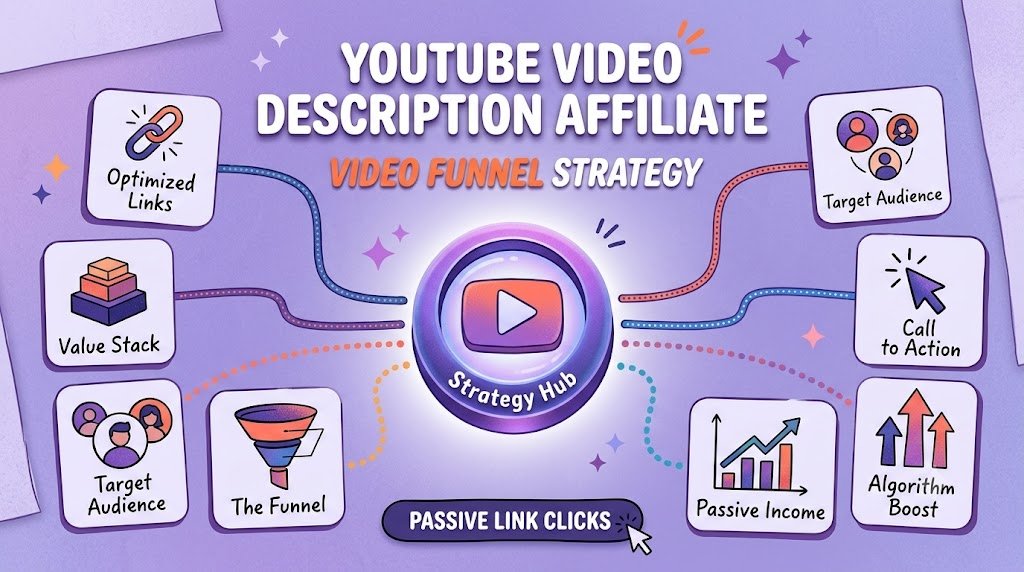
An effective funnel connects five elements:
Helpful YouTube VideoAttracts viewers with a useful solution
Optimized Video DescriptionBuilds interest with benefits and clear disclosures
Relevant Affiliate Link or Resource PageConnects visitors to the next useful step
Purchase or Email SignupCreates an opportunity for conversion or follow-up
Ongoing Discovery and EngagementEvergreen views and permitted automated follow-ups
Once the video is published and the links are configured, parts of this process can operate continuously. Viewers can find the video through YouTube search, suggested videos, Google Search, or external recommendations.
However, affiliate income is not guaranteed or completely passive. Links can expire, products can change, and successful funnels require periodic updates.
Why YouTube Descriptions Are Valuable for Affiliate Marketing
YouTube combines the educational power of video with the ability to direct audiences toward useful external resources.
A well-produced video can demonstrate how a product works, answer common objections, and help viewers decide whether it meets their needs.
The description then becomes the connection between that educational experience and the next action.
Viewers Often Arrive With a Specific Problem
Consider these common YouTube searches:
- Best budget camera for beginner YouTubers
- How to create a website without coding
- Best AI tools for content creators
- How to edit videos faster
- Affordable home office setup
- Email marketing software for small businesses
Each represents an identifiable problem or goal.
Some viewers want information. Others are comparing solutions, evaluating costs, or preparing to buy.
A creator who understands these differences can match video descriptions to audience needs instead of promoting unrelated products.
Video Demonstrations Can Build Purchasing Confidence
An affiliate product recommended inside a text article may require the reader to imagine its usefulness.
A video offers the opportunity to show the product in action.
For example, a creator reviewing video editing software can demonstrate its interface, features, limitations, and real editing workflow.
When viewers find that demonstration useful, the description provides a convenient place to explore the product further.
Trust remains essential. Clear demonstrations and balanced recommendations are generally more persuasive than exaggerated promises.
Evergreen Videos Can Continue Generating Link Clicks
An evergreen video addresses a topic that remains useful over time.
Examples include beginner tutorials, product setup guides, software comparisons, and practical troubleshooting videos.
A tutorial explaining how to set up an email newsletter might continue attracting interested viewers long after publication.
If the description includes current, relevant affiliate recommendations, those ongoing views can create additional opportunities for commissions.
The important distinction is that evergreen affiliate revenue is possible, but it is not automatic.
Traffic, viewer intent, link visibility, product relevance, and conversion rates all influence performance.
Step 1: Choose Affiliate Products That Naturally Fit Your YouTube Content
The foundation of a successful YouTube affiliate funnel is product relevance.
Creators sometimes begin with the commission rate and then search for an audience. A more sustainable approach starts with the viewer’s problem and identifies products that genuinely help solve it.
If your channel teaches beginner photography, your audience may benefit from recommendations for tripods, editing software, lighting equipment, and beginner camera accessories.
A channel focused on blogging could recommend website hosting, keyword research software, email platforms, or content planning resources.
The strongest affiliate products usually share several qualities.
They address a recognizable audience need, offer practical benefits, come from credible companies, and have clear purchasing terms.
Before recommending any offer, investigate the product’s quality, pricing, refund policy, customer support, and affiliate conditions.
Affiliate Product Categories Worth Exploring
| YouTube niche | Potential affiliate products |
|---|---|
| Technology | Software, accessories, electronics |
| Blogging and SEO | Website hosting, research tools, website builders |
| Video production | Editing software, microphones, lighting |
| Online education | Courses, educational tools, learning platforms |
| Productivity | Project management software, organizational tools |
| Design | Design subscriptions, creative applications, templates |
| Gaming | Accessories, peripherals, eligible software |
| Home improvement | Tools, equipment, organization products |
For a beginner creator, choosing two or three closely related products may be more effective than adding twenty unrelated affiliate links.
A focused recommendation makes the next step easier to understand.
Choose Products Based on Viewer Readiness
Not every viewer is ready to purchase immediately.
A beginner watching “How to Start a YouTube Channel” may first need a free equipment checklist.
Someone watching “Best USB Microphone Under $100” might be much closer to buying.
Match offers to these different stages.
Informational videos can introduce free guides or beginner resources. Comparison videos can link to detailed product pages. Product reviews can provide purchase links alongside important limitations and alternatives.
This creates a more helpful video funnel strategy.
Step 2: Understand the Three Stages of a YouTube Affiliate Funnel
Affiliate conversions rarely depend on a single persuasive sentence.
They usually become possible when the creator addresses the viewer’s needs at the appropriate stage.
Stage One: Awareness
At this stage, viewers are exploring a problem.
For example, they may search for “how to improve YouTube audio quality.”
Your video can explain basic audio problems, demonstrate simple improvements, and introduce equipment options.
A relevant next step might be a free audio setup checklist.
Stage Two: Consideration
The viewer understands the problem and is comparing solutions.
A video titled “USB Microphone vs XLR Microphone for YouTube” can help someone evaluate features, cost, and setup requirements.
The description can link to a comparison guide or the specific products discussed.
Stage Three: Decision
The viewer is ready to take action.
A video reviewing a particular microphone can demonstrate audio quality, describe limitations, and explain which viewers would benefit from it.
The description can offer a disclosed affiliate link to the product.
The goal is not to force every viewer into a purchase. It is to create an appropriate next step for each stage.
Step 3: Structure Your YouTube Description for Affiliate Clicks
One of the most important parts of YouTube affiliate marketing is description organization.
A strong description balances helpful information with a simple path to relevant offers.
It should help viewers understand the video, locate recommended resources, and recognize any commercial relationships.
Begin With a Clear Statement of Value
The opening should tell viewers what the video helps them accomplish.
For example:
“Want better audio for your YouTube videos without building an expensive recording studio? In this tutorial, I compare three beginner-friendly microphones and explain which setup makes sense for different budgets.”
This introduction connects with a problem, introduces the video’s benefit, and prepares the viewer for relevant recommendations.
Place the Most Relevant Resource Near the Top
People often expand descriptions looking for a specific product mentioned in a video.
Make that resource easy to identify.
Instead of displaying an unexplained URL, explain what viewers will find.
For example:
“Explore the microphone demonstrated in this tutorial and check its current specifications and price.”
Avoid claiming a product is the cheapest or best unless you have reliable evidence supporting that statement.
Use a Clear, Compliant Description Template
Learn how to improve your YouTube audio without spending money on equipment you do not need. This video compares beginner-friendly microphone options, explains common recording mistakes, and demonstrates a practical setup.
Recommended resources
Disclosure: I may earn a commission if you purchase through the links below, at no additional cost to you.
🎙️ Microphone featured in the video: [Affiliate Link]
🎧 Recommended audio accessory: [Affiliate Link]
📘 Free beginner recording checklist: [Landing Page Link]
Inside this video
00:00 Introduction
01:15 Understanding microphone types
03:20 Comparing audio performance
05:40 Budget considerations
08:10 Setting up your microphone
10:30 Recommendations and limitations
Keep learning
Watch next: [Related YouTube Video]
Explore the complete beginner recording guide: [Website Link]
About this channel
We publish practical tutorials, product comparisons, and creator resources to help you improve your videos and build a more effective content workflow.
Subscribe for new tutorials, setup guides, and honest equipment comparisons.
Additional information
Product prices, features, availability, and affiliate terms may change. Always verify details directly with the seller before purchasing.
This structure is a starting point, not a universal formula. Adapt it to your actual video and avoid adding timestamps for chapters that do not exist.
YouTube supports descriptions up to 5,000 characters. For ordinary long-form videos, clickable external URLs require the channel to have advanced features enabled; external URLs placed in Shorts descriptions and comments are not clickable.
YouTube Help
+1
That distinction is important when planning an affiliate strategy involving both Shorts and long-form content.
Step 4: Write Calls to Action That Feel Helpful Rather Than Aggressive
A successful affiliate call to action does not need to sound like an advertisement.
Its purpose is to help the viewer understand why a particular resource may be useful.
Compare two approaches.
Weak approach: “CLICK HERE NOW! BEST PRODUCT! BUY TODAY!”
Stronger approach: “If you want to see the microphone used in this tutorial, I’ve included its product link below so you can review the specifications and current price.”
The second version is more closely connected to the viewer’s interests.
It explains what will happen after clicking without creating artificial urgency.
Match the Action to the Video’s Purpose
For tutorials, use invitations such as:
“Download the checklist used in this tutorial.”
For product comparisons:
“Compare the current features and pricing of the products demonstrated.”
For software demonstrations:
“Explore the software’s official plans and see whether its features fit your workflow.”
For beginner education:
“Get the free starter guide and follow the complete setup process.”
For advanced viewers:
“Explore the full workflow and the tools used to build it.”
The best wording depends on the problem your video actually solves.
A single primary action often makes the description easier to navigate, although additional relevant resources may still be useful.
Step 5: Build a Landing Page That Connects YouTube Traffic to Affiliate Offers
Direct affiliate links are useful when viewers already know what they want.
However, some visitors need more information before making a decision.
A dedicated landing page can provide that information.
Instead of directing every viewer immediately to a merchant website, you can create a focused resource page containing product explanations, comparisons, tutorials, and clearly disclosed affiliate recommendations.
Imagine a YouTube channel teaching beginners how to create professional videos.
The creator publishes a video called “My Complete Beginner YouTube Studio Setup.”
The description links to a page titled “Beginner YouTube Studio Equipment Guide.”
That page could include:
- A recommended starter setup with approximate budgets
- Equipment specifications and compatibility notes
- Comparison tables explaining important differences
- Product demonstration videos
- Affiliate links with visible commission disclosures
- A free downloadable setup checklist
The landing page provides additional context while giving the creator more control over the educational experience.
A Simple Landing Page Structure
PAGE HEADER
Build Your First YouTube Studio
A practical equipment guide for creators working with a limited budget.
Step 1: Find the right equipment
Compare entry-level microphones, lighting, and tripods with clear pros and cons.
Step 2: Explore recommended products
See available features, suitability, and affiliate links with visible disclosures.
Step 3: Get the free setup checklist
Optional email signup for a downloadable guide and related lessons.
Step 4: Continue learning
Access the next tutorial, troubleshooting guide, or equipment comparison.
A landing page should never exist solely to conceal or redirect affiliate links. It should provide genuine value and clearly identify where visitors are going.
Also review the affiliate program’s rules before using redirects, intermediate landing pages, or tracked links. Some programs restrict these practices.
Step 6: Create an Automated Email Funnel for Interested Viewers
A video description can attract visitors, but it cannot independently collect email addresses or send follow-up messages.
To automate that process, connect your video to an email signup landing page.
This allows interested viewers to voluntarily receive useful resources and additional information.
For example, someone watching a tutorial about starting a blog might download a free blogging checklist.
After subscribing, the viewer can receive a relevant series of emails.
Example Five-Email Affiliate Funnel
| Timing | Email focus | Main objective |
|---|---|---|
| Immediately | Deliver the free checklist | Fulfill the signup promise |
| Day 2 | Explain common beginner mistakes | Provide practical value |
| Day 4 | Compare useful tools | Help the reader evaluate options |
| Day 6 | Demonstrate a complete workflow | Build confidence |
| Day 9 | Offer additional resources and relevant products | Invite a considered decision |
This sequence can be configured with an email marketing platform such as MailerLite, Kit or Brevo.
The automation begins only after the visitor completes the relevant signup process.
Each email should serve a meaningful purpose rather than repeatedly requesting a purchase.
Affiliate relationships should also be clearly disclosed whenever the email contains commission-earning endorsements.
Why Email Subscribers Can Be Valuable
A YouTube subscriber and an email subscriber are not the same.
YouTube subscriptions help viewers discover your channel’s future content. Email subscriptions allow you to communicate with people who have explicitly chosen to receive your messages.
An owned email list can support recurring engagement, educational series, and relevant product recommendations.
It also reduces exclusive dependence on recommendation algorithms.
However, email automation requires proper consent practices, an appropriate privacy notice, and a working unsubscribe mechanism.
Step 7: Automate Affiliate Funnel Operations Without Sacrificing Trust
Automation should reduce repetitive work, not eliminate human judgment.
Once you establish your funnel, you can automate several operational steps.
Use Description Templates
Create separate description templates for different video categories.
For example, a product review template might contain sections for recommended products, comparisons, disclosures, and supporting resources.
A tutorial template might emphasize a free checklist, a relevant software recommendation, and the next lesson.
Templates save preparation time and support consistency.
However, every description should be reviewed to ensure that links, product recommendations, and chapter timestamps accurately match the individual video.
Use Dedicated Tracking Links
Tracking parameters can help distinguish traffic sources.
A link from your microphone review should be identifiable separately from a link in your studio setup tutorial.
For landing pages, a tagged URL might look like:
These parameters can help you analyze website traffic in compatible analytics tools.
If you link directly to an affiliate merchant, use approved sub-IDs, tracking IDs, or other measurement options provided by that affiliate program.
Do not assume standard UTM tags will appear in affiliate commission reports.
Automate Email Delivery
After a visitor opts in, email software can automatically deliver a promised resource and schedule subsequent lessons.
You can also segment subscribers according to their stated interests, provided your data collection and use are appropriately disclosed.
For example, subscribers interested in video editing may receive different educational content from those interested in camera equipment.
Schedule Periodic Link Checks
Affiliate links can stop working when companies change URLs, discontinue programs, or remove products.
Use a scheduled review process to check for broken links, outdated offers, and misleading product claims.
Automated link checking may help identify problems, but manual review remains important for verifying pricing, program conditions, and product suitability.
Step 8: Turn Evergreen YouTube Videos Into Long-Term Traffic Sources
An automated funnel becomes more useful when it receives consistent traffic.
This makes evergreen content an attractive foundation for affiliate marketing.
Evergreen videos answer questions people may continue asking for months or years.
Instead of relying entirely on rapidly changing trends, build a library around recurring audience needs.
Evergreen YouTube Video Ideas
| Video title idea | Affiliate opportunity |
|---|---|
| How to Start a Blog for Beginners | Hosting and website tools |
| Best Budget Microphone Setup | Microphones and accessories |
| How to Create Professional Thumbnails | Design applications |
| Beginner Video Editing Tutorial | Editing software |
| How to Build an Email Newsletter | Email platforms |
| How to Organize Content Production | Project management tools |
| Essential Tools for Remote Work | Productivity software and equipment |
Each video should answer a genuine question and link to relevant solutions.
Avoid creating videos that exist only to deliver affiliate links. The video itself must justify the viewer’s time.
Connect Related Videos Into a Learning Journey
Suppose your channel teaches website creation.
You could publish:
“How to Choose a Domain Name”
followed by:
“How to Set Up WordPress”
and then:
“How to Design Your First Website.”
Each description can point to the next appropriate tutorial.
This supports continued learning while giving viewers more opportunities to discover relevant tools and resources.
For returning visitors, consider maintaining a clearly organized playlist or regularly updated resource hub.
Instead of asking viewers to return simply because more content will appear, give them a specific reason: the next lesson solves the next problem.
Step 9: Measure Affiliate Funnel Performance With the Right Metrics
One of the biggest mistakes in YouTube affiliate marketing is focusing entirely on views.
A video with fewer views can generate more affiliate revenue than a popular video if its audience has stronger purchasing intent.
To evaluate performance, monitor the journey from video discovery to action.
Important Metrics to Track
Video views: How many times the video is viewed.
Audience retention: How effectively the content holds viewer attention.
Landing page visits: How many visitors reach the linked resource page.
Outbound link clicks: How often visitors proceed toward an affiliate offer.
Email conversion rate: The percentage of landing page visitors who voluntarily subscribe.
Affiliate conversion rate: The percentage of tracked affiliate clicks that result in commissionable actions.
Earnings per click: Affiliate commissions divided by tracked affiliate clicks.
Use YouTube Analytics, website analytics, and affiliate program reporting together. They represent different parts of the journey and may not reconcile perfectly because of attribution windows, consent settings, tracking limitations, and reporting differences.
Example: Understanding the Numbers
Suppose a tutorial receives 10,000 views in a month.
Of those viewers, 300 visit your resource page, 120 click through to an affiliate merchant, and 6 complete commissionable purchases.
If the average commission is $15, the estimated commission revenue is $90.
ILLUSTRATIVE AFFILIATE FUNNEL CALCULATORMonthly video viewsCommission per sale ($)Video-to-page visit rate
3%Page-to-merchant click rate
40%Merchant purchase rate
5%
Page visits
300
Merchant clicks
120
Estimated sales
6
ESTIMATED MONTHLY COMMISSIONS
$90.00
Hypothetical gross commission estimate, before expenses, reversals, refunds or taxes. Not an earnings prediction.
This calculation shows why conversion quality matters.
Improving product relevance, providing clearer descriptions, or making a landing page more useful may be more valuable than simply attracting additional low-intent views.
Use your own results to identify the most promising opportunities.
Step 10: Improve Link Clicks Without Misleading Your Audience
Affiliate marketing succeeds over time when viewers believe your recommendations are useful and reliable.
A creator who exaggerates product benefits may earn a few clicks but damage long-term audience trust.
Instead, focus on helping viewers make informed choices.
Explain Why a Product Is Relevant
Avoid recommending a tool merely because it offers attractive commissions.
Explain which problem it solves and who should consider it.
For example:
“This editing tool may be useful for beginners who want a simpler timeline, although users who need advanced color grading should compare its capabilities with professional alternatives.”
Balanced information can reduce confusion and attract more appropriately qualified visitors.
Make Descriptions Easy to Scan
Long, unstructured descriptions are difficult to navigate.
Use short paragraphs, descriptive labels, timestamps, and clear links.
Keep disclosures visible.
The most important resources should be easy to locate without requiring viewers to search through unrelated promotions.
Test One Meaningful Change at a Time
You might test whether a benefit-oriented link label attracts more relevant traffic than a generic label.
Or compare performance between a direct product link and a detailed resource page.
Avoid changing numerous elements simultaneously if you want to understand what caused a difference.
Remember that YouTube traffic fluctuates, so small changes in clicks do not necessarily prove that one variation performs better.
Review Mobile Experiences
Many viewers watch YouTube on mobile devices.
Descriptions may be collapsed, and external pages must work on smaller screens.
Review your landing page on mobile, check button visibility, and ensure the signup process is simple.
A complicated mobile form can undermine an otherwise useful funnel.
Step 11: Use Search-Focused Videos to Attract High-Intent Affiliate Visitors
A YouTube affiliate funnel benefits from videos that align with the questions people are already searching for.
The most commercially relevant topics often involve comparisons, product reviews, tutorials, and troubleshooting.
Examples include:
“Best Email Marketing Software for Beginners”
“Can You Build a Website Without Coding?”
“Budget Microphone Comparison for YouTube Creators”
“How to Automate an Email Welcome Sequence”
“Which Website Builder Is Better for Small Businesses?”
These topics can attract viewers at different stages of decision-making.
Build Videos Around Complete Questions
Search engines and AI-powered discovery experiences benefit from content that clearly answers specific questions.
A useful video should explain the problem, identify relevant considerations, and provide practical steps or comparisons.
For example, a video about email marketing software can address:
What features do beginners need?
How much does the software cost?
Does it support automation?
What are the limitations?
Which types of businesses is it suitable for?
When the description accurately summarizes these topics, viewers can better understand the content before choosing additional resources.
Descriptions should support the video, not attempt to compensate for weak or unrelated content.
Connect Your YouTube Channel With Your Website
A related article on your website can provide additional detail that does not fit naturally into a video.
For example, a video comparing email marketing platforms might link to a written comparison guide with updated pricing, feature tables, and implementation instructions.
The website article can also embed the corresponding video where useful and permitted.
This creates a connected educational experience across your channel and website.
You may also improve content discoverability by using descriptive page titles, clear headings, accurate metadata, and appropriate structured data where applicable.
These practices can help search systems interpret content, but they do not guarantee Google Search rankings, AI answer citations, or Google Discover visibility.
Step 12: Build a Returning-Visitor System Around Useful Resources
Affiliate success should not depend entirely on attracting first-time viewers.
Returning visitors may become more familiar with your educational approach and the resources you recommend.
A useful way to encourage repeat engagement is to create connected content series.
For example, a channel teaching digital entrepreneurship could publish a sequence covering website setup, content creation, email marketing, and basic automation.
Each tutorial introduces the next skill.
The accompanying resource pages can help viewers continue their progress.
Create a Resource Library
Instead of maintaining disconnected links across dozens of descriptions, build an organized resource library on your website.
Sections might include:
Beginner creator tools, video production equipment, website-building resources, marketing software, and workflow templates.
Each section should provide helpful explanations, not simply a collection of affiliate buttons.
When a recommended product changes, the resource library can be easier to update than hundreds of individual video descriptions.
However, descriptions that contain direct links still require periodic auditing.
Offer Regular Educational Updates
You could publish a monthly tools comparison, a new practical tutorial, or an updated beginner checklist.
Encourage viewers to subscribe or revisit your resource page for future improvements.
Avoid promising updates you cannot realistically maintain.
The strongest returning-visitor strategy is to consistently provide something worth returning for.
Common Mistakes That Reduce YouTube Affiliate Conversions
Some affiliate funnels fail because their structure creates unnecessary friction or undermines credibility.
Adding too many unrelated links. A long list of offers can distract viewers. Prioritize the few resources that directly support the video’s topic.
Hiding affiliate disclosures. Viewers should clearly understand when a recommendation may generate a commission.
Promoting products without evaluating them. Research products carefully, be transparent about what you have and have not personally tested, and never invent firsthand experience.
Using outdated offers. Expired promotions, discontinued products, and incorrect specifications create frustration.
Ignoring the viewer’s purchasing stage. Someone seeking a basic explanation may need more educational information before considering a purchase.
Failing to track results. Without reliable measurement, creators may continue promoting offers that attract clicks but little meaningful engagement.
Treating automation as a substitute for maintenance. Automated email sequences and landing pages still need accuracy checks, updates, and ongoing performance reviews.
Creating misleading urgency. Unsupported claims about limited availability, discounts, or guaranteed results can harm users and violate advertising standards.
A Practical 30-Day Plan to Launch Your First YouTube Affiliate Funnel
You do not need a large team or complicated technology to launch a basic funnel.
Start with one audience problem and build a small system that can be measured and improved.
| Timeline | Action | Desired outcome |
|---|---|---|
| Days 1–5 | Identify a niche problem and evaluate relevant affiliate products | Select a credible offer |
| Days 6–10 | Create or improve one educational YouTube video | Publish genuinely useful content |
| Days 11–15 | Write an optimized description with a clear disclosure and relevant links | Establish a trustworthy next step |
| Days 16–20 | Build a useful resource page and optional email signup | Support visitors who need more detail |
| Days 21–25 | Configure approved tracking and email automation | Enable measurement and permitted follow-up |
| Days 26–30 | Review links, test the mobile experience, and analyze initial engagement | Identify early improvements |
By the end of the month, your objective should not be a specific income target.
It should be a functioning system that connects a helpful video with a relevant offer and allows you to evaluate what happens next.
Once that process works, you can apply the lessons to other related videos.
Five Frequently Asked Questions
1. Can you earn affiliate commissions from YouTube video descriptions without joining the YouTube Partner Program?
Yes. Creators can generally participate in independent affiliate programs without being members of the YouTube Partner Program, provided they satisfy the affiliate program’s eligibility rules and YouTube’s applicable policies.
However, clickable external links in long-form video descriptions require the relevant advanced channel features. Affiliate relationships must be disclosed appropriately.
2. How many affiliate links should I add to a YouTube description?
There is no universal number that guarantees better conversions.
For many videos, one primary recommendation and a small number of relevant supporting resources create a clearer experience than an extensive list of unrelated links.
Choose the number based on the products genuinely discussed, the viewer’s needs, and the terms of each affiliate program.
3. Are direct affiliate links better than landing pages?
Neither approach is always better.
Direct affiliate links may suit product review videos where viewers already know what they want to explore.
Landing pages can be valuable when visitors need comparisons, additional education, or a downloadable resource before deciding.
Test both approaches where permitted, and choose based on visitor usefulness, compliance, and actual performance.
4. Can YouTube descriptions generate passive affiliate income?
They can contribute to recurring commission opportunities when evergreen videos continue attracting viewers.
However, income depends on traffic, product demand, affiliate tracking, commission terms, and purchase behavior.
Descriptions and links also need occasional maintenance, so the process is better understood as a partially automated marketing system rather than guaranteed passive income.
5. What is the best way to automate a YouTube affiliate marketing funnel for beginners?
Begin with a helpful long-form video, a relevant disclosed affiliate recommendation, and a clear description.
If visitors need additional information, connect the description to a useful landing page.
An optional email signup can deliver educational resources through an automated sequence, provided visitors give appropriate consent.
Track performance through your website analytics and affiliate dashboard, then improve the funnel based on real data.
Compliance Note: Affiliate Disclosure, YouTube Policies, Privacy and Responsible Marketing
Affiliate funnels must comply with applicable advertising laws, platform requirements, affiliate program agreements, and privacy regulations.
The U.S. Federal Trade Commission recommends that creators clearly disclose affiliate relationships both within relevant videos and in descriptions near affiliate links. A disclosure hidden at the bottom of a description may not be sufficient, and labels such as “affiliate link” alone may be unclear to viewers.
Federal Trade Commission
A clear example is:
“I may earn a commission if you buy through the links below, at no additional cost to you.”
Disclosures should reflect the actual commercial relationship. If a brand supplied a free product, paid for an endorsement, or sponsored the content, disclose those arrangements as applicable.
YouTube also requires creators to use its paid promotion declaration when content qualifies under its branded-content rules. YouTube permits affiliate content generally, but excessive affiliate posting or links to prohibited destinations may violate its spam or external-links policies.
Before launching your funnel, follow these safeguards:
- Review each affiliate program’s requirements for link placement, tracking, promotions, and permitted marketing channels.
- Do not make fabricated reviews, false savings claims, or unsupported income promises.
- Protect visitor information, obtain required consent, provide appropriate privacy disclosures, and comply with applicable email-marketing and data-protection rules.
- Clearly distinguish independent recommendations, affiliate partnerships, and sponsored promotions.
- Check current product information, pricing, availability, and refund conditions before publishing claims.
- For international audiences, consider relevant jurisdiction-specific advertising requirements, including those applicable in India, the United States, the United Kingdom, and other markets.
Official references include YouTube’s guidance on sharing links, YouTube’s external links policy, and the FTC Endorsement Guides FAQs.
These principles are general educational information, not individualized legal advice.
Build a YouTube Affiliate System That Keeps Working Beyond the Upload Date
A YouTube video description is more than a summary beneath your content. When organized around audience needs, it can connect useful videos with relevant tools, educational resources, and legitimate affiliate opportunities.
The most effective strategy is not to overwhelm viewers with promotions. It is to make their next decision easier.
Start by identifying a genuine audience problem. Create a video that offers a practical answer. Write a description that connects viewers with useful resources. Add an appropriate landing page when more explanation is needed, and use permitted automation to deliver further education to interested subscribers.
Then measure results, maintain accurate recommendations, and improve the system over time.
Your next step: Choose one existing evergreen YouTube video, review the questions it answers, and rebuild its description around one relevant resource and one clear next action.
A single well-structured description will not guarantee commissions. But a library of helpful videos, trustworthy recommendations, and well-maintained affiliate funnels can become a valuable long-term asset for a creator’s business.
Stay ahead with exclusive updates
Join our community. Get curated industry trends, actionable guides, and fresh resources delivered straight to your inbox.