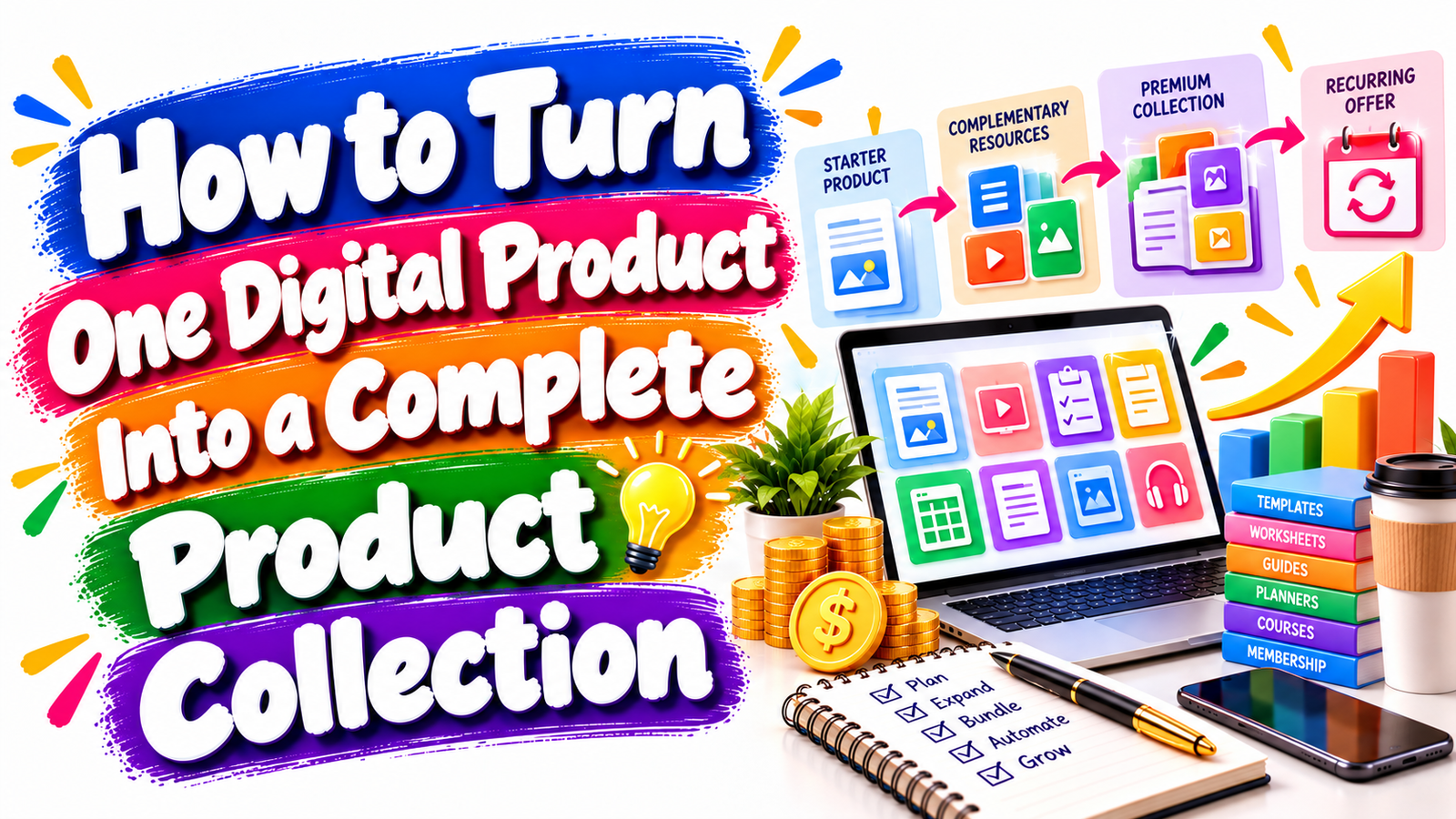
Creating one digital product can generate sales. Creating a connected collection of digital products can build an entire business.
Many creators, freelancers, coaches, educators, and digital entrepreneurs make the same mistake: they launch one ebook, template, planner, course, or resource bundle and immediately begin searching for a completely different product idea.
That approach can work, but it often creates a scattered store filled with unrelated products.
A stronger digital product strategy is to take one useful product and expand it into a carefully connected digital product ecosystem.
Instead of selling isolated downloads, you create a customer journey.
A beginner might purchase a low-cost starter resource. Once they see value, they may want templates that help them implement what they learned. Later, they may want a larger toolkit, premium bundle, advanced course, membership, update service, or recurring resource library.
The result is a digital product collection in which every product naturally supports the others.
This model can improve customer experience, increase average order value, create opportunities for repeat purchases, and make product creation easier because you are building around one audience and one core problem.
What Is a Digital Product Collection?
A digital product collection is a group of related digital resources designed for the same audience or closely connected customer needs.
For example, imagine that your first product is:
Freelancer Client Onboarding Checklist
Instead of creating an unrelated meal planner next, you could expand the original product into:
- Client onboarding checklist
- Client questionnaire template
- Proposal template
- Welcome packet
- Contract preparation checklist
- Project tracker
- Invoice tracker
- Client communication templates
- Freelancer business toolkit
- Premium freelancer operations bundle
Each product solves a different part of the same customer journey.
Together, they form a digital product ecosystem.
The key idea is simple:
Do not always search for another audience. Look for the next problem your existing customer needs solved.
Why a Digital Product Ecosystem Can Be More Powerful Than Individual Products
Selling individual digital products often means attracting a new buyer for every transaction.
A product ecosystem gives customers reasons to return.
Someone who purchases your beginner budgeting spreadsheet today may later purchase your savings tracker, debt planner, annual finance dashboard, business budget system, or complete financial planning bundle.
Instead of starting your marketing from zero every time, each product can introduce customers to another relevant offer.
A strong digital product ecosystem can support several business goals at once.
It Creates Natural Upselling Opportunities
Your starter product can introduce a customer to a larger solution.
A buyer who downloads a $9 content calendar may later discover a $29 social media template pack and eventually purchase a $79 complete content management system.
The products are different, but the customer need remains connected.
It Increases Customer Lifetime Value
A customer does not necessarily have to purchase your most expensive product first.
They may begin with a small purchase and gradually move through your collection.
One customer could potentially purchase several products over time.
It Makes Product Development Easier
When you already understand your audience, you do not need to begin every product with completely new research.
You already know:
- Who the customer is
- What problem they have
- What language they use
- What resources they need
- What questions they ask
- What outcome they want
Your next product becomes an extension of existing knowledge.
It Strengthens Your Brand Positioning
A store with 20 unrelated products can look like a general marketplace.
A store with 20 connected products can look like a specialist resource center.
For example:
General store
Wedding invitations
Fitness planner
Instagram templates
Recipe ebook
Budget spreadsheet
Children’s worksheets
Focused store
Freelancer proposal template
Freelancer onboarding kit
Client tracker
Project dashboard
Invoice system
Freelance business planner
Freelancer SOP library
The second store immediately communicates expertise in a particular market.
The Four-Level Digital Product Ecosystem
A practical digital product strategy can be built around four levels:
Starter product → complementary resources → premium collection → recurring offer
Each stage gives customers a logical next step.
Level 1: Create a Simple Starter Product
Your starter product should solve one specific problem quickly.
It does not need to contain everything.
In fact, smaller products can sometimes work better as entry offers because customers can immediately understand what they are buying.
Examples include:
- Checklist
- Mini ebook
- Printable planner
- Spreadsheet
- Canva template
- Prompt library
- Swipe file
- Worksheet
- Short video workshop
- Notion template
- Calculator
- SOP
- Mini course
Suppose your target audience is small business owners.
Your starter product could be:
Small Business Monthly Expense Tracker
It addresses one clear need: organizing expenses.
Now ask:
What will the customer need before, during, or after using this product?
That question begins your product ecosystem.
Level 2: Build Complementary Digital Products
Complementary products solve closely related problems.
Using the expense tracker example, complementary resources could include:
- Income tracker
- Profit and loss worksheet
- Invoice tracker
- Cash-flow planner
- Tax preparation checklist
- Business budget template
- Financial goal planner
- Monthly financial review worksheet
These products should not feel like random add-ons.
They should make the customer’s original goal easier to achieve.
A useful method is to examine five stages of the customer’s journey:
Before
What does the customer need before using your main product?
For a social media content calendar, they might need:
- Brand strategy worksheet
- Audience research template
- Content pillar planner
During
What helps customers use the product more effectively?
They might need:
- Caption templates
- Hashtag research sheet
- Content tracker
- Design templates
After
What happens once they have completed the original task?
They may need:
- Analytics dashboard
- Performance review sheet
- Content optimization checklist
Faster
What resource helps them achieve the result more quickly?
Examples include:
- Done-for-you templates
- Swipe files
- Automation guides
- Prompt libraries
Better
What helps them improve the quality of the outcome?
Examples include:
- Advanced workbook
- Strategy guide
- Professional templates
- Case studies
- Expert checklist
Each answer can become another digital product idea.
Level 3: Combine Products Into a Premium Collection
Once several complementary products exist, you can combine them into a higher-value offer.
This is where a small digital product business begins to feel like a complete product system.
Suppose you sell these individual resources:
- Content calendar
- Caption templates
- Social media design templates
- Content planning workbook
- Analytics tracker
- AI prompt library
- Brand voice worksheet
You could combine them into:
Complete Social Media Business Toolkit
The premium collection creates convenience.
Customers do not have to search for every resource separately.
They can purchase one organized package built around a larger outcome.
This approach can also increase perceived value because the customer receives multiple coordinated tools rather than an isolated download.
How to Structure a Premium Digital Product Collection
A premium collection should feel organized rather than simply large.
More files do not automatically create more value.
A good collection might include:
Start Here Guide
Explain what the collection contains and how customers should use it.
Core Product
Include the main resource that addresses the primary problem.
Planning Resources
Add worksheets, checklists, or planning documents.
Implementation Tools
Include templates, trackers, dashboards, scripts, prompts, or systems.
Supporting Resources
Add guides, tutorials, examples, or reference material.
Bonus Resources
Include useful extras that strengthen the offer without distracting from the core purpose.
The goal is not to create the biggest bundle possible.
The goal is to create the most useful collection for a specific result.
Level 4: Add a Recurring Digital Offer
Once you have an established product ecosystem, you can consider a recurring offer.
Recurring digital products can provide customers with fresh resources while creating more predictable revenue for the business.
Possible models include:
- Monthly template club
- Prompt library membership
- Printable subscription
- Business resource membership
- Monthly spreadsheet collection
- Design asset library
- Content idea subscription
- Digital planner update club
- Training membership
- Industry resource newsletter
- Premium resource vault
For example, someone who purchases your Social Media Business Toolkit could later join a monthly membership that provides:
- New Canva templates
- Monthly content calendars
- Caption ideas
- Promotional campaign templates
- AI marketing prompts
- Seasonal content packs
The recurring offer becomes the ongoing layer of your digital product ecosystem.
One Product Can Produce Many New Product Ideas
A powerful exercise is to place your original product at the center of a page.
Then create categories around it.
Suppose your original product is:
Wedding Planning Spreadsheet
Your ecosystem might become:
Planning
Wedding timeline
Venue checklist
Vendor checklist
Guest list organizer
Budgeting
Wedding budget spreadsheet
Payment tracker
Vendor expense tracker
Communication
Vendor email templates
Wedding invitation wording guide
Bridesmaid communication templates
Event Organization
Seating chart template
Wedding day schedule
Photography shot list
Premium Collection
Complete Wedding Planning Digital Toolkit
Recurring Offer
Seasonal wedding planning resource membership or updated wedding template library
A single product concept has now become an entire product line.
Use Customer Problems to Expand Your Collection
Your customers can tell you what to build next.
Pay attention to questions such as:
“Do you have a template for this?”
“Can I get an editable version?”
“Is there a spreadsheet included?”
“Do you have something for beginners?”
“Is there a more advanced version?”
“Can I purchase everything together?”
“Do you offer monthly updates?”
Each question may reveal demand for another product.
Customer support messages, reviews, search queries, marketplace questions, social media comments, and email replies can all provide useful product research.
Create Products for Different Customer Experience Levels
Another effective digital product strategy is to design offers for different stages of experience.
Beginner
Simple guide
Checklist
Starter template
Mini workbook
Intermediate
Toolkit
Template pack
Advanced spreadsheet
Implementation system
Advanced
Premium resource library
Complete business operating system
Masterclass
Professional bundle
Ongoing
Membership
Monthly updates
Resource subscription
Premium community
This structure helps customers find an offer appropriate to their current needs.
Turn One Format Into Multiple Formats
You can also expand a digital product by changing how customers consume the information.
Imagine you create:
50 AI Prompts for Freelancers
That concept could become:
PDF guide
Prompts with instructions and examples.
Canva workbook
Interactive exercises based on the prompts.
Notion system
A searchable prompt database.
Spreadsheet
Prompts organized by business category.
Video workshop
Demonstrations showing how to use the prompts.
Template bundle
Prompt-based client documents.
Premium library
Hundreds of categorized prompts and workflows.
One intellectual concept can support several product formats.
However, each version should offer a meaningful difference rather than simply repackaging identical information.
Build Around Outcomes, Not File Counts
Digital product sellers sometimes focus heavily on numbers.
1,000 templates.
10,000 prompts.
50,000 printables.
Large collections can be useful, but customers are usually searching for a result.
Instead of asking:
How many files can I include?
Ask:
What can the customer accomplish with this collection?
Compare these two descriptions:
“Includes 120 freelancer templates.”
versus:
“Organize client inquiries, proposals, onboarding, project management, invoicing, and offboarding with one connected freelancer business system.”
The second communicates a customer outcome.
Your product collection should feel like a solution, not a storage folder.
Create a Clear Product Ladder
A product ladder gives customers logical purchasing options.
For example:
Entry product — $7
Freelancer Client Checklist
Core product — $19
Freelancer Client Onboarding Kit
Expanded toolkit — $39
Freelancer Project Management System
Premium collection — $89
Complete Freelancer Business Toolkit
Recurring offer — $15/month
Freelancer Resource Membership
The exact pricing will vary based on audience, quality, market positioning, licensing, complexity, and competition.
What matters is that every offer serves a different level of customer need.
Avoid Making Products Compete With Each Other
A common problem appears when several products look almost identical.
Customers become confused.
For example:
“Business Planner”
“Business Planning Workbook”
“Business Success Planner”
“Ultimate Business Planner”
If the differences are unclear, buyers may hesitate.
Each product should have a distinct purpose.
A clearer structure would be:
Startup Planning Workbook
For defining the business concept.
Marketing Planner
For planning promotional campaigns.
Financial Dashboard
For tracking business numbers.
Complete Business Management System
Combines planning, marketing, operations, and finances.
Clear positioning helps customers understand why each offer exists.
Use Bundles Without Destroying Individual Product Value
Bundles can be powerful, but they should be structured carefully.
If customers know that every product will eventually appear in an extremely cheap bundle, they may have little reason to purchase individual products.
Instead, consider offering:
- Individual products for specific needs
- Small themed bundles
- Professional toolkits
- Premium all-in-one collections
Each tier should provide a clear value proposition.
Use Internal Links Across Your Product Pages
Your website can help customers discover related products.
For example, a product page for a content calendar could mention:
“Need ready-made social designs? Explore the Social Media Template Pack.”
Your template pack could then mention:
“Want the complete planning and content system? View the Social Media Business Toolkit.”
This internal linking strategy can improve navigation while helping search engines understand relationships between your content and product pages.
It can also strengthen SEO around topics such as:
- digital product collection
- digital product ecosystem
- digital product strategy
- digital products to sell online
- digital product bundle ideas
- digital download business
- product ladder strategy
- digital product business model
- digital product bundle
- recurring digital products
Create Supporting Content Around the Ecosystem
Your product collection can also power your content marketing.
Suppose you sell a freelancer business toolkit.
You could publish articles such as:
- How to Onboard Freelance Clients Professionally
- What Should Be Included in a Freelance Proposal?
- How to Create a Client Welcome Packet
- Freelancer Project Management Tips
- How to Track Freelance Income and Expenses
- Best Templates for Freelancers
- How to Build a Freelance Business System
Each article attracts visitors interested in problems solved by your products.
Rather than writing unrelated blog posts simply for traffic, create content around the customer journey.
This produces a stronger connection between SEO traffic and commercial intent.
Create One Master Topic Map
Before building dozens of products, organize your market into categories.
For example, a digital store serving content creators might use:
Planning
Content calendar
Campaign planner
Content strategy workbook
Creation
Canva templates
Caption library
Video scripts
Blog templates
AI Productivity
AI prompts
Workflow templates
Automation guides
Analytics
Performance dashboard
KPI tracker
Monthly review template
Business
Client proposal
Pricing calculator
Invoice system
SOP templates
You now have a roadmap for future products.
This reduces random product creation.
A Practical 7-Step Digital Product Expansion Strategy
You can use this simple process to turn one product into a larger digital business.
Step 1: Identify Your Strongest Product
Choose a product that solves a clear problem.
It does not necessarily have to be your highest-selling product. It should have enough potential to support related resources.
Step 2: Identify the Core Customer
Clearly define who uses the product.
For example:
Freelancers
Teachers
Coaches
Small businesses
Etsy sellers
Content creators
Parents
Students
Designers
Step 3: Map the Customer Journey
Write down what the customer needs:
Before using your product
While using your product
After using your product
To get results faster
To get better results
Step 4: Create Three Complementary Products
Start small.
You do not need 50 products immediately.
Create three resources that naturally extend the original product.
Step 5: Build a Small Bundle
Combine related resources into one themed collection.
Step 6: Develop a Premium System
Create a more complete solution covering the larger customer outcome.
Step 7: Consider an Ongoing Offer
If customers regularly need new content, updates, templates, data, training, or resources, explore a recurring product model.
Example: Turning One Canva Template Into a Product Ecosystem
Imagine that your first product is:
Instagram Post Template Pack
You could expand it into:
Starter product
30 Instagram post templates
Complementary products
Instagram Story templates
Reel cover templates
Carousel templates
Quote templates
Launch templates
Promotion templates
Supporting resources
Caption library
Content calendar
Brand style worksheet
Hashtag research tracker
Premium product
Complete Instagram Content Business Kit
Recurring offer
Monthly social media template membership
The original template pack is no longer simply one product.
It becomes the entrance to an entire digital product ecosystem.
Example: Turning One Ebook Into a Product Collection
Suppose your original product is:
Beginner’s Guide to Freelancing
You could create:
Mini products
Freelance niche worksheet
Pricing calculator
Proposal template
Client questionnaire
Invoice template
Intermediate products
Freelancer onboarding kit
Freelance project tracker
Client communication library
Premium offer
Complete Freelance Business System
Recurring offer
Monthly freelancer resource membership
An ebook that once generated a single transaction can become the foundation of multiple connected offers.
Think Like a Product Architect
Successful digital product creation is not only about designing files.
It is about designing pathways.
Ask:
What does the customer need first?
What comes next?
What problem appears after that?
What would save them time?
What would improve their results?
What could combine these resources into a complete solution?
What might they need repeatedly?
Those questions transform individual products into a business ecosystem.
Build the Collection Around the Customer Journey
One of the most useful shifts in digital product strategy is moving from:
“What product should I create next?”
to:
“What does my customer need next?”
That question can change the direction of an entire digital product business.
Your first product does not have to remain a standalone download.
It can become the starting point for complementary resources, bundles, premium systems, and recurring offers.
Start with one problem.
Solve the next related problem.
Then another.
Organize those solutions into a connected collection.
Over time, you can build a digital product ecosystem that is easier for customers to understand, easier for you to market, and capable of supporting multiple revenue opportunities without constantly searching for completely new audiences.
Frequently Asked Questions
1. What is a digital product ecosystem?
A digital product ecosystem is a connected group of products designed for the same audience or customer journey. A customer might begin with a small starter product, move to related templates or resources, purchase a premium collection, and eventually join a recurring offer.
2. How many products should be included in a digital product collection?
There is no required number. A useful collection might contain three carefully connected products or dozens of resources. Relevance and organization matter more than quantity. Every product should support a clear customer need or outcome.
3. What is the best way to turn one digital product into several products?
Start by identifying what customers need before, during, and after using the original product. Then look for tools that could make the process faster or easier. These needs can become checklists, templates, spreadsheets, guides, workbooks, courses, bundles, or other complementary products.
4. Should I sell digital products individually or as bundles?
Both approaches can work together. Individual products are useful for customers who need one specific solution, while bundles and premium collections can serve customers who want a more complete system. Clearly explain what each offer contains so buyers can choose the option that fits their needs.
5. Can a digital product collection generate recurring revenue?
Yes, when customers have an ongoing need for new resources, updates, templates, training, data, or content. A membership, subscription library, monthly template club, resource vault, or update service can become the recurring layer of a larger digital product ecosystem.
Stay ahead with exclusive updates
Join our community. Get curated industry trends, actionable guides, and fresh resources delivered straight to your inbox.