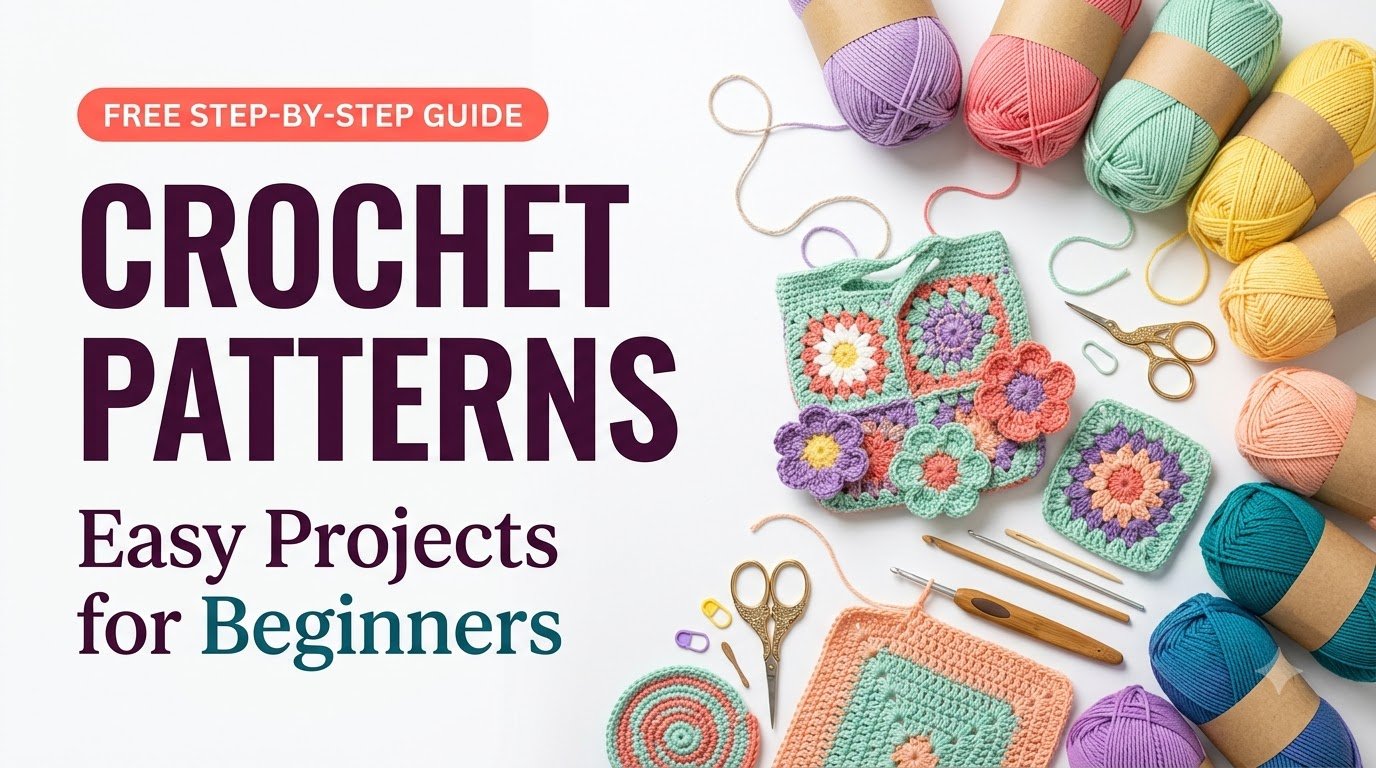
Discover easy crochet patterns for beginners, free step-by-step tutorials, stitch guides, yarn tips, and beautiful DIY projects you can start today.
Crochet Patterns Made Easy: Beautiful Beginner Projects, Free Tutorials & Creative Ideas
One hook. One ball of yarn. A world of things you can make.
Discover easy crochet patterns, learn essential stitches, and make your first practical handmade project using our free step-by-step guide. Whether you want a cozy blanket, a stylish tote, or a thoughtful gift, your crochet journey starts here.
You don’t need expensive equipment, years of experience, or a perfectly organized craft room to start crocheting. You need a hook, yarn, a little patience, and instructions that explain what to do next.
That’s where a well-written crochet pattern makes all the difference. Instead of guessing how many stitches to make or when to turn your work, you follow a repeatable roadmap. Once you understand the basic language, the possibilities expand quickly—from small accessories to larger handmade home decorations.
This guide brings together beginner-friendly crochet pattern ideas, helpful supplies and techniques, a complete free coaster pattern, common mistake fixes, and advice on finding printable PDF crochet patterns that are actually worth using.
What Is a Crochet Pattern?
A crochet pattern is a set of instructions explaining how to create an item with yarn and a crochet hook. It usually specifies the required materials, hook size, stitch abbreviations, starting foundation, row or round instructions, and finishing techniques.
Some patterns also include stitch diagrams, progress photographs, charts, measurements, and instructions for changing the finished size.
Why Crochet Is a Great Creative Hobby for Beginners
Crochet can be delightfully simple. You build fabric one stitch at a time, and you can see your progress as rows accumulate. A small project also gives you a chance to practice a technique without committing to weeks of work.
- Accessible supplies: Many simple projects require only yarn, a hook, and scissors.
- Flexible project sizes: Start with a coaster or bookmark before making a blanket.
- Creative freedom: Experiment with colors, textures, shapes, and personal gifts.
- Repeatable skills: The stitches learned in one project often apply to dozens of others.
- Portable creativity: Compact projects can travel with you when it is practical to crochet.
Many people also find repetitive crafting enjoyable and calming. Experiences differ, though, and crochet should be viewed as a creative pastime rather than a treatment for stress or a medical condition.
Essential Crochet Supplies: What Do You Really Need?
| Supply | Beginner Recommendation | Why It Matters |
|---|---|---|
| Crochet hook | 5 mm (US H/8) as a useful starting option | Comfortable for practicing with many medium-weight yarns. |
| Yarn | Medium #4, smooth and light-colored | Makes individual stitches easier to identify. |
| Scissors | Small sharp craft scissors | For trimming yarn tails. |
| Yarn needle | Blunt tapestry needle | For weaving loose ends into finished work. |
| Stitch markers | Removable markers | Help identify edge stitches and important positions. |
| Measuring tape | Flexible tape | Useful for checking width, length, and gauge. |
Not every medium-weight yarn works identically with a 5 mm hook. Yarn texture, fiber, hook shape, and personal tension all affect your stitches. The yarn label and your pattern’s recommended gauge are more useful than treating one hook size as a universal rule.
How to Read Crochet Patterns Without Feeling Confused
Crochet patterns look technical because designers use abbreviations instead of writing every stitch instruction as a full sentence. Learning a handful of terms removes much of the mystery.
Basic Crochet Abbreviations: US Terminology
| Abbreviation | Meaning | Typical Use |
|---|---|---|
| ch | Chain | Starting foundation and turning chains |
| sc | Single crochet | Dense and sturdy fabric |
| hdc | Half double crochet | Moderately tall stitches |
| dc | Double crochet | Taller stitches and more open fabric |
| sl st | Slip stitch | Joining and moving between positions |
| st / sts | Stitch / stitches | Stitch counting |
| rep | Repeat | Repeating instructions |
| inc | Increase | Adding stitches |
| dec | Decrease | Reducing stitches |
| BLO | Back loop only | Creating ridged fabric |
| RS / WS | Right side / wrong side | Identifying fabric faces |
Important: UK crochet terms differ from US terms. A US single crochet is called a UK double crochet. Check which system a pattern uses before beginning.
How to Make the Three Starter Movements
- Slip knot: Form a loop and pull a bight of yarn through it. Place the adjustable loop on your hook and gently tighten.
- Chain stitch (ch): Yarn over the hook and pull the yarn through the loop already on the hook. Repeat to make a foundation chain.
- Single crochet (sc): Insert the hook into the indicated stitch, yarn over and pull up a loop, yarn over again, then pull through both loops on the hook.
Example: How to Understand a Pattern Row
Understanding Yarn Weight, Hook Size and Gauge
Yarn weight refers to thickness, not necessarily how heavy the entire ball of yarn feels. Common categories include fine, light, medium, bulky, and super bulky.
Gauge describes how many stitches and rows fit within a measured area of your crocheted fabric. For fitted garments and size-sensitive projects, it matters enormously. If your stitches are bigger than the pattern designer’s, the finished piece may be wider or longer.
To check gauge, work a swatch larger than the specified measuring area, lay it flat without stretching, then count stitches and rows over the requested distance. Try a different hook size if needed.
For an informal coaster, small size differences may be acceptable. For a sweater, hat, or wearable item, following gauge instructions helps prevent disappointing sizing errors.
Free Crochet Pattern: Easy Textured Coaster for Beginners
Ready to make something useful? This simple single-crochet coaster gives you an opportunity to practice foundation chains, consistent stitch counts, turning your work, and finishing yarn ends.
Free Original Practice Pattern
The Everyday Crochet Coaster
A compact square-style coaster with simple rows and a softly textured handmade appearance. Make one as a practice project or create a coordinated set in your favorite colors.
Materials
- Small amount of smooth medium-weight cotton yarn
- 5 mm crochet hook, or a size that produces a comfortable fabric
- Scissors and yarn needle
- Optional removable stitch marker
Pattern Notes
Instructions use US terms. Turning chains do not count as stitches. Keep your tension comfortably even without pulling the yarn too tightly.
Step-by-Step Instructions
- Foundation: Make a slip knot and chain 16.
- Row 1: Single crochet in the second chain from the hook, then single crochet in every remaining chain. You will have 15 stitches.
- Row 2: Chain 1 and turn. Work one single crochet in each of the 15 stitches across.
- Rows 3–15: Repeat Row 2. Keep checking that each row contains 15 stitches.
- Check the shape: Measure your fabric. If the coaster is not approximately square, add or omit a row or two until the proportions look balanced.
- Fasten off: After your final stitch, cut the yarn leaving a tail. Pull the tail completely through the remaining loop and gently tighten.
- Finishing: Thread the yarn tail through a tapestry needle and weave it back and forth discreetly through several stitches. Repeat for the starting tail.
Optional Variations
- Change yarn color between rows to create simple stripes.
- Use two complementary colors for a matching coaster set.
- Add more rows for a rectangular design.
- Practice a larger version as a small table mat.
What did this project teach you? You now know how to read simple instructions, build a flat fabric, count stitches, turn at row ends, and secure loose yarn tails. Those skills appear in many beginner scarves, dishcloths, blankets, and bags.
12 Beautiful Crochet Pattern Ideas to Try Next
After completing a practice coaster, the most rewarding next step is choosing something that feels useful or personally exciting. The best project is not necessarily the most elaborate one—it is a project you feel motivated to finish.
1. Crochet Dishcloth
A practical way to practice even rows, edges, and absorbent cotton yarn. A beginner-friendly first household accessory.
2. Simple Crochet Scarf
A longer project that reinforces repetition, tension, and confidence while creating a wearable accessory.
3. Granny Square
Learn clustered stitches, corners, and working in rounds. Squares can later be joined into blankets or bags.
4. Crochet Tote Bag
Explore stronger stitches, straps, and construction techniques. Choose a structured pattern with clear sizing notes.
5. Crochet Baby Blanket
A thoughtful larger project that practices stitch repetition. Choose suitable washable fibers and follow infant safety guidance.
6. Crochet Bucket Hat
Practice increasing in rounds, crown shaping, and fitting. Gauge becomes especially important.
7. Crochet Flower
A small decorative project for practicing joining, working into spaces, and shaping petals.
8. Crochet Bookmark
A quick project ideal for practicing neat edges and thinner yarn when you are ready.
9. Amigurumi Animal
Discover three-dimensional crochet through small stuffed shapes, increases, decreases, and spiral rounds.
10. Crochet Cushion Cover
Create personalized home décor while learning to join panels and finish a larger project.
11. Crochet Headband
Try simple ribbed textures and learn why stretch and finished measurements matter.
12. Crochet Market Bag
Practice open mesh fabric, reinforced straps, and yarn selection for carrying everyday items.
Choosing a Crochet Pattern by Skill Level
| Skill Level | Best Projects | Skills to Develop |
|---|---|---|
| Absolute beginner | Coasters, dishcloths, scarves | Chains, single crochet, turning |
| Confident beginner | Granny squares, headbands, simple blankets | Double crochet, repeats, joining |
| Intermediate | Bags, hats, fitted accessories | Shaping, working in rounds, gauge |
| Experienced | Complex garments, lace, advanced amigurumi | Construction, intricate stitch combinations |
Free Crochet Patterns vs Paid PDF Patterns: Which Is Better?
Free patterns are an excellent introduction to crochet. They allow you to practice different stitches, discover designers you enjoy, and try project styles without buying a large library.
A paid crochet pattern can be worth considering when it provides additional convenience or detailed guidance, such as printable instructions, charts, organized photography, variations, or designer support.
| Feature | Free Online Pattern | Paid Pattern PDF |
|---|---|---|
| Access cost | Typically free | One-time purchase or bundle |
| Print-friendly layout | Varies by website | Often available |
| Step-by-step images | Varies | Varies; check listing |
| Pattern variations | Depends on designer | May offer more options |
| Support and updates | Designer dependent | Designer dependent |
| License to sell finished items | Check terms | Check terms |
Before purchasing a pattern, look for a sample page, clear finished measurements, yarn requirements, skill level, stitch terminology, and the designer’s usage policy. Detailed product information is far more useful than an impressive cover image alone.
Make Your Next Crochet Project Easier to Plan
Prefer organized, printable instructions? Explore beginner-friendly crochet pattern collections and choose a project that matches your experience, tools, and creative goals.
Explore Digital Idea ToolReplace this general website link with your verified crochet product or collection page when available.
7 Common Crochet Mistakes and How to Fix Them
1. Your Project Keeps Getting Wider
Extra stitches are often added near the beginning or end of a row. Count stitches every few rows and use a marker to identify the final stitch.
2. Your Edges Look Uneven
Make sure you work into the correct first and last stitches. Follow the pattern’s rule about whether the turning chain counts as a stitch.
3. Your Foundation Chain Is Too Tight
Try relaxing your grip or using a slightly larger hook for the foundation chain, then return to your planned hook size for the remaining rows.
4. Your Fabric Feels Too Stiff
The hook may be too small for the yarn, or your tension may be tight. Test a larger hook and compare the resulting fabric.
5. Your Finished Item Is the Wrong Size
Check gauge, yarn thickness, hook size, and stitch counts. Even if you follow the correct number of rows, different tension can change the final dimensions.
6. You Lose Track of Rows
Use a row counter, a paper checklist, or a simple note on your phone. Mark each row immediately after finishing it.
7. Loose Ends Come Out After Washing
Weave yarn tails securely through the fabric in more than one direction when appropriate for the fiber and project. Follow the yarn manufacturer’s laundering directions.
How to Select High-Quality Crochet Pattern PDFs
A beautiful image may attract you to a pattern, but the instructions determine whether the experience is enjoyable. Before purchasing or downloading, check the following:
- Does the listing clearly state the crochet skill level?
- Are US or UK stitch terms identified?
- Does it specify the required yarn, hook, and additional materials?
- Are finished dimensions and gauge included where relevant?
- Are photographs, diagrams, or video links available for challenging steps?
- Does the listing explain the file type and download process?
- Are seller contact information, licensing terms, and refund rules clear?
For downloadable patterns, look for an accessible, readable layout that works on both mobile devices and printable paper. A well-structured PDF should allow you to find the materials list and the relevant row without excessive scrolling.
Can You Sell Items Made From Crochet Patterns?
In many places, selling a handmade item created from a pattern can be legally distinct from copying or redistributing the written pattern itself. However, copyright, contract terms, trademarks, licensing rules, and product safety requirements can vary by jurisdiction and product type.
Always review the designer’s usage terms. Do not assume that buying a PDF allows you to resell its photographs, charts, written instructions, or original files. For commercial work, use original product photographs and verify applicable labeling, tax, and consumer protection requirements.
How to Build a Simple Weekly Crochet Practice Routine
You don’t need an ambitious schedule to improve. Consistent small projects and repetition can help you develop more reliable stitches.
| Day | Practice | Goal |
|---|---|---|
| Day 1 | Slip knots and chains | Build comfortable hook control |
| Day 2 | Single crochet rows | Practice consistent stitch counts |
| Day 3 | Start a coaster | Apply foundation and turning skills |
| Day 4 | Finish the coaster | Practice fastening off and weaving ends |
| Day 5 | Learn half double crochet | Expand your stitch vocabulary |
| Day 6 | Make a color swatch | Experiment with stitch texture |
| Day 7 | Review and choose a project | Plan a realistic next step |
How to Make Your Crochet Projects Look More Professional
Presentation starts long before the finished photograph. Focus on matching yarn with the project, counting accurately, maintaining comfortable tension, and weaving ends neatly.
If your chosen fiber supports it, gentle blocking can help even out the shape of finished fabric. Follow the yarn’s care instructions and avoid applying excessive heat, particularly to heat-sensitive synthetic fibers.
When photographing finished work, use indirect natural light or soft studio lighting, a clean background, and a close-up that reveals stitch detail. If you sell handmade products, show accurate dimensions and colors rather than relying only on heavily edited promotional photographs.
Test Your Skills: 5 Crochet Quiz Flashcards
You’ve learned the basics. Now challenge yourself with five quick crochet questions. Open each card to reveal the answer, then decide which topic you want to practice again.
Flashcard 1 — What does “sc” stand for in US crochet patterns?
Answer: Single crochet. It is a basic stitch commonly used for sturdy, closely spaced fabric.
Flashcard 2 — What happens if you accidentally add an extra stitch every row?
Answer: The fabric usually becomes wider or develops uneven edges as the stitch count increases.
Flashcard 3 — What is crochet gauge?
Answer: The number of stitches and rows within a specified measurement. It helps control the finished size.
Flashcard 4 — What does “ch 1, turn” mean?
Answer: Make one chain stitch and turn your work to begin the next row. Whether the chain counts as a stitch depends on the pattern.
Flashcard 5 — Why should a beginner check US and UK stitch terms?
Answer: Some stitch names have different meanings. For example, US single crochet corresponds to UK double crochet.
Frequently Asked Questions About Crochet Patterns
1. What is the easiest crochet pattern for an absolute beginner?
A square coaster, dishcloth, or simple scarf using single crochet is a practical starting point. These projects introduce chains, rows, counting, and finishing without complex shaping.
2. What size crochet hook should a beginner use?
A 5 mm (US H/8) hook is a popular starting option with many medium-weight yarns. However, always check the yarn label and pattern recommendation because hook size depends on yarn and desired fabric.
3. How long does it take to learn basic crochet stitches?
Learning time varies. Some beginners become comfortable with chains and single crochet after a few short sessions, while others need more practice. Regular repetition and clear instructions are more important than speed.
4. Are free crochet patterns as useful as paid patterns?
Yes, free crochet patterns can be excellent learning resources. Paid PDF patterns may offer additional convenience, detailed instructions, and printable layouts, but quality depends on the individual designer.
5. Can I sell handmade items created from crochet patterns?
Sometimes, depending on applicable law, the pattern’s terms, and the product being sold. Creating a finished item is different from reproducing or reselling the pattern PDF. Review the designer’s terms and relevant legal and product safety requirements before selling.
Your Next Crochet Project Begins With One Stitch
Every experienced crocheter once had to learn how to hold a hook, count stitches, and recognize the loops in a row. What makes crochet rewarding is not completing everything perfectly. It’s watching an ordinary strand of yarn become something practical and personal.
Start with the free coaster pattern in this guide. Learn how your yarn behaves, practice your tension, and make notes about what worked. Then return for the stitch guide or explore a more ambitious project such as a granny square, blanket, or handmade bag.
The most satisfying crochet pattern is the one that inspires you to keep creating.
Find Your Next Creative Project
Looking for organized digital craft resources, creative guides, and printable project ideas? Explore Digital Idea Tool and discover resources that can support your next handmade adventure.
Explore Creative Resources →Have a question or a project suggestion? Share it in the comments. Save this guide and return whenever you’re ready to learn another stitch.
Compliance & Important Information
Educational purposes: This article provides general crafting education and a beginner practice pattern. Project measurements and results vary according to yarn, hook, tension, and experience.
Copyright and licensing: Respect individual designers’ copyright and licensing terms. Do not reproduce or redistribute third-party pattern files or photographs without appropriate authorization.
Product safety: Crochet hooks, sharp scissors, small embellishments, loose fibers, and detachable components may present hazards to young children. Supervise children appropriately. For products intended for infants or children, review applicable safety rules; avoid loose or detachable decorative parts and do not place soft handmade items in an infant’s sleep space.
Commercial disclosure: Some links may lead to paid products. Add an accurate affiliate disclosure near any affiliate links if applicable. Clearly describe product contents, pricing, licensing, download requirements, and refund policies before purchase.
Results: No particular learning speed, finished appearance, sales outcome, or search engine ranking is guaranteed.
Publisher: Digital Idea Tool | digitalideatool.com
📝 Key Takeaways & Action Notes
Jot down insights, next steps, or thoughts from this post. Your notes save automatically in your browser.
- What is the #1 breakthrough insight you took away today?
- What is one concrete action you will take in the next 24 hours?
- What questions or ideas do you want to research further?
Stay ahead with exclusive updates
Join our community. Get curated industry trends, actionable guides, and fresh resources delivered straight to your inbox.