Some of the best digital product ideas are not hiding inside a brainstorming session, a complicated keyword tool, or a viral social media trend.
They are already sitting in your inbox.
They appear in customer emails, support tickets, live chat conversations, comments, product reviews, refund requests, sales questions, community discussions, and messages from people who are almost ready to buy but still need help.
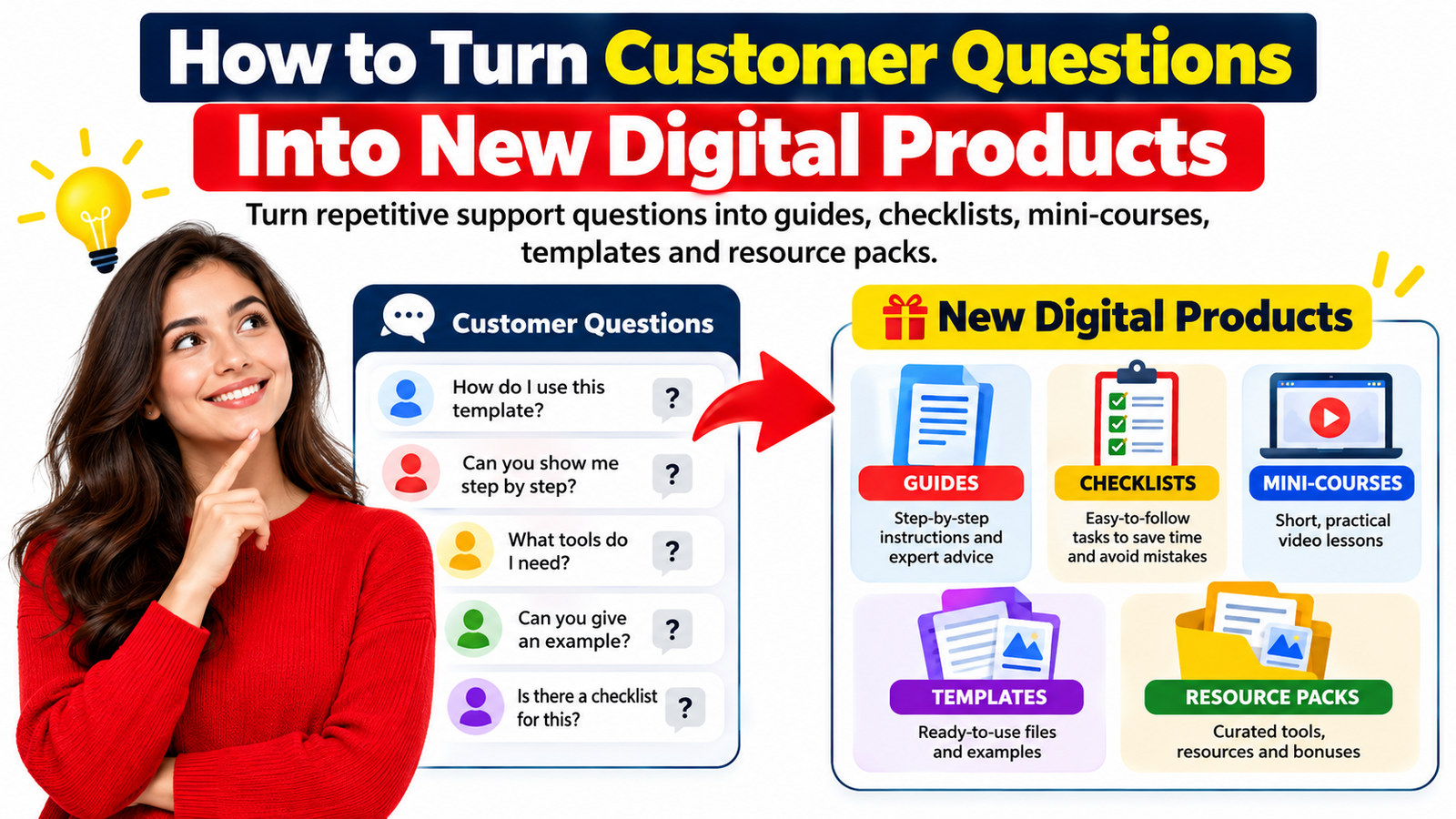
A customer who asks, “How do I use this template?” may be giving you an idea for a quick-start guide.
Someone who asks, “Can you show me how to do this step by step?” may be describing your next mini-course.
Ten buyers asking for the same workflow could be pointing toward a checklist, workbook, template pack, resource library, or premium digital bundle.
This is one of the most practical approaches to digital product creation ideas because it replaces guessing with evidence.
Instead of asking, “What digital product should I create?” you begin asking a more useful question:
What problem are my customers repeatedly asking me to solve?
That shift can help you build customer driven products, improve existing offers, create additional revenue opportunities, reduce repetitive support work, and ultimately create products customers want because the ideas come directly from real customer needs.
Your Customer Support Inbox Is Really a Product Research Database
Most businesses treat customer questions as individual support problems.
A customer asks something. You answer it. The conversation ends.
But repeated questions are different.
When different customers keep asking variations of the same thing, you are no longer looking at an isolated support request. You are looking at a pattern.
Patterns reveal friction.
Friction reveals unmet needs.
And unmet needs can become valuable digital products.
Imagine that you sell social media templates. Customers regularly ask how to choose the right template for different types of posts.
You could continue answering that question individually.
Or you could create a “30-Day Social Media Content Planning Guide” explaining which templates to use for educational posts, promotions, testimonials, engagement posts, launches, and announcements.
One customer question has suddenly become a potential product.
The important principle is simple:
Do not only answer customer questions. Study them.
Every question can tell you something about what customers do not understand, what they are trying to accomplish, what is slowing them down, and what they may be willing to pay to solve faster.
Why Customer Questions Produce Strong Digital Product Creation Ideas
Traditional product brainstorming often begins with the seller.
“What can I make?”
“What am I good at?”
“What is popular?”
“What can I sell quickly?”
Customer-driven product development starts from the opposite direction.
It begins with demand.
“What are people struggling with?”
“What do they repeatedly ask?”
“What outcome are they trying to reach?”
“What information, system, tool, or shortcut would make that outcome easier?”
This approach does not guarantee that every question will become a profitable product. It does, however, give you stronger evidence than creating products entirely from assumptions.
A repeated question can reveal three valuable things at once: there is a recognizable problem, people care enough about the problem to ask for help, and your existing audience already associates you with the subject.
That is a useful foundation for creating a new offer.
Start Collecting Questions Instead of Relying on Memory
One of the easiest mistakes is assuming you will remember the questions customers ask most often.
You probably will not.
Questions arrive through different channels and at different times. One customer emails you today. Another leaves a comment next week. A third sends almost the same question through social media a month later.
Unless you collect those questions in one place, the pattern may remain invisible.
Create a simple customer-question database using a spreadsheet, note-taking application, CRM, support platform, or project-management tool.
For every useful question, record the original question, the product or service involved, what the customer was trying to accomplish, how often similar questions appear, whether the problem occurs before or after purchase, and what solution you provided.
Do not overcomplicate the system.
Your goal is simply to turn scattered conversations into searchable customer research.
After collecting questions for several weeks, you may discover that five apparently different questions are really versions of the same underlying problem.
That underlying problem is usually more valuable than the exact wording of any single question.
Look for the Problem Behind the Question
Customers do not always tell you exactly what product they need.
They describe symptoms.
Suppose someone asks:
“How do I edit this?”
Another person asks:
“What software do I need?”
A third asks:
“Can I customize the colors?”
A fourth asks:
“Why does the file look different after I open it?”
These may appear to be four separate questions.
But the underlying issue could be:
Customers need beginner-friendly instructions for editing and customizing the product.
That insight could become a downloadable setup guide, video tutorial series, customization workbook, beginner mini-course, or expanded resource pack.
Learning to identify the deeper problem is an important part of customer driven product development.
Do not build a product around the words people use. Build it around the outcome they want.
Turn Simple Questions Into Practical Guides
Guides are one of the easiest products to create from repeated customer questions.
They work especially well when customers need explanation, education, examples, or a clear process.
Imagine that customers repeatedly ask how to launch their first digital product.
Instead of answering with another short email, you could develop a guide covering product selection, audience research, file preparation, pricing, product descriptions, previews, licensing information, delivery, customer support, and launch preparation.
A helpful guide organizes scattered knowledge into a logical path.
That organization itself has value.
People are often not paying only for information. They are paying for clarity, convenience, structure, and the ability to reach an outcome without searching through dozens of disconnected resources.
A strong guide therefore should not merely explain a subject. It should help the reader move from uncertainty to action.
Turn Repetitive Processes Into Checklists
Some customer questions are not really requests for more information.
They are requests for reassurance.
“Have I completed everything?”
“What should I check before uploading?”
“What files should be included?”
“What do I need before launching?”
“What should I send to my customer?”
These questions are ideal candidates for checklists.
Checklists work because they turn a complicated process into visible, manageable steps.
If customers regularly ask how to prepare a digital product before publishing, for example, you could create a Digital Product Launch Checklist covering file names, download testing, licensing information, product images, descriptions, pricing, FAQs, support instructions, backup copies, and delivery links.
A checklist may be shorter than a guide, but that does not automatically make it less useful.
Customers often value a simple resource that saves time and prevents mistakes more than a long document they never finish reading.
Turn “Show Me How” Questions Into Mini-Courses
Pay close attention whenever customers use phrases such as:
“Can you show me?”
“Can I see an example?”
“Can you explain the process?”
“Is there a tutorial?”
“Where do I start?”
Those questions often indicate that written information alone may not be enough.
A short mini-course can provide demonstrations, examples, screen recordings, exercises, walkthroughs, and explanations that are difficult to communicate through a single PDF.
For example, suppose you sell editable business templates and customers continually ask how to customize them professionally.
That question could become a mini-course covering brand colors, typography, logo placement, image selection, page consistency, exporting files, and preparing finished documents.
The course does not have to contain 50 lessons.
A focused course solving one specific problem can be more attractive than a massive course trying to cover everything.
The stronger offer is usually the one with the clearest transformation.
Turn “Can You Give Me an Example?” Into Templates
Questions asking for examples are particularly valuable.
They often indicate that the customer understands the theory but struggles with execution.
A business owner may understand that an email welcome sequence is important but still ask, “What should I actually write?”
That could become an email template pack.
A content creator may know they need a monthly content plan but ask, “What should I post every day?”
That could become a content calendar.
A freelancer may understand client onboarding but ask, “What documents should I send?”
That could become an onboarding template bundle.
Templates reduce blank-page anxiety.
They give customers a starting point they can adapt instead of forcing them to create everything from scratch.
That is why template-based offers can be powerful digital product creation ideas when the customer problem involves implementation rather than education alone.
Turn Scattered Questions Into Resource Packs
Sometimes customers ask many related questions around one larger goal.
Where can I find suitable tools?
What resources should I use?
Which file types work?
Where can I get images?
Which software is beginner friendly?
What should I prepare first?
Instead of creating six separate products, you may be able to combine the answers into a focused resource pack.
A resource pack could include reference guides, worksheets, checklists, recommended resources, planning documents, templates, examples, trackers, glossaries, and quick-start instructions.
The key is coherence.
Do not add files simply to make the bundle appear larger.
Every component should help the buyer achieve the central outcome.
A smaller, carefully organized resource library can provide more practical value than a huge collection of unrelated files.
Measure Frequency, Frustration and Commercial Intent
Not every repeated question deserves a paid product.
Some questions should simply become better product instructions or a clearer FAQ.
To identify stronger product opportunities, look at the intensity of the problem.
Frequency matters because repeated questions can indicate broader demand.
Frustration matters because customers are more motivated to solve problems that waste time, cause mistakes, create confusion, delay progress, or cost money.
Commercial intent matters because some questions reveal that customers actively want a faster solution.
For example, “What does PNG mean?” may be best answered in a FAQ.
But “Can you give me a complete system for organizing 5,000 digital files so I can actually find and sell them?” may justify a larger paid product consisting of a folder structure, naming system, inventory spreadsheet, quick-start guide, and video training.
The difference is not simply the number of words required to answer the question.
It is the value of solving the problem.
Pay Attention to Questions Asked Before Purchase
Pre-sale questions are especially useful because they reveal what customers need before they feel comfortable buying.
People might ask:
“Is this beginner friendly?”
“What software do I need?”
“Can I use this commercially?”
“What exactly is included?”
“Can I customize it?”
“Will this work with my platform?”
These questions can improve your current sales page, but they may also reveal new product opportunities.
For instance, repeated beginner-level questions may suggest demand for a starter edition.
Questions from advanced customers may reveal demand for a professional version.
Questions about licensing may suggest a licensing guide.
Questions about implementation may suggest an onboarding kit or training course.
Customer conversations can therefore help you develop both better products and better positioning.
Study Post-Purchase Questions for Expansion Products
Questions asked after the sale can be even more valuable.
A customer has already trusted you enough to buy something. Their next question often reveals what they need in order to get greater value from the purchase.
Imagine selling a collection of spreadsheet templates.
Customers then begin asking how to choose the correct spreadsheet, customize formulas, create dashboards, organize monthly records, or combine several sheets into one workflow.
Those questions could lead to an Excel tutorial, customization guide, financial dashboard pack, business tracking system, or advanced spreadsheet course.
This creates a natural product ladder.
Your original product solves the first problem.
The next product solves the problem that appears after the first one has been solved.
Instead of inventing random upsells, you build the next offer around the customer’s actual journey.
Use Refund Requests as Product Research
Refund requests and complaints are uncomfortable, but they can contain some of the most useful product research you receive.
A customer might say the product was too complicated, required software they did not have, contained too many files, lacked instructions, or did not explain where to begin.
The correct response is not always to create another product.
Sometimes the existing product simply needs to be improved.
However, repeated requests for additional help can expose opportunities.
If buyers repeatedly struggle with organization, create a navigation guide.
If they struggle with implementation, create a quick-start system.
If beginners feel overwhelmed while experienced users want greater depth, consider creating separate beginner and advanced versions.
Customer feedback becomes much more valuable when you stop treating negative comments only as criticism and start studying what they reveal about the customer experience.
Convert One Question Into Multiple Product Formats
A useful customer problem can often support several formats.
Suppose customers frequently ask:
“How do I organize hundreds of digital products?”
The basic solution could become a short PDF guide.
The step-by-step process could become a checklist.
The system itself could become a folder-structure template.
The management process could become an inventory spreadsheet.
A demonstration could become a mini-course.
Examples and supporting tools could become a resource pack.
Eventually, those products might be combined into a premium digital-product organization bundle.
This approach lets you serve people with different budgets and learning preferences without repeatedly searching for completely new topics.
The same underlying customer problem becomes an ecosystem of products.
Validate the Idea Before Building the Full Product
Customer questions provide evidence, but validation is still important.
Before investing heavily in a large course or bundle, test the concept with the smallest useful version.
You might publish an article about the problem, create a short free checklist, send the topic to your email subscribers, ask existing customers which part is most difficult, create a low-cost starter resource, or offer a limited early version.
Watch what happens.
Do people click?
Do they download?
Do they reply?
Do they ask follow-up questions?
Do customers purchase the small version?
Do they request a more complete solution?
Those signals can help you determine whether to expand the idea.
The goal is not to eliminate all uncertainty. No validation method can guarantee sales.
The goal is to reduce unnecessary guessing.
Use Customer Language in Your Product Positioning
Customer questions do more than provide product ideas.
They also provide marketing language.
A creator might describe a product as:
“An advanced modular productivity framework for digital entrepreneurs.”
Customers may actually be asking:
“How do I keep all my digital product files organized?”
The customer’s version is usually clearer.
Collect the exact phrases customers use to describe their frustrations, goals, questions, and desired results.
Then use those insights when developing your product title, description, landing page, FAQs, articles, email campaigns, and social content.
Do not manufacture pain points your audience has never expressed.
Reflect genuine customer needs in language readers immediately understand.
This can strengthen both SEO and conversion because people frequently search using the same natural questions they ask businesses directly.
Turn Support Questions Into SEO Content Before Turning Them Into Products
Not every useful question has to become a paid product immediately.
Some should first become search-focused articles.
A detailed customer question can make an excellent long-tail SEO topic because people outside your existing customer base may be searching for the same answer.
For example, customer questions such as “How do I organize a large digital bundle?”, “What information should a digital product listing include?” or “How do I preview a digital product without giving everything away?” can become useful educational articles.
Those articles can attract relevant readers and then naturally introduce the related guide, checklist, template, course, or resource pack.
This creates a simple content-to-product pathway:
A customer asks a question.
You publish the useful answer.
Searchers discover the answer.
The article helps them understand the problem.
Your digital product helps them implement the solution.
The content is useful independently, while the paid product provides additional convenience, depth, tools, or implementation support.
Build Topic Clusters Around Real Customer Problems
One strong customer problem can support an entire content cluster.
Suppose your audience wants help starting a digital product business.
You could create separate articles covering product research, file organization, product descriptions, pricing, licensing, digital delivery, product previews, customer support, FAQs, and launch preparation.
Each article solves a specific question while contributing to a larger topic.
A related guide, template pack, course, or resource library can then serve readers who want a complete system.
This is much stronger than publishing disconnected articles simply because random keywords appear popular.
Google’s current guidance continues to emphasize helpful, reliable, people-first material that provides substantial value and demonstrates real knowledge of the topic.
Combine Customer Research With Search Research
Customer questions show you what your audience wants.
Search research can help reveal how broadly people are searching for similar problems.
Use both.
Take a recurring customer question and research related search terms, autocomplete suggestions, long-tail queries, community discussions, competitors’ content gaps, and relevant trend data.
Google Trends can also help you understand whether interest in a topic is rising, seasonal, regional, or relatively stable.
But avoid chasing unrelated trending subjects merely because they have search volume.
A better strategy is to identify current interest that overlaps naturally with your existing audience and expertise.
That approach supports both customer relevance and long-term authority.
Design Products Around Outcomes, Not File Counts
Digital sellers sometimes focus too heavily on quantity.
“500 templates.”
“2,000 prompts.”
“10,000 resources.”
Large collections can be useful, but quantity alone does not guarantee value.
Customers usually care more about what the product helps them accomplish.
Compare these two concepts:
“100 Business Worksheets”
and
“Small Business Launch Workbook: Plan Your Offer, Pricing, Customer Profile and 30-Day Launch”
The second concept communicates an outcome.
When converting customer questions into products, start with the transformation and work backward.
What should the customer be able to do after using the product?
What obstacle should be removed?
What decision should become easier?
What time-consuming process should become faster?
Once the desired result is clear, include only the materials necessary to support it.
Create a Simple Customer-Question-to-Product Workflow
Whenever a question appears repeatedly, capture it.
Then identify the deeper problem behind the question.
Determine whether the issue requires information, organization, implementation, demonstration, examples, or a collection of resources.
Information-heavy problems are often suitable for guides.
Process-heavy problems can become checklists or workbooks.
Demonstration-heavy problems may work well as mini-courses.
Implementation problems can become templates.
Problems requiring several supporting tools can become resource packs.
Next, validate the concept with actual customers or a smaller version.
Finally, build the simplest product capable of delivering the desired outcome.
This workflow prevents product development from becoming an endless brainstorming exercise.
Your audience effectively becomes an ongoing source of product research.
Create a Customer Question Score
As your database grows, you may collect more opportunities than you can realistically pursue.
A simple scoring process can help.
Consider how frequently the question appears, how frustrating the problem is, how closely it matches your expertise, whether customers already spend money solving similar problems, how clearly you can define the outcome, and whether the solution fits your existing product ecosystem.
Do not automatically choose the idea with the highest search volume.
A smaller but highly relevant problem from your existing customers can sometimes make more commercial sense than a huge broad topic where you have little authority or audience connection.
Use Your Existing Products to Discover Your Next Products
Your first digital product does not have to be perfect.
It can become a research tool.
Once real buyers begin using it, observe what happens.
What do they understand immediately?
Where do they become confused?
What feature do they request?
What do they want to do next?
Which part takes them too long?
What additional example would help them?
What do experienced users request that beginners do not?
Those answers can guide your next product.
A template can lead to a tutorial.
A tutorial can lead to a course.
A course can lead to a workbook.
A workbook can lead to a professional toolkit.
A toolkit can lead to a membership or resource library.
Your product catalog grows around the customer journey rather than around random product ideas.
Customer Questions Can Also Improve Free Resources
Turning customer questions into products does not mean putting every answer behind a paywall.
Some questions should become free FAQs, onboarding instructions, troubleshooting information, blog posts, videos, or product documentation.
Providing good free answers can reduce support volume and increase trust.
Paid products should normally provide something beyond the basic answer: deeper instruction, reusable tools, structured implementation, organized templates, demonstrations, examples, convenience, or a complete system.
That distinction is important.
Customers should not feel that essential instructions have been deliberately removed from a product so they can be sold separately.
Instead, your paid resource should genuinely extend the value of the original offer.
How This Strategy Can Reduce Customer Support Work
Creating resources from repetitive questions can benefit the business even when the new resource is free.
Suppose your team answers the same setup question 30 times every month.
A clear visual setup guide may eliminate many of those conversations.
A video walkthrough may solve another group of questions.
A searchable knowledge base can handle basic troubleshooting.
A paid advanced training product can support customers who want deeper help.
This allows customer support and product development to reinforce each other.
Support identifies repeated friction.
Content solves common issues.
Products solve deeper needs.
New customer questions reveal the next opportunities.
You create a continuous learning system rather than treating support and product creation as separate activities.
Make the Article and Product Discover-Friendly Without Chasing Clicks
Strong SEO does not require exaggerated headlines.
In fact, Google’s current Discover guidance recommends headlines that capture the essence of the content while avoiding misleading clickbait and sensational tactics. Google also says Discover may favor content connected to current interests, strong storytelling, or unique insights.
For an article like this, originality can come from your own customer-question data, examples, screenshots, case studies, workflows, templates, or first-hand observations.
That gives readers something they cannot obtain from a generic summary.
Visual presentation also matters. Google recommends relevant, compelling Discover images that are at least 1200 pixels wide, exceed 300,000 total pixels, and work well at a 16:9 aspect ratio. The max-image-preview:large setting can enable large image previews. Google also says schema.org markup or og:image can help indicate a preferred representative image.
For article pages, Article or BlogPosting structured data can help Google better understand details such as the article headline, author, date, and representative image. Google recommends relevant, crawlable high-resolution images and supports providing multiple aspect ratios such as 16:9, 4:3, and 1:1.
These practices can improve eligibility and presentation, but they do not guarantee Google Search or Discover rankings.
Build What Customers Are Already Asking For
You do not always need another brainstorming session to discover your next digital product.
Start listening more carefully to the questions already reaching you.
One repeated question may become a guide.
Another may become a checklist.
A request for demonstrations may become a mini-course.
A request for examples may become a template.
A cluster of related questions may become a resource pack.
And a large recurring problem may eventually become an entire product line.
The biggest advantage of this approach is not simply that it gives you more digital product creation ideas.
It brings customers into the product-development process.
Instead of creating something first and desperately trying to convince people they need it, you begin with demonstrated needs and develop solutions around them.
If you want to create products customers want, your support conversations, customer comments, reviews, sales questions, and feedback are some of the most valuable research sources available to you.
Start with one simple exercise today: review your most recent customer conversations and identify the question you have answered more than once.
That question may already contain the idea for your next digital product.
Questions and Answers
1. How can customer questions help me find digital product creation ideas?
Customer questions reveal real problems, uncertainties, desired outcomes, and obstacles. When the same question appears repeatedly, it can indicate a broader need. You can convert that need into a guide, checklist, template, workbook, mini-course, tutorial, or resource pack rather than relying entirely on assumptions about what customers might want.
2. How many customers need to ask a question before I create a product about it?
There is no universal number. Frequency is only one signal. Also consider how serious the problem is, whether customers actively seek a solution, whether similar audiences experience the same issue, and whether people already spend money addressing it. Validate promising ideas before investing heavily in production.
3. What types of customer questions make the best customer driven products?
Questions connected to repeated frustration, confusing processes, time-consuming tasks, implementation difficulties, missing examples, desired shortcuts, and clear outcomes often provide strong opportunities. Questions such as “How do I do this?”, “Can you give me a template?”, “Can you show me an example?” and “Is there an easier way?” are particularly useful signals.
4. Should I charge customers for answers to common support questions?
Basic instructions necessary to use a product should generally remain part of good customer support or product documentation. A paid product should provide additional value such as deeper training, reusable templates, advanced workflows, demonstrations, structured implementation tools, resource collections, or a complete system.
5. What is the easiest way to start creating products customers want?
Begin by collecting customer questions from email, support tickets, reviews, social media messages, comments, sales conversations, and existing product feedback. Group similar questions together, identify the underlying problem, choose the simplest useful format, validate the concept, and create a focused solution around one clear customer outcome.
Stay ahead with exclusive updates
Join our community. Get curated industry trends, actionable guides, and fresh resources delivered straight to your inbox.