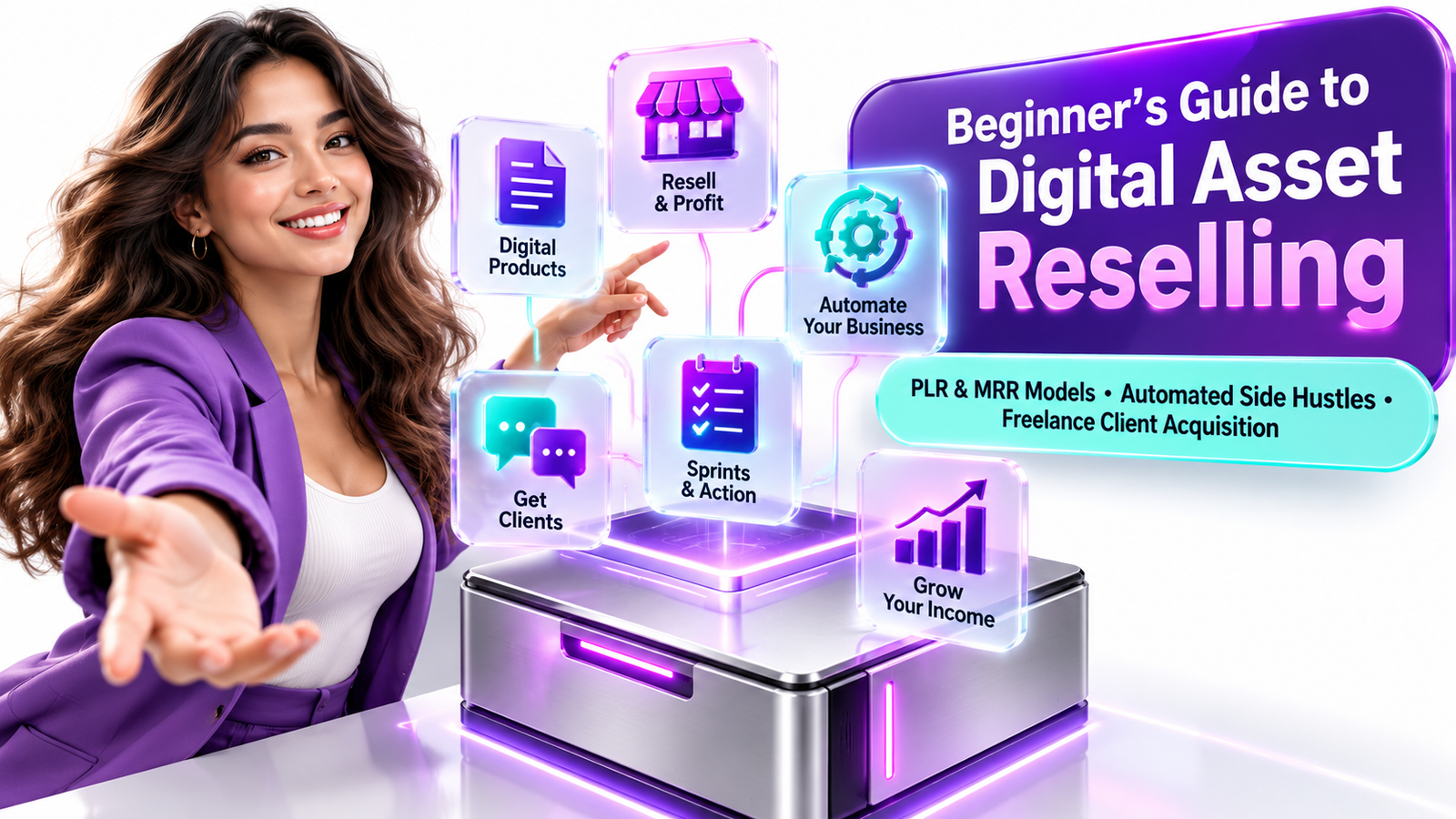
Digital Asset Reselling, Automated Side Hustles & Freelance Client Acquisition: A Beginner’s Guide
Learn how beginners can resell PLR and MRR digital products, build an automated side hustle, and use a practical freelance client acquisition sprint to create multiple online income opportunities.
Starting an online side hustle used to mean choosing between two difficult options: spend months creating a product from scratch or compete endlessly for freelance projects.
That is changing.
Digital products, PLR and MRR licensing models, AI-assisted workflows, simple automation tools, and specialized freelance services are giving beginners more ways to enter the digital economy without building an enormous business on day one.
The important word, however, is system.
Buying a folder filled with PLR products does not automatically create a business. Opening a freelance profile does not automatically attract clients. Connecting a few automation tools does not automatically produce passive income.
Successful beginners learn how to connect three activities:
Acquire useful digital assets → turn them into valuable offers → build repeatable systems for reaching buyers or clients.
This guide explains how those pieces can work together.
Why Digital Assets, Freelancing and Automation Fit Together
A traditional side hustle often depends directly on your time. You work another hour and earn another hour’s worth of income.
Digital assets can change part of that equation.
An eBook, planner, business template, checklist, workbook, prompt collection or educational resource can potentially be delivered repeatedly without manually recreating the product after every purchase.
Freelancing works differently. You sell a skill or outcome to a client.
Instead of viewing these as competing business models, beginners can use them together.
A freelance designer could sell social-media design services while also developing editable template packs. A virtual assistant could provide client services and later create workflow checklists. A marketing freelancer could customize properly licensed PLR resources into lead magnets, educational bundles or supporting materials where the license permits it.
Current freelance-market signals make this combination particularly relevant. Upwork’s 2026 research says businesses continue hiring for established capabilities such as graphic design, virtual assistance, data analytics and development while increasingly layering AI skills onto traditional work. Its 2026 Future Workforce Index also reported that 38% of skilled workers in its research were freelancing, compared with 28% in 2025.
The opportunity is therefore not simply “use AI” or “sell digital products.”
It is learning how to combine useful skills, intellectual property, distribution and efficient systems.
What Is Digital Asset Reselling?
Digital asset reselling involves obtaining legitimate rights to a digital product and selling, modifying or redistributing that product according to its license.
Examples can include eBooks, printable planners, worksheets, Canva templates, business documents, training resources, prompt libraries, graphics and other downloadable products.
Two terms frequently appear in this market: PLR and MRR.
What Is PLR?
PLR generally means Private Label Rights.
Depending on the exact license, PLR may allow you to modify a product, redesign it, add your branding, change portions of the content and sell your resulting version.
That flexibility can make good PLR useful as raw material.
Instead of staring at a blank page, you begin with an existing framework and improve it.
But there is an important rule:
PLR rights are not universal.
One supplier may permit extensive editing while another prohibits particular distribution methods. Some licenses may restrict marketplace sales, membership use, free giveaways, source-file distribution or transferring resell rights to another person.
Always read the license attached to the specific product you purchase.
What Is MRR?
MRR generally means Master Resell Rights.
An MRR license may permit you to sell the product and, where specifically authorized, allow your customers to obtain certain resale rights as well.
Again, the exact rights depend on the license.
Do not assume that the letters “MRR” give unlimited rights to edit, repackage, give away or sublicense a product.
A legitimate digital-product business begins with understanding exactly what you are legally permitted to do.
The Biggest Beginner Mistake With PLR and MRR
The easiest strategy is also usually the weakest:
Buy a generic bundle, upload everything unchanged and wait for sales.
That creates several problems.
Other sellers may have exactly the same files. Product descriptions can look identical. Covers may be outdated. Information may no longer be accurate. Customers have little reason to choose your version over dozens of competing versions.
A stronger mindset is:
Don’t simply resell files. Build a better customer solution.
Imagine you purchase properly licensed PLR material about personal budgeting.
Instead of uploading the original eBook untouched, you might verify and update the information, rewrite confusing sections, redesign the workbook, add a budget calculator, create a 30-day challenge and package everything around a specific audience such as first-time freelancers.
The underlying asset becomes an ingredient rather than the entire offer.
That creates differentiation.
A Simple Digital Asset Reselling Model for Beginners
Begin with one narrow problem.
Not “business.”
Not “health.”
Not “productivity.”
Something more specific, such as:
“Weekly content planning for solo consultants.”
“Simple household budgeting for new couples.”
“Client onboarding for beginner freelancers.”
“Meal planning for busy professionals.”
Specific problems make product positioning easier because the customer can immediately understand who the product is designed for.
Next, research what the audience actually needs.
Look at customer questions, marketplace reviews, community discussions, search suggestions and competitor offers. Pay particular attention to complaints.
Customers will often tell you exactly what competing products are missing.
Then acquire or create a digital asset that solves part of that problem.
If you use PLR or MRR, verify the license before doing anything else. Keep a copy of the license and purchase documentation.
Improve the product significantly where permitted.
Add original examples. Improve formatting. Correct outdated material. Build additional worksheets. Create clearer instructions. Develop a stronger product identity.
Finally, create the sales system around the asset.
Your landing page should answer four questions quickly:
What is this?
Who is it for?
What problem does it help solve?
What exactly does the buyer receive?
Clarity usually converts better than exaggerated promises.
Build a Value Stack Instead of Selling a Lonely File
A single PDF can be useful.
A coordinated solution often feels more valuable.
For example, a freelance-startup package might contain an introductory guide, client questionnaire, discovery-call worksheet, proposal template, onboarding checklist and follow-up tracker.
The important principle is not adding random files merely to advertise a huge product count.
Every component should move the customer closer to the intended outcome.
That is the difference between a file bundle and a product system.
What an Automated Side Hustle Actually Means
“Automated income” is one of the most abused phrases in online business.
Automation does not mean earning money without creating value or maintaining the business.
A better definition is:
Automation removes repetitive manual steps from a functioning business process.
A basic digital-product workflow might operate like this:
Traffic reaches a useful article or social post. A visitor downloads a free resource or visits a sales page. Payment software processes the transaction. The product is delivered automatically. An email sequence explains how to use it. Follow-up emails introduce complementary products. Customer questions are routed into an organized support system.
You still need marketing, product improvement, customer support, compliance and analysis.
But you no longer need to manually email every download or individually process every ordinary transaction.
That is useful automation.
The Beginner Automation Stack
Do not begin with fifteen applications.
Begin with the smallest system capable of completing the customer journey.
You generally need a storefront or checkout mechanism, a reliable digital-delivery method, an email platform, an analytics system and somewhere to organize customer support and business records.
Only add automation when a repetitive task becomes noticeable.
For example, if purchasers repeatedly receive the same onboarding information manually, automate the onboarding email.
If you spend hours transferring leads between tools every week, automate the transfer.
If something happens twice a month, complicated automation may save less time than it costs.
Automation should reduce operational friction, not become another hobby.
Why Freelancing Can Accelerate the Side-Hustle Model
Digital products have an attractive advantage: scalability.
Freelancing has another advantage: immediate market feedback.
Talking directly with clients teaches you what businesses are willing to pay to solve.
Suppose you offer Pinterest design services.
After working with ten customers, you discover that almost every small business owner struggles with planning content before the design stage.
That repeated problem could eventually inspire a planning template, content workbook or educational product.
Freelancing becomes market research.
Digital products turn repeated knowledge into reusable intellectual property.
Automation allows you to distribute that knowledge more efficiently.
That is a powerful cycle.
What Freelance Services Are Worth Exploring in 2026?
Avoid chasing every fashionable skill.
Current market data suggests businesses still value fundamental execution while increasingly looking for professionals who know how to integrate AI into real workflows.
Upwork’s August 2026 hiring insights highlighted growing interest in AI automation and AI-assisted video work, while its broader 2026 research continues to show demand for established areas such as design, virtual assistance, analytics and development.
For beginners, the lesson is important:
You do not necessarily need to become an advanced AI engineer.
A graphic designer can become better at AI-assisted production.
A virtual assistant can learn workflow automation.
A video editor can incorporate AI-assisted editing.
A marketer can learn AI-supported research while remaining responsible for strategy, fact-checking and judgment.
Clients ultimately purchase outcomes.
Technology is part of how you produce them.
The 10-Day Freelance Client Acquisition Sprint
If you have been “preparing to freelance” for months without contacting potential customers, use a short execution sprint.
- Day 1 — Choose one service and one customer type. Replace “I do digital marketing” with something concrete such as “I create short-form video packages for local fitness brands.”
- Day 2 — Define your outcome. Explain what your service helps the client achieve rather than simply listing software you know.
- Day 3 — Build one strong sample. If you have no client portfolio, create a clearly labeled demonstration project showing the quality and thinking behind your work.
- Day 4 — Create a simple offer. Define the deliverables, scope, turnaround expectations, revision policy and price or pricing method.
- Day 5 — Build a prospect list. Find businesses that genuinely fit the service rather than sending hundreds of random messages.
- Day 6 — Research prospects. Identify a visible problem, opportunity or gap for each high-priority prospect.
- Day 7 — Send personalized outreach. Keep the message short. Mention the relevant observation, explain your solution and suggest an easy next step.
- Day 8 — Publish proof of expertise. Share a useful mini-case study, tutorial, audit, before-and-after demonstration or practical insight related to your service.
- Day 9 — Follow up professionally. Many prospects are busy rather than uninterested. Send a concise follow-up that provides additional value without pressuring them.
- Day 10 — Review the numbers. Measure prospects researched, messages sent, replies, qualified conversations, proposals and closed projects. Improve the weakest stage and repeat the sprint.
The purpose of a client-acquisition sprint is not to guarantee a contract in ten days.
Its purpose is to transform vague ambition into measurable activity.
Stop Selling Skills and Start Selling Outcomes
Compare these two offers.
“I do graphic design.”
“I create branded social-media content systems for independent coaches who need a consistent month of content without designing every post themselves.”
The second is easier to understand.
Clients rarely wake up thinking, “I need somebody who knows six software applications.”
They think:
I need more leads.
My website looks outdated.
Publishing content takes too long.
Our videos need professional editing.
Our admin workflow is disorganized.
Translate your skill into one of those business problems.
A Simple Outreach Formula
Good outreach should feel researched rather than mass-produced.
Start with relevance.
Explain why you contacted this particular person or business.
Then identify a genuine opportunity.
Briefly describe how you could help.
Provide appropriate evidence—a sample, portfolio item, observation or relevant experience.
End with a low-friction invitation to continue the conversation.
Do not pretend you performed extensive research when you did not. Do not manufacture compliments. Do not send a six-paragraph biography to a prospect who has never heard of you.
Specificity builds credibility.
How AI Fits Into the Model
AI can dramatically improve speed, but speed without judgment creates mediocre businesses faster.
Use AI to assist with activities such as brainstorming product angles, organizing research, generating initial outlines, summarizing customer feedback, exploring headline variations, categorizing leads, preparing first-pass workflows and generating ideas for repurposing content.
Then apply human judgment.
Check facts.
Verify licenses.
Rewrite generic material.
Protect confidential client information.
Remove fabricated claims.
Make the output useful.
This matters increasingly as clients become more sophisticated about AI-enabled work. Upwork’s recent research suggests demand is moving toward professionals who can integrate AI into actual business processes rather than simply demonstrate that they can use an AI tool.
The competitive advantage is not pressing the AI button.
It is knowing what should happen before and after the button is pressed.
Create an Income Ladder, Not a Single Product
A resilient side hustle can eventually contain several levels.
Your free educational content attracts attention.
A free checklist or resource can turn interested visitors into email subscribers.
An affordable digital product gives the audience a low-risk way to experience your work.
A larger bundle solves a deeper problem.
A freelance or consulting service provides individualized implementation.
The exact structure depends on your business, but the principle remains powerful:
Different customers want different levels of support.
Someone may gladly purchase a $15 template but never hire a consultant.
Another person may download your checklist, discover that implementation is difficult and then hire you.
Your digital products and services can support each other.
Use Content as Your Long-Term Acquisition Engine
A storefront alone rarely creates consistent visibility.
Educational content gives potential customers a reason to discover you before they are ready to buy.
Instead of publishing endless promotional posts, answer specific questions your target customer is already asking.
For example:
Rather than writing “Buy My Freelance Template Bundle,” publish an article explaining how a freelancer can build a client onboarding process.
Then introduce your relevant template naturally.
The content delivers value even if the reader never purchases anything.
That people-first approach is also consistent with Google’s current Search guidance, which emphasizes content created primarily to help an intended audience rather than pages produced primarily to manipulate rankings.
SEO, GEO and AEO for Digital Side-Hustle Content
Modern content discovery extends beyond inserting a target keyword into a page.
SEO helps search engines discover and understand your content.
AEO, or answer-engine optimization, focuses on making information easy to extract and understand as direct answers.
GEO, often described as generative-engine optimization, emphasizes creating clear, authoritative and well-structured material that can be understood in AI-driven discovery environments.
The fundamental strategy remains remarkably human:
Answer real questions clearly.
Use descriptive headings.
Explain unfamiliar terms.
Provide practical examples.
Support factual statements.
Demonstrate experience or expertise when you have it.
Update outdated information.
Avoid unsupported income promises.
A beginner searching “how to sell PLR products legally” wants a straightforward explanation of licensing, not 800 words designed to delay the answer.
Give readers the answer first and then deepen their understanding.
Designing This Topic for Google Discover
There is no legitimate way to guarantee a Google Discover ranking.
Google’s documentation emphasizes useful, people-first content and relevant, compelling imagery rather than a secret Discover keyword formula. Google currently recommends large Discover images that are at least 1,200 pixels wide, high resolution, suitable for landscape presentation and enabled through max-image-preview:large or AMP. Google also notes that a representative large image can be specified using schema markup or og:image.
For this article, a strong featured-image concept could show a modern creator workspace connecting three visual ideas: a digital product storefront, an automated workflow and freelance client communication.
Keep it original and visually representative of the actual article.
Avoid sensational imagery implying instant wealth, piles of cash or unrealistic overnight success.
Google’s Article and BlogPosting structured-data documentation also recommends providing useful article details such as the headline, author and representative images. For image coverage, Google recommends high-resolution alternatives in 16:9, 4:3 and 1:1 aspect ratios where practical.
Metrics Beginners Should Actually Watch
Revenue matters, but it should not be your only metric.
For digital products, monitor how visitors reach the page, sales-page conversion, email sign-ups, refund requests, support questions and which products create repeat purchases.
For freelancing, monitor targeted prospects contacted, response rate, qualified conversations, proposal rate, closing rate, average project value and repeat-client activity.
These numbers expose the actual bottleneck.
If nobody visits your offer, changing the checkout button will not solve the problem.
If hundreds visit but nobody buys, traffic may not be your biggest problem.
If prospects reply but nobody books, examine your offer and sales conversations.
Business becomes easier to improve when you measure stages rather than emotions.
Common Reasons Beginners Fail
One reason is product hoarding.
They collect thousands of PLR files but never build one polished offer.
Another is automation addiction.
They spend weeks connecting tools before making their first sale.
Another is generic positioning.
They offer “everything for everyone” and become memorable to nobody.
Another is mass outreach.
Sending hundreds of irrelevant messages damages trust rather than building a pipeline.
Another is ignoring licensing.
A profitable-looking product is worthless if you do not possess the necessary rights to distribute it as intended.
Finally, many beginners quit before accumulating enough evidence to know what should be changed.
Build small.
Measure.
Improve.
Repeat.
A Practical Three-Engine Business Model
A useful beginner business can eventually operate through three connected engines.
Engine One: Service
Use freelancing to generate cash flow, develop expertise and discover real customer problems.
Engine Two: Assets
Turn repeatable knowledge into original or properly licensed digital products, templates, systems and educational resources.
Engine Three: Distribution
Use useful articles, email, search visibility, social content, referrals and partnerships to bring relevant people into the business.
Automation connects the engines.
But value powers them.
That distinction matters.
Frequently Asked Questions
1. Can beginners really make money reselling PLR or MRR digital products?
They can build a legitimate business using properly licensed digital products, but purchasing PLR or MRR does not guarantee sales. Results depend on factors such as product quality, licensing rights, differentiation, positioning, audience demand, pricing, marketing and customer experience. Treat PLR as business material that may need improvement rather than a shortcut to guaranteed income.
2. What is the difference between PLR and MRR?
PLR, or Private Label Rights, typically provides certain modification or branding permissions. MRR, or Master Resell Rights, may allow resale and may permit customers to receive specified resale rights. However, there is no universal license covering every PLR or MRR product. Read the exact licensing agreement supplied with each asset before editing, selling, distributing or sublicensing it.
3. How much money do I need to start an automated digital side hustle?
You can begin relatively lean because digital businesses may not require inventory, warehousing or physical shipping. Your actual expenses can include products or content creation, a domain, storefront, email software, payment processing, design resources and advertising. Start with only the tools necessary to validate the offer before investing heavily in automation.
4. How can a beginner get their first freelance client?
Choose one defined service for one identifiable customer group, create credible sample work, identify businesses with a genuine need and contact them with personalized messages focused on their problem. Track your outreach and follow up professionally. Referrals, freelance marketplaces, professional networks and useful educational content can complement direct prospecting.
5. Is an automated side hustle really passive income?
Usually not in the literal sense. Digital delivery, email sequences and routine processes can be automated, but product businesses still require customer acquisition, maintenance, support, financial administration, compliance, optimization and occasional product updates. A more accurate goal is leveraged income with fewer repetitive manual tasks, not income requiring no work.
Build One Small System That Can Grow
You do not need 1,000 digital products.
You do not need 50 services.
And you certainly do not need an enormous automation system before you have customers.
Start with one audience.
Identify one valuable problem.
Create or properly acquire one useful asset.
Turn it into a differentiated offer.
Choose one service you can confidently deliver.
Contact real prospects.
Create useful content around the problems your audience is already trying to solve.
Automate repetitive processes only after the underlying process makes sense.
The biggest advantage available to a beginner is not having the largest PLR library, the most advanced AI subscription or the fanciest sales funnel.
It is becoming consistently useful.
Build a useful product.
Provide a useful service.
Publish useful information.
Listen to customers.
Then transform what works into a repeatable system.
Choose one product idea or one freelance service today and give yourself seven days to produce something that can be shown to a real potential customer. Do not spend the week building a perfect business. Build the smallest credible offer, put it in front of the market and use the response to decide what to improve next.
Stay ahead with exclusive updates
Join our community. Get curated industry trends, actionable guides, and fresh resources delivered straight to your inbox.