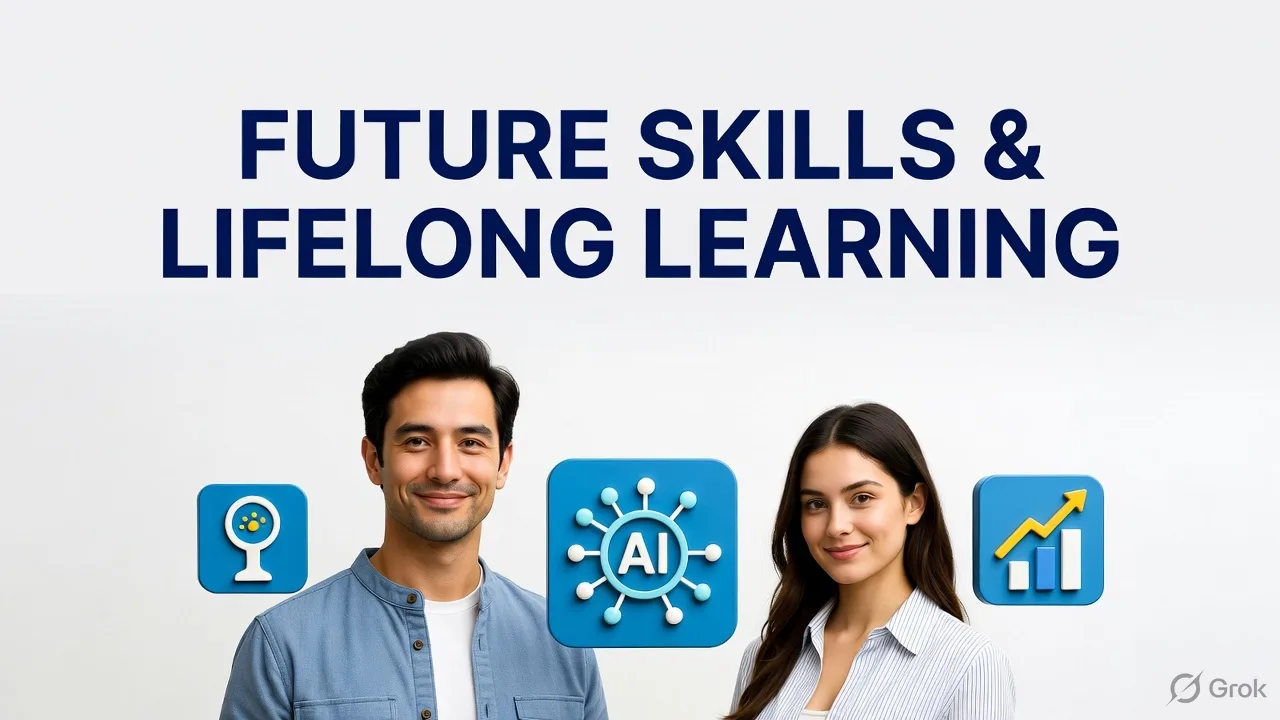
Discover how to identify high-value future skills, optimize retention, leverage AI, and turn self-education into sustainable career and business success.
Mastering Artificial Intelligence
Your quick-start guide to AI literacy across career, productivity, and modern business.
Why Do I Need to Learn This?
AI fundamentally reshapes daily life, careers, and business, making AI literacy essential for remaining competitive, relevant, and highly productive in a technology-driven world.
What Should I Learn First?
Start with core concepts: generative AI basics, practical prompt engineering, and everyday tools like ChatGPT to build foundational intuition.
How Can I Start Learning as a Complete Beginner?
Take free introductory courses on Coursera, YouTube, or DeepLearning.AI while actively experimenting with user-friendly web interfaces.
What Is the Best Way to Learn Quickly and Effectively?
Adopt a project-first mindset by applying AI immediately to solve personal routines, automate chores, or streamline daily tasks.
Which Skills Should I Focus on First?
Focus on prompt crafting, critical evaluation of AI outputs, workflow automation, and basic data literacy.
How Much Time Should I Spend Learning Every Day?
Dedicate a focused 30 to 45 minutes daily to ensure steady, cumulative retention without burnout.
What Are the Most Common Mistakes Beginners Should Avoid?
Avoid passively watching endless tutorials, blindly trusting unverified AI “hallucinations,” and skipping hands-on practice.
How Can I Practice and Improve My Skills?
Build micro-projects like automated email sorters, personal study assistants, or data summarizers using platforms like Make or Zapier.
How Can I Use What I Learn in Real Life and My Future Career?
Deploy AI to automate repetitive workflows, draft business communications, analyze market data, and scale your professional output.
Mastering New Skills & Growth
A strategic framework to learn faster, overcome plateaus, and turn modern abilities into career opportunities.
How Will I Know When I Have Mastered a Skill?
You have achieved mastery when you can instinctively solve complex, novel problems, teach the core concepts clearly to others, and produce consistent, high-quality results without relying on guides.
What Are the Benefits of Learning This Skill?
It broadens your creative problem-solving capacity, increases your market value, boosts career autonomy, and future-proofs your ability to adapt to fast-evolving industries.
Where Can I Find the Best Free Learning Resources?
Top free resources include university open courseware (like MIT OpenCourseWare and Harvard Online), comprehensive YouTube tutorials, GitHub repositories, free tiers on Coursera and edX, and official technical documentation.
How Can I Create a Step-by-Step Learning Plan?
Deconstruct the primary skill into modular sub-skills, sequence them logically from foundational to advanced, attach measurable milestone projects to each stage, and set realistic completion deadlines.
What Tools and Resources Do I Need to Get Started?
You only need a dedicated computer with a stable internet connection, an organized workspace, note-taking software (such as Notion or Obsidian), and the primary open-source software or platforms standard to that skill.
How Can I Stay Motivated While Learning Something New?
Tie your study sessions to exciting, tangible outcomes rather than abstract theory, celebrate small wins, establish an accountability partner, and remind yourself regularly of your overarching goals.
How Can I Overcome Difficulties During the Learning Process?
Break intimidating roadblocks into bite-sized components, consult community forums like Reddit or Stack Overflow, use targeted AI prompts for alternate explanations, and step away briefly to let diffuse thinking take over.
How Can I Measure My Learning Progress and Improvement?
Track your advancement through finished real-world projects, benchmark your time-to-completion on standard tasks, take periodic objective assessments, and compare your current output against your day-one attempts.
What Daily Habits Can Help Me Learn Faster?
Practice active recall and spaced repetition daily, build a habit of teaching what you learn through notes or blogs, maintain 30–60 minutes of uninterrupted focus, and prioritize restorative sleep for memory consolidation.
How Can I Turn My New Skills into Career or Business Opportunities?
Build a public portfolio showcasing end-to-end case studies, share your learning journey on LinkedIn or X, solve real problems as an open-source contributor or freelancer, and network within relevant niche communities.
Strategic Skill Acceleration
A pragmatic roadmap to master in-demand abilities, eliminate distractions, and assemble high-impact portfolios.
Why Is Learning This Skill Important for My Future?
High-leverage skills increase your professional adaptability, protect you against technological displacement, and open higher-earning opportunities in an evolving economy.
How Can I Learn This Skill Without Spending Money?
Leverage comprehensive open-courseware, official software documentation, community-built GitHub guides, and high-quality YouTube lectures before investing in paid programs.
What Are the Essential Concepts Every Beginner Should Understand?
Focus on first principles: foundational terminology, core operational workflows, standard industry tools, and how individual components connect into a complete system.
How Can I Build Confidence While Learning a New Skill?
Set tiny, achievable daily milestones, document every completed task, and immediately build simple, functional projects rather than getting stuck in passive tutorial loops.
What Is the Difference Between Beginner, Intermediate, and Advanced Learning?
Beginners follow step-by-step instructions to reproduce known outputs, intermediates troubleshoot errors and combine tools independently, and advanced learners design novel solutions, optimize complex architectures, and establish best practices.
How Can I Apply My Knowledge to Solve Real-World Problems?
Identify manual, inefficient processes in your daily routine or local community, break them down systematically, and deploy your skills to build practical, automated, or streamlined solutions.
Which Learning Methods Produce the Best Long-Term Results?
Project-based learning paired with active recall, spaced repetition, and the Feynman technique (explaining concepts in plain language to others) delivers the highest long-term retention.
How Can I Avoid Distractions and Stay Focused While Learning?
Use dedicated 25- to 50-minute focused sprint intervals (Pomodoro technique), keep a single browser tab open, place your phone out of reach, and define your exact practice deliverable before sitting down.
How Can I Build a Portfolio to Showcase My New Skills?
Create 3 to 5 polished case studies hosted on a personal website or GitHub, each detailing the problem, your step-by-step methodology, the tools used, and the measurable end result.
Personal Growth & Career Scaling
Turn your self-education into financial independence, digital assets, and an adaptable career roadmap.
How Can I Transform My Learning into Personal Growth, Financial Independence, and Long-Term Success?
Apply your new competencies to build high-margin assets, negotiate higher compensation, and solve scalable market problems that generate recurring value.
How Can I Identify My Strengths and Weaknesses Before Learning a New Skill?
Conduct a personal SWOT audit, review past project performance, take objective diagnostic tests, and gather candid feedback from peers and mentors.
What Are the Biggest Challenges I Might Face While Learning?
The primary hurdles include cognitive overload, imposter syndrome, inconsistent motivation, the dreaded intermediate plateau, and lack of structured feedback loops.
How Can I Use Artificial Intelligence (AI) to Learn Faster and Smarter?
Use AI as an on-demand Socratic tutor to summarize complex papers, generate practice drills, debug code, and explain difficult concepts at multiple comprehension levels.
How Can I Develop Creative Thinking and Problem-Solving Skills Through Learning?
Combine principles across unrelated domains (first-principles thinking), reverse-engineer successful case studies, and continuously practice solving ambiguous problems with deliberate constraints.
What Practical Projects Should I Complete to Gain Real-World Experience?
Build end-to-end applications that solve personal workflow bottlenecks, redesign broken public platforms, contribute to active open-source projects, or execute pro-bono client work.
How Can I Balance Learning with My Daily Life, Work, and Personal Responsibilities?
Block non-negotiable 30- to 60-minute daily deep-work windows, habit-stack learning with passive chores via audio, and ruthlessly eliminate low-value screen time.
How Can I Find Mentors, Experts, and Learning Communities to Guide Me?
Engage actively on technical Discord servers, specialized Subreddits, and GitHub discussions, and offer value first before seeking advice from industry leaders on LinkedIn or X.
How Can I Keep My Knowledge and Skills Updated in a Rapidly Changing World?
Curate a lean feed of top industry newsletters, follow core repository release notes, practice continuous unlearning, and spend a few hours weekly auditing emerging tools.
How Can I Turn My Learning Experience into a Digital Product, Online Business, or Passive Income Opportunity?
Document your step-by-step transformation into modular digital guides, workflow templates, curated toolkits, or cohort-based workshops sold to beginners following in your footsteps.
How Can I Create a Long-Term Learning Roadmap for Future Career Growth and Success?
Map backwards from your five-year target role, identify high-demand evergreen skills, divide them into quarterly milestone sprints, and schedule annual roadmap audits.
Future Skills & Lifelong Learning
A practical framework to predict high-value capabilities, build robust learning systems, and create powerful skill stacks.
How Can I Discover Which Skills Will Be Most Valuable in the Next 5–10 Years?
Analyze macroeconomic labor reports from institutions like the World Economic Forum, track venture capital flows, review rising job board keywords, and identify automated tasks versus irreplaceable human strengths.
What Questions Should I Ask Myself Before Starting a New Learning Journey?
Ask: “Does this align with my long-term career goals?”, “What tangible output proves I know this?”, “Do I have 30–60 minutes daily?”, and “What low-priority habit will I sacrifice to make room?”
How Can I Develop Self-Discipline and Consistency to Achieve My Learning Goals?
Rely on systems over fleeting motivation by anchoring study sessions to existing daily routines (habit stacking), minimizing friction in your workspace, and tracking non-negotiable daily streaks.
How Can I Learn from Successful People and Apply Their Strategies to My Own Growth?
Study their early bios and failures rather than just their current wins, reverse-engineer their core decision-making frameworks, and test their specific daily operating habits in your own context.
What Are the Best Ways to Remember, Understand, and Retain New Information?
Combine active recall flashcards, spaced repetition schedules (like Anki), and the Feynman Technique—distilling concepts into simple terms without jargon as if teaching a beginner.
How Can I Use Digital Tools, Online Courses, and Smart Technology to Improve My Learning Experience?
Use personal knowledge management software (Obsidian, Notion) as a “second brain,” employ AI conversational tutors for real-time Socratic quizzing, and curate project-based online courses rather than passive lectures.
How Can I Build a Personal Learning System That Matches My Goals, Interests, and Lifestyle?
Design a sustainable loop: choose one primary focus topic quarterly, set clear 30-minute calendar blocks matching your peak energy hours, and centralize all notes and practice tasks into a single dashboard.
How Can I Turn My Mistakes and Failures into Valuable Learning Opportunities?
Run unemotional “post-mortems” after setbacks: document the failure, isolate whether the root cause was knowledge gap or poor execution, adjust your process, and immediately re-test.
How Can I Combine Multiple Skills to Create Unique Career, Freelancing, or Business Opportunities?
Build a “skill stack” by pairing a technical capability (such as data analysis or coding) with creative storytelling, sales, or niche domain expertise to stand out in the top 1% intersection.
How Can I Become a Lifelong Learner and Stay Competitive in the Future Digital Economy?
Treat your brain like updating operating software: normalize regular “unlearning,” embrace deliberate experimentation with new technologies every month, and stay persistently curious about adjacent disciplines.
Personal Learning Strategy & Growth
A pragmatic roadmap to choose your path, execute 30-day challenges, and build sustainable routines.
How Can I Choose the Right Learning Path Based on My Age, Experience, and Future Goals?
Conduct an honest assessment of your current baseline, align target skills with where you want to be in 3–5 years, and choose paths that leverage your existing strengths while minimizing unnecessary friction.
What Are the Most Effective Ways to Learn a Difficult Skill from Scratch?
Deconstruct the complex skill into core fundamentals (first principles), focus on the 20% of sub-skills that deliver 80% of practical utility, and build tiny functional projects immediately.
How Can I Create a 30-Day Learning Challenge to Build Knowledge and Confidence?
Define one tangible deliverable for day 30, break the curriculum into daily 30- to 45-minute practice tasks, track streaks visually, and share your daily progress publicly or with an accountability partner.
How Can I Use Real-Life Examples and Case Studies to Understand Complex Topics?
Dissect real-world successes and post-mortems of failures to reverse-engineer why specific strategies worked, linking theoretical models to concrete commercial or operational outcomes.
What Are the Best Strategies for Learning Independently Without a Teacher or Mentor?
Rely on official technical documentation, cross-reference high-quality open-source code or projects, consult community forums like Reddit or GitHub, and use AI as an interactive Socratic tutor.
How Can I Develop Critical Thinking and Better Decision-Making Skills Through Learning?
Consistently ask “What are the second-order consequences?”, challenge baseline assumptions, examine contradictory viewpoints, and conduct quick pre- and post-mortems on decisions.
How Can I Test My Knowledge and Identify Areas That Need Improvement?
Use active recall tests, explain core concepts in basic terms using the Feynman Technique, and attempt to build a project or solve an unexpected problem without looking at reference guides.
How Can I Turn My Learning Goals into Daily Actions and Measurable Achievements?
Translate high-level milestones into daily, non-negotiable time blocks (e.g., 40 minutes at 7:00 AM), define exact daily deliverables (e.g., “write 20 lines of code”), and log completed tasks weekly.
How Can I Use My New Skills to Improve My Lifestyle, Productivity, and Personal Happiness?
Automate repetitive administrative chores, solve personal bottlenecks with custom workflows, and build creative work that fosters autonomy and a sense of progress.
How Can I Build a Sustainable Learning Routine That Supports Personal Development, Career Advancement, and Long-Term Success?
Anchor study sessions to existing daily rituals, schedule periodic rest to prevent burnout, and treat continuous learning as a lifelong system rather than an exhausting, temporary sprint.
Passion to High-Value Mastery
A structured blueprint to discover your genuine interests, execute a 90-day mastery plan, and monetize practical expertise.
How Can I Find My True Interests and Choose Skills That Match My Passion?
Audit your curiosity by observing what topics you naturally read about in your free time, run low-friction 1- to 2-week mini-experiments across different disciplines, and select the skill where you genuinely enjoy the daily practice—not just the end title.
Why Is Practical Experience More Important Than Theoretical Knowledge in Some Skills?
Theory only explains how systems should behave in ideal conditions, whereas real execution develops muscle memory, intuition for troubleshooting edge-case errors, and the cognitive flexibility required to deliver reliable results under constraints.
How Can I Break Down a Complex Subject into Simple, Easy-to-Learn Steps?
Deconstruct the broad subject into first principles, identify the vital 20% of foundational components that drive 80% of actual utility, sequence them in chronological order, and attach a distinct micro-deliverable to each step.
What Are the Best Techniques for Learning Faster Without Feeling Overwhelmed?
Limit your focus to a single core topic at a time, implement short 25- to 35-minute focused sprints (Pomodoro method), eliminate passive tab-switching, and immediately build toy projects to turn cognitive load into muscle memory.
How Can I Use Feedback and Self-Assessment to Improve My Learning Performance?
Establish strict objective benchmarks against standard work, request targeted critique from senior practitioners on specific friction points rather than general impressions, and log recurring errors in an audit notebook.
How Can I Build a Growth Mindset and Overcome the Fear of Learning Something New?
Reframe beginner confusion as biological proof that new neural pathways are forming, decouple your personal self-worth from early failures, and view mistakes as neutral diagnostic data rather than permanent lack of ability.
How Can I Create a Personalized 90-Day Action Plan to Master a New Skill?
Dedicate Month 1 to foundational principles and guided exercises, Month 2 to building an independent end-to-end milestone project with community feedback, and Month 3 to polishing, stress-testing, and publishing a real-world case study.
What Are the Best Ways to Connect My Learning with Real-World Opportunities and Industry Needs?
Monitor open job board requirements and freelance briefs to spot unmet operational bottlenecks, contribute directly to active open-source repositories, and tailor your portfolio projects to solve documented business problems.
How Can I Teach Others What I Have Learned to Strengthen My Own Knowledge?
Apply the Feynman Technique by drafting plain-language guides or recording brief walk-throughs for complete novices; stripping out jargon instantly exposes the hidden gaps in your own comprehension.
How Can I Transform My Knowledge and Skills into a Meaningful, Successful, and Financially Rewarding Future?
Combine your technical skill with clear communication, solve expensive problems for businesses or communities, package your methodologies into scalable assets, and build a public track record that attracts compounding opportunities over time.
Strategic Skill Acceleration
A pragmatic blueprint to target essential capabilities, build practical experience, and future-proof your career.
How Can I Identify the Most Important Skills I Need to Achieve My Personal and Professional Goals?
Work backward from your ideal 3- to 5-year target position: analyze senior job descriptions, consult industry skills reports, and isolate recurring baseline requirements to bridge the gap between your current capabilities and your future objectives.
Why Should I Invest My Time and Effort in Learning Something New Every Day?
Consistent micro-learning compounds intellectual agility over time, sharpens your everyday problem-solving capacity, and protects your professional relevance against industry automation and economic shifts.
How Can I Create a Beginner-Friendly Learning Schedule That Fits My Lifestyle?
Anchor a focused, non-negotiable 30-minute block to an established morning or evening habit, schedule two restorative rest days each week to avoid burnout, and focus strictly on one topic per study session.
What Are the Best Ways to Develop Hands-On Experience Without Professional Training?
Build personal portfolio projects from scratch, solve operational friction points for non-profits or local small businesses, and contribute documentation, bug fixes, or features to open-source communities.
How Can I Use AI-Powered Learning Assistants to Understand Difficult Topics More Easily?
Prompt conversational AI models to act as Socratic tutors: have them explain intricate concepts using relatable analogies, generate step-by-step diagnostic quizzes, and challenge your understanding with counter-arguments.
How Can I Stay Inspired and Continue Learning When Progress Feels Slow?
Shift your primary metric from broad outcome goals to daily process adherence, document visible micro-milestones inside a practice journal, and review your day-one work to recognize actual compound growth.
What Are the Most Useful Exercises and Activities to Strengthen My Knowledge and Practical Skills?
Use active recall flashcards, recreate real-world industry projects without referencing starter guides, and teach foundational ideas in simple language to non-experts using the Feynman Technique.
How Can I Evaluate Whether a Course, Tutorial, or Learning Resource Is Worth My Time?
Check that the curriculum emphasizes building tangible, independent deliverables rather than passive video lectures, verify the instructor’s verifiable real-world domain track record, and inspect student project outcomes.
How Can I Build a Strong Personal Brand Around My Knowledge, Experience, and Expertise?
Share your learning journey openly on platforms like LinkedIn or X by documenting problem-solving case studies, publishing project breakdowns, and curating actionable takeaways for peers in your space.
How Can I Prepare Myself for Future Technologies, Emerging Industries, and New Career Opportunities?
Cultivate strong first-principles thinking, experiment regularly with emerging software tools, build a versatile “skill stack” combining technical acumen with sharp communication, and practice unlearning obsolete workflows.
Strategic Learning & 5-Year Growth
A pragmatic roadmap to master core fundamentals, build personal knowledge vaults, and execute a 5-year career transformation.
How Can I Set Realistic Learning Goals and Achieve Them Within a Specific Timeframe?
Define clear SMART milestones (Specific, Measurable, Achievable, Relevant, Time-bound), work backward to establish weekly sprint deliverables, and allocate dedicated calendar appointments rather than relying on spare time.
Why Is It Important to Understand the Fundamentals Before Learning Advanced Techniques?
Core fundamentals provide the cognitive framework required to debug unexpected errors, synthesize complex concepts, and prevent bad habits that inevitably cause bottlenecks when tackling advanced workflows.
How Can I Discover My Personal Learning Style and Use It to Study More Effectively?
Experiment systematically with visual diagrams, audio breakdowns, text summaries, and kinesthetic building to observe which medium produces the fastest comprehension, then customize your resource intake accordingly.
What Are the Best Ways to Practice a New Skill When I Have Limited Time and Resources?
Leverage 20-minute daily micro-drills focused exclusively on high-impact sub-skills, use free browser-based sandboxes or open-source tools, and mentally simulate problem-solving scenarios during idle daily routines.
How Can I Use Online Communities, Discussion Forums, and Study Groups to Accelerate My Learning?
Actively participate in specialized Discord servers, Reddit threads, and GitHub discussions by answering beginner questions, requesting code or work critiques, and collaborating on shared community challenges.
How Can I Develop Adaptability and Resilience While Learning New Skills?
Treat confusion and early mistakes as essential neurological feedback, practice deliberate problem-solving under varying constraints, and regularly pivot to unfamiliar tools to remain comfortable outside your comfort zone.
What Are the Most Effective Ways to Turn Knowledge into Practical Results and Real Achievements?
Transition immediately from passive consumption to building real-world deliverables, solving operational bottlenecks for local clients or organizations, and open-sourcing complete functional projects.
How Can I Create a Personal Knowledge Library to Organize and Remember Everything I Learn?
Implement a linked note-taking system using tools like Notion or Obsidian, store atomic concept summaries written in your own words, and organize assets by actionable project categories rather than static folders.
How Can I Use My Skills to Help Others, Solve Everyday Problems, and Create Positive Change?
Identify recurring manual inefficiencies in your local community, school, or workplace, build accessible automation tools or instructional guides to resolve them, and mentor newcomers entering the field.
How Can I Design a Five-Year Personal Development Plan for Continuous Learning, Career Growth, and Financial Success?
Identify your ultimate five-year target role or business state, decompose the required competency stack into annual focus areas, set quarterly measurable deliverables, and schedule biannual audits to recalibrate with industry trends.
Mastering Lifelong Growth & Expertise
A practical framework to eliminate knowledge gaps, harness AI-assisted learning, and build sustainable career mastery.
How Can I Identify Knowledge Gaps That Are Preventing Me from Reaching My Full Potential?
Benchmark your work against senior industry standards, conduct candid post-mortems on failed tasks to isolate precise technical roadblocks, and take diagnostic assessments to uncover blind spots.
Why Is Learning Through Experimentation and Trial and Error Important for Skill Development?
Direct experimentation builds intuitive muscle memory, deepens diagnostic troubleshooting capabilities under uncertain conditions, and reveals non-obvious constraints that static theory simply cannot convey.
How Can I Build a Strong Foundation of Knowledge Before Starting Practical Projects?
Study domain first principles, master the primary terminology and operational workflows, analyze end-to-end reference architectures, and reproduce basic toy examples before attempting complex deliverables.
What Are the Best Strategies for Turning Small Daily Learning Efforts into Significant Long-Term Results?
Commit to non-negotiable 30-minute daily blocks, stack study sessions onto established habits, log continuous progress in a public streak tracker, and trust mathematical compounding over sporadic cramming.
How Can I Use Visual Learning, Mind Maps, and Interactive Exercises to Understand New Concepts?
Map conceptual hierarchies visually using tools like Miro or Obsidian Canvas, draw flowcharts connecting dependent variables, and solve active sandboxed code or design exercises to reinforce neural connections.
How Can I Develop the Confidence to Apply Newly Learned Skills in Professional and Real-Life Situations?
Start with low-stakes internal tasks or pro-bono work, thoroughly document your edge-case tests, build verifiable fallback procedures, and treat initial real-world deployments as learning iterations rather than final exams.
What Are the Most Effective Ways to Overcome Procrastination and Maintain a Consistent Learning Routine?
Lower activation friction by preparing your workspace the night before, apply the 5-minute rule to begin without emotional resistance, and work in distraction-free 25-minute Pomodoro sprints.
How Can I Combine Traditional Learning Methods with Modern AI Technology to Improve My Skills?
Pair deep reading of authoritative textbooks and canonical documentation with conversational AI tutors configured to interrogate your understanding, provide real-time analogies, and debug syntax.
How Can I Create My Own Learning Projects, Challenges, and Experiments to Build Practical Expertise?
Identify manual bottlenecks in your personal workflows, define strict 14- to 30-day scope constraints, build custom functional prototypes to eliminate those bottlenecks, and publish the results transparently.
How Can I Turn My Learning Journey into a Lifetime of Personal Achievement, Professional Growth, and Meaningful Success?
Continually refresh your foundational knowledge, assemble a versatile multi-disciplinary skill stack, mentor upcoming practitioners, and build scalable public assets that generate compounding career equity over decades.
Disclaimer & Compliance Notice
Educational & Informational Purpose Only: All content, strategies, prompts, and frameworks presented in this post are intended solely for general informational and self-educational purposes. They do not constitute formal professional, financial, employment, legal, or investment advice.
No Earnings or Career Guarantees: References to career growth, skill monetization, client acquisition, freelancing, or passive income represent potential outcomes based on industry analysis, not guaranteed results. Individual outcomes depend entirely on market conditions, prior experience, execution, and external economic variables.
AI Tool Usage & Accuracy: Artificial intelligence platforms and third-party software mentioned in this guide are subject to rapid technical updates, algorithmic changes, and occasional inaccuracies (“hallucinations”). Users are advised to independently verify critical facts, code, and sensitive data before deployment in business or legal contexts.
Intellectual Property & Third-Party Services: All product names, logos, registered trademarks, and services (such as OpenAI, WordPress, Coursera, GitHub, etc.) belong to their respective copyright holders. Reference to them does not imply endorsement, formal sponsorship, or affiliation.
📝 Key Takeaways & Action Notes
Jot down insights, next steps, or thoughts from this post. Your notes save automatically in your browser.
- What is the #1 breakthrough insight you took away today?
- What is one concrete action you will take in the next 24 hours?
- What questions or ideas do you want to research further?
Stay ahead with exclusive updates
Join our community. Get curated industry trends, actionable guides, and fresh resources delivered straight to your inbox.