
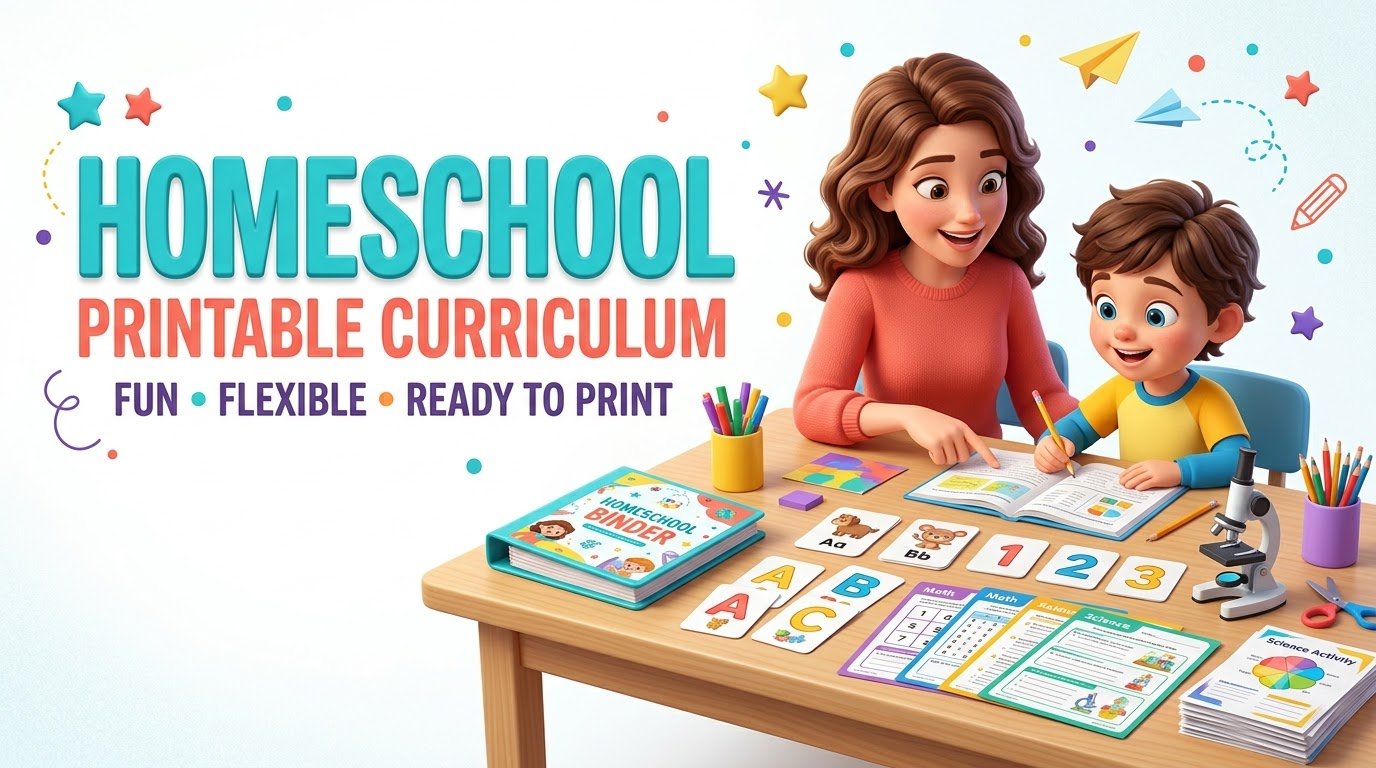
Homeschool Printable Curriculum: Make Learning at Home Easier, Happier, and More Organized
Discover how to choose age-appropriate worksheets, build a flexible learning routine, and turn printable curriculum resources into meaningful lessons without overwhelming your family.
Preschool–Elementary Printable PDFs Parent-Friendly Flexible LearningExplore Curriculum Options →Build Your Weekly Plan
Published by Digital Idea Tool | Updated October 2026
Imagine sitting down to homeschool and already knowing what to teach, what to print, and how to tell whether your child understands the lesson. No frantic internet searches. No mountains of unrelated worksheets. Just a clear plan that leaves room for curiosity, creativity, and family life.
That is the real promise of a well-designed homeschool printable curriculum. It helps you organize learning without forcing every child into the same pace or routine.
But there is an important distinction: a printable worksheet collection is not automatically a complete curriculum. A useful curriculum explains what children will learn, how skills build, what activities to teach, and how to check progress. The printables support that process.
Whether you are beginning homeschooling, teaching several ages, or looking for affordable supplemental resources, this guide will help you make thoughtful choices.
1. What Is a Homeschool Printable Curriculum?
A printable homeschool curriculum typically comes as PDF files containing instructional materials that families can download, print, and use at home.
Some packages are full learning programs with structured lessons and assessments. Others contain themed worksheets, practice exercises, flashcards, planners, or enrichment activities intended to supplement another program.
For example, a kindergarten literacy package might contain letter-sound instruction, phonics games, blending exercises, printable readers, handwriting practice, and a simple skills checklist. Together with clear teaching instructions and an appropriate progression, these materials can form part of a systematic literacy program.
Structured Lessons
A sequence that identifies learning objectives and connects each activity to a skill.
Printable Activities
Worksheets, task cards, games, manipulatives, and reusable learning sheets.
Planning Resources
Weekly schedules, materials lists, reading logs, and subject trackers.
Progress Checks
Observation prompts, answer keys, skill reviews, and assessment records.
2. Why Families Choose Printable Homeschool Resources
Printable resources appeal to families because they offer control over cost, timing, learning pace, and classroom setup. Unlike a rigid online program, a PDF can often be printed when needed and combined with books, conversations, experiments, and hands-on activities.
- Flexible pacing: Repeat difficult lessons or advance when a skill is secure.
- Convenient preparation: Print upcoming activities before the school week begins.
- Potential cost savings: Reuse eligible files under the seller’s license rather than purchasing separate workbooks.
- Screen-light learning: Offer offline writing, drawing, cutting, sorting, and problem-solving opportunities.
- Personalized practice: Select tasks based on a child’s demonstrated abilities rather than age alone.
- Portfolio support: Save dated examples of completed work where useful or required.
There are drawbacks too. Printing uses paper and ink, young children usually need adult instruction, and disconnected activity sheets can create gaps in learning. A good system balances convenience with teaching quality.
3. Choosing Printable Curriculum by Age and Learning Stage
Age labels provide a starting point, not a rigid rule. Children develop skills at different rates, so choose material according to what they can already do and what they are ready to learn next.
| Learning Stage | Useful Printable Resources | Main Goal |
|---|---|---|
| Preschool (about 3–5) | Picture cards, matching games, shapes, counting mats, letter-sound play | Language, play, motor skills, number sense |
| Kindergarten (about 5–6) | Phonics activities, number practice, handwriting, storytelling cards | Foundational literacy and numeracy |
| Grades 1–2 (about 6–8) | Decodable reading activities, spelling, addition, subtraction, measurement | Fluency and growing independence |
| Grades 3–5 (about 8–11) | Reading comprehension, fractions, multiplication, research and writing | Deeper knowledge and problem-solving |
These age ranges are approximate. For children learning at a different pace, choose resources by skill level and adapt the amount of work, directions, and response format.
4. Essential Subjects for a Balanced Homeschool Program
A comprehensive homeschool plan should give children opportunities to develop strong foundational skills while exploring the wider world. The specific subjects required by law depend on where the family lives.
Reading and Phonics
Letter-sound connections, decoding, vocabulary, fluent reading, and comprehension.
Printable ideas: Sound cards, word-building mats, reading response sheets.Mathematics
Counting, number relationships, operations, shapes, measurement, and reasoning.
Printable ideas: Number lines, ten frames, fraction models, word problems.Writing and Language
Handwriting, spelling, sentence construction, grammar, and expressive writing.
Printable ideas: Story organizers, writing journals, sentence-building cards.Science
Observation, asking questions, collecting evidence, and exploring natural phenomena.
Printable ideas: Experiment logs, nature journals, life-cycle diagrams.History and Geography
Communities, cultures, geography, timelines, and historical inquiry.
Printable ideas: Maps, timelines, primary-source questions.Art and Life Skills
Creativity, practical problem-solving, communication, and everyday independence.
Printable ideas: Art prompts, recipe planners, project checklists.5. Printable Curriculum vs. Traditional Workbooks vs. Online Learning
There is no single best delivery format for every household. Many successful learning routines combine print, books, discussion, physical materials, and carefully chosen digital resources.
| Feature | Printable PDFs | Physical Workbooks | Online Programs |
|---|---|---|---|
| Access | Download, then print | Physical delivery or store purchase | Internet or app; varies |
| Offline use | Yes, once printed | Yes | Depends on provider |
| Customization | Often flexible | Usually limited | Depends on platform |
| Ongoing expense | Paper and ink, plus purchase price | Replacement books | May require subscription |
| Automatic feedback | Usually unavailable | Usually unavailable | Sometimes included |
| Adult teaching needed | Often, especially younger ages | Often | Varies |
For example, a family might use printable math practice, physical library books for reading, outdoor observation for science, and a short online demonstration to introduce a complicated concept. The goal is not to eliminate other tools. It is to choose the right tool for the lesson.
6. How to Build a Homeschool Printable Curriculum Step by Step
Step 1: Check Your Local Requirements
Before choosing materials, determine what is required for home education in your jurisdiction. Depending on location, this might include notification, compulsory subjects, attendance or instructional records, assessments, or other procedures.
In the United States, homeschooling is primarily regulated at the state and local levels. Consult your official state education department for current requirements. A useful supplementary reference is the U.S. Department of Education’s state regulation resource.
Step 2: Identify Your Child’s Starting Skills
Observe how your child reads, writes, counts, explains ideas, and handles activities independently. Use short, low-pressure tasks rather than turning the first day into a lengthy test.
Record strengths and areas needing support. A child who counts confidently may still need hands-on help understanding place value. A fluent reader may need more support summarizing a passage.
Step 3: Set Specific Learning Objectives
A clear objective makes lesson selection easier. Instead of writing “do math,” try “use pictures and objects to solve addition problems within 20.”
Instead of “practice reading,” try “blend simple sound patterns and read appropriate decodable words.” Specific goals help families measure learning without relying solely on the number of completed pages.
Step 4: Choose a Coherent Lesson Sequence
Look for materials with clearly explained teaching methods, prerequisites, progressive difficulty, and regular review. Avoid choosing a large bundle simply because it contains hundreds of pages.
For early reading, check whether skills progress systematically and whether children receive explicit instruction and opportunities to practice connected text. For math, look for conceptual models, worked examples, manipulatives, and progressively challenging problems.
Step 5: Add Hands-On Learning
Combine worksheets with real experiences. Use blocks to demonstrate multiplication, kitchen measurements to explore fractions, and nature walks to practice observation.
For young children, play, movement, conversation, and tactile activities should remain central. A printable is a teaching aid, not a substitute for interactive learning.
Step 6: Plan, Print, Teach, and Review
Organize activities by week, keep resources in clearly labeled folders, and review progress regularly. Save a small collection of dated student work and note which skills need revisiting.
7. A Flexible Weekly Printable Homeschool Schedule
You do not need to imitate a conventional classroom schedule minute by minute. The following example is a planning template for an early elementary learner, not a required daily timetable.
| Day | Literacy | Mathematics | Exploration |
|---|---|---|---|
| Monday | Phonics and reading | Number relationships | Nature observation |
| Tuesday | Spelling and writing | Addition and subtraction | Art project |
| Wednesday | Reading comprehension | Shapes and measurement | Science investigation |
| Thursday | Phonics review and stories | Word problems | Geography activity |
| Friday | Reading and writing review | Math games and review | Project, library, or fieldwork |
Reading aloud, outdoor movement, creative play, family responsibilities, and breaks can happen throughout the week. Adjust lesson duration to attention, developmental needs, and local requirements.
Sample Morning Learning Flow
- Connect: discuss the day and revisit a familiar concept.
- Teach: introduce one manageable new skill with examples.
- Practice: complete a short printable activity or hands-on task.
- Explore: read, investigate, build, draw, or experiment.
- Reflect: ask the child to explain what they learned.
The quality of engagement matters more than filling every available hour with worksheets.
8. How to Homeschool Multiple Ages Without Doubling the Work
One of the best uses of homeschool printables is adapting a shared topic to several skill levels.
Imagine a family studying the weather. A preschooler sorts sunny, rainy, and cloudy picture cards. A first grader records temperatures and writes simple observations. A fourth grader builds a graph and compares patterns across a week.
Everyone learns about the same topic, but the activities match individual readiness. Shared read-alouds, science demonstrations, field trips, and family projects can further reduce preparation time.
9. Free vs. Paid Homeschool Printable Curriculum: What Is Worth Buying?
Free worksheets are useful for sampling teaching styles, reinforcing specific skills, or addressing short-term gaps. A paid curriculum becomes attractive when it saves planning time and provides an organized learning progression.
However, a higher price does not automatically mean stronger instructional quality.
| Buying Factor | Questions to Ask |
|---|---|
| Content coverage | Which subjects, skills, and levels are actually included? |
| Teaching guidance | Are lesson instructions or worked examples supplied? |
| Learning progression | Are activities sequenced or simply grouped by theme? |
| Assessment | Are answer keys, rubrics, or progress checks included? |
| Print quality | Are files readable, ink-friendly, and correctly sized? |
| Accessibility | Are editable, large-print, or digital alternatives available? |
| Licensing | May the purchaser print for multiple children or only one? |
| Support | Are there previews, corrections, updates, and clear contact details? |
Consider total value rather than just page count. A focused 60-page resource with clear instructions and meaningful assessment may be more useful than a disorganized 600-page download.
10. What Should a Quality Homeschool Curriculum PDF Bundle Include?
If you are shopping for an all-in-one downloadable homeschool bundle, look for the following components:
- Overview of intended ages, levels, and prerequisites.
- Subject-specific learning goals and a scope-and-sequence guide.
- Daily or weekly teaching instructions.
- Age-appropriate printable worksheets and games.
- Answer keys or teaching notes where applicable.
- Assessment and review materials.
- Weekly planner and supply checklists.
- Print instructions, page sizing, and file organization.
- Clear copyright, usage, and refund terms.
- Accessibility and adaptation suggestions.
Before paying, inspect sample pages. Check for factual errors, appropriate reading difficulty, coherent instructions, and cultural inclusivity. Verify that pictures, charts, and questions are useful rather than decorative filler.
11. How to Organize Your Printable Files and Learning Binder
An organized digital library prevents duplicate printing and makes the start of each week easier.
📂 Folder 1 — Weekly Lesson Plans
Keep the schedule, objectives, materials checklist, and teacher notes here. Use descriptive filenames such as “Week-03-Math-Place-Value.pdf”.
📘 Folder 2 — Core Subject Worksheets
Use separate subfolders for literacy, math, science, social studies, and writing. Arrange materials by difficulty or lesson sequence.
🎲 Folder 3 — Games and Hands-On Activities
Store flashcards, printable board games, picture cards, and reusable learning mats. Laminate only when it is worthwhile and appropriate.
📊 Folder 4 — Assessments and Progress
Keep dated work samples, reading notes, checklists, and assessment records. Follow any record-keeping rules applicable to your location.
🗃️ Folder 5 — Future Lessons and Extras
Move enrichment activities and upcoming units here rather than mixing them into the current week’s work.
12. Printable Learning Activities That Keep Children Interested
Children do not need constant entertainment to learn, but variety can make practice more meaningful. These ideas blend academic goals with choice, movement, and creativity.
Reading Treasure Hunt
Hide word cards around the room. Children find a card, read the word, and use it in a sentence.
Mini Grocery Store
Use printable price tags and play money to practice counting, addition, and comparison.
Plant Growth Journal
Track a seedling with sketches, dates, measurements, and short observations.
Map Your Community
Draw a simple neighborhood map and identify routes, landmarks, and directions.
For a child who dislikes traditional worksheets, allow responses through drawing, speaking, building, pointing, or using manipulatives when that still meets the learning objective.
13. Common Homeschool Printable Curriculum Mistakes
Buying Too Many Materials at Once
Large bundles can feel like a bargain but become overwhelming. Start with the core subjects and a manageable number of lessons, then expand as needed.
Confusing Busywork with Learning
Completed pages do not necessarily demonstrate understanding. Ask children to explain their reasoning, apply a concept in a new situation, or teach it back to you.
Ignoring Instructional Sequence
A colorful worksheet may be attractive but poorly timed. Make sure prerequisite skills have been taught and practiced.
Skipping Review and Feedback
Notice recurring mistakes and adjust instruction promptly. Review should help determine the next lesson rather than merely produce a score.
Forgetting Legal and Accessibility Needs
A generic printable packet may not cover mandatory subjects or address a learner’s support needs. Supplement or modify materials as appropriate, and seek qualified guidance when needed.
14. How to Track Homeschool Learning Progress
A practical progress tracker might list the date, skill, activity, observation, and next action. This creates a useful record without turning every activity into a formal assessment.
| Date | Skill | Evidence of Learning | Next Step |
|---|---|---|---|
| Week 1 | Letter sounds | Identifies familiar sounds with cards | Practice blending |
| Week 2 | Addition within 10 | Solves problems with counters | Try pictures and number lines |
| Week 3 | Sentence writing | Writes a short sentence with support | Expand details |
These are illustrative observations, not universal performance standards. Use each child’s prior work as one important comparison and follow any legally mandated evaluation requirements separately.
15. Homeschool Printable Curriculum for Different Learning Needs
Accessible materials allow more children to participate meaningfully. Consider clear fonts, strong contrast, uncluttered pages, readable text sizes, and multiple ways to respond.
Some learners may benefit from visual schedules, shortened assignments, movement breaks, assistive technology, or tactile alternatives. Children with vision, motor, language, or learning-related disabilities may require more specific accommodations.
Printable resources can help support individualized learning, but they are not a substitute for professional educational assessment, disability-related services, or legally required supports where those apply.
16. How to Choose a Printable Curriculum Seller You Can Trust
Before purchasing from a marketplace or independent store, look beyond promotional banners. Reliable product listings should provide enough detail to help a parent make an informed decision.
- Look for genuine previews rather than only decorative mockups.
- Check the intended grade or skill range and exact included files.
- Read the license carefully, especially for sibling use, classroom sharing, and redistribution.
- Verify that claims such as “standards aligned” or “complete curriculum” are supported by documented coverage.
- Read reviews critically, paying attention to specifics about usability and accuracy.
- Confirm the seller’s support, delivery, refund, and update policies.
Be cautious of promises that a printable packet will guarantee high test scores, solve every learning challenge, or automatically satisfy all homeschool laws. Those outcomes cannot responsibly be guaranteed by a PDF download.
17. Five Frequently Asked Questions
1. Can I homeschool my child using only printable curriculum?
Potentially, but only if the overall program provides sufficient instruction, appropriate learning opportunities, assessment, and required subject coverage under local rules. Worksheets alone often need to be supplemented with direct teaching, books, discussion, experiments, and hands-on experiences.
2. What is the best printable homeschool curriculum for beginners?
Look for a beginner-friendly package with clear instructions, manageable daily lessons, a coherent subject sequence, printable activities, and progress checks. The best fit depends on a child’s skill level, your teaching preferences, budget, and applicable requirements.
3. Are free homeschool worksheets enough for a complete education?
Free resources can be excellent supplements and may contribute to a well-planned program. However, unrelated free worksheets are not necessarily comprehensive. Check the learning sequence, content coverage, accuracy, and assessment approach.
4. How much should I spend on a homeschool printable curriculum?
There is no universal budget. Total expenses depend on the number of children, subjects, printing costs, books, materials, and optional services. Compare included instructional support and quality rather than choosing by price or page count alone.
5. Can I reuse a purchased printable curriculum for multiple children?
That depends on the product license. Some products permit household reuse, while others restrict printing to one learner, class, or account. Always read the purchase and usage terms before copying or distributing files.
18. Test Your Knowledge: Five Homeschool Curriculum Flashcards
Try answering each question before expanding the card to reveal the answer.
FLASHCARD 1: Is a large set of worksheets automatically a complete curriculum?
Answer: No. A complete curriculum needs planned objectives, a sensible learning sequence, appropriate instruction, and ways to review progress.
FLASHCARD 2: What should you check before choosing homeschool materials?
Answer: Your local homeschool requirements and your child’s current skills, learning needs, and subject coverage.
FLASHCARD 3: Why are hands-on activities important?
Answer: They help children explore ideas, connect concepts to real experiences, and demonstrate understanding in different ways.
FLASHCARD 4: What makes a paid PDF bundle worth considering?
Answer: Clear teaching guidance, organized progression, accurate content, useful activities, and appropriate assessment tools.
FLASHCARD 5: What should you do when a learner struggles with an activity?
Answer: Revisit prerequisite skills, provide another explanation or model, and adjust the pace or response format.
19. Make Your Homeschool Plan Work for Your Family
Effective homeschooling is not about collecting the most resources or creating the most impressive daily schedule. It is about helping children build understanding, confidence, curiosity, and practical skills over time.
A thoughtful homeschool printable curriculum can make planning easier and provide structure. But the meaningful learning happens through instruction, conversation, practice, exploration, and responsive support.
Start with your child’s needs. Choose a coherent approach. Keep your materials organized. Observe what works. Adjust when something does not.
With that foundation, printable learning resources can become a valuable part of a flexible and rewarding home education experience.
20. Compliance and Educational Disclaimer
Educational information: This article is provided for general educational and informational purposes only. It does not constitute legal, professional teaching, psychological, medical, or individualized special-education advice.
Homeschool law: Home education laws and requirements vary by country, state, territory, and local jurisdiction. Families are responsible for verifying official requirements, including registration or notification, compulsory subjects, attendance, assessments, record keeping, and any applicable educational support obligations. This guide does not establish legal compliance.
Learning outcomes: Children develop at different rates. No particular curriculum, worksheet bundle, teaching method, or educational resource guarantees academic achievement, test scores, grade advancement, or admission outcomes.
Product terms and copyright: Downloadable files remain subject to the creator’s copyright, licensing, distribution, and refund policies. Purchasing a product does not automatically grant resale, redistribution, school-wide sharing, or commercial reuse rights.
Commercial disclosure: Links to Digital Idea Tool may promote resources offered by the publisher. If affiliate links, sponsored placements, or paid recommendations are added to this article, they should be clearly disclosed to readers.
Accessibility: Families should adapt educational activities to the child’s abilities and consult qualified specialists when individualized assessment or support is needed.
Verification: Product contents, availability, prices, and relevant requirements can change. Check authoritative sources and individual product descriptions before making educational or purchasing decisions.
Helpful reference: U.S. Department of Education — Non-Public Education FAQ. For state-specific information, also consult your state education department.
© Digital Idea Tool. All rights reserved. Educational information updated October 2026.
📝 Key Takeaways & Action Notes
Jot down insights, next steps, or thoughts from this post. Your notes save automatically in your browser.
- What is the #1 breakthrough insight you took away today?
- What is one concrete action you will take in the next 24 hours?
- What questions or ideas do you want to research further?
Stay ahead with exclusive updates
Join our community. Get curated industry trends, actionable guides, and fresh resources delivered straight to your inbox.