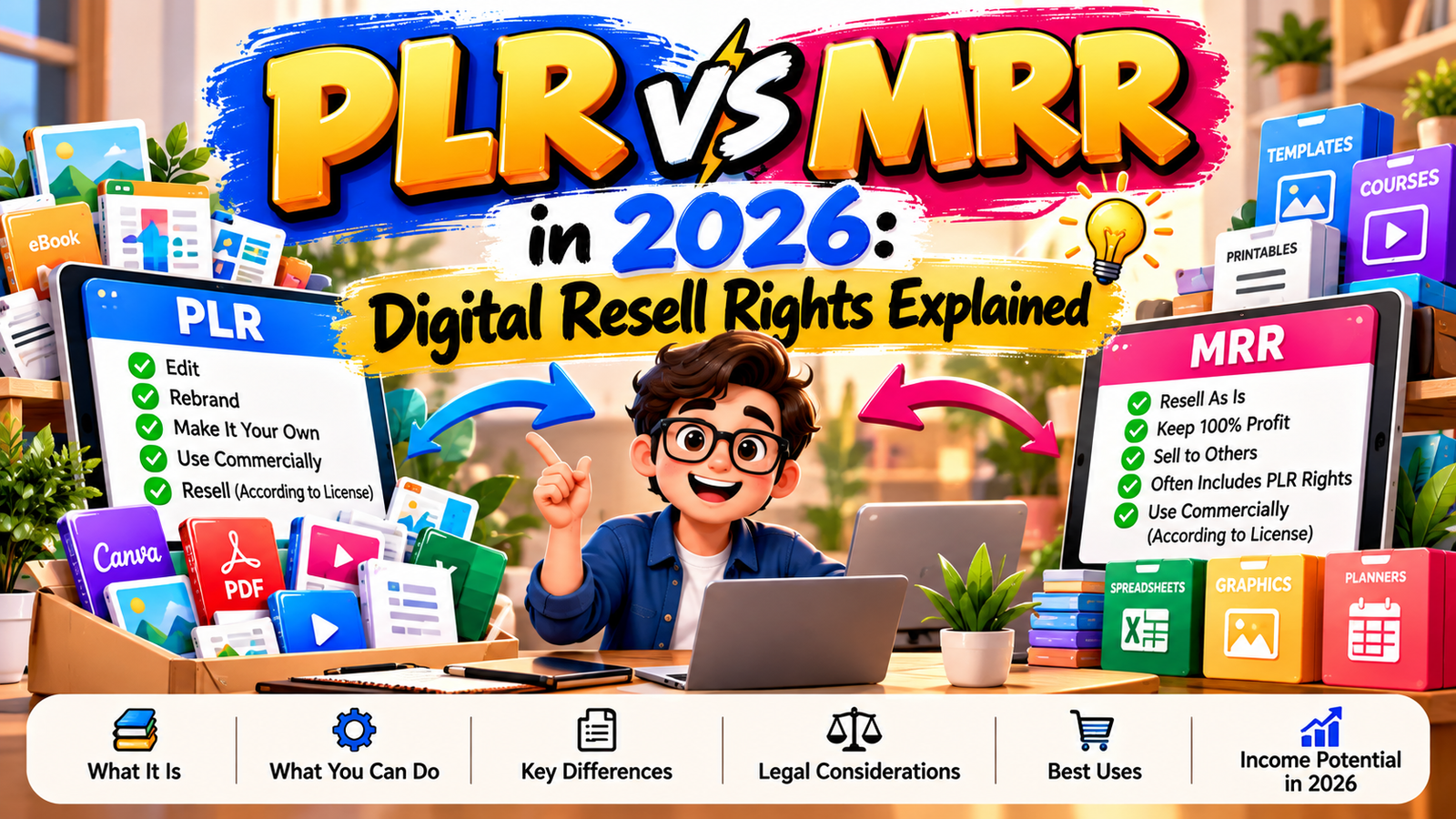
PLR vs MRR in 2026: How Digital Resell Rights Actually Work
If you have spent any time exploring the digital-product business in 2026, you have probably encountered terms such as PLR, MRR, resell rights, commercial use, private label rights, and master resell rights.
At first, they can sound almost interchangeable.
They are not.
The difference between these licenses can determine whether you are allowed to edit a product, put your brand on it, sell it to customers, include it inside a bundle, or give your own customers permission to resell it.
That makes understanding PLR vs MRR important for anyone buying digital products for business.
Whether you sell ebooks, templates, courses, worksheets, prompts, planners, business resources, graphics, spreadsheets, or downloadable toolkits, the license attached to the product matters just as much as the product itself.
There is also one rule worth remembering from the beginning:
The letters PLR or MRR alone never tell you everything you are allowed to do. The actual license supplied with the individual product is what matters.
Copyright owners can grant different permissions through licenses, and the specific conditions of those licenses determine what uses are permitted. WIPO similarly advises users to pay attention to the exact conditions attached to licensed works.
With that foundation, here is how digital resell rights actually work.
What Are PLR Products?
PLR stands for Private Label Rights.
In the digital-product marketplace, PLR generally refers to content that comes with permission to modify or repurpose it according to the terms supplied by the original seller or rights holder.
Depending on the license, a PLR ebook might allow you to change the title, rewrite chapters, redesign the cover, add your business name, insert your own examples, combine material with another product, or sell a customized version.
That flexibility is what makes PLR products attractive to entrepreneurs.
Instead of beginning with an empty page, you start with an existing foundation and build something more closely aligned with your audience or brand.
For example, imagine buying a PLR ebook called 30 Social Media Marketing Tips.
A generous PLR license might allow you to transform it into The Small Business Guide to Instagram Marketing, rewrite portions of the content, add your branding, design a new cover, and sell the revised ebook through your own website.
But another PLR license might impose restrictions.
It could prohibit selling the editable source files, transferring the PLR license to customers, uploading the content to certain marketplaces, or selling below a specified price.
That is why buying something labeled PLR should never be interpreted as receiving unlimited ownership.
You are purchasing or receiving a set of permissions defined by the license.
What Are MRR Products?
MRR stands for Master Resell Rights.
In common digital-product usage, an MRR license usually focuses more heavily on resale.
You may be permitted to sell the product to customers, and certain MRR licenses also allow those customers to receive specified resale rights themselves.
This creates an important distinction.
With a traditional end-user digital product, you sell the product for the buyer to use.
With some master resell rights digital products, you sell the product together with permission for the next buyer to resell it under the conditions established by the original license.
For example, suppose you purchase a digital marketing course with MRR.
The license may allow you to sell copies of that course through your store and permit customers to resell it again.
However, it might prohibit editing the videos, claiming copyright ownership, changing certain branding elements, giving the product away for free, or transferring rights beyond a specified level.
Again, there is no substitute for reading the actual license.
A product being advertised as MRR does not automatically mean every possible commercial action is allowed.
PLR vs MRR: The Simple Difference
The easiest way to understand PLR vs MRR is to think about their typical purpose.
PLR generally emphasizes customization.
MRR generally emphasizes redistribution or resale rights.
But these are common marketplace descriptions rather than universal license rules. The individual agreement always takes priority.
| Feature | PLR | MRR |
|---|---|---|
| Sell the product | Often allowed | Usually a central permission |
| Edit the product | Frequently allowed | Depends on license |
| Add your branding | Often allowed | Depends on license |
| Rewrite content | Often allowed | Not always |
| Sell to end customers | Usually possible when licensed | Commonly allowed |
| Let customers resell | Sometimes restricted | Often associated with MRR |
| Transfer PLR/MRR rights | Depends entirely on license | Depends entirely on license |
| Claim original copyright | Usually not automatically allowed | Usually not automatically allowed |
| Give away free | Depends on license | Depends on license |
| Sell editable source files | Depends on license | Depends on license |
The last column in almost every licensing comparison could realistically say the same thing:
Read the license.
That is not simply legal fine print. It is part of responsible digital-product business management.
Commercial Use Is Not the Same as PLR or MRR
Another common source of confusion involves commercial-use licenses.
A commercial-use license generally means you have permission to use the licensed material in some form of commercial activity.
That does not automatically mean you can resell the original digital file.
For example, a commercial-use graphic license might let you place an illustration on a finished T-shirt, poster, invitation, or physical product that you sell.
It might not allow you to upload the original graphic files to your website and sell those files individually.
Similarly, a template could permit commercial use in work created for clients while prohibiting redistribution of the original template.
The phrase commercial use therefore should not automatically be interpreted as resell rights.
The permitted use depends on the wording of the license.
This principle is common across intellectual-property licensing: permission can cover some activities while restricting others. WIPO’s own licensing examples demonstrate that permissions such as reproduction, distribution, adaptation, translation, and commercial use can be granted separately and subject to particular conditions.
What Does Rebranding Actually Mean?
Rebranding is one of the biggest attractions of PLR digital products to resell.
But rebranding can mean different things under different licenses.
A broad PLR license might allow you to replace the product name, redesign the visual identity, rewrite the content, change images, add your logo, reorganize sections, create a new cover, or combine the material with your own original content.
A more restrictive license may allow only certain modifications.
This is why serious digital-product sellers should avoid assuming that rebranding permission automatically includes every type of modification.
For example, being allowed to change a PDF cover does not necessarily mean you are allowed to modify embedded photographs, fonts, stock assets, videos, software, or other third-party components.
Each element may carry its own licensing conditions.
Can You Put Your Name on a PLR Product?
Sometimes.
Many PLR licenses are specifically designed to permit branding or customization. However, the extent of that permission varies.
A license might allow you to publish a modified ebook under your business brand while prohibiting you from claiming that you personally created every original component.
Others might explicitly allow author-name changes.
Some may require substantial modification before resale.
Instead of asking only, “Does this product have PLR?”, ask:
“What exactly does this PLR license allow me to change, represent, distribute, and transfer?”
That question is much more useful.
Can You Sell PLR Products Without Editing Them?
That depends on the license.
Some PLR products can be sold in their original form.
Others are intended to be customized first.
Even where unchanged resale is permitted, customization can often make stronger business sense.
If hundreds of sellers receive exactly the same ebook, cover, description, and graphics, selling the untouched version gives customers little reason to choose your offer instead of another seller’s.
Customization gives you an opportunity to create differentiation.
You could improve the design, update examples, reorganize information, add original worksheets, create additional bonuses, develop a better product description, or reposition the material for a particular audience.
PLR is often most useful as a starting asset rather than a shortcut to uploading identical products everywhere.
Can You Resell MRR Products?
Reselling is typically the central attraction of MRR products, but you still need to check exactly what kind of resale the license permits.
An MRR license might specify where the product can be sold, whether the customer receives resale rights, whether modifications are permitted, whether minimum pricing applies, and whether the item can be bundled with other products.
For example, one MRR package may allow you to sell a course from your own website but prohibit listing it on third-party marketplaces.
Another may allow marketplace sales but prohibit giving the product away as a lead magnet.
A third may permit your customers to resell the product but prevent them from passing master rights further down the chain.
The words Master Resell Rights are therefore only the beginning of your license review.
PLR vs MRR vs Resell Rights
There is another term worth understanding: Resell Rights, sometimes shortened to RR.
In common usage, ordinary resell rights may permit you to sell a product to customers for their own use without giving those customers permission to resell it again.
MRR can go further by allowing some form of resale permission to pass to the next buyer.
PLR often adds another dimension by permitting editing, customization, or private-label branding.
A simplified way to remember them is:
Resell Rights: “I may sell this.”
Master Resell Rights: “I may sell this, and the license may permit my customers to resell it too.”
Private Label Rights: “I may have permission to edit, customize, rebrand, or repurpose this.”
Those explanations are useful for learning the concepts, but your actual rights remain those stated in the specific license you receive.
What Should You Check Before Buying PLR or MRR?
A professional digital seller should treat the license as part of the product rather than something to read after purchasing.
Before buying, check:
- whether commercial resale is allowed; whether editing and rebranding are permitted; whether customers can receive resale rights; whether the original source files can be distributed; whether marketplace sales are allowed; whether there are minimum or maximum pricing conditions; whether the product may be bundled, gifted, or used as a bonus; whether membership-site use is allowed; whether attribution is required; whether sublicensing is permitted; whether included graphics, fonts, videos, software, templates, or stock assets carry separate restrictions; and whether the seller provides a written license you can retain for your records.
If the permissions that matter to your business are unclear, obtain clarification from the rights holder before selling the product.
A Practical PLR Example
Imagine purchasing a collection of 100 business-planning templates with PLR.
Your goal is to create a product called The Freelancer Business Planning Toolkit.
If the license allows the necessary activities, you could select the most relevant templates, redesign them using your visual identity, rewrite instructions for freelancers, add several original worksheets, create a new cover, bundle the files, and sell the finished toolkit.
You are not simply copying a product.
You are using licensed source material as part of a differentiated offer.
That is one of the most valuable ways to approach PLR products in 2026.
A Practical MRR Example
Now imagine purchasing a business course with MRR.
The supplied license permits resale and allows buyers to receive specified resale rights.
You create a product page explaining what the course covers, who it is intended for, what files the customer receives, and what resale permissions come with the purchase.
The important part is accuracy.
Do not promise customers more rights than you received yourself.
If your license prohibits modification, do not advertise the course as fully editable.
If sublicensing is limited, explain those limitations.
If particular components cannot be resold separately, make that clear.
Transparent licensing does more than reduce confusion. It can increase customer confidence.
Why License Transparency Matters in 2026
The digital-product market has become increasingly accessible.
Creators can now launch stores selling ebooks, templates, AI prompts, courses, spreadsheets, printables, design assets, marketing resources, and business kits with relatively little technical infrastructure.
That accessibility creates opportunity, but it also makes licensing knowledge increasingly important.
Buyers want to understand what they are purchasing.
Sellers need to know what they are permitted to distribute.
Marketplaces may have their own product and intellectual-property policies in addition to the license attached to a product.
And third-party assets included inside a bundle may carry restrictions different from the primary product.
A professional seller therefore thinks beyond:
“Can I download this?”
The better question is:
“Do I have documented permission for the way I plan to use, modify, market, and distribute this product?”
PLR Is Not Automatically “Passive Income”
PLR is often marketed as a shortcut to passive income.
That description can be misleading when it suggests that purchasing a file automatically creates a successful business.
A PLR license gives you permissions.
It does not automatically give you customers.
Successful digital-product businesses still depend on positioning, audience research, branding, product quality, customer experience, pricing, marketing, search visibility, and trust.
The most effective PLR sellers frequently create additional value around the licensed material.
They improve it.
They specialize it.
They make it easier to use.
They package it for a clearly defined customer.
And they communicate honestly about what buyers receive.
MRR Is Not Automatically an Unlimited Resale License
The same caution applies to master resell rights digital products.
The word “master” can sound extremely broad.
It should not be interpreted as unlimited permission.
The license might contain significant restrictions concerning modification, pricing, marketplaces, transfer of rights, advertising methods, branding, or redistribution.
Therefore, avoid making statements such as:
“Do anything you want with this product.”
“Unlimited rights included.”
“Full copyright ownership.”
“Sell anywhere with no restrictions.”
Those claims should only be made if the actual license clearly supports them.
Specific language builds greater trust than exaggerated language.
Which Is Better: PLR or MRR?
There is no universal answer because PLR and MRR solve different business needs.
If your goal is to build customized products around your own brand, a flexible PLR license may be useful.
If your goal is primarily to distribute an existing product with resale permissions, an MRR product may suit that business model.
Some products combine PLR and MRR permissions.
Others include only one.
The valuable question is not whether PLR is better than MRR.
It is whether the license gives you the permissions required for your intended business model.
The Smartest Way to Use PLR Products in 2026
The strongest opportunity in PLR is not simply finding the biggest bundle.
It is finding useful material that can become more valuable through thoughtful transformation.
A generic productivity ebook can become a guide for freelancers.
A collection of budgeting spreadsheets can become a financial toolkit for small online shops.
A set of social-media templates can become a content system for local businesses.
An AI prompt collection can become a specialized prompt library for coaches.
A broad worksheet bundle can become a carefully organized educational resource for a particular age group.
In other words:
Start with licensed content. Finish with a product designed around a real customer’s needs.
That is a much stronger strategy than competing only on the number of files inside a bundle.
Frequently Asked Questions About PLR vs MRR
What does PLR mean?
PLR stands for Private Label Rights. In common digital-product usage, it usually refers to a license allowing certain levels of modification, customization, rebranding, or resale. Exact permissions depend on the specific PLR license.
What does MRR mean?
MRR stands for Master Resell Rights. It commonly refers to permission to resell a digital product and may include permission for customers to receive certain resale rights. Exact conditions vary by product.
What is the main difference between PLR and MRR?
PLR commonly focuses on customization and rebranding, while MRR commonly focuses on resale and transferring specified resale permissions. These are general conventions; the written license determines the actual rights.
Can I edit MRR products?
Only when the license permits editing. Some MRR products can be modified, while others must remain substantially unchanged.
Can I resell PLR products?
Many PLR licenses permit resale, but not all licenses use identical rules. Check the product’s terms before selling.
Can I sell PLR products on Etsy, Amazon, Gumroad, Shopify, or other marketplaces?
Possibly, but two separate sets of rules matter: the product’s license and the marketplace’s current policies. Permission under one does not automatically guarantee compliance with the other.
Does PLR mean I own the copyright?
Not necessarily. A PLR license can give you extensive usage rights without transferring the underlying copyright itself. WIPO notes that authorization to use protected work may take the form of a license or an assignment—two distinct concepts.
Are commercial-use rights the same as resell rights?
No. A commercial-use license may permit commercial use without allowing redistribution of the original digital product. Always check the specific terms.
Can I give MRR products away for free?
Only if the license allows it. Some licenses require a minimum sale price or specifically prohibit free distribution.
Can I transfer PLR rights to my customers?
That depends entirely on the license. Some PLR licenses allow certain rights to be passed on, while others expressly prohibit transferring PLR status.
Final Thoughts: Read the License Before You Build the Business
Understanding PLR vs MRR in 2026 is less about memorizing abbreviations and more about understanding permission.
PLR products can provide an excellent foundation for creating customized digital products.
MRR products can offer opportunities to sell existing resources with specified resale permissions.
Commercial-use licenses can support profitable businesses without necessarily allowing resale of the original files.
Each model can be valuable when used correctly.
But none of the labels should replace the actual license.
Before you edit, rebrand, bundle, upload, advertise, or resell a digital product, review the rights provided with that specific product and keep a copy of the license for your records.
Buy the product for its value. Read the license for its permissions. Add your own value before asking customers to buy from you.
That simple approach can help you build a more professional, transparent, and sustainable digital-product business in 2026.
Important Notice: This article provides general educational information about commonly used digital-product licensing terms. PLR, MRR, resale, and commercial-use conditions can differ substantially between sellers and products. Always review the specific license supplied with a product. For legal advice concerning copyright, licensing, or intellectual-property rights in your jurisdiction, consult a qualified professional.
Confused about PLR vs MRR? Learn how PLR products, MRR products, commercial-use licenses, rebranding, and digital reselling actually work in 2026.
Stay ahead with exclusive updates
Join our community. Get curated industry trends, actionable guides, and fresh resources delivered straight to your inbox.