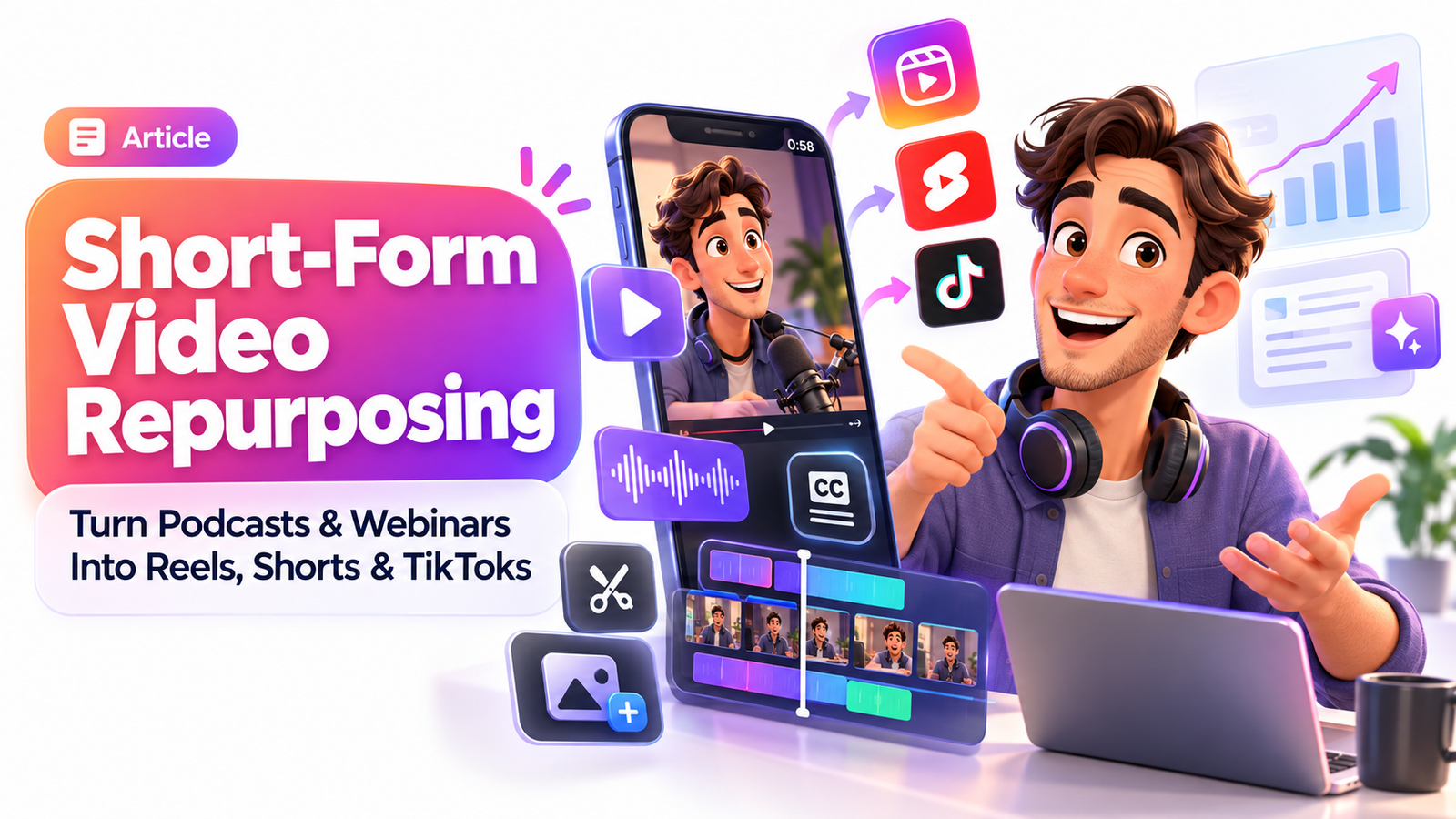
Turn Podcasts and Webinars Into Reels, Shorts, and TikToks
A creator records a 60-minute podcast.
A coach teaches a 90-minute webinar.
A founder answers questions during a live stream.
A consultant gives a detailed presentation.
Most of that valuable content is published once, receives a burst of attention, and then disappears into an archive.
That creates an opportunity.
Short-form video repurposing turns long-form podcasts, interviews, webinars, livestreams, presentations, and educational videos into compact, engaging clips designed for Instagram Reels, YouTube Shorts, TikTok, X, and other social platforms.
Instead of asking a business owner to record more content, a short-form video editor helps them get more value from content they have already created.
For freelancers, editors, creators, and digital-service entrepreneurs, this makes video repurposing an attractive service because the offer is simple to understand:
“Give me one podcast or webinar, and I’ll turn its best moments into social-ready short videos.”
The entry barrier can also be relatively low. A beginner can take an authorized podcast or sample video, import it into an editor such as CapCut, identify a strong moment, format it vertically, add captions and relevant B-roll, and send the creator one polished sample.
Done properly, that single sample can communicate more value than a long cold email ever could.
What Is Short-Form Video Repurposing?
Short-form video repurposing is the process of extracting useful or entertaining moments from longer content and transforming them into standalone vertical videos.
A 60-minute podcast might contain several potential clips: a surprising opinion, an actionable tip, a memorable story, a strong statistic, a common mistake, a controversial question, or a concise explanation of a difficult idea.
The editor’s job is not simply to cut the video shorter.
The real job is to identify the strongest idea, remove unnecessary material, create a compelling opening, improve viewing clarity, and package the clip for a short-form audience.
That distinction matters.
A random 45-second section of a podcast is merely a clip.
A carefully selected and edited 45-second segment with a strong opening, captions, visual pacing, supporting B-roll, clean framing, and a clear payoff becomes a piece of short-form content.
Why Short-Form Repurposing Is Becoming a Valuable Creator Service
Modern businesses have no shortage of content.
Their bigger problem is distribution.
A founder may have hours of interviews but no time to review them.
A podcast host may consistently publish episodes but struggle to create social content.
A course creator might have dozens of webinars sitting unused.
A consultant may have valuable Zoom recordings but no editor.
This creates a straightforward business opportunity for someone willing to organize existing material.
You are not necessarily selling “video editing.”
You are selling content leverage.
One long-form recording can potentially become multiple short-form assets, allowing the client to maintain a more active social presence without constantly recording new material.
That is particularly valuable for podcasters, coaches, consultants, SaaS founders, educators, agency owners, business speakers, personal brands, real-estate professionals, financial educators, recruiters, fitness professionals, and online-course creators.
Why 60-Second Clips Are a Practical Starting Point
Short-form platforms now support different maximum video lengths, so every clip does not need to be exactly 60 seconds.
However, roughly 30-60 seconds remains an excellent working format for a repurposing business.
It gives an editor enough time to develop one useful idea while forcing the content to remain focused.
Think in terms of:
One clip = one idea.
If the speaker begins explaining three separate concepts, consider creating three videos rather than forcing everything into one crowded edit.
A useful 60-second structure is:
0-3 seconds: Create curiosity.
3-15 seconds: Establish the problem or context.
15-45 seconds: Deliver the main insight.
45-55 seconds: Provide the conclusion or payoff.
55-60 seconds: Add a natural CTA where appropriate.
The timing does not need to be rigid. Strong clips often feel conversational rather than engineered. The purpose of the framework is simply to remove unnecessary material.
The Most Important Skill Is Not Editing
Many beginners assume that flashy transitions determine whether a short video works.
Usually, they do not.
Clip selection is often more important than editing complexity.
Imagine a one-hour interview.
Clip A begins:
“So, yeah, one of the things we started thinking about last year was…”
Clip B begins:
“We spent $20,000 solving a problem that a $30 tool eventually fixed.”
Which clip creates stronger curiosity?
Probably Clip B.
The editor who recognizes that moment provides real value.
You are searching for statements that make someone stop scrolling because they want to hear what happens next.
Strong source moments often contain tension, transformation, surprise, specificity, emotion, disagreement, a useful shortcut, an unusual lesson, a clear mistake, or a satisfying before-and-after story.
A Simple CapCut Workflow for Podcast and Webinar Clips
CapCut can be a practical starting editor because its current caption tools can automatically generate subtitles from spoken audio, with manual correction available afterward. Feature availability can differ by device and region, so editors should always review captions instead of publishing them untouched.
Start by importing the creator’s authorized podcast, interview, webinar, livestream, or video file into a new project.
Watch or scan the recording with one question in mind:
“Would somebody who knows nothing about the full episode still understand and care about this moment?”
Once you identify a promising section, cut aggressively.
Remove greetings, repeated words, unnecessary setup, long pauses, technical interruptions, off-topic conversation, and anything that delays the central idea.
Then convert the project into a vertical format suitable for short-form viewing.
Reframe the speaker so the face remains visible and natural rather than awkwardly cropped.
Generate captions, then manually check names, product terms, numbers, technical terminology, punctuation, and phrases that speech recognition may have misunderstood.
Captions should improve comprehension—not distract from the speaker.
Use readable typography, sensible line lengths, and enough contrast for mobile viewing.
Next, add B-roll only where it improves understanding.
If the speaker says, “Most freelancers lose clients because they stop following up,” you might briefly introduce a visual of an inbox, CRM, sales pipeline, or freelancer working at a laptop.
The B-roll should support the message instead of competing with it.
Finally, review the entire clip without sound.
Can you still understand the central message?
Then listen without looking at the screen.
Does the story still flow naturally?
If both tests work, the edit is probably close to ready.
Avoid Over-Editing
A common beginner mistake is trying to demonstrate every CapCut feature in one video.
Zoom.
Transition.
Emoji.
Sound effect.
Animated caption.
B-roll.
Another zoom.
Another animation.
The result may look busy rather than professional.
Good editing frequently disappears into the background.
The viewer should be thinking about the speaker’s idea, not constantly noticing the editor.
Use movement when attention needs refreshing. Use B-roll when the viewer benefits from additional visual context. Use captions because mobile users often encounter videos before turning on sound.
Every element should have a purpose.
The 3-Second Test
Before sending a sample to a prospective client, watch only the first three seconds.
Ask yourself:
Would the intended audience have a reason to continue?
Weak opening:
“We were discussing something interesting on the podcast yesterday…”
Stronger opening:
“Most creators don’t have a content problem. They have a repurposing problem.”
Another example:
Weak:
“There are several things freelancers should keep in mind…”
Stronger:
“If your cold emails aren’t getting replies, this may be the reason.”
You are not trying to manufacture sensational clickbait.
You are clarifying the most interesting promise already present in the content.
How to Find Your First Potential Clients
You do not need thousands of prospects.
You need people already producing long-form content.
Search YouTube, Instagram, X, LinkedIn, podcast platforms, company websites, and creator communities for individuals publishing interviews, webinars, podcasts, training videos, livestreams, or educational content.
A strong prospect often has good long-form material but inconsistent short-form distribution.
That gap is important.
A podcaster who already publishes ten professionally edited Shorts from every episode may not urgently need another editor.
A podcaster publishing excellent hour-long interviews while barely using short-form content could be a much stronger opportunity.
The Free-Sample Strategy
Instead of contacting a creator and saying:
“I am a professional video editor. Do you need video editing?”
show the result.
Choose a suitable piece of content the creator has publicly published, respect copyright and platform terms, and use it only in a legitimate sample/outreach context rather than presenting someone else’s content as your own.
Create one short sample.
Then contact the creator.
Your message can be simple:
“I watched your recent episode about client acquisition and thought the section about follow-up could work well as a short video. I edited a sample from that section so you can see the style. If you like the direction, I can turn each episode into a consistent batch of short-form clips.”
That approach changes the conversation.
You are no longer asking the prospect to imagine your capabilities.
You are demonstrating them.
X, Instagram, and Cold Email as Client-Acquisition Channels
Different channels work for different niches.
On X, look for founders, consultants, creators, indie business owners, marketers, and podcast hosts who actively discuss their work.
Engage intelligently with their content before pitching when possible. Familiarity can improve the quality of the eventual outreach.
On Instagram, look for coaches, educators, personal brands, podcasters, fitness professionals, real-estate professionals, and consultants publishing long-form talking-head content but few polished Reels.
Cold email can be particularly useful for businesses with established websites, newsletters, webinars, YouTube channels, or podcasts.
Avoid sending a generic mass email.
Reference a specific episode, webinar, idea, or moment.
Specificity proves you actually reviewed the prospect’s work.
A Better Positioning Statement
Avoid positioning yourself as simply:
“Video Editor.”
It is too broad.
A stronger positioning statement could be:
“I turn podcasts and webinars into short-form videos for Reels, Shorts, and TikTok.”
Or:
“I help coaches and consultants turn long-form videos into captioned short-form content.”
Or even more specific:
“I help B2B podcast hosts turn every episode into social-ready Shorts.”
Specialization makes your value easier to understand.
Turn One Sample Into a Productized Service
After a client approves your sample, avoid reinventing the arrangement every week.
Create a repeatable package.
For example, a starter offer might include five short videos from one podcast or webinar, vertical formatting, edited captions, basic B-roll, hook optimization, brand styling, and one revision round.
A larger package could include twelve or twenty monthly clips, platform-specific exports, clip titles, suggested captions, content categorization, and priority turnaround.
The exact price should depend on complexity, experience, turnaround requirements, source-video length, revision expectations, B-roll requirements, and market.
Do not compete only on being the cheapest editor.
Compete on reliability, understanding the client’s audience, finding strong moments, and delivering consistent content without requiring constant instructions.
Create a Repeatable Repurposing System
A scalable editing service needs a process.
A practical workflow is:
- Receive the long-form recording and brand guidelines.
- Review or transcribe the source content.
- Identify high-potential moments.
- Rank clips by hook strength and standalone value.
- Cut unnecessary context.
- Reframe for vertical viewing.
- Generate and proofread captions.
- Add relevant B-roll or graphics where useful.
- Apply consistent brand styling.
- Review for pacing, accuracy, rights, and clarity.
- Export clean files using consistent names.
- Deliver the batch with suggested titles or posting ideas.
Once this workflow becomes routine, producing ten videos becomes dramatically easier than treating every clip as a completely new project.
Think Like a Content Strategist, Not Only an Editor
The strongest repurposing specialists eventually begin recognizing content patterns.
You may notice that a client’s educational clips perform better than motivational clips.
You may find that questions create better openings than statements.
You may discover that personal stories attract more engagement than abstract advice.
Those observations can shape future clip selection.
That means the service gradually moves from:
“I edit videos.”
to:
“I help decide which moments deserve distribution.”
That is a more valuable position.
The Originality Rule Matters More in 2026
Repurposing does not mean blindly reposting someone else’s popular video.
In October 2026, YouTube said it is further prioritizing original Shorts while reducing distribution for channels primarily re-uploading other creators’ videos without meaningful added value. YouTube specifically encourages creators using others’ clips to contribute genuine commentary, storytelling, or substantial creative value.
For a professional repurposing business, the safest model is straightforward:
Work with content the client owns or has rights to use.
Transform that source material for the client’s own channels.
Add meaningful editing and presentation value.
Do not build a business around scraping viral clips and lightly modifying them.
Interestingly, YouTube itself now provides tools in Studio that can extract engaging sections from a creator’s existing long-form videos into Shorts, including transcript-based selection and, for eligible creators, AI suggestions. That is a strong signal that long-form-to-short-form workflows are becoming a normal part of creator publishing.
Your advantage therefore cannot simply be pressing “clip.”
Your advantage must be judgment, storytelling, positioning, editing quality, consistency, and understanding what matters to the client’s audience.
How AI Can Speed Up the Workflow Without Replacing Judgment
AI-assisted tools can accelerate transcription, caption generation, silence detection, clip discovery, reframing, and editing.
But automated clip suggestions should be treated as starting points.
An AI tool may recognize a sentence that sounds dramatic while missing the nuanced story that happens thirty seconds later.
Human judgment remains especially important when deciding whether a clip makes sense without the complete episode.
Use automation to reduce mechanical work.
Use human judgment to decide what deserves attention.
How to Make Repurposed Videos Feel Native
A good short video should not feel like somebody randomly cut sixty seconds from a Zoom recording.
It needs its own beginning, middle, and payoff.
Start close to the strongest sentence.
Remove references that require viewers to have watched the previous ten minutes.
If necessary, add a tiny amount of contextual text.
Keep visual changes purposeful.
Build a consistent caption style.
Maintain natural facial framing.
End shortly after the promised insight is delivered.
One of the easiest ways to weaken a short-form video is continuing fifteen seconds after the important idea is finished.
Once the payoff arrives, leave.
A Practical Example
Imagine a marketing consultant publishes a 52-minute podcast called:
“How We Signed Our First 100 SaaS Customers.”
During the conversation, she says:
“We sent more than 2,000 emails before realizing our best customers were coming from a completely different message.”
That could become the opening.
The next forty seconds explain what changed.
The editor removes unrelated conversation, frames the speaker vertically, generates accurate captions, inserts a brief email-inbox visual, highlights the key lesson visually, and finishes when the explanation reaches its natural payoff.
Now the short video works independently from the podcast.
Someone who discovers the clip on Instagram can learn something immediately.
Someone watching on YouTube Shorts might become curious about the full episode.
Someone seeing it on TikTok could visit the creator’s profile.
One piece of content now has another opportunity to work.
How to Make Clients Want to Continue
Landing one editing job is useful.
Creating a recurring relationship is better.
Clients continue when the service reduces work rather than creates more work.
That means meeting deadlines, maintaining consistent styling, proofreading captions, keeping project files organized, understanding feedback, remembering preferences, communicating clearly, and making smart decisions without asking the client to approve every tiny edit.
The easiest client to retain is one who feels:
“I send them the episode, and the short-form content gets handled.”
Build your service around creating that experience.
Common Mistakes Beginners Should Avoid
Avoid selecting clips simply because they are easy to edit.
Avoid adding captions without proofreading them.
Avoid using irrelevant B-roll just to create motion.
Avoid copying another editor’s style too closely.
Avoid using copyrighted material without permission or a legitimate basis for its use.
Avoid filling videos with effects that overpower the speaker.
Avoid sending the same generic pitch to hundreds of creators.
Avoid promising guaranteed views, followers, leads, or viral results.
An editor can improve content quality and distribution readiness.
No ethical editor can guarantee how an algorithm or audience will respond.
Building a Portfolio Before You Have Paying Clients
You do not need twenty clients before creating a useful portfolio.
Create several carefully chosen demonstration edits using content you own, content you’ve received permission to edit, properly licensed material, or sample projects clearly identified as demonstrations.
Show different abilities:
Talking-head editing.
Podcast repurposing.
Webinar clipping.
Educational content.
Story-based content.
B-roll integration.
Clean subtitle styling.
Hook restructuring.
The goal is not to display hundreds of videos.
The goal is to make a potential client think:
“I want my videos to look like this.”
SEO, AEO, and GEO Opportunity Around Video Repurposing
People are increasingly searching conversationally.
They may not search only for “video editor.”
They may ask:
“How do I turn a podcast into Instagram Reels?”
“How can I repurpose webinars into short videos?”
“What is the best way to create YouTube Shorts from podcasts?”
“How can coaches reuse long-form video content?”
“How do I hire someone to turn podcasts into TikToks?”
Content targeting these real questions can perform well across traditional search engines and answer-oriented discovery systems because it directly resolves specific user intent.
For publishers, this means creating useful supporting articles, tutorials, examples, templates, and case studies around real repurposing workflows rather than publishing pages overloaded with variations of the same keyword.
Google Discover and Search Visibility
No publishing technique can guarantee placement in Google Discover.
Google emphasizes helpful, reliable, people-first material rather than articles created primarily to manipulate search rankings. Original information, clear authorship, useful first-hand experience, descriptive headlines, trustworthy sourcing, and a satisfying page experience are stronger long-term principles than chasing a temporary keyword trend.
For this article, use a descriptive title rather than sensational clickbait.
Add a real author byline and author profile.
Include an original featured image that genuinely represents short-form video editing.
Use fast mobile loading, readable typography, sensible internal linking, and strong visual hierarchy.
When implementing Article or BlogPosting structured data, Google recommends properties such as the headline, author, publication and modification dates, and representative images. Google also recommends providing high-resolution representative images in useful 16:9, 4:3, and 1:1 aspect ratios where possible.
Do not confuse optimization with qualification.
The article still has to deserve attention.
Five Frequently Asked Questions
1. What is short-form video repurposing?
Short-form video repurposing means taking valuable sections from longer content such as podcasts, webinars, interviews, livestreams, or presentations and turning them into standalone videos designed for platforms such as Instagram Reels, YouTube Shorts, and TikTok. Effective repurposing involves more than trimming footage; it includes selecting a strong idea, creating an effective opening, improving pacing, adding accurate captions, reframing for vertical viewing, and adding supporting visuals where useful.
2. Can I start a podcast repurposing service with CapCut?
Yes. CapCut can handle many of the core tasks required for beginner and intermediate short-form editing, including trimming footage, vertical formatting, captions, graphics, audio adjustments, and other editing functions. Its current Auto Caption feature can automatically recognize speech and create captions, although editors should always proofread generated text before delivery.
3. How can I get my first short-form video editing client?
One practical method is identifying a creator who already produces good long-form content but has limited short-form output. Create one legitimate sample using appropriate source material and send a personalized message explaining which episode or moment you selected and why. The objective is to demonstrate your ability before asking the prospect to purchase a large package.
4. How many Shorts can be created from one podcast?
There is no universal number. A focused 30-minute interview might contain several strong standalone moments, while a two-hour conversation may contain many more. Quality is more important than forcing an arbitrary number of clips from every recording. Choose sections that provide independent value and make sense without requiring the audience to watch the entire episode.
5. Is short-form video repurposing still a useful service when AI can automatically create clips?
Yes, but the value proposition is evolving. Automated tools can identify moments, generate captions, and accelerate editing, while platforms such as YouTube are adding their own transcript- and AI-assisted clip-creation tools. A professional repurposing specialist therefore needs to provide value beyond automatic clipping: stronger editorial judgment, better storytelling, audience understanding, brand consistency, creative direction, reliable delivery, and intelligent content selection.
Turn Existing Content Into a Distribution Engine
The opportunity in short-form video repurposing is easy to understand.
Thousands of creators and businesses have already done the difficult part.
They have recorded the podcast.
They have hosted the webinar.
They have answered the questions.
They have shared the expertise.
What many of them have not done is extract and redistribute the best moments consistently.
That is where a skilled repurposing editor becomes useful.
Start small.
Choose a niche.
Study strong short-form storytelling.
Learn a reliable editing workflow.
Create a few excellent examples.
Find creators with underused long-form content.
Send one thoughtful sample rather than fifty generic messages.
Then turn successful experiments into repeatable monthly packages.
The goal is not to make every clip “go viral.”
The goal is to help valuable ideas travel further.
And when one long-form recording can become multiple useful pieces of content, both the creator and the editor have something worth building on.
Stay ahead with exclusive updates
Join our community. Get curated industry trends, actionable guides, and fresh resources delivered straight to your inbox.