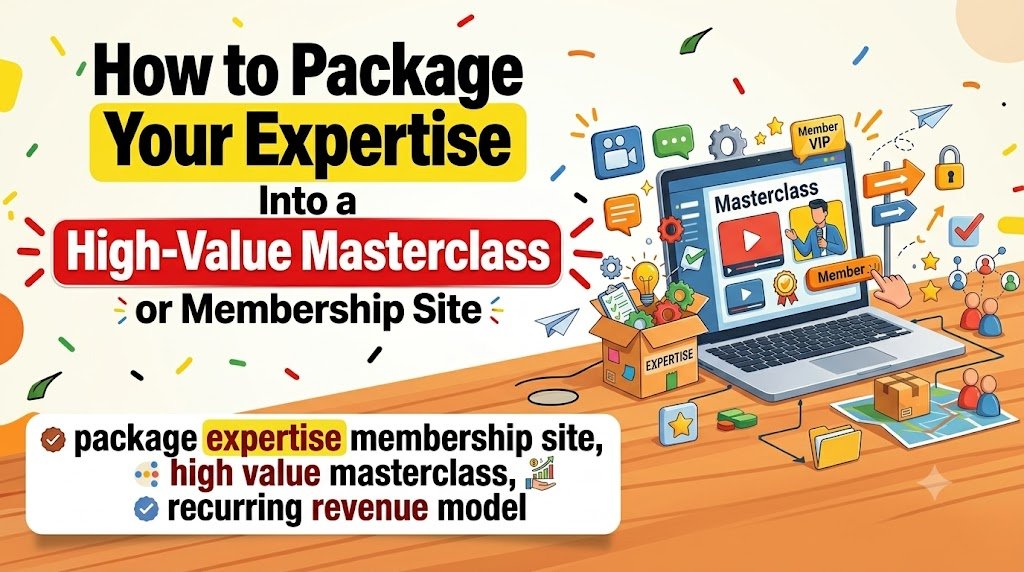
Turn What You Know Into a Digital Learning Business That Delivers Real Value, Attracts Loyal Customers, and Builds Recurring Revenue
Imagine waking up to discover that someone has purchased access to your knowledge while you were sleeping. You haven’t scheduled another client meeting, repeated the same presentation, or exchanged another hour of your day for payment.
Instead, someone has enrolled in a masterclass you created weeks ago or joined a membership community where your expertise helps people achieve meaningful results.
This is one of the most attractive opportunities in the modern creator economy: turning valuable knowledge into an educational product that can generate revenue beyond one-to-one client work.
You don’t necessarily need millions of followers, a university degree, or expensive production equipment. What you need is a valuable skill, a clearly defined audience, a genuine understanding of its problems, and a structured way to help people make progress.
Whether you’re a freelance designer, writer, consultant, marketer, photographer, business coach, educator, or experienced professional, your knowledge may already contain the foundations of a profitable digital learning business.
But there is an important distinction.
People rarely pay premium prices simply to access information. They pay for clarity, structure, implementation support, and the possibility of achieving a result they care about.
That’s why learning how to package expertise into a membership site or high-value masterclass is about much more than recording videos and uploading them to a website.
It’s about transforming what you know into an experience people find worth purchasing, completing, recommending, and potentially renewing.
In this guide, you’ll discover how to choose a profitable teaching topic, create an effective masterclass, build a sustainable recurring revenue model, attract your first paying students, and turn occasional website visitors into long-term customers.
1. Why Your Expertise Could Be More Valuable Than You Think
Many professionals underestimate the commercial value of their experience because the skills they use every day feel ordinary to them.
A graphic designer might consider creating professional branding materials a routine task.
A freelance writer may think outlining articles is simple.
An experienced spreadsheet user might not realize how much time small business owners waste trying to organize financial information.
What feels familiar to you may represent a difficult, expensive, or frustrating problem for someone else.
That difference creates an opportunity.
Knowledge becomes commercially valuable when it solves a specific problem
Consider two educational offers.
Offer A: Learn Everything About Digital Marketing.
Offer B: Build Your First Email Marketing Funnel in Seven Days Using Ready-to-Use Templates.
The second offer provides a clearer picture of what the student will learn, the intended outcome, and the effort involved.
It is easier for a potential buyer to understand why the training might be useful.
This principle applies across industries.
A broad course about photography becomes more compelling when positioned as a practical workshop about taking professional product photographs with a smartphone.
A general productivity course becomes more attractive when it teaches freelancers how to plan their working week and reduce missed deadlines.
A business consulting program becomes easier to evaluate when it helps new service providers design their first client onboarding system.
The opportunity is not necessarily to teach everything you know.
It’s to identify the part of your expertise that solves a meaningful problem for a clearly defined audience.
The Expertise Value Formula
A useful way to evaluate a teaching idea is:
Perceived Educational Value = Problem Relevance + Outcome Clarity + Practical Guidance + Trust + Learner Support
This is a positioning framework, not a mathematical guarantee of sales.
The more relevant the problem, the clearer the benefit, and the more credible the learning experience, the easier it becomes for potential customers to evaluate your offer.
Action step: Write down five problems people regularly ask you to help solve. Circle the one that is specific, recurring, and important enough that someone may be willing to pay for a structured solution.
2. Masterclass vs. Membership Site: Which Business Model Should You Choose?
Before building a course website, decide what kind of learning experience you want to sell.
A high-value masterclass and a paid membership can both monetize your knowledge, but they serve different customer needs.
What is a high-value masterclass?
A high-value masterclass is a focused educational experience designed to help students develop a skill, complete a project, or solve a specific problem.
It may be delivered through prerecorded lessons, live workshops, guided exercises, downloadable resources, or a combination of formats.
For example:
The 14-Day AI Content Workflow Masterclass
Students learn how to research topics, create editorial briefs, draft content responsibly, review factual accuracy, and develop a repeatable publishing process.
A masterclass works particularly well when the promised learning outcome has a clear beginning and end.
What is a membership site?
A membership site is a private learning environment where customers pay for continuing access to educational resources, community participation, expert guidance, or regularly updated tools.
For example:
The Content Growth Lab
Members receive access to a resource library, monthly publishing workshops, new workflow templates, community discussions, and periodic feedback sessions.
Memberships work best when customers have a reason to keep participating after completing their initial training.
A sustainable recurring revenue model depends on ongoing value, not simply recurring billing.
Comparing the two models
| Feature | Masterclass | Membership Site |
|---|---|---|
| Primary value | Focused learning outcome | Continuing improvement |
| Typical payment | One-time purchase | Monthly or annual subscription |
| Content delivery | Structured curriculum | Library plus continuing resources |
| Customer relationship | Course completion focused | Retention and engagement focused |
| Maintenance | Periodic updates | Regular ongoing delivery |
| Revenue pattern | Depends on new or repeat purchases | Recurring but subject to cancellations |
| Best suited for | Specific projects and skills | Evolving skills and continuing needs |
The hybrid model: A powerful option for experienced creators
You don’t necessarily need to choose just one.
A hybrid learning business can offer a standalone masterclass alongside an optional membership.
For example:
- Customers purchase a $99 masterclass about starting a digital product business.
- Graduates can optionally join a $29 monthly community for feedback, updated templates, and continuing support.
- Advanced learners may later purchase specialized workshops.
These prices are illustrative, not market benchmarks.
The advantage is that each offer serves a different stage of the customer journey.
The masterclass teaches the system. The membership helps people keep using and improving it.
A hybrid approach can also reduce pressure to constantly create new standalone courses.
3. Identify a Profitable Niche Before Creating Your Content
One of the biggest mistakes aspiring course creators make is spending months producing lessons before confirming that anyone wants to buy them.
A polished course doesn’t automatically create market demand.
Start with the customer problem.
Find the intersection of expertise, demand, and willingness to pay
A promising educational niche should satisfy three conditions:
You can teach it credibly. Your knowledge comes from practical experience, professional training, meaningful projects, or demonstrated skill.
People actively want help with it. You can find evidence through customer questions, search behavior, professional communities, or existing purchasing activity.
The problem is worth solving. Your audience has a reason to invest time, money, or both.
Potential niches include:
- AI-assisted workflows for freelancers and small businesses.
- SEO content planning for independent website owners.
- Financial spreadsheet skills for entrepreneurs.
- Smartphone product photography for online sellers.
- Client communication systems for service providers.
- Digital product design using accessible tools.
- Career portfolio development for job seekers.
- Online teaching methods for subject experts.
Narrowing your audience can make your offer more attractive.
Instead of creating a course called Social Media Marketing, consider Instagram Content Planning for Independent Beauty Professionals.
Specificity makes it easier to shape examples, create relevant exercises, and communicate the benefits.
Validate the idea before building
Use a simple validation process.
First, collect real audience questions.
Explore customer conversations, relevant forums, industry communities, search suggestions, and existing educational products.
Look for recurring frustrations such as:
“I understand the basics, but I don’t know where to start.”
“I’ve tried several tools, but I can’t make them work together.”
“I need a step-by-step process, not another collection of random tutorials.”
Second, interview potential learners.
Ask what they’ve already tried, where they became stuck, and what a successful outcome would look like.
Avoid asking only whether someone likes your course idea. Interest without purchasing intent can be misleading.
Third, test a small paid offer.
Run a focused live workshop or invite a limited number of beta students to join a clearly described pilot program.
Make sure buyers understand what is available now and what will be delivered later.
A small number of genuine paying customers can provide stronger demand evidence than hundreds of social media likes.
Action step: Before producing a full course, write a one-paragraph offer and show it to ten people who genuinely match your ideal customer profile. Use their questions and objections to improve the concept.
4. Build a High-Value Masterclass Around Transformation, Not Information
You can find an enormous amount of free educational content online.
Therefore, charging money for information alone can be difficult unless the material offers something meaningfully different.
The value of a strong masterclass lies in how effectively it helps learners move from uncertainty to practical capability.
Define the learner’s starting point and destination
Before recording anything, complete this statement:
This masterclass helps [specific audience] move from [current challenge] to [achievable result] using [your teaching method].
For example:
“This masterclass helps new bloggers move from inconsistent content planning to building a practical 30-day publishing calendar using topic research, reusable templates, and a repeatable editorial workflow.”
Notice that the promise describes a process and a realistic deliverable rather than guaranteeing traffic, income, or rankings.
Create a clear curriculum
Suppose you’re developing a course called:
Build Your First Professional Digital Product in 14 Days
A practical curriculum might include:
Module 1: Find the Right Product Opportunity
Help learners identify a target audience, research competing offers, and evaluate customer problems.
Module 2: Design the Product Structure
Teach students to define deliverables, organize content, and outline a simple product.
Module 3: Create the Core Product
Demonstrate practical production methods, quality control, and accessibility considerations.
Module 4: Develop Professional Packaging
Cover naming, product descriptions, previews, instructions, and presentation.
Module 5: Prepare the Sales Experience
Introduce a sales page, pricing, checkout configuration, and customer communication.
Module 6: Launch and Evaluate
Guide students through launch preparation, gathering feedback, and making useful improvements.
Each module should have an identifiable learning objective and a practical activity.
Include implementation assets
Useful supporting materials might include:
- Worksheets that help students make decisions.
- Templates that reduce repetitive setup work.
- Checklists that prevent common mistakes.
- Worked examples showing completed tasks.
- Mini-projects that demonstrate skill application.
- Self-assessments that help learners identify gaps.
A 90-minute class supported by excellent examples and exercises may be more useful than a ten-hour video library with little practical direction.
A premium educational experience is defined by the quality of the learning journey, not the number of videos.
5. Create a Membership Site People Want to Renew
A membership site can appear attractive because it creates the possibility of monthly recurring revenue.
However, recurring revenue also creates recurring responsibilities.
If customers stop receiving meaningful value, they may cancel.
This makes retention one of the most important parts of membership business design.
Build around a recurring customer need
A membership should answer one central question:
Why would someone continue paying after the first month?
Strong reasons may include continuing skill development, accountability, access to expert feedback, professional networking, updated resources, or regular problem-solving support.
For example, someone learning the basics of spreadsheet formulas may only need a standalone course.
A small business owner who frequently creates financial reports, tracks projects, and updates business processes may benefit from an ongoing learning library and monthly help sessions.
The second situation offers a more natural reason for membership.
Design a sustainable membership experience
A simple membership might include a core training library, a monthly group workshop, a curated collection of templates, and a moderated discussion area.
Members should know exactly what they are paying for.
Avoid promising daily live sessions or unlimited personal coaching unless your pricing and available time make those commitments sustainable.
A consistent monthly workshop delivered well is often more useful than an ambitious schedule that becomes difficult to maintain.
Focus on the first 30 days
Members are especially likely to evaluate their purchase during the onboarding period.
Help them experience progress early.
A useful onboarding journey could look like this:
Day 1: Welcome message, clear navigation, and a recommended first lesson.
Day 3: A practical quick-win exercise that takes less than 30 minutes.
Day 7: A progress check and an invitation to ask questions.
Day 14: A recommended next learning path.
Day 30: A member feedback request and a summary of available upcoming resources.
These touchpoints can be partly automated, but they should still feel relevant and helpful.
The goal is not to send more messages.
It’s to reduce confusion and help members benefit from what they’ve purchased.
6. Price Your Masterclass or Membership for Value and Sustainability
Pricing educational products requires balancing perceived value, competitive alternatives, audience purchasing power, delivery costs, and the depth of support.
There is no universal price that guarantees a successful course launch.
Example pricing structures
The following are hypothetical starting points for testing, not verified average market prices.
| Offer Type | Illustrative Price | Included Value |
|---|---|---|
| Introductory workshop | $19–$49 | Focused training and worksheet |
| Self-paced masterclass | $79–$199 | Structured lessons and templates |
| Supported masterclass | $199–$599 | Training plus group feedback |
| Resource membership | $15–$39/month | Library and periodic updates |
| Community membership | $39–$99/month | Workshops, community, and support |
| Advanced cohort program | $500+ | Intensive teaching and guided implementation |
Prices should be adjusted for the audience, subject, instructor credibility, and service commitments.
A highly specialized professional training program may justify substantially different pricing from an introductory hobby workshop.
Understand recurring revenue mathematics
Suppose your membership costs $29 per month.
<text-placeholder> </text-placeholder>
With 100 active members, monthly recurring revenue would be:
100 × $29 = $2,900 MRR
At 250 active members:
250 × $29 = $7,250 MRR
At 500 active members:
500 × $29 = $14,500 MRR
These are hypothetical gross monthly revenue figures before payment processing fees, software expenses, marketing costs, refunds, taxes, staffing, and other operating expenses.
They also assume all the members are paying the same full monthly price.
Why churn matters more than many beginners realize
Churn refers to customers canceling their subscriptions during a given period.
Imagine that you begin a month with 100 active members and 5 cancel during that month.
Your monthly member churn rate would be 5%, assuming no adjustments for reactivations or other membership changes.
If you acquire only three new members during that same period, your membership count declines rather than grows.
This reveals an important business principle:
A membership business grows sustainably when customer acquisition and retention work together.
Monitor new members, cancellations, active paying subscribers, monthly recurring revenue, customer acquisition cost, and delivery profitability.
Where possible, also measure how often members complete meaningful activities and whether they feel the learning experience is useful.
7. Choose the Right Technology Without Building an Unnecessarily Complicated Website
You do not need to develop custom software to sell educational products.
For most independent experts, an established course or membership platform can provide the necessary starting infrastructure.
Options to evaluate include Teachable, Thinkific, Kajabi, Podia, and WordPress-based learning management systems.
Different platforms support different combinations of course hosting, subscriptions, community features, payments, email marketing, and automation.
Before choosing, investigate the current plans, feature limitations, transaction fees, payout availability, tax settings, and cancellation tools in your location.
The essential features
A practical setup should offer secure account access, a mobile-friendly learning interface, organized lessons, reliable checkout, clear subscription management, email communication, and basic reporting.
Depending on your audience, you may also need captions, downloadable transcripts, multiple payment methods, community moderation, and integrations with existing business tools.
Prioritize simplicity.
A fast, understandable website with excellent educational content is more useful than an elaborate platform that makes enrollment and learning difficult.
Design the first-time user experience
A visitor should quickly understand:
- Who the program is designed for.
- What skills or results it helps develop.
- What is included in the purchase.
- How the learning experience works.
- What the price and renewal terms are.
- How to request support or cancel a subscription.
Create a prominent course overview, a sample lesson, an understandable curriculum page, and a transparent checkout process.
Mobile optimization is especially important because prospective students may discover the offer through social media or search while using a smartphone.
8. Create a Sales Page That Converts Interest Into Enrollment
A high-converting masterclass sales page doesn’t need exaggerated promises or aggressive countdown timers.
It needs to answer the questions a serious buyer naturally asks.
What will I learn?
Is this designed for someone like me?
Can I trust the instructor?
What exactly will I receive?
Is the price reasonable for the value offered?
Use a clear, benefit-driven headline
Consider this example:
Build a Professional Content Publishing System Without Starting From Scratch Every Week
Supporting description:
“A practical masterclass for bloggers and digital creators who want to plan, organize, and improve their publishing workflow using reusable templates and guided lessons.”
The headline identifies the desired improvement without promising guaranteed results.
Demonstrate what is included
Rather than writing “Get access to exclusive premium resources,” describe the materials specifically.
For example:
“Includes six guided modules, a 30-day content planner, downloadable editorial checklists, three worked examples, and a course completion roadmap.”
Concrete deliverables make it easier for buyers to compare the price with their needs.
Build trust with transparent proof
Credibility might come from your professional background, authentic project examples, real student feedback, demonstrations, or a free sample lesson.
Only use testimonials from genuine customers and obtain any necessary permissions.
If the course is new, explain that it is a new program rather than suggesting an established track record.
Place CTAs where they make sense
For a masterclass sales page, useful calls to action include:
“Explore the Masterclass Curriculum”
“Watch a Free Sample Lesson”
“See What’s Included”
“Enroll in the Masterclass”
For a membership:
“Explore Membership Benefits”
“View This Month’s Learning Resources”
“Join the Learning Community”
The strongest CTA depends on the buyer’s readiness.
Someone discovering your program for the first time may prefer a sample lesson, while a returning visitor comparing prices may be ready to enroll.
9. Build an Evergreen Marketing Funnel That Attracts Students Consistently
An evergreen sales funnel helps potential customers discover your educational content, understand your approach, and decide whether to purchase.
An effective funnel doesn’t force every visitor to buy immediately.
Instead, it creates a logical journey from discovery to trust to action.
Stage 1: Attract the right visitors
Publish genuinely helpful content related to problems your masterclass solves.
For example, an expert selling a course about building digital products could publish articles such as:
“How to Validate a Digital Product Idea Before Spending Money”
“7 Mistakes Beginners Make When Pricing Digital Downloads”
“How to Create a Digital Product Sales Page That Explains Its Value”
These subjects attract readers who may eventually need more structured assistance.
Stage 2: Offer a valuable free resource
A lead magnet gives visitors a practical reason to subscribe to your email updates.
Examples include a downloadable product-planning worksheet, a lesson preview, a beginner checklist, or a mini training session.
The resource should provide genuine value even if the subscriber never makes a purchase.
Stage 3: Develop the relationship through email
A simple welcome sequence could include:
Email 1: Deliver the promised resource.
Email 2: Explain a common beginner mistake and how to avoid it.
Email 3: Share a practical demonstration or useful example.
Email 4: Introduce the masterclass as an optional structured learning path.
Email 5: Answer common questions and provide a clear enrollment link.
Use a relevant subject line, avoid excessive messaging, and make unsubscribing straightforward.
Stage 4: Convert with appropriate offers
A small percentage of interested readers may be ready to buy right away.
Others may need to review the curriculum, read more educational content, or return later.
Provide opportunities for both groups.
Stage 5: Encourage customers to return
A completed purchase should begin a useful customer relationship, not end it.
Send onboarding instructions, recommend relevant lessons, highlight new resources, and invite feedback.
For members, regular communication about upcoming activities can reinforce the reasons they subscribed.
The most durable sales funnel is one that builds trust before the transaction and continues delivering value afterward.
10. Turn First-Time Visitors Into Returning Readers and Future Customers
Not everyone who reads a useful article is ready to join a program.
Some are researching the topic. Others are comparing solutions or learning basic terminology.
That’s why repeat visits matter.
Create connected educational content
Build a topic cluster around the subject you teach.
For a membership focused on AI-assisted content production, related articles might explore editorial planning, content review, research workflows, productivity systems, and responsible AI use.
Link naturally between articles when the next page provides additional useful information.
This gives readers a reason to continue exploring your website.
Give people a reason to return
Create a regularly updated resource collection, an educational email series, a useful downloadable template, or a monthly workshop preview.
A returning-visitor message might say:
“Already working on your content calendar? Explore the next tutorial on turning your plan into a repeatable publishing workflow.”
This approach respects the visitor’s progress rather than treating everyone as a new prospect.
Build recognition through consistency
Use a recognizable teaching style, consistent terminology, clear visual design, and helpful examples.
Visitors should be able to understand what your website specializes in and why returning could be worthwhile.
Over time, a coherent collection of trustworthy content can help establish credibility with both human readers and search systems.
11. Improve Visibility Through SEO, AEO, GEO, and Search-Friendly Content
Search visibility is especially useful for expertise businesses because people frequently search for solutions before purchasing educational products.
For example, someone searching for “how to build a membership website for beginners” may have a different intention from someone searching for “best membership platform for paid courses.”
Both searches may be relevant, but the content should match what each searcher needs.
Create content around search intent
Educational search intent includes learning concepts, understanding processes, and comparing methods.
Commercial search intent involves evaluating tools, prices, training programs, or services.
A strong content strategy should serve both without forcing every article into an obvious sales pitch.
Use natural variations of relevant phrases such as package expertise membership site, high value masterclass, recurring revenue model, online course creation, sell your knowledge online, membership website for beginners, course pricing strategy, and subscription learning business where they genuinely fit the discussion.
Longer search questions are also useful editorial prompts.
For example, “How do I turn consulting experience into an online course?” reveals a more specific audience need than the broad phrase “online education.”
Write complete answers instead of repeating keywords unnecessarily.
Make answers easy to understand and reference
Answer Engine Optimization (AEO) focuses on making useful answers accessible and understandable to search-driven experiences.
Generative Engine Optimization (GEO) is commonly used to describe visibility strategies for AI-assisted discovery.
For this topic, a concise answer might be:
How do you package expertise into a membership site?
Start by identifying a specific audience problem, validating willingness to pay, organizing your expertise into a practical learning pathway, choosing reliable membership technology, and delivering ongoing benefits that justify subscription renewal.
Support concise explanations with detailed examples, meaningful headings, original demonstrations, and evidence where relevant.
Google’s published guidance emphasizes that established SEO practices, original value, technical accessibility, and helpful content remain important for generative AI search experiences. There is no guaranteed special optimization that secures a citation or placement.
Add appropriate structured data
For a published educational article, relevant Article or BlogPosting structured data can help describe the page’s headline, author, publication date, and representative imagery.
Structured data should accurately match the visible page content.
When publishing a genuine course landing page, evaluate whether the available course-related markup is appropriate for that particular page and eligible for any currently supported search feature.
Structured data improves machine-readable clarity; it does not guarantee enhanced search results.
Strengthen your publication experience
Use a descriptive title, useful introduction, logical headings, readable typography, accessible images, and a well-designed mobile layout.
Include relevant internal links and maintain accurate publication information.
For Google Discover, choose a representative, high-resolution featured image that fits the subject rather than using sensational imagery.
A visual showing an expert teaching students through a digital learning platform could be suitable for this article.
Because search appearance and interest patterns change, evaluate performance using actual website data instead of assuming a trending keyword will automatically produce traffic.
12. Use AI to Improve Course Production Without Replacing Your Expertise
AI tools can accelerate certain parts of masterclass creation, but the educational value should still come from reliable subject knowledge and thoughtful instruction.
You can use AI-assisted workflows to explore curriculum structures, create draft worksheets, generate practice scenarios, summarize non-sensitive feedback, and prepare alternative explanations for difficult concepts.
However, automatically generated content may contain inaccuracies, incomplete explanations, or examples that don’t reflect real-world conditions.
Review every lesson carefully.
For specialized topics such as health, law, financial decision-making, and regulated professional services, appropriate expert oversight is especially important.
Build your own signature teaching system
A memorable teaching framework can make your masterclass easier to follow.
For example, consider the CLEAR Learning Framework:
C — Clarify: Identify the precise problem and desired learning outcome.
L — Learn: Explain the essential concepts without unnecessary complexity.
E — Execute: Demonstrate the process through realistic examples.
A — Apply: Give learners a practical exercise to complete.
R — Review: Evaluate results, correct mistakes, and identify the next step.
This is an illustrative instructional framework, not a scientifically validated teaching model.
The goal is to create a repeatable learning experience that moves beyond passive video consumption.
Your examples, demonstrations, explanations, and judgment are the qualities that can distinguish your program from generic information.
13. Automate Delivery Without Making the Experience Impersonal
Automation can reduce administrative work and help you serve more learners.
Useful automations include enrollment confirmations, account setup instructions, welcome messages, payment receipts, lesson reminders, and notifications about scheduled workshops.
You can also automate some reporting and feedback collection.
But not every interaction should be automated.
Complex student questions, billing disputes, complaints, and sensitive concerns may require personal attention.
Separate repeatable tasks from relationship-building tasks
Automate tasks that have a predictable process.
Reserve human attention for activities where judgment, empathy, or professional feedback creates meaningful value.
For example, an automated welcome email can explain how to navigate the platform.
A live monthly feedback session can help members apply lessons to their own projects.
Together, they create a system that is both efficient and supportive.
Document your operations
Create internal instructions for uploading lessons, responding to support requests, handling failed payments, moderating discussions, processing cancellations, and updating resources.
Documenting these procedures makes the business easier to maintain and can simplify delegation as it grows.
Automation should make your expertise easier to access, not make paying customers feel ignored.
14. Measure What Matters: From Course Sales to Member Retention
A successful educational business needs more than website traffic and attractive sales figures.
Measure whether people are finding the right offer, purchasing it, using it, and receiving the value they expected.
Track the customer journey
Important measurements include:
Visitor-to-lead conversion rate: The percentage of website visitors who subscribe or register for a useful free resource.
Lead-to-customer conversion rate: The proportion of leads who become paying customers.
Course completion rate: The percentage of students who complete the defined learning pathway, measured consistently.
Monthly recurring revenue: The monthly recurring subscription revenue from active paying members.
Member churn rate: The proportion of members who cancel during a specified period.
Customer acquisition cost: The marketing and sales expense associated with acquiring a customer, calculated using a clearly defined attribution method.
Refund rate: The proportion of transactions refunded during a defined period.
Member engagement: Participation in lessons, workshops, exercises, and community activities.
Example of a simple conversion calculation
Suppose a course landing page attracts 2,000 visitors during a month and 40 make a purchase.
Your visitor-to-purchase conversion rate is:
40 ÷ 2,000 × 100 = 2%
This figure is illustrative, not a benchmark.
To improve results, examine whether visitors understand the offer, whether the traffic matches the intended audience, whether the price and deliverables are clear, and whether the checkout experience works properly.
Do not assume that a low conversion rate always means the copy needs to be more persuasive.
Sometimes the offer needs to change.
Listen to students as closely as you monitor analytics
Quantitative reports help show what is happening.
Student feedback can help explain why.
Ask learners which lessons were most useful, where they encountered confusion, what resources they still need, and whether the program delivered the learning experience described.
Use that feedback to make your curriculum and membership more effective.
15. A Practical 30-Day Launch Plan for Your First Educational Offer
You don’t need to build a large membership platform immediately.
A focused launch can help establish whether the business concept deserves further investment.
Days 1–5: Identify and validate the opportunity
Choose a subject based on your credible expertise and a clearly defined problem.
Research your intended audience, review competing learning offers, and speak with potential learners.
Create a simple description of the proposed transformation.
Days 6–10: Design the teaching experience
Outline your modules, learning objectives, supporting materials, and practical assignments.
Decide whether the initial product will be a live workshop, self-paced masterclass, or small pilot membership.
Choose a delivery format that matches your available time.
Days 11–15: Create the minimum viable learning product
Produce the essential teaching materials needed to deliver the first promised outcome.
Prioritize accurate instruction, clear demonstrations, and useful exercises.
Avoid spending most of your resources on decorative elements.
Days 16–20: Prepare the sales experience
Create a clear landing page explaining who the program serves, the curriculum, the price, what is included, and any access or refund conditions.
Set up payments and test the enrollment process.
Create a sample lesson or useful free resource.
Days 21–25: Invite initial customers
Share relevant educational content through channels where your audience already spends time.
Invite qualified prospects to the paid pilot, communicate the exact delivery terms, and answer their questions.
Avoid manufacturing scarcity or guaranteeing financial outcomes.
Days 26–30: Deliver, evaluate, and improve
Welcome your learners, deliver the promised materials, gather feedback, and review early performance.
Identify which parts of the experience worked well and where changes would make the greatest difference.
At the end of the month, you may have enough evidence to improve your offer and plan the next stage.
You should not expect this schedule to guarantee a profitable launch. Course complexity, expertise, audience access, and production needs will affect the timeline.
16. Common Mistakes That Can Undermine an Expertise Business
Trying to teach everyone
An offer that targets everyone often struggles to communicate why it is particularly useful to anyone.
Define a specific starting audience, then expand only when there is evidence of demand.
Creating too much content before selling
Large video libraries can consume significant time and money.
Validate the offer first and build around the learning outcomes that customers actually need.
Promising unrealistic results
Claims about guaranteed income, rapid career success, or automatic business growth can damage trust and create compliance concerns.
Describe what the training teaches and supports rather than promising outcomes beyond your control.
Underpricing an expensive membership
Low subscription prices can become unsustainable if members expect extensive personal coaching and live support.
Calculate service costs before establishing benefits.
Ignoring onboarding
Students who cannot find their first lesson or understand what to do next may disengage.
Make the first experience simple and useful.
Confusing content volume with customer value
Constantly adding resources does not necessarily improve the membership.
New material should address actual learner needs.
Treating passive income as zero-work income
Self-paced courses can reduce repeated teaching time, but marketing, content updates, technical operations, customer service, and quality assurance still require attention.
A membership typically requires even more ongoing involvement.
17. How to Scale Beyond Your First Masterclass
Once an initial offer attracts satisfied customers and demonstrates viable unit economics, consider growing the business carefully.
One approach is to create an educational product ladder.
Start with a free article or learning resource that helps visitors understand a problem.
Offer an affordable introductory workshop for readers who want structured guidance.
Develop a more complete masterclass for customers seeking deeper learning.
Introduce an optional membership for customers who need continued education or support.
Later, a specialized advanced program may serve learners with more complex needs.
Each level should provide additional, clearly differentiated value.
Avoid making essential instructions deliberately incomplete just to pressure customers into buying the next tier.
You can also expand through relevant partnerships, referral arrangements, group licensing, or employer training packages where appropriate.
The priority is to preserve quality while testing new revenue opportunities.
A strong education business becomes more valuable when its systems, content, customer relationships, and reputation improve together.
18. Your Expertise Can Become a Business Asset That Grows Over Time
The most important shift is moving from selling isolated hours of work to creating a repeatable educational experience.
When your knowledge exists only in individual conversations, its reach is limited by your available time.
When you organize it into clear lessons, practical resources, and structured learning pathways, more people can benefit from it without requiring you to deliver every explanation individually.
That doesn’t make the business effortless.
It makes certain parts of the educational experience reusable.
Over time, a carefully maintained masterclass can become a valuable digital asset.
An effective membership can add continuity through community, support, updated resources, and continuing learning opportunities.
But long-term success is not simply about collecting subscription payments.
It’s about creating a program customers can understand, trust, use, and recommend.
Start with one audience. Solve one meaningful problem. Build one credible learning experience. Improve it using real feedback.
Your knowledge does not need to be packaged into a giant course library before it can help people.
It needs to be presented in a way that makes learning practical, accessible, and worthwhile.
And when the educational value is strong enough, a masterclass or membership site can become a meaningful part of a diversified digital business.
Frequently Asked Questions
1. How do I package my expertise into a membership site if I have never created an online course?
Begin by identifying a problem you can credibly teach people to solve. Define the intended audience, develop a small learning pathway, and test the concept through a paid workshop or pilot program. Use the feedback to improve your teaching before investing in a full membership site. Once you identify a genuine need for continuing resources or support, you can introduce a recurring subscription.
2. What makes a high-value masterclass different from a regular online course?
A high-value masterclass typically emphasizes a focused learning outcome, effective teaching, practical application, and appropriate supporting resources. Its value does not depend on an expensive price or a large number of lessons. Students should understand what they will learn, why the instructor is credible, and how the program helps them apply the knowledge.
3. How much should I charge for a membership website?
Membership pricing depends on the audience, value provided, support obligations, competitive alternatives, and operating costs. A simple learning-resource subscription may be priced differently from a program offering frequent expert feedback. Test a price that customers understand and that can sustainably cover your costs. Review retention and profitability rather than focusing only on the number of subscribers.
4. Can a masterclass or membership site generate passive income?
A self-paced masterclass may generate sales without requiring live instruction for every customer. However, marketing, support, content maintenance, refunds, and administration still require work. Membership revenue may recur automatically while subscribers remain active, but retaining them typically requires ongoing value. These businesses are better understood as potentially scalable or partially automated income models, not guaranteed passive income.
5. How can I attract paying members without a large social media following?
Focus on a narrowly defined customer problem and publish useful, search-friendly content around it. Offer an informative free resource, demonstrate your teaching style, build an email audience with consent, and invite relevant prospects to a clearly described workshop or membership. Referral partnerships and authentic recommendations can also help. A smaller audience with strong interest in the subject may be more commercially relevant than a large, disengaged following.
Build Your First Learning Offer With Confidence
You don’t need to create dozens of lessons or launch an expensive platform to begin.
Choose one area of expertise, identify the people who need it, and design a learning experience that helps them make meaningful progress.
Ready to turn your knowledge into a product? Start by outlining your first masterclass, validating the offer with potential learners, and building a practical lesson they can genuinely use.
If you’re still exploring the opportunity, save this guide and return to the 30-day launch roadmap when you’re ready to test your first educational offer.
For continuing growth, explore related resources on digital product development, sales funnels, online course marketing, and sustainable recurring revenue strategies.
Compliance Note
Educational and business information: This article is provided for general educational and informational purposes. It does not constitute personalized business, financial, legal, tax, or professional advice. Readers should evaluate decisions in light of their individual circumstances and consult qualified professionals where necessary.
Income and performance claims: Examples of course pricing, sales calculations, subscription revenue, and business models are illustrative only. They are not verified market averages or promises of future earnings. Actual revenue and profitability depend on customer demand, pricing, marketing effectiveness, retention, costs, competition, and other factors. No sales, income, conversion, or search-ranking outcome is guaranteed.
Subscriptions and consumer protection: Membership operators should clearly disclose billing frequency, total charges, automatic renewals, cancellation procedures, refund conditions, and any material restrictions before accepting payment. Applicable consumer protection, digital service, advertising, accessibility, and subscription laws vary by location. Follow the requirements of the jurisdictions where the business operates and sells.
Privacy and email marketing: Obtain appropriate consent where required, protect customer information, publish accurate privacy notices, and provide functional unsubscribe and account-management options. Comply with applicable privacy and marketing laws, including relevant requirements under GDPR, CAN-SPAM, India’s Digital Personal Data Protection framework, and other applicable regulations, as they become operative.
Intellectual property and teaching materials: Use original or properly licensed lessons, photographs, videos, templates, illustrations, software demonstrations, and supporting materials. Respect copyright, trademark, licensing, confidentiality, and third-party platform terms.
Testimonials, affiliations, and advertising: Present authentic reviews, disclose material commercial relationships and affiliate commissions where required, and avoid misleading testimonials, fabricated case studies, unsupported endorsements, artificial scarcity, or unsubstantiated success claims.
AI-assisted content: Independently review AI-generated teaching materials for accuracy, originality, intellectual property compliance, bias, and relevance. Protect confidential information and use suitable expert oversight for specialized or regulated educational subjects.
Search visibility and publishing: SEO, AEO, GEO, structured data, and Google Discover optimization may improve content clarity and discoverability but cannot guarantee indexing, placement, citations, traffic, or rankings. Follow current search platform policies and prioritize original, reliable, user-focused information. Update examples, external references, software details, and time-sensitive statements as needed.
Disclosure: Any references to software platforms or educational tools are informational examples and do not imply sponsorship, endorsement, or an existing commercial relationship.
Last reviewed: October 9, 2026. Readers should independently verify current platform features, pricing, and applicable legal requirements before making business decisions.
Stay ahead with exclusive updates
Join our community. Get curated industry trends, actionable guides, and fresh resources delivered straight to your inbox.