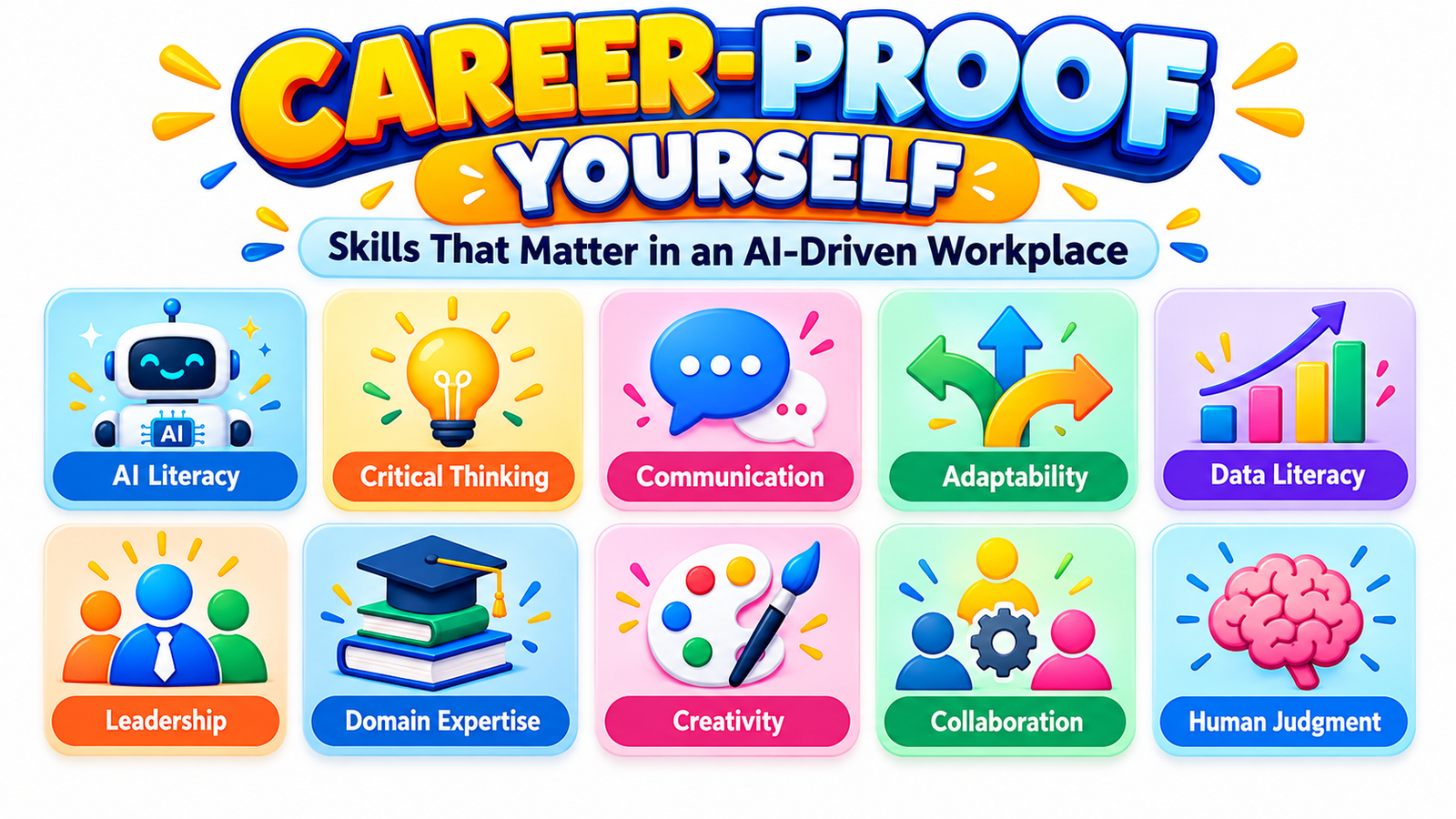
Skills That Matter in an AI-Driven Workplace
Artificial intelligence is changing work faster than most career playbooks were designed to handle.
Tasks that once required hours of research can now be completed in minutes. AI assistants can summarize meetings, draft reports, analyze documents, generate presentations, write code, brainstorm marketing ideas, support customer service and automate increasingly complex workflows.
That can make the future of work feel uncertain.
But career uncertainty does not mean career opportunity is disappearing. It means the definition of a valuable professional is changing.
The people best positioned for the AI-driven workplace will not necessarily be those who know the most AI tools. They will be people who know how to combine AI fluency, human judgment, domain expertise, communication, creativity, adaptability and business awareness to produce results that matter.
That distinction is important.
The World Economic Forum projects that global labor-market transformation could create about 170 million jobs while displacing 92 million by 2030, producing a net increase of approximately 78 million roles. At the same time, close to 40% of skills required for jobs are expected to change.
Meanwhile, PwC’s 2026 Global AI Jobs Barometer found that jobs requiring specific AI skills were growing considerably faster than the overall job market, while AI-exposed roles were increasingly rewarding human-intensive capabilities such as judgment and leadership.
The message is not simply “learn AI or lose your job.”
A better message is:
Learn how to create value in a workplace where AI is available to almost everyone.
That is how you begin to build a truly future-proof career.
What Does It Mean to Career-Proof Yourself in the AI Age?
Career-proofing does not mean finding a profession that technology will never change.
Very few careers work that way.
A career becomes more resilient when you develop a combination of capabilities that allows you to move between tools, responsibilities, projects, industries and opportunities as conditions change.
Think of career security less as a job title and more as a portfolio of valuable skills.
A traditional career strategy might have looked like this:
Learn a profession → gain experience → become senior → protect your position.
An AI-era career strategy looks more like:
Build expertise → learn AI → solve better problems → demonstrate outcomes → continuously update your skills.
Your job title may change.
The software you use will certainly change.
Some tasks will disappear.
New responsibilities will appear.
But professionals who repeatedly learn, adapt and solve meaningful problems remain valuable even when the tools around them change.
Why AI Career Skills Matter More Than Ever
AI is no longer limited to technology companies or software developers.
It is becoming part of marketing, finance, healthcare, education, law, sales, operations, design, research, human resources, consulting, administration and entrepreneurship.
LinkedIn’s 2026 Skills on the Rise research points to growing demand not only for technical AI capabilities such as prompt engineering and large language model skills, but also for collaboration, stakeholder communication, mentorship, leadership and business-growth capabilities.
For professionals in India, the pattern is similar. LinkedIn’s 2026 skills data highlights areas including prompt engineering, LLMOps and data storytelling alongside stakeholder management, collaboration and leadership.
This creates an important career principle:
The strongest AI career skills sit at the intersection of technology and human capability.
Knowing AI alone is not enough.
Being creative without understanding modern tools may not be enough either.
The opportunity lies in combining both.
1. AI Literacy: Learn to Work With AI, Not Just Talk About It
You do not need to become a machine-learning engineer to benefit from AI.
But almost every professional should understand what modern AI can do, where it fails and how it fits into their field.
AI literacy includes knowing how to:
- Write useful instructions and prompts
- Provide context and examples
- Break large problems into smaller tasks
- Evaluate AI-generated answers
- Identify hallucinations or unsupported claims
- Compare outputs
- Protect confidential information
- Understand basic automation
- Work with AI assistants and agents
- Know when human review is essential
The World Economic Forum identifies AI and big data among the fastest-growing skill areas expected through 2030.
The practical lesson is simple:
Do not try to memorize every AI platform. Learn transferable AI-working skills.
Tools will change.
The ability to instruct, supervise, verify and integrate AI into real work is far more durable.
Try This
Choose one task you perform every week.
Ask yourself:
Could AI help me research, organize, analyze, draft, check or automate part of this process?
Experiment with that single workflow before chasing ten new tools.
2. Critical Thinking and Judgment
AI can produce answers quickly.
Speed, however, is not the same as correctness.
The more organizations use AI-generated information, the more valuable people become who can determine:
- What is accurate?
- What is missing?
- What assumption is questionable?
- What evidence supports the recommendation?
- What risk has been ignored?
- What should actually be done?
This is why judgment is becoming one of the most valuable skills for jobs in the AI age.
PwC’s 2026 analysis found that AI-exposed entry-level roles were substantially more likely to require capabilities traditionally associated with senior professionals, including judgment and leadership.
AI may help generate ten strategic options.
A valuable professional knows which two deserve attention.
AI can summarize customer complaints.
A valuable manager identifies the underlying business problem.
AI can draft a financial explanation.
A responsible professional checks whether the numbers support it.
The goal is not simply to produce more information.
It is to make better decisions.
3. Communication
AI can draft an email.
That does not mean it understands your colleague, customer, manager or client better than you do.
Strong communication includes:
- Explaining complex topics simply
- Asking intelligent questions
- Listening carefully
- Presenting ideas persuasively
- Handling disagreement
- Writing clearly
- Communicating uncertainty
- Managing expectations
- Influencing stakeholders
As automated content becomes abundant, clarity becomes more valuable.
Consider two employees using exactly the same AI assistant.
Employee A generates a 20-page report.
Employee B turns the information into three recommendations executives can understand and act on.
Who creates more value?
Usually, Employee B.
Communication converts information into action.
That makes it one of the most durable future-of-work skills.
4. Domain Expertise
One of the biggest mistakes professionals can make is assuming AI makes expertise unnecessary.
In many situations, AI makes expertise more powerful.
A marketer with deep customer knowledge can use AI better than someone who simply knows dozens of prompts.
An experienced accountant can notice when an AI-generated interpretation does not fit the financial context.
A teacher understands the learner behind the assignment.
A recruiter understands organizational culture and candidate fit.
A doctor understands that a patient is more than a collection of symptoms.
A lawyer understands the consequences of context, precedent and interpretation.
AI can increase access to information.
Domain expertise helps you determine what that information means.
Instead of asking:
“What career will AI not replace?”
Ask:
“What expertise can I combine with AI so that I become significantly more effective?”
That question creates a much stronger career strategy.
5. Adaptability
The workplace is entering a period where learning once and applying that knowledge for decades is becoming less realistic.
The World Economic Forum expects resilience, flexibility, agility, curiosity and lifelong learning to increase in importance alongside technology skills.
Adaptable workers do several things differently.
They do not become emotionally attached to one software platform.
They learn adjacent skills.
They experiment.
They update their methods.
They ask what their industry will need next rather than focusing only on what it needed yesterday.
A graphic designer might learn AI-assisted creative production.
A writer might learn content strategy and AI research workflows.
An accountant might develop data-analysis capabilities.
A salesperson might learn AI-powered prospect research.
An HR professional might learn workforce analytics.
A project manager might learn workflow automation.
You do not need to reinvent yourself every year.
You do need to remain teachable.
6. Creative Problem-Solving
Generative AI can produce hundreds of ideas.
That makes choosing the right problem increasingly important.
Creativity in the AI era is not only artistic creativity.
It includes:
- Reframing problems
- Combining unrelated ideas
- Discovering new opportunities
- Designing better workflows
- Identifying unmet customer needs
- Experimenting with alternatives
- Finding simpler solutions
The World Economic Forum lists creative thinking among the capabilities expected to rise in importance.
AI can expand the number of possibilities available to you.
Human creativity determines which possibilities deserve development.
7. Data Literacy
You do not have to become a data scientist.
But professionals increasingly need to understand how data supports decisions.
Basic data literacy means being comfortable with:
- Percentages and trends
- Spreadsheets
- Dashboards
- KPIs
- Comparisons
- Data visualization
- Basic statistics
- Data quality
- Correlation versus causation
- Evidence-based recommendations
AI makes sophisticated analysis more accessible.
That is useful.
It also makes it easier to produce impressive-looking analysis that may be wrong.
Professionals who understand both data and AI will be better equipped to ask the right questions and validate the answers.
8. AI Verification and Information Literacy
AI creates a strange workplace problem:
Producing information is becoming easier while verifying information may become more important.
Professionals should develop habits such as:
Check important facts.
Trace claims to reliable sources.
Verify numbers before presenting them.
Distinguish evidence from AI-generated interpretation.
Watch for outdated information.
Treat confident wording as separate from factual reliability.
This skill matters in journalism, business, education, healthcare, finance, legal work, marketing and almost every knowledge profession.
Your reputation will increasingly depend not on whether you can generate information quickly, but whether other people can trust what you deliver.
9. Leadership Without Waiting for a Management Title
Leadership in an AI-driven workplace is not limited to executives.
It includes taking responsibility for outcomes.
That means being able to:
- Coordinate people
- Set priorities
- Delegate effectively
- Make decisions
- Resolve uncertainty
- Mentor others
- Manage AI-supported workflows
- Take ownership when something goes wrong
Microsoft’s workplace research has explored the emergence of human-agent teams in which people increasingly delegate work to AI systems while retaining responsibility for direction and results.
That means tomorrow’s valuable employee may not only manage tasks.
They may manage a mixture of:
their own work + colleagues + contractors + software + AI agents.
The ability to orchestrate resources around an outcome could become a major professional advantage.
10. Business Acumen
A technically impressive skill does not automatically create business value.
Professionals who understand how organizations operate become more difficult to commoditize.
Learn how your employer or clients:
- Make money
- Acquire customers
- Control costs
- Manage risk
- Measure performance
- Retain customers
- Compete
- Build products
- Allocate resources
Then connect your work to those outcomes.
Instead of saying:
“I use AI to create reports.”
Say:
“I redesigned our reporting workflow using AI-assisted analysis, reducing preparation time and allowing the team to respond to customer issues faster.”
The second statement communicates value.
Businesses do not ultimately pay for tools.
They pay for outcomes.
11. Collaboration
Complex work rarely happens alone.
As organizations become more cross-functional, professionals increasingly need to work effectively with people outside their immediate specialization.
A marketer may collaborate with product teams.
A developer may work with legal and security teams.
A finance professional may partner with operations.
An HR specialist may work with data analysts.
AI may make individual employees faster, but major business outcomes still require coordination.
LinkedIn’s 2026 skills research identifies cross-functional collaboration and related people-management skills as growing areas of demand.
Being brilliant but difficult to work with is a weaker career strategy than it once was.
12. Cybersecurity and Digital Responsibility
As employees gain access to increasingly powerful AI systems, they also gain new responsibilities.
A seemingly harmless prompt could expose confidential information.
An AI-generated file could contain incorrect or sensitive material.
Automated systems can scale both productivity and mistakes.
Professionals should understand basics such as:
- Password and account security
- Phishing awareness
- Confidential-data handling
- Access permissions
- Responsible AI use
- Intellectual-property considerations
- Data privacy
- Human approval for high-risk decisions
The World Economic Forum ranks networks and cybersecurity among the fastest-growing skill categories expected through 2030.
Cyber awareness is increasingly becoming part of professional competence rather than something reserved for IT departments.
The Most Powerful Career Strategy: Build a Skill Stack
Career resilience rarely comes from being world-class at one isolated capability.
It often comes from combining several complementary skills.
For example:
Marketing + AI + analytics + copywriting + customer psychology
creates a different professional profile from marketing alone.
Accounting + AI + Excel + financial storytelling + business strategy
creates a different profile from bookkeeping alone.
Teaching + AI + instructional design + communication + digital products
creates new opportunities beyond traditional classroom teaching.
Software development + AI agents + cybersecurity + product thinking
can create a powerful technology skill stack.
HR + people analytics + AI literacy + communication + organizational design
may become increasingly valuable as companies redesign AI-enabled work.
Your goal is not to collect certificates.
Your goal is to create a combination of capabilities that helps you solve valuable problems.
Skills AI Is Likely to Make More Valuable
Some people assume that anything AI can assist with automatically becomes less valuable.
The reality is more nuanced.
When AI makes execution cheaper, complementary capabilities can become more important.
Examples include:
Judgment because someone must evaluate AI-generated recommendations.
Leadership because someone must coordinate people and AI systems.
Creativity because producing generic output becomes easier.
Trust because organizations need reliable professionals.
Domain knowledge because context determines whether an answer is useful.
Communication because someone must explain complex information.
Strategy because producing options is different from choosing direction.
Relationship-building because clients, customers and employees still care about human interaction.
This helps explain why current workforce research increasingly places technical AI skills beside distinctly human capabilities.
Jobs in the AI Age: Where Could Opportunity Grow?
Nobody can predict individual professions perfectly.
What we can identify are broad areas where demand is developing.
The World Economic Forum highlights fast-growing areas including big-data specialists, fintech engineers, AI and machine-learning specialists, software developers, security specialists and a number of green-economy roles.
But you do not necessarily need to move into a job with “AI” in the title.
AI transformation can create opportunities inside existing professions.
Examples may include:
- AI-enabled marketing
- AI-supported financial analysis
- AI workflow design
- AI governance
- AI training
- AI product management
- Automation consulting
- Data storytelling
- AI-assisted research
- Cybersecurity
- Digital transformation
- AI-enabled customer success
- AI operations
- Human-AI workflow management
The smarter question may be:
How is AI changing my existing industry, and which new problems will organizations need people to solve?
That is often where emerging career opportunities appear first.
Stop Competing With AI on the Wrong Tasks
Imagine spending your career trying to become faster at a task that software can increasingly perform instantly.
That is not the best place to build long-term career differentiation.
Instead, move gradually upward in the value chain.
From:
Formatting information
to:
Interpreting information
From:
Writing routine content
to:
Developing communication strategy
From:
Collecting data
to:
Explaining what the data means
From:
Following instructions
to:
Identifying what should be done
From:
Completing isolated tasks
to:
Owning business outcomes
AI should push your career toward higher-value work.
Build Proof, Not Just Knowledge
Learning is important.
Evidence is better.
Employers and clients increasingly want to know what you can actually do.
Create proof.
Build a portfolio.
Document projects.
Create case studies.
Show before-and-after workflows.
Publish useful analysis.
Demonstrate measurable improvements.
For example:
Instead of writing:
“Skilled in generative AI.”
Show:
“Created an AI-assisted customer research workflow that converted hundreds of feedback responses into categorized insights for product planning.”
Instead of:
“Excellent communication skills.”
Show:
“Presented monthly performance findings to cross-functional teams and converted complex analytics into five actionable recommendations.”
Skills become more commercially valuable when people can see the results they produce.
Your 30-Day AI Career-Proofing Plan
You do not need a dramatic career transformation this week.
Start with focused progress.
Week 1: Audit Your Career
List your main responsibilities.
Divide them into three groups:
Routine tasks — predictable work that may be automated.
Expert tasks — work requiring knowledge and judgment.
Human tasks — communication, leadership, relationships and decision-making.
Look carefully at where your value currently comes from.
Week 2: Build AI Fluency
Choose one mainstream AI platform relevant to your work.
Practice using it for:
- Research
- Brainstorming
- Summarization
- Analysis
- Drafting
- Planning
- Quality checking
Learn deeply enough to understand both its power and limitations.
Week 3: Add One Complementary Skill
Choose one capability that strengthens your existing expertise.
Examples:
Data analysis.
Public speaking.
Automation.
Sales.
Project management.
Cybersecurity.
Leadership.
Writing.
Financial literacy.
Do not choose ten.
Choose one.
Week 4: Build Evidence
Create a practical project combining your existing knowledge with your new capability.
Record:
Problem → Approach → AI/tool used → Human decisions → Result → Lesson learned
You have now created something more valuable than another certificate:
proof that you can adapt.
A Simple Career-Proof Formula
A useful way to think about career resilience is:
Career Value = Domain Expertise × AI Fluency × Human Skills × Business Impact × Adaptability
If one part is extremely weak, your overall value may suffer.
AI knowledge without domain expertise can create shallow work.
Expertise without adaptability can become outdated.
Communication without results creates limited impact.
Technical capability without business awareness may struggle to attract opportunities.
The strongest professionals develop the combination.
What Employers May Increasingly Look For
As skills change faster, employers are becoming more interested in capability rather than relying only on job titles or traditional linear career paths. LinkedIn’s 2026 Skills on the Rise analysis specifically points to increasing emphasis on demonstrated skills.
That means your career profile should answer five questions:
Can you learn?
Can you use AI effectively?
Can you think independently?
Can you work well with people?
Can you produce meaningful results?
If the answer to all five is clearly yes, your professional value is difficult to summarize with a single job title—and that can be an advantage.
Build a Career That Becomes More Valuable With AI
The goal should not be to outrun artificial intelligence.
You will probably lose that race.
AI will generate information faster.
It will process larger datasets.
It will work longer hours.
It will perform certain routine tasks at dramatically lower cost.
Your opportunity is different.
Learn to direct it, question it, verify it, combine it with expertise and turn its capabilities into useful human outcomes.
Career security in the AI age will not come from resisting change.
It will come from becoming the kind of professional who can repeatedly adapt to it.
Start small.
Choose one AI workflow.
Improve one human skill.
Build one meaningful project.
Document one measurable result.
Then repeat.
That process may be more powerful than trying to predict exactly which job title will be safest five years from now.
Your career becomes more future-ready when learning itself becomes part of your work.
Career-Proof Yourself Today
Do not wait until your job description changes before upgrading your skills.
Choose one area from this article—AI literacy, critical thinking, communication, data literacy, leadership, adaptability or domain expertise—and spend the next 30 days improving it through real projects.
Your next career advantage may not come from working harder. It may come from learning how to combine human judgment with AI more effectively than the people around you.
Frequently Asked Questions
1. What are the most important AI career skills to learn?
The strongest AI career skills include AI literacy, critical thinking, prompt and workflow design, data literacy, verification, communication, adaptability and domain expertise. For many professionals, learning how to use and supervise AI effectively will be more practical than learning to build AI models from scratch.
2. How can I future-proof my career against AI?
Focus on skills that complement automation rather than competing directly with it. Build expertise in your industry, learn to use AI productively, strengthen communication and judgment, understand business outcomes and continuously update your skills. Most importantly, demonstrate these capabilities through real projects and measurable results.
3. Will AI replace most jobs?
AI is expected to automate or transform many tasks, but that does not mean every affected occupation disappears. The World Economic Forum projects substantial job creation and displacement simultaneously through 2030, with an overall net increase in employment in its scenario. The bigger challenge for many workers may therefore be skill transition rather than simple job elimination.
4. Which jobs are likely to grow in the AI age?
Current workforce research identifies growth in areas such as AI and machine learning, big data, software development, cybersecurity, fintech and other technology-driven professions. Opportunities are also appearing inside existing industries as organizations need people who can redesign workflows, govern AI systems, analyze information and manage human-AI collaboration.
5. Do I need coding skills to stay competitive in an AI-driven workplace?
Not necessarily. Coding can be extremely valuable in technical careers, but many professionals will benefit more from AI literacy, communication, analytical thinking, data skills, leadership and strong domain knowledge. LinkedIn’s 2026 research indicates that AI-related technical skills and people-oriented capabilities are both rising in importance.
Stay ahead with exclusive updates
Join our community. Get curated industry trends, actionable guides, and fresh resources delivered straight to your inbox.