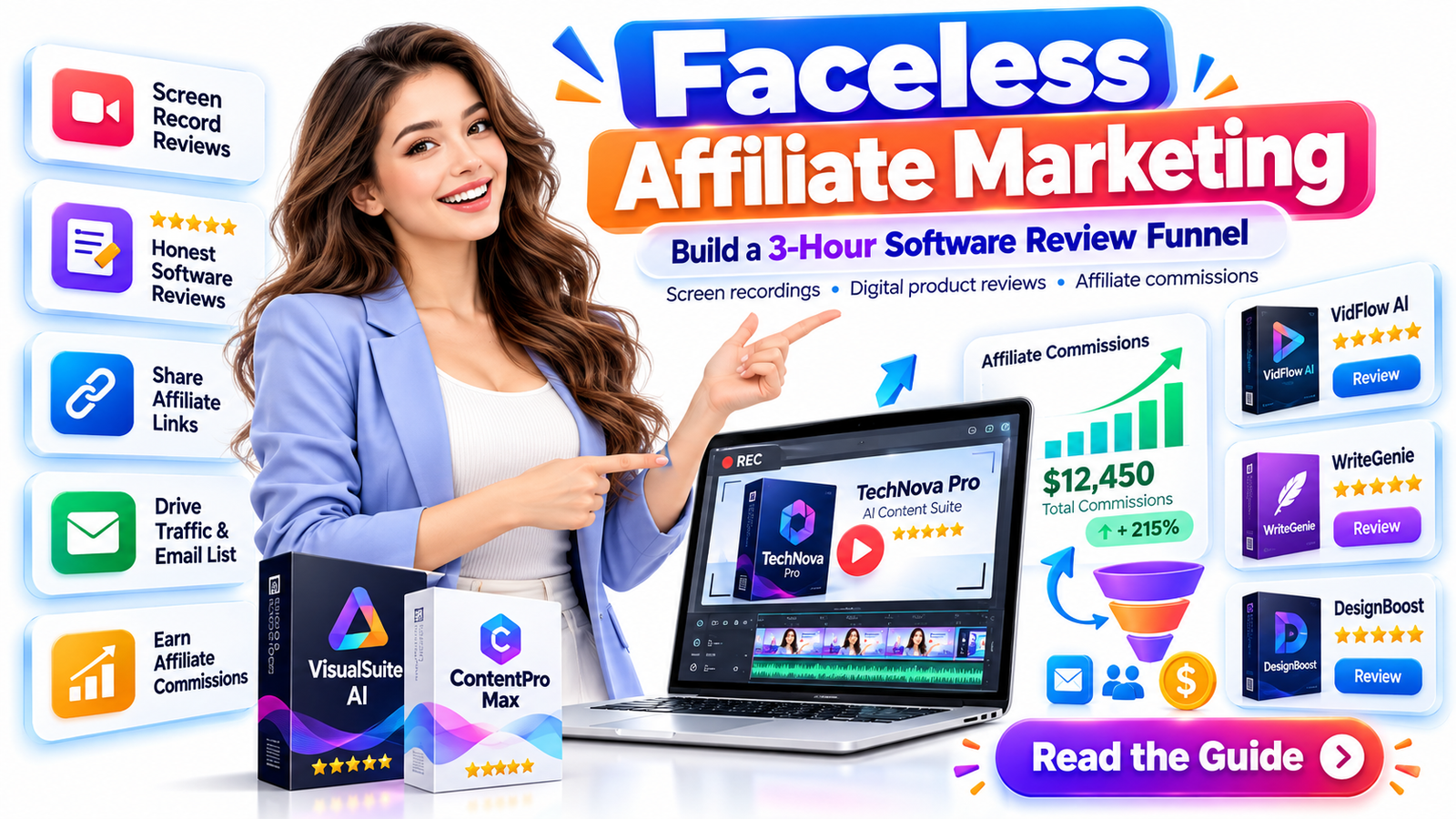
Build a Screen-Recording Review Funnel in 3 Hours
You do not need a studio, expensive camera, podcast microphone, perfect voice, or personal brand built around your face to earn digital affiliate commissions.
For many software, SaaS, AI tool, hosting, productivity, design, marketing, and business-service offers, the product itself can become the content.
Instead of pointing a camera at yourself, you point a screen recorder at the problem.
Instead of saying, “Trust me because I am an influencer,” you show the visitor what the software does, where the important buttons are, how quickly a task can be completed, what the limitations are, and whether the product deserves the price.
That distinction matters.
A buyer searching for “best AI writing tool for ecommerce product descriptions,” “Canva alternative for teams,” “best CRM for freelancers,” or “how to automate invoices with AI” usually does not need entertainment first. They need clarity.
They want to know: Does this solve my problem? How difficult is it to use? What does it cost? Is there a free trial? What are the disadvantages? Is there a better alternative? Can I see it working before I sign up?
That is where faceless affiliate marketing becomes powerful.
A simple combination of screen recordings, annotated screenshots, comparison articles, short tutorial videos, email follow-ups, and contextual affiliate links can create a digital product review funnel that works without your face or voice ever becoming the center of the brand.
And unlike highly personality-dependent creator businesses, a faceless review system can often be repeated across multiple products, search queries, platforms, and content formats.
What Is Faceless Affiliate Marketing?
Faceless affiliate marketing is a content and performance-marketing strategy in which a creator recommends products or services without relying on personal-camera appearances.
The creator earns a commission when an eligible visitor clicks an affiliate link and completes the required action, which might be a purchase, subscription, trial, upgrade, lead submission, or another qualifying conversion.
The “faceless” part does not mean the content should be anonymous, generic, automated, or untrustworthy.
In fact, successful faceless content often needs more proof because the creator cannot rely on personality alone.
A strong faceless software review might include an original screen recording, product screenshots, pricing observations, workflow demonstrations, pros and cons, alternative recommendations, a clearly stated audience, first-hand testing notes, and an honest affiliate disclosure.
Google’s current guidance continues to emphasize helpful, reliable, people-first content, including original information, demonstrated experience, substantial coverage, and content that leaves the reader feeling they have learned enough to accomplish their goal.
That is good news for faceless creators.
You do not need to become famous.
You need to become useful.
Why Screen Recordings Can Convert Better Than Generic Affiliate Content
Imagine two pages competing for the same search.
The first says:
“This software is easy to use, powerful and perfect for small businesses.”
The second opens with a 75-second screen recording showing exactly how a small-business owner can import a customer list, create an automation, send an email campaign and view the result.
Which one removes more uncertainty?
Usually, the demonstration.
Screen recordings work particularly well for digital affiliate products because software purchasing is often driven by perceived friction.
People hesitate because they are wondering whether setup will be difficult, whether the interface will be confusing, whether the promised feature actually exists or whether they will pay for a tool that sits unused.
Showing the workflow reduces that uncertainty.
A screen recording can demonstrate value before the reader ever reaches the affiliate button.
That changes your CTA from an interruption into a logical next step.
Instead of:
“BUY THIS SOFTWARE NOW.”
You can write:
“If this workflow matches the way you want to manage client projects, you can check the current plan options and trial availability here.”
That CTA works because the demonstration has already done much of the selling.
The Faceless Buyer Journey
A visitor rarely wakes up thinking, “I want to click an affiliate link today.”
They wake up thinking about a problem.
Their problem might be slow content creation, missed invoices, expensive software subscriptions, messy customer data, poor search rankings, scheduling chaos, weak email conversions, repetitive administrative work or too many disconnected tools.
Your faceless affiliate funnel should therefore begin with the problem rather than the commission.
At the awareness stage, your visitor searches for an answer.
At the evaluation stage, they compare possible tools.
At the proof stage, they want screenshots, demonstrations, prices, limitations and evidence.
At the decision stage, they want an easy next action.
A well-designed affiliate article can support all four stages on one page.
That is why high-intent content such as “X vs Y,” “best software for X,” “X pricing explained,” “X tutorial,” “X alternatives,” “is X worth it,” and “how to do X using Y” can be commercially valuable.
The article answers the search query while naturally moving the user toward a decision.
Case Study: How a Faceless Screen Recording Can Produce a Same-Day Software Sale
Consider an illustrative example rather than a claimed earnings result.
A faceless creator finds a long-tail query:
“Best appointment scheduling software for freelance consultants.”
The searcher already has a problem and is likely evaluating tools.
The creator selects a scheduling platform they have genuinely tested and produces a 90-second screen recording.
The demonstration shows how to create an appointment type, connect a calendar, add a payment option and send a booking link.
The article accompanying the video is titled:
“Appointment Scheduling Software for Freelancers: Setup, Pricing and Real Workflow”
That title is descriptive rather than sensational.
The creator explains who the software is suitable for, where it saves time, the pricing structure, one limitation and two possible alternatives.
Halfway through the article, a contextual CTA says:
“If you mainly need client booking, automated reminders and calendar syncing, you can compare the current plans before setting up your first booking page.”
Later, another CTA appears after the limitations section:
“If those limitations do not affect your workflow, the free trial is the simplest way to test the exact setup shown above.”
A user searching at 10:00 a.m. could discover the tutorial, watch the workflow, click through, start a trial and potentially purchase or upgrade the same day.
That is what “same-day affiliate sales” should mean in a responsible strategy.
The funnel allows an immediate conversion.
It does not guarantee one.
Traffic quality, affiliate attribution, the product, price, offer, commission structure, visitor geography, cookie duration and buying intent can all affect results.
Why Software Affiliate Offers Fit Faceless Creators So Well
Physical products often depend heavily on lifestyle presentation.
Software is different.
The product lives on a screen.
That makes the screen itself your demonstration environment.
A faceless creator can review project-management apps, email marketing platforms, website builders, ecommerce tools, SEO software, design products, AI applications, accounting tools, productivity platforms, hosting services, customer-support software and business automation systems without building content around personal appearance.
There is another advantage.
Some digital products and SaaS affiliate programs use recurring commissions rather than one-time payouts.
If the affiliate program pays recurring commissions, one qualified referral may continue generating commissions while the customer remains eligible under that program’s terms.
Never assume recurring commissions are permanent, however. Affiliate terms, payout rates, cookie periods and eligibility rules can change. Verify current program documentation before publishing a specific commission claim.
Your 3-Hour Faceless Affiliate Funnel
You do not need a complicated funnel builder to start.
The first version can be extremely lean.
Hour One: Find a High-Intent Problem and Match It With One Product
Your first hour should not be spent designing logos.
Spend it understanding intent.
Look for a specific problem attached to a clear software solution.
“Best productivity software” is broad.
“Best time-tracking software for freelance designers” is stronger.
“Software for business” is weak.
“Best lightweight CRM for a solo consultant who hates complicated CRMs” is much more useful.
Your target should combine commercial intent with a specific user.
Then test the product yourself.
Open the interface.
Complete a real task.
Record your observations.
Find something you like.
Find something you do not like.
Identify the user for whom the product makes sense.
Identify the user who should probably choose something else.
This is how faceless content develops credibility.
You are replacing personality-driven trust with evidence-driven trust.
Hour Two: Record the Product Solving One Problem
Do not try to demonstrate every feature.
Create one transformation.
If you are reviewing an email platform, show how to build one automated welcome sequence.
If you are reviewing an AI tool, show one useful workflow from prompt to output.
If you are reviewing project-management software, show how to create a project, assign a task and view a deadline.
If you are reviewing a website builder, create a simple page.
Keep the cursor movement deliberate.
Remove unnecessary pauses.
Zoom into areas viewers need to understand.
Use captions if you do not want to record narration.
You can add arrows, highlights, short callouts and on-screen steps without using your voice.
The result should answer one question:
“Can I picture myself using this?”
When the answer becomes yes, purchase resistance falls.
Hour Three: Turn the Demonstration Into a Search-Friendly Review Funnel
Embed the video or GIF near the top of the article.
Then build the page around decision-making.
Start by explaining the reader’s problem.
Give a direct answer early.
Show the workflow.
Explain pricing accurately.
Describe the strongest use case.
Include limitations.
Compare alternatives.
Answer frequently asked questions.
Then place affiliate CTAs only where they make contextual sense.
Your goal is not maximum link density.
Your goal is maximum decision clarity.
A visitor who understands the product is usually more commercially valuable than a visitor who clicks because of hype.
The Faceless Review Formula That Builds Buyer Intent
A high-converting review should answer more than “Is this product good?”
It should answer “Is this product good for me?”
That one change can improve both user experience and conversion quality.
Consider a visitor researching an AI presentation tool.
A weak affiliate review discusses every feature.
A stronger review says:
“This tool is best suited to consultants, educators and small teams that need to turn existing text into polished presentation drafts quickly. Designers who require precise manual control over every visual element may prefer a traditional presentation application.”
That sentence qualifies the visitor.
Qualification is conversion optimization.
The wrong visitor may leave.
The right visitor moves closer to buying.
Use Micro-CTAs Instead of One Giant Sales Pitch
A faceless affiliate page should behave like a guided decision rather than a sales letter.
After a demonstration, use an evaluation CTA:
“See the current plan that includes this feature.”
After discussing price, use a comparison CTA:
“Compare the monthly and annual options before choosing.”
After explaining a free trial, use an action CTA:
“Test the workflow yourself using the trial.”
After comparing alternatives, use a fit-based CTA:
“If automation matters more to you than advanced customization, this is the option I would test first.”
These CTAs sound less aggressive because they reflect what the reader is already considering.
They also work particularly well for new visitors who may not yet trust your website.
The Returning-Visitor Hook Most Affiliate Sites Forget
Affiliate websites frequently optimize only for the first click.
That can be expensive.
Many software buyers research for several days before making a decision.
Your site therefore needs a reason to be remembered.
Create comparison pages that can be revisited.
Maintain “last tested” information when appropriate.
Publish related tutorials around the same product.
Link your review to an implementation guide.
Offer a downloadable checklist such as “10 Things to Test During Your Software Trial.”
Create an email sequence that teaches users how to evaluate the category instead of repeatedly asking them to buy.
At the end of a CRM review, for example, you might say:
“Bookmark this page if you are still comparing systems. I recommend testing contact import, automation, mobile access, reporting and export options before choosing any CRM.”
That gives the visitor a reason to return.
Another powerful retention strategy is content clustering.
Someone reading your “best CRM for consultants” article could naturally move to “CRM setup checklist,” “CRM automation examples,” “CRM vs spreadsheet,” and “how to migrate contacts safely.”
Now you are no longer trying to win one click.
You are building topical authority and repeated exposure.
SEO for Faceless Affiliate Content
The primary keyword should describe the page naturally.
For this topic, phrases such as faceless affiliate marketing, faceless affiliate marketing strategy, software affiliate marketing, faceless software reviews and screen recording affiliate marketing may be relevant depending on the exact article.
Secondary terminology can include SaaS affiliate marketing, digital affiliate commissions, affiliate review funnel, software review content, no-camera content marketing, no-face affiliate marketing, affiliate conversion strategy and digital product affiliate marketing.
Long-tail search phrases often reveal stronger intent.
Examples include how to do affiliate marketing without showing your face, how to promote software affiliate programs without YouTube face videos, how to make faceless software review videos, best faceless affiliate marketing strategy for beginners and how to build a SaaS affiliate review funnel.
These phrases should appear only where they genuinely help explain the subject.
Google explicitly warns against creating search-engine-first content and recommends creating material primarily to benefit people.
Keyword placement cannot rescue thin content.
Useful demonstrations, original observations, accurate product details and genuine comparison value are harder to imitate and more useful to buyers.
GEO and AEO: Make the Article Easy for Answer Engines to Understand
Search is increasingly answer-oriented.
That means your article should contain passages that answer specific questions clearly enough to stand on their own.
For example:
“Faceless affiliate marketing is the promotion of products or services through content that does not depend on the creator appearing on camera. Common formats include screen recordings, tutorials, written reviews, comparison pages, slides, demonstrations and annotated screenshots.”
That paragraph is useful to humans, traditional search engines and AI-powered answer systems because it defines the entity directly.
Do the same for important subtopics.
Explain what a software affiliate funnel is.
Explain how affiliate tracking works.
Explain who a product is best for.
State limitations clearly.
Use descriptive headings.
Name tools and categories consistently.
Include original demonstrations.
Cite authoritative sources where factual claims require verification.
If you update pricing or feature information, show meaningful update dates rather than changing dates simply to make old content look fresh. Google specifically cautions against changing page dates solely to create an appearance of freshness.
How to Improve Your Chances in Google Discover
There is no switch that guarantees Discover traffic.
Google states that indexed content meeting Discover policies can be eligible automatically, but eligibility does not guarantee distribution. Current guidance recommends descriptive headlines, useful and timely content, unique insights, quality page experience and avoiding clickbait or misleading preview elements.
This became even more relevant after Google’s February 2026 Discover core update, which Google said was designed to reduce sensational content while surfacing more original, in-depth, timely content and topic-specific expertise.
For a faceless affiliate publisher, that means a headline such as:
“Faceless Affiliate Marketing: A 3-Hour Software Review Funnel”
is more defensible than:
“This Secret Affiliate Hack Makes Money While You Sleep!”
The second headline may create curiosity, but the first communicates exactly what the reader will receive.
Your featured image matters too.
Current Discover guidance recommends compelling, relevant high-quality imagery and particularly large images of at least 1,200 pixels wide. Google also advises against generic or excessively text-heavy preferred images and can use schema.org markup and og:image signals when identifying preferred imagery.
For this article, a strong 16:9 featured image could show a modern laptop interface, affiliate analytics graphics, a screen-recording symbol and a faceless creator working at a desk, with minimal headline text rather than a cluttered promotional poster.
Add Article Structured Data
Structured data will not automatically produce rankings, but it can help Google understand the page.
Google supports Article, NewsArticle and BlogPosting structured data for article pages and recommends relevant information such as the headline, representative image, author information and publication dates.
Google’s Article documentation also recommends supplying high-resolution representative imagery and supports multiple aspect ratios such as 16:9, 4:3 and 1:1.
Use accurate values.
Do not add properties describing content that users cannot actually see.
Structured data improves machine understanding; it does not replace a useful article.
Turn One Review Into a Faceless Content Engine
The real scalability of this strategy appears after you publish your first strong review.
One screen recording can become a long-form review, short vertical tutorial, Pinterest graphic, animated GIF, screenshot carousel, email lesson, social-media post, comparison article and onboarding tutorial.
That gives the same original product experience multiple distribution surfaces.
The important word is original.
Do not simply rewrite a software company’s feature page.
Use the tool.
Create something.
Break something.
Discover a shortcut.
Notice an irritating limitation.
Compare the result with a competitor.
Those observations make the review difficult to duplicate.
They also give readers a reason to return to your site instead of reading ten nearly identical affiliate articles.
The Trust Layer: Affiliate Disclosure
If your content contains affiliate links, transparency should be part of the user experience rather than hidden in fine print.
For audiences subject to U.S. rules, the FTC says material relationships should be disclosed clearly and conspicuously, and it specifically advises affiliate marketers to disclose that they receive commissions from purchases made through their links.
A straightforward disclosure might say:
“This article contains affiliate links. If you purchase through one of them, I may receive a commission at no additional cost to you. Recommendations are based on the criteria explained in this review.”
The exact requirements applicable to you may depend on your location, audience and business circumstances.
Transparency is not merely a compliance exercise.
It is a trust signal.
Avoid the Biggest Faceless Affiliate Mistake
Faceless should never mean soulless.
Some publishers interpret faceless content as permission to mass-produce hundreds of shallow articles using manufacturer descriptions and generic AI summaries.
That strategy creates very little defensible value.
A visitor does not need another article saying a product is “powerful, intuitive and feature-rich.”
They need useful observations.
How long did setup take?
Which plan contains the feature shown?
What surprised you?
What was confusing?
What happened when you imported real data?
Can information be exported?
Does the tool work well on mobile?
Who should avoid it?
What competing product handles that task differently?
These details turn a faceless article into experienced content.
Build Content Around Decisions, Not Products
A product-centric publisher thinks:
“I joined an affiliate program, so I need an article about this product.”
A customer-centric publisher thinks:
“My reader is trying to solve this problem. Which options deserve to be compared?”
The second approach builds a stronger brand.
Sometimes the affiliate product will be the winner.
Sometimes a competitor will be better.
Sometimes the reader does not need paid software at all.
Being willing to say that makes your recommendations more believable when you do recommend a paid product.
Trust compounds.
That is especially valuable when your long-term goal is converting new visitors into returning readers.
Your First 24 Hours
You can have the complete system online in one day without trying to build an enormous website.
Choose one buyer problem.
Choose one relevant digital product.
Test one important workflow.
Record one demonstration.
Publish one comprehensive review.
Include one honest comparison.
Answer five buyer questions.
Add your disclosure.
Place contextual affiliate links.
Link to one supporting tutorial if you have it.
Then distribute the demonstration where your target audience already searches or browses.
The objective of day one is not passive-income perfection.
It is creating one useful piece of commercial content that can answer a real buying question.
Once that page exists, improve it using actual visitor behavior.
If readers leave before the pricing section, improve your opening.
If they watch the demonstration but do not click, improve the transition between proof and CTA.
If visitors repeatedly search for a particular competitor, create a comparison.
If a tutorial starts receiving impressions, expand the topic cluster.
Optimization becomes much easier when you have something real to measure.
Frequently Asked Questions
Can I really do affiliate marketing without showing my face?
Yes. Faceless affiliate marketing can use written reviews, screen recordings, product demonstrations, annotated screenshots, comparison pages, slides, animations and other formats that do not require appearing on camera. The important factor is whether your content helps the customer make a better decision, not whether your face appears in it.
Do I need a microphone for faceless software review videos?
No. Screen recordings can work with captions, cursor movements, zoom effects and on-screen explanations. Voice narration can improve some tutorials, but it is not mandatory. A concise visual demonstration with readable captions can communicate a software workflow effectively.
Which digital products work best for faceless affiliate marketing?
Software and SaaS products are particularly suitable because the product can usually be demonstrated directly on screen. Website tools, AI platforms, marketing software, productivity apps, design tools, hosting services, ecommerce software and business platforms are common categories. Commission rates and program rules vary, so always verify the current affiliate terms.
Can a faceless affiliate funnel generate a sale within 24 hours?
It can, especially when a high-intent visitor discovers a useful product demonstration while already considering a purchase. However, no creator can responsibly guarantee a sale within a specific period. Results depend on traffic quality, search intent, product fit, pricing, trust, program terms and conversion performance.
How many affiliate links should I put in a software review?
There is no universal ideal number. Place links where they support a natural decision: after a demonstration, pricing explanation, comparison or recommendation. Repeating aggressive links throughout the page can weaken trust. A smaller number of well-contextualized CTAs can be more persuasive than constant “buy now” messaging.
Build a Faceless Asset, Not Just Another Affiliate Post
The strongest faceless affiliate business is not built around hiding your identity.
It is built around making your identity unnecessary to the buying decision.
Your demonstration becomes the proof.
Your comparison becomes the salesperson.
Your screenshots become the product tour.
Your tutorial becomes the trust builder.
Your search-optimized article brings the buyer.
Your contextual CTA provides the next step.
Your supporting content gives undecided visitors a reason to return.
Start with one product you can genuinely test and one problem people are actively trying to solve.
Record the solution.
Explain what worked.
Show what did not.
Help the reader determine whether the software fits their situation.
Then give them a simple way to test or purchase the product when they are ready.
That is a faceless affiliate funnel worth building because it creates something more durable than another promotional post: a useful decision-making asset.
Suggested publication tags can naturally include Faceless Affiliate Marketing, SaaS Affiliate Marketing, Software Affiliate Programs, Screen Recording Marketing, Digital Affiliate Commissions, Affiliate Review Funnel, Digital Product Marketing, No-Camera Content Creation, Affiliate SEO and Conversion Marketing.
Stay ahead with exclusive updates
Join our community. Get curated industry trends, actionable guides, and fresh resources delivered straight to your inbox.