
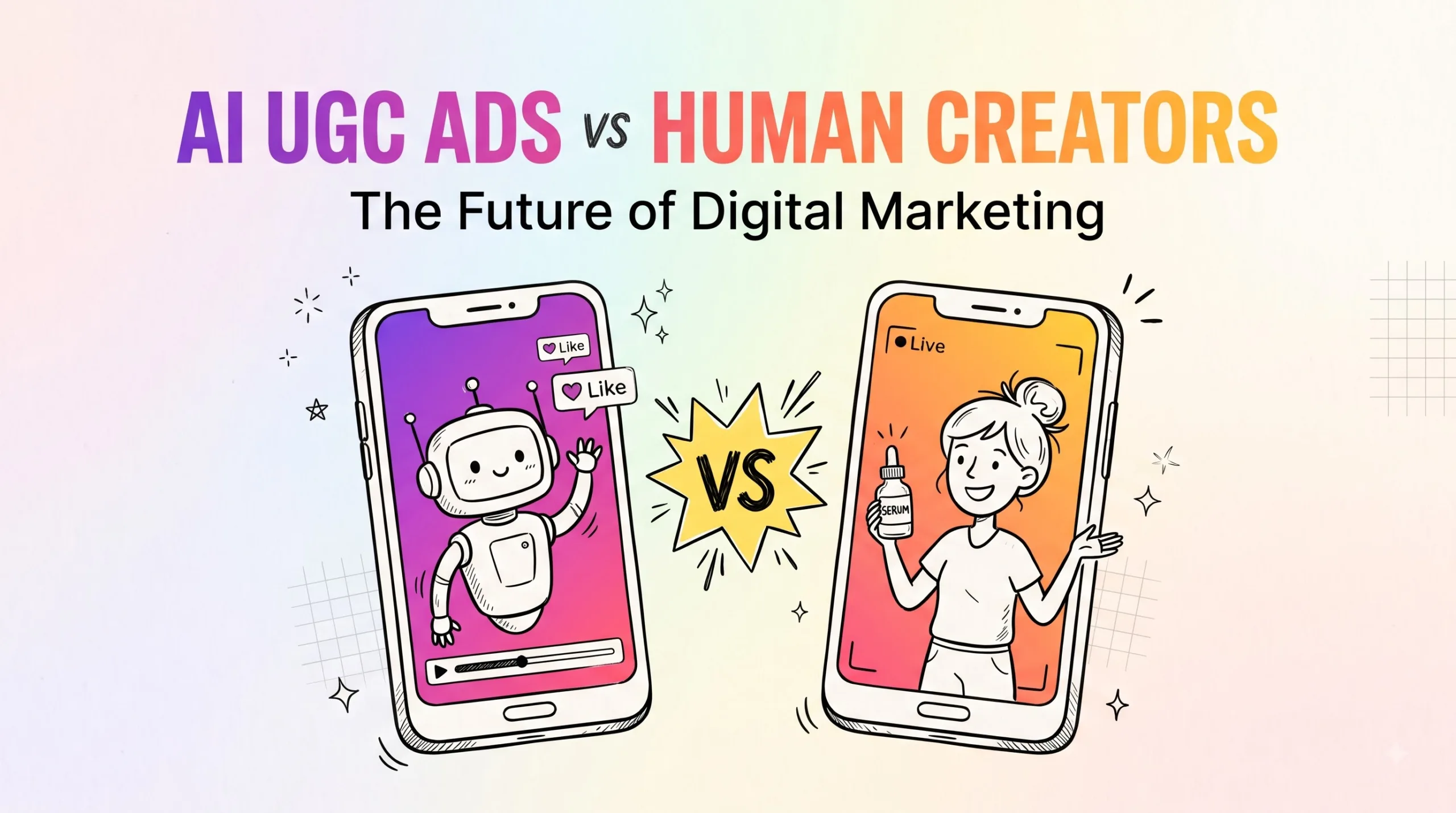
AI UGC ads cost less and ship faster, but human creators still earn more trust. Compare costs, disclosure rules and use cases, then test both the right way.
AI UGC ads vs human creators: who should sell for you?
A cheap test plan, the disclosure rules that apply and the ad jobs each format does best.
Quick summary: AI UGC ads
AI UGC ads are selfie-style videos where an AI avatar reads your script, and they usually cost far less per video than hiring a human creator. That price gap is real. So is the trust gap. Human creators can hold your product, show it working and talk about actually using it, which avatars still struggle to fake on close-ups. In the US, the FTC rule on fake reviews and testimonials, in force since October 2024, bans testimonials from people who don’t exist or never used the product, so an avatar saying “I’ve used this for three months” puts your brand at legal risk. Our short answer: use AI UGC ads to test hooks and scripts cheaply, then pay human creators to film the winners. The guide below has a 7-step test plan, a cost table, six common mistakes and the disclosure rules to check before you spend a dollar.
What AI UGC ads are and how they get made
AI UGC ads copy the look of user-generated content: a person talking into a phone camera, casual lighting, quick cuts and captions on screen. Nobody filmed it. You paste a script into a tool such as HeyGen, Arcads or Creatify, pick an avatar, and the tool renders a talking-head video in a few minutes. Most of these avatars are built from real actors who licensed their face and voice, so the result looks human at a glance.
Human UGC is the older version. You pay a creator, often through a marketplace like Billo, Insense or TikTok One, to film your product in their own home with their own voice and opinions.
Say you sell a $29 skincare serum. The AI version shows an avatar holding up a flat product image, while the human version shows a real hand, real skin and a real bathroom mirror, which is exactly what a shopper scrolling at 11 p.m. wants to see before buying. Both formats run in the same Reels, TikTok and Shorts ad slots.
The 2026 shift behind AI UGC vs human creators
Ad platforms now reward brands that feed them lots of video variations, and most small brands can’t afford to film that many with people. Meta’s Advantage+ campaigns and TikTok’s Smart+ campaigns both test creatives against each other automatically, so a brand with four videos competes against brands with forty.
Avatars also got better. Lip sync, accents and hand gestures in tools like HeyGen and TikTok Symphony look much closer to phone footage than they did a couple of years ago. They still slip on close-ups, product handling and emotional lines.
Rules tightened at the same time. TikTok asks advertisers and creators to label realistic AI-generated content, Meta can add an “AI info” label, and the EU AI Act’s transparency duties for deepfake-style content apply from August 2, 2026. For US brands, the FTC fake-review rule is the one to read first.
Cost, speed, trust and control side by side
Tap each tab. The winner changes depending on what you measure, and most brands only look at the first one.
Cost: AI UGC ads win on paper
Most AI UGC tools charge a monthly subscription that covers a set number of videos or credits, while human creators usually charge per video and then add fees for paid usage rights. Plans change often, so check each tool’s pricing page the week you buy.
- Each extra AI variation costs close to nothing once you’re subscribed.
- Creators often charge more for paid-ad rights, longer licenses and whitelisting, so ask before you book.
- Raw footage and extra hooks from a creator usually cost extra.
- A cheap AI video that never converts is still wasted money.
Speed: AI wins by days
An avatar video renders in minutes. A human creator has to receive the product, film, edit and handle revisions.
- AI is the better pick for flash sales, seasonal offers and language versions.
- Plan a week or two for creators, and book early before Black Friday, when the good ones fill up fast.
Trust: humans still win
Shoppers buying anything personal want proof from someone who actually used it. Real creators bring the small stuff that sells, like an unscripted laugh, a messy counter or a pump bottle that squeaks.
- Human creators can share their honest experience, with the paid relationship disclosed.
- AI avatars can’t claim personal results, because the person doesn’t exist.
- Comments like “this is AI” pull attention away from your offer.
- Viewers who scroll a lot start to recognize popular stock avatars from other brands’ ads.
- Pricier products need more trust before someone buys, so human content earns its fee there.
Control: AI is easier, humans add ideas
With AI you control every word and can change a line in seconds. With people you get angles you didn’t think of, plus some risk.
- AI never misses a deadline or goes off script.
- Better hooks often come from a creator’s own wording.
- A creator’s public controversy can attach itself to your brand.
Six ad jobs and who should do them
Match the format to the job instead of picking a side for your whole account, because a brand that runs only avatars or only creators usually overpays somewhere. Here’s how we’d split the work for a small online store.
Hook testing
Use AI. Run 10 to 20 avatar versions of the first three seconds and keep the two that hold viewers longest. Then hand those hooks to a human creator.
Product demos
Use humans. Pouring, applying, unboxing and fitting look fake when an avatar holds a pasted-in product image.
Translations
Use AI. One English script can become a French version for Quebec or a Spanish version for US Hispanic shoppers in an afternoon. Have a native speaker check it, since synthetic voices still miss slang.
Testimonials and reviews
Use humans, always. Under the FTC rule, a testimonial from someone who doesn’t exist, or who never used the product, can lead to civil penalties. This is the one card with no gray area for US brands.
FAQ explainers
AI works fine. An avatar answering “How long does shipping take?” doesn’t need to feel personal.
Retargeting
Mix both. People who visited your page want proof and a reason to act now, so a human review followed by an AI offer reminder is a cheap combo to test.
A 7-step plan to test AI avatars against UGC creators
This plan fits a modest budget and gives most stores a usable answer in about a month. Don’t skip step 1.
- Pick one product and one goal: Choose your best seller and one metric, such as cost per purchase. Testing three products at once spreads the budget too thin to learn anything.
- Write 10 hooks: Keep each opening line under 12 words. Mix problem hooks (“Serum pilling under your makeup?”) with curiosity hooks, and keep every line free of first-person results.
- Render the AI versions: Pick 2 avatars that look like your actual buyers and render every hook. Keep the rest of the script identical so only the hook changes, and use the platform’s AI-generated content label where it applies.
- Run a cheap hook test: Launch on one platform with a small daily budget per ad for 3 to 5 days. Judge hooks by thumb-stop rate (3-second views divided by impressions) and hold rate. Ignore sales for now.
- Brief a human creator: Send your top 2 hooks to 1 or 2 creators from Billo, Insense or TikTok One. Ask for 3 hook variations each, raw footage and paid usage rights for at least 30 days, in writing.
- Run the head-to-head: Put the best AI ad and the best human ad in the same ad set with the same budget, landing page and offer, and let them run until each has enough purchases to compare, which takes 1 to 3 weeks for most small brands.
- Scale the winner and log the loser: Move most of the budget to the winner, keep 10 to 20 percent for new tests, and write one line on why you think the loser lost. Your next test starts from that note.
🚀 Need scripts and ad templates?
Find ready-made hook files and creator briefs on Gumroad, or browse our own digital products.
UGC ad cost and fit compared
| Factor | AI UGC ads | Human creators | Usually better |
|---|---|---|---|
| Cost per video | Low after subscription | Higher, set by each creator | AI for volume |
| Turnaround | Minutes | Often 1 to 2 weeks | AI |
| Product demos | Weak, often looks pasted in | Strong | Humans |
| Testimonials | Can’t claim real experience | Allowed, with paid link disclosed | Humans |
| Languages | Many, fast | One creator per language | AI |
| Usage rights | Check the tool’s commercial terms | Negotiate length and platforms | Both need paperwork |
Read the table as a starting guess. Your product category changes the answer more than any row here, since a $12 phone case and a $180 supplement bundle need very different amounts of proof before someone pays. Fees and rules change, so check FTC business guidance and the TikTok Ads help center before you decide.
Common mistakes brands make with AI avatars
Most failed AI UGC ads trace back to the script or the setup, and the avatar gets blamed anyway. These six show up again and again.
- Fake first-person results: An avatar saying “I cleared my skin in two weeks” is a fake testimonial. Fix: keep AI scripts about features, price and the offer, and leave personal results to real customers.
- The most popular stock avatar: Viewers have seen her before. Fix: pick a less common avatar or build a custom one with a consenting actor.
- No usage rights from creators: A creator’s organic post isn’t automatically yours to run as a paid ad, even if they tagged you and you paid for the product they reviewed. Fix: get paid-usage terms in writing, with length and platforms listed.
- Judging after one day: Fix: give a hook test at least 3 days of spend.
- Hiding the AI: Fix: use platform labels where required. Hiding it rarely helps once commenters notice.
- Giving creators a robotic script: Fix: send the hook and 4 bullet points, then let them talk in their own words.
FAQ about AI UGC ads
Are AI UGC ads legal?
Do AI UGC ads perform better than human UGC?
How much does a UGC creator charge in 2026?
Do I have to disclose AI-generated ads?
Can people tell when an ad uses an AI avatar?
Which AI UGC tool is best for beginners?
Should small brands skip human creators?
Quick quiz: test your UGC instincts
Ten questions. Tap each one to check your answer.
1. Which format is usually cheaper per extra variation?
- Human creators
- AI UGC ads
- They cost the same
2. Can an AI avatar claim personal results in a US ad?
- Yes, always
- Only on TikTok
- No, that risks breaking the FTC fake-review rule
3. Which job suits human creators best?
- Product demos
- Translations
- FAQ explainers
4. What should you judge a hook test by?
- Total sales
- Thumb-stop rate
- Follower count
5. What should you get in writing from a creator?
- Their phone model
- Paid usage rights
- Their follower list
6. When do EU AI Act transparency duties apply?
- August 2, 2026
- January 1, 2025
- Never
7. Fastest way to make a Spanish version of an ad?
- Hire a new creator
- AI avatar plus a checked translation
- Subtitles only
8. How many products should a small budget test at once?
- One
- Three
- Five
9. Who can run a creator’s organic video as a paid ad?
- Any brand tagged in it
- Whoever the agreement says
- The platform
10. What should AI avatar scripts focus on?
- Personal results
- Features, price and offer
- Celebrity mentions
Your first 48 hours with AI UGC ads
Pick the product that already sells best and start a free trial of one AI UGC tool today. Message two human creators the same afternoon, because their replies take longer than any render. By day two you should have hooks live and creator quotes in your inbox.
- Write 10 hooks: Keep each under 12 words, with no first-person claims.
- Render and launch: Turn your best 5 hooks into avatar videos and start a 3-day test.
- Request creator quotes: Ask for prices that include paid usage rights and raw footage.
✨ Build your ad toolkit
Grab hook swipe files, script templates and creator brief templates in a few clicks.
Disclaimer & compliance note
Affiliate disclosure: Some links on this page, including Gumroad links, are affiliate links. If you buy through them, digitalideatool.com may earn a commission at no extra cost to you. Tools named in this post are examples, not paid endorsements.
No guarantee: Ad results depend on your product, audience and budget, and nothing here guarantees sales or returns. This post isn’t legal advice. Ad and disclosure rules change, so check the FTC, the ASA, the Competition Bureau, Ad Standards or a lawyer for your situation.
AI use: This post was drafted with AI assistance and reviewed and edited by a human. Spot an error? Contact support@digitalideatool.com.
Please Note – Disclaimer
The content, news, topics, and ideas presented on this platform are collected and compiled from various websites, online sources, and digital platforms.
We do not guarantee the accuracy, authenticity, completeness, or reliability of any information, news, or sources mentioned.
Readers are strongly encouraged to independently verify all facts, claims, sources, and information through trusted and official channels before relying on or acting upon them.
This content is provided for general informational and educational purposes only.
✓ Reader Reminder: Always verify important information using trusted, authoritative, and official sources before making decisions or taking action.
📝 Key Takeaways & Action Notes
Jot down insights, next steps, or thoughts from this post. Your notes save automatically in your browser.
- What is the #1 breakthrough insight you took away today?
- What is one concrete action you will take in the next 24 hours?
- What questions or ideas do you want to research further?
Stay ahead with exclusive updates
Join our community. Get curated industry trends, actionable guides, and fresh resources delivered straight to your inbox.