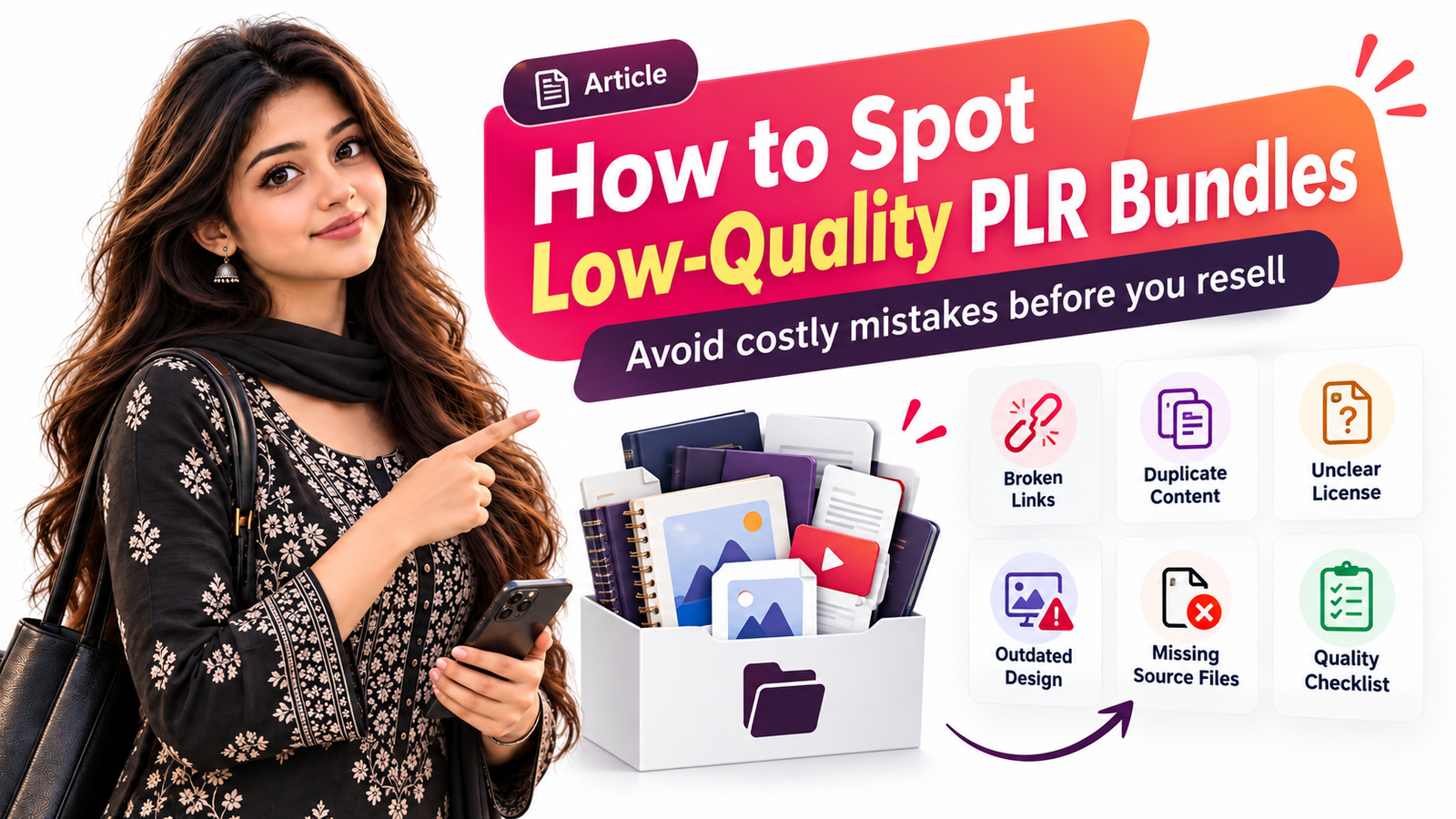
Cheap PLR Can Cost You More Than You Think
Thousands of digital products for the price of a cup of coffee.
It sounds like an incredible opportunity.
You see a bundle advertising 5,000 eBooks, 10,000 templates, hundreds of planners, social-media kits, courses, worksheets, graphics and business resources—all for $5, $10 or $20.
For someone starting a digital-product business, the offer can feel almost impossible to refuse.
Why spend weeks creating products when you can buy an enormous library instantly?
But there is an important question that experienced digital sellers learn to ask:
What are those thousands of files actually worth to your business?
A massive PLR bundle can be valuable when the products are well organized, professionally created and backed by clear licensing.
A poorly assembled bundle can create the opposite result.
You may spend hours searching through duplicate files, repairing broken links, redesigning outdated documents, rewriting weak content, trying to understand confusing licenses and removing products that you would never feel comfortable selling.
Suddenly, your $5 bargain has become a 20-hour cleanup project.
That is why smart PLR sellers stop measuring value by file count.
They measure value by usability, quality, licensing clarity, customer relevance and resale potential.
What Is PLR and Why Do Sellers Buy It?
PLR usually stands for Private Label Rights.
Depending on the exact license supplied by the creator, PLR may allow you to modify content, change branding, redesign products, add your business name and resell the finished product.
PLR is popular because it can significantly reduce the time required to create digital products from zero.
Common PLR products include:
- eBooks
- planners
- worksheets
- journals
- business templates
- Canva templates
- spreadsheets
- checklists
- social-media content
- presentation templates
- prompt collections
- mini-courses
- workbooks
- marketing resources
But the letters PLR alone do not tell you everything you are permitted to do.
Different suppliers can attach very different rules to their licenses.
That makes the license almost as important as the product itself.
The Real Problem With Extremely Cheap PLR
Cheap PLR is not automatically bad.
A legitimate supplier may run a promotion, sell an introductory bundle or offer older material at a discount.
The problem begins when price and quantity become the only selling points.
Consider two offers.
Bundle A:
10,000 digital products for $5
Bundle B:
50 editable business templates for $29
At first glance, Bundle A appears to provide dramatically better value.
But imagine that Bundle A contains:
- 2,000 duplicated files
- 1,500 outdated products
- hundreds of broken links
- poorly organized folders
- missing source files
- generic graphics
- unclear licenses
- old screenshots
- low-resolution images
- badly formatted PDFs
Meanwhile, Bundle B contains 50 professionally designed, editable, properly licensed and well-organized templates.
Which one gives you the better business opportunity?
Probably Bundle B.
The number of files matters far less than the number of files you can realistically turn into products people will buy.
Warning Signs of a Bad PLR Bundle
Before purchasing any PLR or MRR package, examine the offer carefully.
Several warning signs should encourage you to investigate further.
1. The Seller Talks Only About Quantity
Be cautious when nearly every headline focuses on enormous numbers:
50,000 Products!
1 Million Digital Files!
Ultimate Mega Bundle!
Lifetime Collection!
Large collections are not necessarily poor quality, but quantity should never replace meaningful product information.
A professional seller should also explain:
- what types of products are included
- who the products are designed for
- which formats are supplied
- whether files are editable
- what license accompanies them
- how files are delivered
- whether updates are included
- what support is available
If the only compelling feature is the number beside the word “products,” investigate further.
2. There Are Broken Download Links
Broken links are one of the most frustrating problems in cheap PLR collections.
You purchase the bundle, open a PDF containing download links and discover that:
- folders no longer exist
- cloud-storage permissions are restricted
- links return errors
- websites have disappeared
- shared files require access approval
- bonus products are unavailable
A professional supplier should periodically check delivery systems and make sure customers can access what they purchased.
A bundle containing hundreds of inaccessible files is not a bargain.
It is unfinished inventory.
3. The Same Products Appear Again and Again
Some massive PLR libraries look larger because identical products appear in several folders.
You might see:
Marketing Planner.pdf
Then later:
Marketing Planner Final.pdf
Then:
Marketing Planner New.pdf
Then:
Business Marketing Planner.pdf
When opened, they may contain essentially the same material.
Duplicating files makes a collection look bigger without creating additional value.
Before judging a bundle by the advertised number, ask yourself:
How many unique, useful products am I actually receiving?
4. The Designs Look Years Out of Date
Digital-product customers quickly notice outdated design.
Typical warning signs include:
- old-fashioned fonts
- outdated screenshots
- low-resolution graphics
- dated color combinations
- cluttered page layouts
- obsolete interface examples
- poorly sized social-media templates
- inconsistent branding
- stretched or pixelated images
Some outdated PLR can still become valuable raw material.
But understand what you are buying.
If every product needs a complete redesign, you are not buying a ready-to-sell library.
You are buying source material for a major renovation project.
5. The Content Is Poorly Written
Open several eBooks, guides or worksheets before deciding whether a PLR collection is valuable.
Look for:
- spelling mistakes
- awkward sentences
- repeated paragraphs
- inconsistent terminology
- incomplete sections
- obvious factual errors
- weak introductions
- excessive filler
- outdated recommendations
- broken references
Your customer does not know who created the original PLR.
They know who sold it to them.
If your logo appears on a poor-quality product, the customer associates that quality with your brand.
6. Editable Source Files Are Missing
Imagine buying a beautiful workbook that you intend to rebrand.
You download the package and discover only a PDF.
There is no Canva template.
No PowerPoint file.
No DOCX document.
No editable graphics.
No design source.
Technically, you have the product—but changing it may be unnecessarily difficult.
For PLR products specifically marketed as customizable, editable source files can dramatically increase their usefulness.
Before buying, look for clear information about included formats.
Examples may include:
- Canva
- DOCX
- PPTX
- XLSX
- Google Docs-compatible formats
- Google Sheets-compatible formats
- PSD
- AI
- SVG
- editable PDFs
The appropriate format depends on the type of product.
7. The License Is Vague
One of the biggest PLR warning signs is language such as:
“Full resale rights included.”
That sounds reassuring.
But what exactly does it mean?
Can you modify the product?
Can you add your brand?
Can you sell it?
Can you give it away?
Can you include it in a membership?
Can your customer resell it?
Can you sell the source file?
Can you sell it on marketplaces?
Can you break the bundle into individual products?
Can you use graphics separately?
If the license does not answer important questions, contact the supplier before selling anything.
PLR, MRR, RR, Commercial Use and Personal Use: Know the Difference
Licensing terminology can confuse new digital sellers.
The most important rule is simple:
Never rely on the label alone. Read the actual license supplied with the product.
Individual creators may define permissions differently.
PLR — Private Label Rights
PLR often provides the broadest customization options.
Depending on the license, you may be allowed to:
- edit the content
- change the design
- add your branding
- rename the product
- combine it with other content
- sell the modified product
However, restrictions may still apply.
MRR — Master Resell Rights
Master Resell Rights commonly allow you to sell the product while also allowing your customers to receive certain resale rights.
Editing rights may be limited or restricted.
Do not automatically assume that an MRR license permits complete rebranding.
RR — Resell Rights
Basic Resell Rights generally allow you to resell a product to an end customer.
The customer normally does not receive additional resale rights unless the license specifically provides them.
Commercial-Use Rights
Commercial-use permission generally means you may use an asset for permitted business or commercial purposes.
That does not automatically mean you may resell the original file itself.
For example, a commercial-use graphic might be permitted inside a finished workbook but prohibited from being redistributed as an individual graphic file.
Personal-Use Rights
Personal-use products are generally intended only for the purchaser’s own use.
They should not be resold unless the license specifically gives resale permission.
Never Assume Every Product in a Bundle Has the Same License
This is especially important with large digital-product collections.
A bundle may contain products from multiple creators or sources.
One folder may contain PLR.
Another may carry MRR.
Another may permit commercial use only.
Another may contain assets that cannot legally be redistributed individually.
Do not assume that one license document automatically covers everything unless the seller explicitly states that it does.
Create a simple licensing record for your inventory.
For example:
| Product | License | Editing Allowed | Resale Allowed | Customer Resale Rights | Restrictions |
|---|---|---|---|---|---|
| Business Planner | PLR | Yes | Yes | No | Check marketplace rules |
| Marketing Guide | MRR | Limited | Yes | Yes | Sell above minimum price |
| Icon Pack | Commercial Use | Yes | Not standalone | No | Use inside finished designs |
This simple habit can prevent major confusion later.
Your PLR Supplier Becomes Part of Your Brand Reputation
When you resell a digital product, your customer rarely thinks about your supplier.
They think about you.
Imagine someone purchases a productivity workbook from your website.
They open it and discover:
- spelling errors
- inconsistent fonts
- broken website links
- outdated information
- poor graphics
- pages that do not print correctly
The customer probably will not say:
“The original PLR creator should have done a better job.”
They may say:
“This seller produces low-quality products.”
Your supplier’s quality has now affected your reputation.
That is why choosing PLR suppliers should be treated like choosing any other business partner.
You are trusting them with material that may eventually carry your brand.
Why “10,000 Products for $5” Deserves Extra Inspection
Huge bundles appeal to a natural buying instinct:
More feels better.
But digital inventory behaves differently from physical inventory.
Owning 20,000 files does not automatically create a valuable digital business.
Imagine downloading 10,000 products.
If reviewing each product takes only two minutes, examining the entire collection would take more than 300 hours.
Suddenly the size of the bundle becomes a management problem.
A smaller, targeted library can be much more useful.
For example:
Instead of buying 10,000 random products, a freelancer targeting restaurants might purchase:
- restaurant social-media templates
- menu templates
- promotional calendars
- customer-feedback forms
- food-cost spreadsheets
- marketing planners
Only 50 targeted assets might produce more commercial opportunities than thousands of unrelated files.
Cheap PLR Has a Hidden Cost: Your Time
Suppose you purchase a $7 PLR eBook.
Before selling it, you need to:
- rewrite weak sections
- verify information
- redesign the cover
- redesign the interior
- replace outdated examples
- fix grammar
- update links
- create mockups
- write the product listing
- check licensing
You spend five hours preparing it.
Your $7 product did not really cost $7.
It cost $7 plus five hours of your time.
Now compare that with a $35 PLR product requiring only one hour of customization.
The more expensive product may actually be cheaper from a business perspective.
This is why serious sellers evaluate total preparation cost, not simply purchase price.
What a Professional PLR/MRR Package Should Include
Use this buyer checklist before investing in your next bundle.
Clear Licensing Documentation
You should be able to understand:
- whether editing is allowed
- whether rebranding is allowed
- whether resale is allowed
- whether customer resale rights are allowed
- whether products can be bundled
- whether products can be given away
- whether source files can be transferred
- whether marketplace restrictions exist
- whether minimum pricing rules apply
If anything is unclear, ask.
Editable Source Files
When customization is part of the product promise, professional PLR should ideally provide practical source files.
Examples include Canva templates, Word documents, spreadsheets, presentations or editable design files.
Organized Folder Structure
Good organization saves enormous amounts of time.
A professional bundle might contain folders such as:
01 License
02 Editable Files
03 PDFs
04 Product Images
05 Mockups
06 Product Descriptions
07 Instructions
Organization may not seem exciting when buying PLR, but it becomes extremely valuable when managing hundreds of assets.
High-Resolution Graphics
Product images should look professional on modern websites and social platforms.
Check for:
- clear graphics
- sharp mockups
- consistent dimensions
- attractive layouts
- editable branding when applicable
Useful Product Descriptions
Well-prepared packages may include draft product descriptions that you can customize.
Do not blindly copy them.
Rewrite descriptions around your audience, positioning and brand voice.
Common, Usable File Formats
Customers should not need unusual software simply to open a basic digital product.
Common formats such as PDF, DOCX, PPTX, XLSX, PNG, JPG and accessible cloud-template formats are generally easier to manage.
Clear Instructions
A professional package should make it relatively easy to understand:
- what you received
- where editable files are located
- how customization works
- what the license permits
- which restrictions apply
Test the Product Before You Put Your Name on It
Never treat PLR as an automatic upload-and-sell product.
Think of PLR as business inventory that requires inspection.
Before listing anything, perform a simple quality-control process.
Step 1: Open Every Important File
Confirm that PDFs, documents, spreadsheets, templates and graphics actually open.
Step 2: Test Every Important Link
Check:
- download links
- resource links
- website links
- video links
- template links
Remove or replace anything outdated.
Step 3: Read the Product
Do not sell an eBook you have never opened.
Do not sell a workbook you have never reviewed.
Do not sell a spreadsheet you have never tested.
You are attaching your reputation to the product.
Know what your customer is receiving.
Step 4: Verify Time-Sensitive Information
Pay special attention to content involving:
- software
- social platforms
- technology
- marketing tools
- online-business practices
- regulations
- platform policies
- statistics
- pricing
- AI tools
Information in these areas can become outdated quickly.
Step 5: Improve the Branding
Change more than the logo.
Consider improving:
- title
- cover
- fonts
- color palette
- examples
- introduction
- calls to action
- worksheets
- product organization
- bonus materials
The objective is to transform generic source material into something designed for your audience.
Step 6: Check the License Again
Before publishing, confirm that your intended selling method is permitted.
Do Not Confuse a PLR License With Marketplace Permission
Having permission from a product creator does not automatically mean every marketplace must allow that product.
Selling platforms can maintain their own policies regarding originality, digital goods, intellectual property, templates, reselling and seller-created content.
The safest approach is to check both:
The product license
and
The platform’s current seller policies
before creating listings.
Turn Generic PLR Into a Stronger Product
The biggest opportunity in PLR is not simply reselling what you received.
It is improving it.
Suppose you buy a generic product called:
Social Media Planner
Hundreds of other sellers might have exactly the same file.
Instead, reposition it as:
30-Day Instagram Content Planner for Local Bakery Owners
Now improve it with:
- bakery-specific posting ideas
- seasonal promotion examples
- daily content prompts
- hashtag-planning pages
- product-launch checklists
- customer-review prompts
- weekly analytics worksheets
You are no longer competing only on price.
You are competing on usefulness.
Cheap PLR vs. Profitable PLR
The wrong question is:
How many products am I getting?
A better set of questions is:
How many of these products fit my audience?
How many can I legally sell?
How many can I customize efficiently?
How many solve a real customer problem?
How many would I personally feel comfortable putting my brand name on?
That is the difference between collecting files and building a digital-product business.
Use the “Sellability Test” Before Buying PLR
Before purchasing a bundle, score it from 1 to 5 in six areas.
Quality
Does the product look professional?
Relevance
Does it match the audience you serve?
Editability
Can you customize it efficiently?
Licensing Clarity
Do you understand exactly what you can do with it?
Differentiation Potential
Can you transform it into something noticeably better?
Commercial Potential
Can you imagine a specific customer who would pay for the finished product?
A bundle scoring highly in these categories may be far more valuable than a bundle with ten times as many files.
Questions to Ask a PLR Supplier Before Buying
A trustworthy supplier should be able to answer reasonable questions.
Consider asking:
- What exact license is included?
- Can I modify and rebrand the products?
- Can I sell individual products separately?
- Can I combine them into new bundles?
- Can my buyers receive resale rights?
- Are editable source files provided?
- Are all advertised files currently accessible?
- Are any third-party assets subject to separate restrictions?
- Are future updates included?
- What happens if a download link stops working?
Clear answers build confidence.
Vague answers create risk.
Build a PLR Quality-Control System
As your digital-product business grows, create a standard review process.
You might keep a spreadsheet containing:
- product name
- original supplier
- purchase date
- license type
- license location
- editable source file
- review status
- branding status
- information update status
- listing status
- selling platform
- last quality check
This becomes especially valuable once you own hundreds of digital assets.
Instead of wondering where something came from or whether you have permission to sell it, you have a documented inventory system.
Remember That Customers Buy Outcomes, Not File Counts
Customers rarely wake up thinking:
“I need 7,000 PDFs.”
They want solutions.
A freelancer might want a better client-onboarding system.
A teacher might want printable classroom resources.
A small-business owner might need bookkeeping templates.
A creator might need a content-planning system.
A parent might need children’s activity sheets.
The best PLR products help you package useful solutions for specific people.
That is where commercial value comes from.
A $50 PLR Product Can Be Cheaper Than a $5 Bundle
Consider the complete cost.
Cheap Bundle
Purchase: $5
Sorting: 3 hours
Rewriting: 4 hours
Design repair: 3 hours
License investigation: 1 hour
Total preparation: 11 hours
Higher-Quality PLR Package
Purchase: $50
Customization: 1.5 hours
Quality check: 30 minutes
Total preparation: 2 hours
The $5 option may have the lower purchase price.
The $50 option may have the lower business cost.
That distinction becomes increasingly important when you are trying to scale.
The Best PLR Sellers Behave Like Publishers
A strong PLR business is not built by uploading everything you download.
It is built through selection.
Think like a publisher.
Publishers do not release every manuscript they receive.
They choose material, edit it, improve it, package it, position it and present it to the right audience.
Apply the same mindset to PLR.
Curate.
Choose products that fit your market.
Inspect.
Make sure they meet your quality standard.
Verify.
Understand the license.
Improve.
Add meaningful value.
Brand.
Make the customer experience consistent.
Position.
Sell the outcome instead of simply selling another downloadable file.
Your Brand Should Be the Quality Filter
The long-term goal should be simple:
When customers see your brand, they should expect a certain standard.
That means sometimes deciding not to sell a product even though you legally can.
A poorly written $3 eBook may produce a few quick sales.
But if it reduces customer trust, the real cost can be much higher.
A digital-product business becomes stronger when customers think:
“If this seller recommends it, it has probably been checked.”
That reputation is much harder to build than a folder containing thousands of PLR files.
It is also much more valuable.
PLR Buyer Checklist
Before purchasing your next PLR or MRR bundle, ask:
- Is the supplier transparent?
- Is the license easy to understand?
- Are editing permissions explained?
- Are resale permissions explained?
- Are source files included where appropriate?
- Are file formats usable?
- Are the products professionally designed?
- Does the content appear current?
- Are folders organized?
- Are download links functioning?
- Are graphics high quality?
- Are there useful previews?
- Can I identify a clear target customer?
- Can I improve the product?
- Would I confidently attach my brand to it?
If most answers are yes, you may have found useful inventory.
If several answers are no, the low purchase price may not represent genuine value.
Five Frequently Asked Questions About Cheap PLR
1. Is Cheap PLR Always Low Quality?
No.
Price alone does not determine quality.
Suppliers may offer discounts, introductory deals, limited-time promotions or lower-priced older collections.
The better approach is to evaluate the product itself: quality, licensing, editability, relevance, organization and support.
2. Can I Resell Any Product Marked PLR?
Not automatically.
Read the specific license included with the product.
PLR licenses can differ between creators. Some permit extensive editing and resale, while others include restrictions on marketplaces, redistribution, source files, pricing, giveaways or the transfer of resale rights.
Always follow the actual written license rather than relying only on the term “PLR.”
3. What Is the Difference Between PLR and MRR?
PLR generally emphasizes the ability to modify or rebrand content, while MRR generally emphasizes the ability to resell a product and provide specified resale rights to customers.
However, licensing terms vary considerably.
The supplier’s written agreement determines what you are actually permitted to do.
4. Should I Rewrite PLR Before Selling It?
In many cases, customization is a strong business strategy even when extensive rewriting is not required by the license.
Updating titles, examples, design, formatting, resources and branding can make the product more useful and distinctive.
The goal should not merely be making PLR look different.
The goal should be making it better for your particular customer.
5. How Do I Know Whether a PLR Bundle Is Worth Buying?
Evaluate what you can realistically use rather than the total advertised number of files.
Look at:
- quality
- audience relevance
- license clarity
- editability
- organization
- current information
- supplier reputation
- product previews
- differentiation potential
- expected preparation time
A smaller bundle containing 50 useful products can be more profitable than a giant collection containing thousands of files you will never sell.
Buy Assets, Not Numbers
The digital-product market makes it easy to become impressed by enormous numbers.
10,000 templates.
50,000 eBooks.
100,000 downloads.
A million digital resources.
But your customer will never pay you because your hard drive contains a million files.
They pay because one particular product solves one particular problem well.
That is the mindset shift that separates random PLR collecting from professional digital-product selling.
Stop asking:
“How much content am I getting?”
Start asking:
“How much usable value can I create from what I am buying?”
The smartest PLR sellers do not necessarily buy the biggest bundle or the cheapest bundle.
They buy assets they can confidently inspect, meaningfully improve, legally resell and proudly attach their brand name to.
When you make quality your filter, licensing your foundation and customer usefulness your priority, PLR stops being a shortcut to more files.
It becomes a practical raw material for building better digital products and a more trustworthy business.
Stay ahead with exclusive updates
Join our community. Get curated industry trends, actionable guides, and fresh resources delivered straight to your inbox.