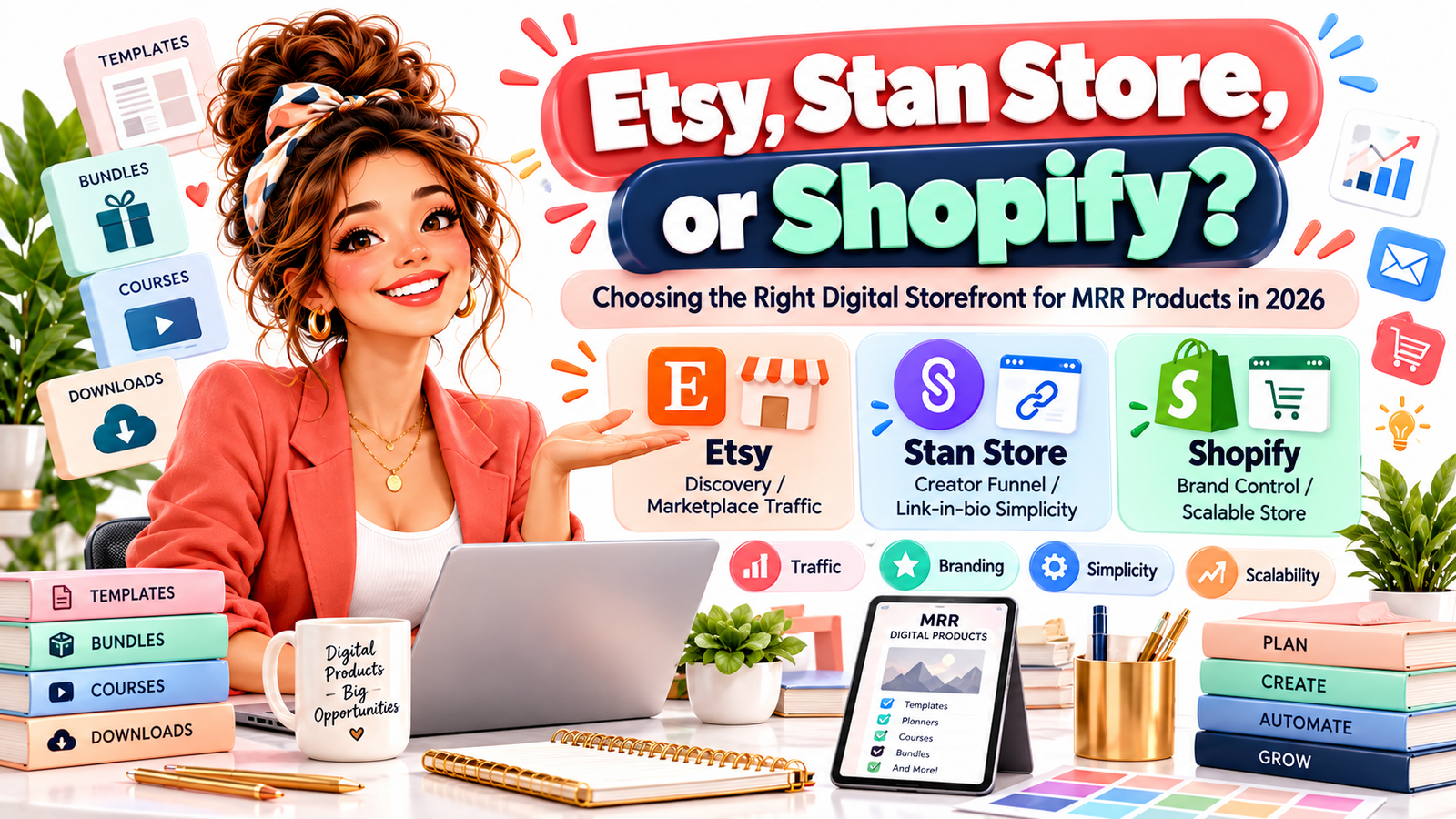
The best platform isn’t the one with the lowest fees—it’s the one that matches how your customers discover, trust, and buy your offer.
Choosing where to sell MRR digital products can become an unexpected form of procrastination.
You find a promising bundle. You check the license. You start thinking about product covers, pricing and marketing. Then comes the question:
Should I sell on Etsy, Stan Store, or Shopify?
Suddenly, you are comparing monthly subscriptions, transaction fees, storefront designs, payment processors, apps, checkout features, marketplace traffic, email integrations and dozens of opinions from other creators.
The problem is that there is no universally “best” platform for selling digital products in 2026.
There is only the platform that best matches your product, traffic source, pricing strategy, licensing rights, customer journey and long-term business model.
A seller offering a $7 printable has very different needs from someone selling a $79 MRR business bundle. And the creator promoting a $249 training system through Instagram or TikTok needs a different buying experience again.
This guide compares Etsy vs. Stan Store vs. Shopify for MRR sellers in 2026, including visibility, costs, control, branding, conversion paths, scalability and an increasingly important issue: whether the product is actually permitted on the platform.
First: What Does MRR Mean?
MRR stands for Master Resell Rights.
An MRR license may allow the purchaser to resell a digital product and, depending on the specific license, may also permit them to pass certain resale rights to their own customers.
MRR should not automatically be treated as the same thing as PLR.
Private Label Rights (PLR) products often provide broader editing or rebranding permissions, but every license is different. One PLR package may allow complete rewriting and rebranding, while another may restrict modifications, marketplace sales, price changes or redistribution of source files.
The most important rule is simple:
Your license tells you what the copyright owner permits. The selling platform separately decides what it permits.
Having legal resale rights to a product does not guarantee that Etsy, Stan Store, Shopify, a payment processor or an advertising platform will allow you to sell it.
That distinction matters enormously when comparing these three storefront options.
The Biggest 2026 Warning for MRR Sellers Considering Etsy
Etsy is often described online as an easy place to start selling digital products. That is true for many original digital products, but MRR sellers need to be much more careful.
Under Etsy’s current Creativity Standards, digital downloads listed as “designed by a seller” must be the seller’s original designs. Etsy specifically identifies a bundle, collection, scan or PDF of someone else’s work as something that does not qualify under that category. Etsy’s help documentation also says digital items in a shop must be made and/or designed by the seller.
That means buying an MRR ebook, template collection or business bundle and simply uploading the unchanged files to Etsy can create a serious policy problem, even when the MRR license itself gives you permission to resell them.
This changes the Etsy vs. Stan Store vs. Shopify decision considerably.
Before using Etsy for anything based on MRR or PLR content, evaluate both the license and Etsy’s current policies rather than assuming “resell rights” automatically means “Etsy-approved.”
Etsy: Think Discovery Engine, Not Just Storefront
Etsy’s greatest attraction is not sophisticated funnel building.
It is marketplace discovery.
People visit Etsy already expecting to browse and purchase products. Instead of creating a website and persuading people to visit it, a qualifying Etsy seller can potentially place products in front of buyers searching inside an established marketplace.
That can be particularly valuable for inexpensive, visual and highly searchable products such as original planners, invitations, worksheets, printable designs and templates.
A shopper might search for something specific, compare several options and make a small purchase without ever knowing the seller beforehand.
That is much harder to reproduce immediately with an independent store.
Why Etsy Can Be Powerful
Etsy reduces one of the hardest problems for a new seller:
“Where will my first visitors come from?”
Marketplace search can create discovery opportunities without requiring every visitor to originate from your Instagram account, email list, YouTube channel or paid advertising.
The platform can also provide familiarity and transactional trust. Someone who has never heard of your brand may still feel comfortable purchasing because they already know Etsy.
That makes Etsy particularly attractive for products with strong search intent.
A buyer searching for a specific type of template is already closer to purchasing than someone casually watching a social media video.
Where Etsy Becomes More Difficult
That built-in audience comes with competition and marketplace rules.
You do not control the entire customer environment. Your listing exists alongside competing products, and buyers can quickly return to search results and compare alternatives.
Fees also extend beyond the headline transaction percentage.
Etsy currently charges $0.20 USD per listing and a 6.5% transaction fee on the total order amount. Payment processing fees are separate and vary by country. Other costs can include currency conversion, regulatory operating fees in certain countries, Etsy Ads and Offsite Ads. Eligible Offsite Ads sales can carry a 15% or 12% fee depending on the seller’s Etsy revenue level.
That does not automatically make Etsy expensive.
Marketplace traffic has value.
Paying a higher percentage to acquire a customer through existing marketplace demand can sometimes be better than paying lower platform fees but spending heavily on advertisements just to create the visitor.
This is why “Which platform has the lowest fees?” is the wrong first question.
The better question is:
“How much does it cost me to acquire a profitable customer?”
Etsy Is Best Considered When…
Etsy makes the most sense when your product clearly complies with its current Creativity Standards, shoppers are already searching for products like yours, your offer is visually easy to understand, and marketplace discovery is more valuable to you than total control over the buying experience.
For conventional unchanged MRR bundles created by another seller, however, Etsy should not be treated as the default option.
Stan Store: Creator-Funnel Simplicity
Stan Store solves a different problem.
Instead of asking, “How can shoppers discover me inside a marketplace?” it is closer to:
“I already have attention. How can I turn that attention into a simple purchase?”
That is why Stan is particularly relevant to TikTok, Instagram, YouTube, podcast and personal-brand creators.
A potential customer watches your content, taps the link in your bio, sees your offers and purchases without navigating through a traditional multi-page ecommerce website.
Stan supports digital downloads such as ebooks, templates, guides and bundles, as well as courses, coaching calls, lead magnets, memberships, webinars and other creator-oriented offers.
This makes it much more than a basic file-delivery page.
The Main Advantage: Fewer Moving Parts
Many beginner digital sellers do not need a highly customized website.
They need a product page.
They need checkout.
They need file delivery.
They need a place to collect leads.
They may need a course area or booking system.
And they need all of it to work without spending three weeks designing a website.
Stan’s appeal is the compression of those functions into a creator-focused sales system.
What Does Stan Store Cost in 2026?
Stan currently states that it takes 0% platform transaction fees and charges a flat subscription. Its Creator plan is listed at $29 per month, while Creator Pro is $99 per month. Stripe or PayPal processing fees still apply and vary depending on factors such as location, currency and payment method.
That distinction matters.
“0% transaction fee” does not mean “free payment processing.”
It means Stan itself does not take a percentage of the transaction in addition to the subscription, while the connected payment processor can still charge normal processing fees.
Why Creator Pro Can Matter for Higher-Value Offers
Creator Pro adds features that become more valuable when the store functions as a funnel rather than just a product page.
Stan currently lists tools including email marketing, affiliate sharing, discount codes, payment plans and pixel/analytics integrations with platforms including Meta, Google, TikTok and Pinterest.
Its email system can also trigger flows after purchases, on set dates and after abandoned checkouts.
These features become much more significant when selling a $79 bundle, $149 course or $299 business system than when selling a $5 download.
A $7 product may struggle to justify a substantial fixed monthly subscription if sales volume is still extremely low.
A $149 offer might justify that fixed cost with only a small number of monthly sales.
Where Stan Is Weaker
Stan is not a substitute for marketplace discovery.
Opening a Stan Store does not automatically create buyer demand.
You generally need an audience source such as short-form video, social media, email, partnerships, affiliates, search content, advertising or an existing community.
This is the fundamental Stan question:
Do you already have attention—or a realistic strategy for generating it?
If yes, the simplicity can be extremely attractive.
If no, an elegant storefront can sit online with almost no visitors.
Shopify: Build the Digital Business, Not Just the Checkout Page
Shopify becomes especially compelling when your goal moves from:
“I want to sell a digital product.”
to:
“I want to build a digital product brand.”
Shopify provides a full ecommerce environment with themes, custom domains, product catalogs, analytics, marketing integrations, apps, multiple sales channels and considerably more control over the storefront.
It also supports digital products. Shopify’s current Digital Products app can deliver files or links after purchase and can set download limits and delivery options.
Why Shopify Is Attractive for Serious Catalog Growth
Imagine that today you have one MRR business bundle.
Six months later, you may have:
an entry-level product, several niche bundles, an original course, templates, premium memberships, upsells, lead magnets, subscriptions, affiliate offers and perhaps even physical products.
That is where Shopify’s broader ecommerce architecture becomes valuable.
You can design collections, build landing pages, install specialized apps, connect sophisticated email platforms, implement analytics and conversion tracking, build SEO content around your domain and control more of the customer journey.
With greater control comes greater responsibility.
You are also responsible for generating demand.
Shopify does not function like Etsy’s marketplace search.
Shopify Pricing in 2026
Pricing varies by country and billing arrangement.
For example, Shopify’s U.S. pricing currently lists Basic at $39 per month when paid monthly or $29 per month when billed yearly. Current India pricing lists Basic at ₹1,994 per month on monthly billing or ₹1,499 per month on annual billing.
Payment costs also depend on the payment setup. Shopify states that when Shopify Payments is used as the sole payment provider, Shopify does not charge its separate third-party transaction fee, although normal card processing charges still apply. Using third-party payment providers can introduce additional Shopify transaction fees depending on the plan and market.
Therefore, always check the pricing and payment options for your own country before making a profitability calculation.
Shopify’s Hidden Cost: Complexity
Shopify can do much more.
That does not always mean you should do much more.
Themes, apps, conversion tools, SEO, analytics, automations and customization can become another form of distraction.
A creator who only has one product and 2,000 Instagram followers may be able to start selling faster with a creator storefront.
A seller planning 50 products, content marketing, email segmentation, upsells and a recognizable long-term brand may quickly outgrow a minimalist storefront.
Etsy vs. Stan Store vs. Shopify: The Real Difference
The three platforms solve three different business problems.
| Business Need | Etsy | Stan Store | Shopify |
|---|---|---|---|
| Fast setup | Strong | Excellent | Good |
| Built-in marketplace discovery | Excellent | Low | Low |
| Social-media funnel simplicity | Moderate | Excellent | Strong |
| Branding freedom | Limited–Moderate | Moderate | Excellent |
| Store customization | Limited | Moderate | Excellent |
| Product catalog scalability | Strong | Good | Excellent |
| Funnel tools | Limited | Strong | Excellent with native features/apps |
| Recurring platform cost | Low entry cost, sale-based fees | Fixed subscription | Fixed subscription + possible apps |
| Seller control | Moderate | Strong | Excellent |
| Good for original low-ticket searchable downloads | Excellent | Good | Good |
| Good for $29–$99 creator bundles | Conditional | Excellent | Excellent |
| Good for $100+ courses/systems | Limited | Excellent | Excellent |
| Suitability for unchanged third-party MRR products | Often problematic under Etsy originality rules | Potentially suitable subject to license/platform/payment rules | Potentially suitable subject to license/platform/payment rules |
| Best strategic role | Discovery | Creator funnel | Owned brand infrastructure |
The scores are not universal rankings.
They represent the role each platform is best positioned to play.
Don’t Choose a Platform by Fees Alone
Imagine two stores.
Store A pays relatively high selling fees but receives consistent marketplace visitors.
Store B has extremely low transaction costs but receives no visitors unless the owner produces content or pays for advertising.
Which store is cheaper?
You cannot answer without knowing acquisition costs.
The real cost of selling digital products includes the storefront subscription, listing fees, transaction fees, payment processing, advertising, design tools, email software, apps, refunds, taxes where applicable, customer support and the time spent generating traffic.
This leads to a better metric:
Customer acquisition cost + fulfillment cost + platform cost compared with customer lifetime value.
A storefront charging $29 per month can be inexpensive when it generates profitable $99 sales.
A storefront costing almost nothing can be extremely expensive when you spend hundreds of dollars generating traffic that does not convert.
Best Platform for a $5–$19 Digital Product
Low-ticket products depend heavily on volume.
At $5, a large fixed monthly technology stack can quickly consume the margin.
This is where marketplace discovery can be particularly valuable—provided the product qualifies for that marketplace.
For an original $9 planner or seller-designed template with active search demand, Etsy can make strategic sense because buyers can discover the product without first becoming followers.
For an MRR product created by someone else, Etsy’s originality rules make the decision much less straightforward.
In that situation, a creator storefront or independent store may be more appropriate, but you need a traffic strategy.
Low prices do not eliminate the need for customer acquisition.
In fact, they make efficient acquisition even more important.
Best Platform for a $29–$99 MRR Bundle
This is where Stan Store becomes particularly interesting.
A $49, $69 or $99 digital bundle often needs more selling context than a small impulse purchase, but not necessarily an elaborate ecommerce site.
Social content can demonstrate the problem.
The bio link can introduce the product.
The checkout page can explain the bundle.
The customer can purchase and receive the files.
Order bumps, email follow-ups and related creator tools can increase customer value.
Shopify remains an excellent option if you already intend to build a broader brand, but Stan can reduce technical friction for a creator whose main growth engine is social media.
For MRR sellers, the underlying license still needs to authorize your intended resale, modification and marketing practices.
Best Platform for a $100+ Masterclass or Business System
At higher price points, the product rarely sells because someone saw a thumbnail and instantly clicked Buy.
Trust becomes increasingly important.
Customers want to understand what they receive, who it is for, what problem it solves, what makes the offer different, how delivery works and why they should purchase from you rather than another seller.
For a creator-led $149 course, coaching product or premium system, Stan can provide a clean and relatively short purchase journey.
For a larger brand with multiple products, advanced segmentation, extensive content, custom landing pages, sophisticated analytics and a long-term ecosystem, Shopify becomes especially powerful.
At this level, saving one or two percentage points in fees is often less important than increasing conversion rate, average order value and repeat purchase rate.
Traffic vs. Ownership: The Question Behind the Question
The Etsy vs. Stan vs. Shopify debate becomes easier when you reframe it as:
Do you want to borrow an audience or build your own?
Etsy can potentially help you access marketplace demand.
But the marketplace controls the environment.
Stan and Shopify give you more direct control over your sales journey, but they usually require you to generate more of your own traffic.
Neither approach is inherently superior.
They solve different stages of business growth.
A beginner without an audience might value discovery.
A creator with 100,000 followers may have little reason to depend on marketplace search.
A mature seller may want an independent brand that is not heavily dependent on any one social network or marketplace.
The 2026 Hybrid Strategy: Stop Thinking “One Platform Only”
One of the smartest approaches is to stop treating the platforms as mutually exclusive.
A more advanced digital product business can use different channels for different jobs.
A compliant marketplace product can introduce new buyers to your work. Social content can create awareness and establish expertise. An independent storefront can host broader product collections, higher-value offers and repeat-purchase opportunities. Email can nurture the relationship with people who have properly consented to receive marketing.
The model becomes:
Discovery → Trust → First Purchase → Relationship → Upsell → Repeat Customer
This is stronger than expecting one storefront to perform every function in your business.
The exact implementation must respect each platform’s rules regarding customer information, links, marketing, product eligibility and off-platform activity.
A Practical Example of the Hybrid Model
Imagine you sell productivity resources.
Your original searchable planner products may attract marketplace customers where permitted.
Your TikTok, Instagram, Pinterest, YouTube or blog content teaches productivity principles and attracts a wider audience.
Your independent store sells a $49 productivity toolkit.
A $99 business productivity bundle follows.
Later, you introduce a $249 course.
The marketplace becomes a discovery channel rather than your entire business.
Social media becomes an attention channel rather than your entire business.
Your store becomes the commercial infrastructure connecting the products and customer journey.
That diversification matters because every external platform can change algorithms, policies, fees or account requirements.
When Etsy Is the Better Choice
Choose Etsy when marketplace search is central to your acquisition strategy, the product clearly complies with Etsy’s Creativity Standards, shoppers already search for the type of item you offer, you are comfortable competing beside similar listings and you value easier discovery more than complete storefront control.
Do not treat Etsy as automatically suitable simply because an MRR or PLR license says you can resell the files.
Etsy’s own product rules still apply.
When Stan Store Is the Better Choice
Choose Stan when you are a creator whose audience primarily comes from Instagram, TikTok, YouTube or another community-driven channel and your priority is a short path from content to checkout.
It is particularly attractive when you want to combine digital downloads with courses, memberships, webinars, coaching or lead-generation offers without building a traditional ecommerce site.
Its flat subscription structure can also become increasingly attractive as revenue rises, although payment processing still needs to be included in your calculations.
When Shopify Is the Better Choice
Choose Shopify when the storefront itself is becoming a business asset.
It is particularly well suited to sellers who want strong branding, larger catalogs, richer analytics, custom landing pages, advanced marketing integrations, apps, multiple sales channels and greater control over how customers move from first visit to repeat purchase.
The tradeoff is that you must take more responsibility for traffic, store optimization and technology decisions.
The 2026 MRR Platform Scorecard
The following score uses a five-point scale, with 5 representing the strongest fit for that category.
| Category | Etsy | Stan Store | Shopify |
|---|---|---|---|
| Startup ease | 4/5 | 5/5 | 4/5 |
| Built-in traffic potential | 5/5 | 1/5 | 1/5 |
| Branding freedom | 2/5 | 3/5 | 5/5 |
| Seller control | 3/5 | 4/5 | 5/5 |
| Social conversion path | 3/5 | 5/5 | 4/5 |
| Low fixed-cost entry | 5/5 | 3/5 | 3/5 |
| Catalog scalability | 4/5 | 3/5 | 5/5 |
| Marketing ecosystem | 3/5 | 4/5 | 5/5 |
| High-ticket offer potential | 2/5 | 5/5 | 5/5 |
| Unchanged third-party MRR suitability | 1/5 | 4/5* | 5/5* |
*Subject to the specific MRR license, intellectual-property rights, product category, platform terms, payment-processor policies and applicable laws.
So, Which Platform Should a New MRR Seller Choose in 2026?
If you want marketplace discovery, think Etsy—but only for products that genuinely satisfy Etsy’s current product and originality requirements.
If you already create social content and want the shortest possible journey from follower to buyer, Stan Store deserves serious consideration.
If you want to build a long-term digital product company with maximum branding freedom, product expansion and ecommerce infrastructure, Shopify is usually the strongest foundation.
And if you are serious about building beyond a single product?
Do not assume you must choose only one acquisition channel forever.
Your first platform should help you make the first profitable sale.
Your long-term system should help you attract customers without depending completely on any single platform.
The Better Question to Ask Before You Launch
Instead of asking:
“Which platform is best?”
Ask:
“Where does my ideal customer already discover products like mine, and what buying experience does this offer require?”
Then ask a second question:
“If this business grows 10X, will this platform still support the way I want to sell?”
Those two questions reveal far more than a simple comparison of transaction fees.
For some sellers, the answer will be Etsy.
For others, it will be Stan Store.
For sellers building a substantial independent digital brand, it may be Shopify.
And increasingly, the answer may be a carefully designed combination.
The goal is not to build the most complicated storefront.
It is to create the shortest trustworthy path between the right customer and the right offer.
5 Frequently Asked Questions
1. Can I sell MRR products on Etsy in 2026?
Do not assume that an MRR license alone makes a product eligible for Etsy. Etsy currently says digital items must be made and/or designed by the seller, and its Creativity Standards exclude examples such as bundles, collections or PDFs of someone else’s work from the “designed by a seller” category. Review both your product license and Etsy’s latest policies before listing.
2. Is Stan Store better than Shopify for selling digital products?
Stan can be better for a social-media-first creator who values fast setup and a simple content-to-checkout funnel. Shopify can be better when you need deeper branding, a larger catalog, advanced integrations, analytics and long-term ecommerce flexibility. The right choice depends more on your business model than on the platform alone.
3. Is Etsy cheaper than Stan Store or Shopify?
Not necessarily. Etsy has a low fixed-cost barrier but charges listing, transaction and payment-processing fees, with other fees possible in some situations. Stan charges a recurring subscription and currently takes 0% platform transaction fees, while payment processors still charge their own fees. Shopify charges a subscription, payment-processing costs and potentially third-party-provider transaction fees depending on the setup. Total customer acquisition cost matters more than comparing one fee in isolation.
4. Which platform is best for selling a $99 MRR bundle?
For a creator who already has traffic from social media, Stan Store can provide a particularly efficient path from content to checkout. Shopify may be the stronger option when the $99 bundle is part of a larger branded product ecosystem. Etsy should only be considered when the actual product satisfies Etsy’s marketplace policies rather than merely because its license permits resale.
5. Can I use Etsy, Stan Store and Shopify together?
Potentially, yes, provided your products and marketing practices comply with each platform’s terms. A hybrid strategy can assign different jobs to different channels: marketplace discovery, social audience building and an independent storefront for broader catalog development, bundles and repeat-purchase strategies. The objective is not to duplicate everything everywhere, but to make each channel serve a clear role.
Stay ahead with exclusive updates
Join our community. Get curated industry trends, actionable guides, and fresh resources delivered straight to your inbox.