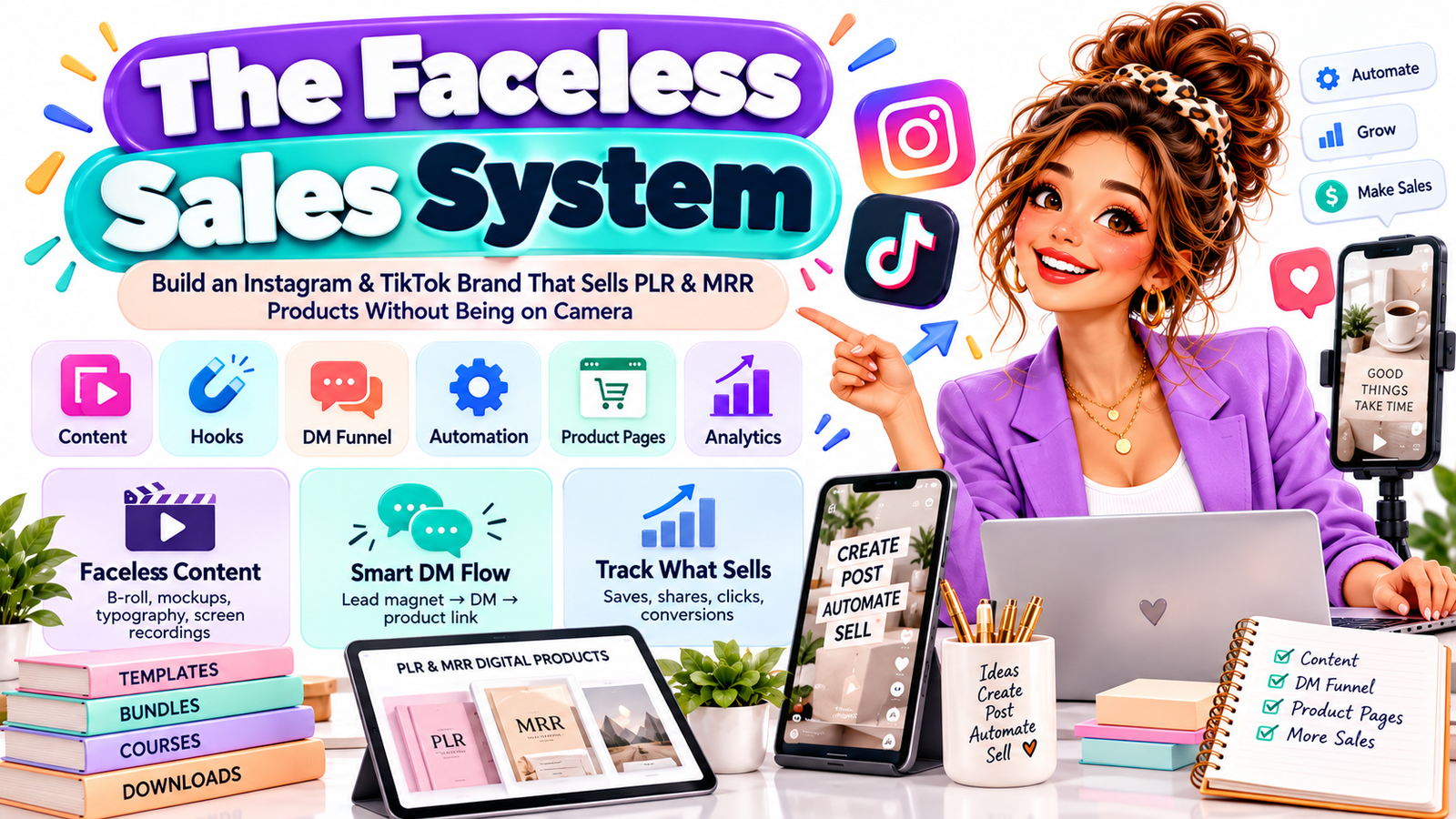
The Faceless Sales System: How to Build an Instagram & TikTok Brand That Sells PLR & MRR Products Without Being on Camera
You do not need to become an influencer to sell digital products.
You do not need to film your morning routine, speak into a camera every day, dance to trending audio, show your home, or turn your private life into content.
What you do need is something far more useful: a recognizable brand, valuable content, a clear offer, and a simple system that moves interested viewers from scrolling to buying.
That is the opportunity behind faceless digital marketing for PLR and MRR sellers.
A faceless Instagram or TikTok brand keeps the creator off camera while allowing the business itself to develop a clear personality. Instead of relying on your face, the account becomes recognizable through typography, color, editing style, product demonstrations, screen recordings, illustrations, useful ideas, strong hooks and consistent positioning.
Done properly, faceless marketing is not about hiding.
It is about making the message, problem and product more important than the person presenting them.
For sellers of PLR products, MRR products, templates, ebooks, digital planners, business resources, prompt collections, educational products and other downloadable assets, that can be a powerful business model.
What Is Faceless Digital Marketing?
Faceless digital marketing is a content strategy in which a creator or business promotes products without making their physical identity the central feature of the content.
Instead of talking-head videos, a faceless digital-product brand might publish animated text, hands-only demonstrations, screen recordings, product mockups, aesthetic B-roll, before-and-after redesigns, dashboards, illustrations, kinetic typography or short educational videos.
The goal is not simply to remain anonymous.
The goal is to build enough visual and strategic consistency that someone can recognize your content before noticing your username.
That distinction matters.
A page filled with random stock footage, copied quotes and identical reseller graphics is technically faceless, but it is not necessarily a brand.
A real faceless brand has a point of view.
Why Faceless Marketing Appeals to Digital-Product Sellers
One of the biggest psychological barriers to starting an online business is the assumption that selling on social media requires becoming a public personality.
Many potential sellers are comfortable creating useful resources but uncomfortable performing for an audience. Others have full-time jobs, family responsibilities, privacy concerns or simply no interest in becoming lifestyle creators.
Faceless content removes much of that pressure.
It can also make production easier to systemize. Once you establish templates for your hooks, typography, product demonstrations, calls to action and editing style, you can produce multiple pieces of content without setting up lights, cameras, backgrounds or personal filming sessions.
But there is an important warning.
Faceless does not mean effortless.
Removing your face from the content means other elements must work harder. Your opening hook has to be clearer. Your visual identity has to be stronger. Your product positioning has to be more specific. Your demonstrations have to make benefits visible.
The strongest faceless pages compensate for the absence of a personality-led creator by developing a brand-led personality instead.
Faceless Does Not Mean Generic
This is especially important for PLR and MRR businesses.
PLR generally refers to Private Label Rights, while MRR commonly refers to Master Resell Rights. Exact permissions differ from product to product, so sellers must always read the individual license rather than assuming that every PLR or MRR package allows the same modifications, redistribution or resale methods.
The biggest strategic mistake is buying a licensed digital product and immediately posting the supplier’s original cover, original sales copy and original promotional graphics.
If dozens or hundreds of people have access to the same package, identical marketing makes your business almost impossible to distinguish.
Instead, treat the licensed product as raw commercial material.
Your competitive advantage comes from what you add to it.
Build a Recognizable Faceless Brand Identity
Imagine someone seeing three of your Instagram Reels without seeing your account name.
Would they realize all three came from the same brand?
If the answer is no, your brand identity needs more structure.
Start with a small visual system. Choose a limited typography family, a consistent color direction, a recognizable cover style and one or two editing patterns. Decide whether your brand should feel minimal, luxurious, energetic, educational, playful, bold or professional.
Then repeat those visual signals.
You might use white backgrounds with strong black typography and one electric accent color. Another brand may use warm neutral B-roll with elegant serif headlines. A business-template shop might use clean dashboard mockups, grid layouts and modern interface-inspired graphics.
Consistency does not mean every post should look identical.
It means every post should appear to come from the same creative world.
This approach also fits the direction of modern recommendation systems. Meta reported in January 2026 that original content had become more prevalent in Instagram recommendations in the United States, with 75% of recommendations coming from original posts in Q4 2025. That makes differentiation increasingly important for brands tempted to rely heavily on recycled material.
Seven Visual Formats That Work Without Showing Your Face
A strong faceless account can rotate among several content formats instead of depending on a single stock-video formula.
Aesthetic B-roll can provide movement while text communicates the lesson. Product mockups can make intangible downloads feel more concrete. Screen recordings can demonstrate what is actually inside a template or workbook. Typography Reels can turn a powerful hook into the visual centerpiece. Illustrations and AI-assisted visuals can create a distinctive brand universe when used responsibly. Moodboard-style videos can communicate aspirations or transformations. Hands-only demonstrations can show planners, printables or digital workflows without revealing the creator.
The important question is not, “Which format is viral?”
Ask instead:
Which format communicates this idea most clearly?
TikTok’s own creative guidance recommends vertical 9:16 production, high-resolution footage, room for interface elements and a simple hook → body → close structure. It also emphasizes making content feel native to the platform rather than forcing traditional advertising into short-form video.
That basic structure works remarkably well for faceless content.
The Faceless Reel Formula
A simple faceless Reel can be built in three stages.
The opening creates tension.
The middle delivers useful information.
The ending gives the viewer one obvious next action.
For example:
Hook: “Your digital product isn’t the problem. Your positioning might be.”
Then show three fast screen recordings comparing an ordinary product listing with a more specific, benefit-focused version.
Finish with:
“Want the product-page checklist? Comment CHECKLIST.”
No face is required.
No voiceover is required.
The viewer receives a problem, insight and next step in seconds.
Stop Writing Hooks Like Advertisements
Many digital sellers begin videos with phrases such as:
“Check out my amazing digital product.”
The viewer has no reason to care yet.
A strong hook enters the conversation already taking place in the customer’s mind.
If your audience wants to make its first digital-product sale, talk about the problems preventing that sale.
If your audience struggles to create content, lead with that struggle.
If your audience worries about saturation, address that fear.
Effective faceless hooks frequently revolve around six psychological territories: a desirable result, a frustrating problem, a common mistake, a before-and-after transformation, an information gap or a practical opportunity.
Instead of:
“Buy my social media templates.”
Try:
“Your content calendar shouldn’t take three hours to build.”
Instead of:
“Get my MRR bundle.”
Try:
“Before you resell another digital product, change these three things.”
Instead of:
“Passive-income opportunity.”
Try:
“What would you build if you didn’t have to create the product from zero?”
The second versions create curiosity without making unrealistic promises.
That matters for credibility.
Income-related content should never imply that purchasing a template, PLR bundle or MRR course guarantees earnings. Your marketing becomes stronger—not weaker—when expectations are realistic.
Build Repeatable Formats Instead of Chasing Endless Ideas
One of the advantages of faceless marketing is repeatability.
You do not need 100 completely different concepts.
You need several formats that can support 100 different ideas.
For example, one recurring format might be:
“3 mistakes beginners make when…”
Another could be:
“Watch me turn this generic product into…”
Another:
“If I had to launch this digital product from zero…”
Another:
“Before you buy another PLR product, check…”
Another:
“What customers actually want from a digital download…”
The visual framework stays familiar while the subject changes.
This reduces production time and helps your audience learn what to expect from you.
It also gives you better data. If you constantly change your hook style, editing, CTA, offer and format at the same time, you cannot easily determine what caused performance to improve.
Repeatable formats create cleaner experiments.
Use Product Demonstrations to Build Trust
Digital products have an inherent marketing challenge:
Customers cannot hold them.
Your content therefore has to make an invisible product feel tangible.
Do not show only a flat ebook cover.
Open the ebook.
Scroll through the pages.
Zoom into a worksheet.
Show the Canva template being customized.
Demonstrate a spreadsheet changing after data is entered.
Show how the prompts are organized.
Show a before-and-after transformation.
Turn abstract value into visible utility.
This is especially important when several sellers offer similar licensed products.
A buyer may not care that a bundle contains “500 templates.”
They care whether one of those templates solves the problem they have this afternoon.
The Content Mix That Prevents Your Account From Becoming a Constant Advertisement
A strong digital-product account should not behave like a 24-hour television commercial.
People follow accounts because the content itself is useful or interesting.
Sales happen after relevance and trust develop.
Your content should therefore move naturally among several roles.
Educational content helps someone solve a small problem.
Demonstration content shows the product in action.
Proof content gives evidence that the method, resource or workflow is useful.
Storytelling content explains a problem, realization or transformation.
Objection content answers doubts before they become reasons not to purchase.
Promotional content presents the offer directly.
The result is a feed where buying feels like the logical continuation of the content rather than an interruption.
A Simple Faceless Content-to-Sale Funnel
The most important change you can make is to stop viewing content as an isolated activity.
A Reel should have somewhere to send people.
A profile should have somewhere to send people.
A DM should have somewhere to send people.
A product page should have one primary job.
A simple funnel might look like this:
Short-form content → profile visit → CTA → DM conversation → useful free resource or product recommendation → product page → purchase → follow-up
Each stage removes a different kind of uncertainty.
The video earns attention.
The profile establishes relevance.
The DM creates interaction.
The product page explains the offer.
The checkout converts intent into revenue.
When sellers say, “My videos get views but I don’t make sales,” the problem is often not the views.
It is the missing bridge between attention and purchase.
Optimize Your Profile for the Person Who Has Never Heard of You
When someone lands on your Instagram or TikTok profile, they should understand what you offer within seconds.
Do not make the bio a biography.
Make it a positioning statement.
A simple structure is:
Who you help + what you help them achieve + what they should do next.
For example:
“Practical digital-product tools for new online sellers. Templates, guides and launch resources. Start with the free Launch Checklist ↓”
That profile is much clearer than:
“Entrepreneur | Dreamer | Digital Creator | Helping You Win Online.”
Specificity improves trust.
Turn Calls to Action Into Conversations
“Link in bio” has a place.
But it should not be your only CTA.
For Instagram, comment-to-DM and keyword-based conversations can reduce friction because the user can request something without immediately leaving the platform.
A Reel might say:
“Comment PLAN and I’ll send you the launch planner.”
The automated conversation might begin:
“Here it is. Are you currently planning your first digital product, or have you already launched one?”
Now the interaction feels like a conversation rather than a robotic link delivery.
That distinction matters.
Automation should shorten response time without removing the feeling that there is a real business behind the account.
Using ManyChat Without Making Your Brand Feel Robotic
Tools such as ManyChat can automate parts of the Instagram DM journey. Its current documentation supports keyword-triggered automations across supported channels, allowing specific words or phrases to start an automated response or flow. ManyChat also documents Instagram-specific triggers and workflows.
A practical workflow could begin when someone requests a free resource.
The first message delivers what was promised.
The second asks one relevant question.
Based on the answer, the person can receive a useful tip, product recommendation or FAQ.
The final message can direct them to the appropriate product page.
Avoid creating a 15-message robotic sales sequence.
Short is often better.
ManyChat’s Instagram documentation also notes messaging-window requirements for certain interactions, including a 24-hour sending window in its Instagram Ref URL workflow. Sellers using automation should therefore build campaigns around current platform rules rather than outdated chatbot tactics.
ManyChat describes itself as using Instagram’s official APIs and being Meta-approved, but Meta’s policies still govern what can and cannot be automated.
Automation should improve customer service.
It should never become permission to spam.
A Better DM Funnel for PLR and MRR Sellers
Imagine you sell a digital-product starter bundle.
Your Reel says:
“Most new digital sellers waste time building these five launch assets separately. Comment START and I’ll send you the checklist.”
Someone comments START.
Your automation sends the checklist.
Then:
“Which stage are you at—choosing a product, building your store, or trying to get your first sales?”
If the user selects “building my store,” you can respond with one practical suggestion and mention the relevant product.
The product is now contextual.
You are not pushing the same sales pitch to everyone.
That is the difference between automated messaging and an automated conversation.
How to Rebrand PLR and MRR Products Without Becoming Another Copycat Store
Faceless marketing becomes much more effective when the product itself feels distinctive.
Start with positioning.
A generic social-media planner might become:
“The 30-Day Content Planner for Home-Based Service Businesses.”
A generic ebook about productivity could become:
“The Solo Creator’s Weekly Focus System.”
A generic collection of business prompts could become:
“100 Client Communication Prompts for Freelance Designers.”
You are changing the context, audience and promise—not simply changing the cover color.
Then improve the customer experience.
Reorganize the material when your license allows it.
Create a better introduction.
Add instructions.
Develop examples.
Build a quick-start section.
Improve visual consistency.
Bundle complementary resources.
Create demonstration videos.
Write original sales copy.
Add genuinely useful bonuses you created yourself.
The objective is to make your version meaningfully more useful for a specific audience.
Always work within the exact rights granted by the original license.
“PLR” and “MRR” are not universal permissions.
Originality Matters More in an AI-Heavy Content Environment
AI tools can help faceless marketers brainstorm hooks, generate storyboard ideas, create supporting illustrations, draft captions, reorganize product information and speed up repetitive production tasks.
But AI should increase creative leverage—not create hundreds of indistinguishable posts.
The more sellers gain access to the same generation tools, the more valuable human choices become.
Which audience are you serving?
Which problem do you understand?
Which examples do you use?
Which products do you reject?
Which angle do you take?
Which claims are you willing not to make?
Those decisions become your brand.
Google’s current people-first guidance similarly emphasizes originality, substantial value, usefulness and content produced for an intended audience rather than mass publishing primarily to attract search traffic.
That principle applies beyond websites.
Generic content is easy to create.
Useful perspective is harder to copy.
Measure Sales Signals, Not Just Views
A Reel with 500,000 views can produce disappointing revenue.
Another with 8,000 views can generate meaningful sales.
Views tell you that distribution happened.
They do not tell you whether the correct people became interested.
Instead, build a simple performance dashboard around the customer journey.
Track save rate to understand whether people consider the content worth revisiting.
Track share rate to identify ideas people find valuable enough to send to others.
Track profile visits to determine whether the content creates curiosity about your business.
Track DM starts to see whether your CTA is generating real intent.
Track link clicks to understand whether conversations are progressing toward the offer.
Track product-page conversion rate to evaluate whether your page is turning interested visitors into customers.
Track revenue by content source whenever your setup allows it.
The goal is not to become obsessed with analytics.
The goal is to diagnose the system.
Lots of views but few profile visits?
Your content may be entertaining but poorly positioned.
Strong profile visits but few DMs?
Your profile or CTA may need improvement.
Plenty of DMs but few clicks?
Your offer may not match the conversation.
Strong clicks but few sales?
Investigate the product page, pricing, proof, positioning and checkout experience.
This is how a faceless account becomes a business rather than a content hobby.
The Metric That Matters: Movement
Every piece of content should encourage some form of movement.
A stranger becomes a viewer.
A viewer becomes a follower.
A follower becomes a lead.
A lead becomes a customer.
A customer becomes a repeat buyer.
Your analytics should help you identify where that movement stops.
Once you know where people stop, optimization becomes much easier.
Do You Need to Post Every Day?
No universal posting schedule guarantees success.
Consistency matters because it generates learning.
The purpose of publishing regularly is not to satisfy a magical algorithm quota.
It is to accumulate enough real-world feedback to determine which topics, formats, products and calls to action resonate with your audience.
A manageable schedule that you can maintain and improve is usually more useful than an aggressive posting target that produces rushed, repetitive content.
The best content calendar is one that your business can actually sustain.
Build Content Around Customer Questions
A useful faceless content system begins with questions rather than trends.
What does your potential buyer misunderstand?
What are they afraid of?
What are they trying to create?
Why have they delayed starting?
What have they already tried?
Why might they believe your product will not work for them?
What would they need to see before purchasing?
Every answer can become content.
One customer objection can produce a Reel.
One customer question can produce a carousel.
One recurring mistake can become a TikTok.
One product feature can become a screen-recorded demonstration.
One support question can become an FAQ.
This creates a content engine connected directly to commercial intent.
Search-Led Social Content Can Extend the Life of Your Posts
Instagram and TikTok are not only entertainment feeds. People increasingly use short-form platforms to discover products, tutorials, comparisons, ideas and answers.
That means captions, on-screen text and spoken or displayed phrases should describe the subject clearly.
Instead of writing:
“You NEED this 😱”
Try:
“3 ways to rebrand a PLR ebook before selling it.”
Instead of:
“This changed everything.”
Try:
“How to build an Instagram DM funnel for digital products.”
Clear language benefits both humans and retrieval systems.
SEO is becoming less about repeating keywords and more about making the subject unmistakable.
Your Brand Should Have a Point of View
A faceless account can still sound human.
You can believe that digital products should be practical rather than bloated.
You can believe beginners need fewer tools and better systems.
You can believe PLR should be transformed rather than dumped into a store unchanged.
You can believe automation should improve conversations instead of replacing them.
Those ideas create personality without requiring personal exposure.
A brand people remember usually stands for something.
The Faceless Sales Flywheel
The strongest model is not “post a Reel and hope someone buys.”
It is a loop.
Publish useful content.
Notice what attracts high-intent engagement.
Turn winning topics into stronger posts.
Convert interest into conversations.
Study the questions people ask.
Use those questions to improve your content and product pages.
Improve the products.
Collect legitimate feedback and customer stories.
Turn those insights into new educational content.
Then repeat.
The business becomes smarter each time the cycle runs.
Where AI Fits Into the System
AI can help brainstorm hook variations, organize content calendars, transform long-form ideas into short videos, analyze customer questions, create draft scripts, generate visual concepts and speed up product customization.
But never outsource judgment.
Verify factual claims.
Review generated visuals.
Edit robotic wording.
Avoid fabricated testimonials.
Do not invent sales results.
Do not manufacture screenshots implying purchases that never occurred.
Do not use AI to impersonate real customers.
Trust compounds slowly and can disappear quickly.
For a faceless business, credibility is particularly valuable because customers cannot rely on your personal presence as a trust signal.
How to Make Your Faceless Brand Feel Human Without Showing Your Face
Human brands do not require human faces.
They require human decisions.
Write captions that sound like someone trying to help.
Answer DMs thoughtfully.
Admit limitations.
Show the product honestly.
Explain who a product is not for.
Respond to objections without pressure.
Celebrate customer progress without manufacturing hype.
Use specific examples instead of vague motivational claims.
Transparency can become the personality of the brand.
Creating Content That Has a Better Chance of Performing Beyond Social Media
If you publish supporting articles on your website, the same topic can also support organic search and Google Discover visibility.
Google’s current Discover guidance recommends descriptive headlines that capture the essence of the content rather than clickbait, along with timely or uniquely insightful content and strong page experience. Google also recommends compelling, relevant large images that are at least 1200 pixels wide, high resolution, and suitable for landscape presentation; it specifically recommends max-image-preview:large or AMP for large-image previews.
For this article, a strong featured image would therefore communicate the concept visually without stuffing the entire headline into the graphic.
Think:
A clean modern smartphone interface, social-media content cards, digital-product mockups, a DM conversation symbol, analytics indicators and an anonymous creator workstation—rather than a giant block of text.
Google also supports Article and BlogPosting structured data, which can help it understand article information such as the headline, images, publication dates and author. Google currently recommends representative high-resolution images and suggests supplying suitable 16:9, 4:3 and 1:1 versions where practical.
Structured data can improve understanding and eligibility for certain search presentations, but it does not guarantee rankings.
The 2026 Opportunity for Faceless Digital-Product Brands
Faceless marketing is attractive because it lowers one barrier to entry.
But removing your face does not remove the fundamentals of business.
You still need a customer.
You still need a problem worth solving.
You still need an offer people understand.
You still need original positioning.
You still need trust.
You still need a conversion path.
And you still need to improve based on evidence.
The accounts most likely to struggle are those that interpret “faceless” as permission to automate everything, repost generic material and imitate whichever reseller page appears successful this week.
The stronger opportunity is the opposite.
Build something recognizable.
Use licensed products as starting material rather than finished brands.
Add original value.
Create content worth saving.
Use automation to begin helpful conversations.
Track actions connected to sales.
Then improve the system one stage at a time.
You never have to become the product.
You have to build a brand people can recognize, understand and trust.
Frequently Asked Questions
1. Can I really sell digital products on Instagram and TikTok without showing my face?
Yes. A digital-product business can use screen recordings, mockups, B-roll, text-led videos, illustrations, tutorials, animations and product demonstrations instead of talking-head content. The important factor is not whether your face appears; it is whether your content attracts the correct audience, communicates useful information and creates a clear path toward your offer.
2. What is the best faceless content for selling PLR and MRR products?
Product demonstrations, transformations, tutorials, mistake-based educational posts, before-and-after rebranding examples, FAQs, objection-handling posts and screen recordings are particularly useful because they connect directly to buying decisions. Avoid relying entirely on generic motivational videos or unrelated aesthetic footage.
3. Can I use ManyChat to sell digital products through Instagram DMs?
ManyChat supports Instagram automation features including keyword-triggered conversations and other Instagram triggers. These can be used to deliver resources, answer questions and direct interested users toward relevant offers. Automation should still comply with current Meta messaging rules and should feel helpful rather than spammy.
4. How do I make a PLR or MRR product look different from everybody else’s?
Begin by checking the license. Where your rights permit modification, change more than the cover. Reposition the product for a specific audience, reorganize the material, improve instructions, add original examples, create unique bonuses, rewrite the sales copy, build fresh mockups and develop an original content strategy around the problem the product solves.
5. How many followers do I need before I can start selling?
There is no universal follower threshold. A smaller audience with clear purchase intent can be commercially more valuable than a large audience that watches without taking action. Focus on relevant reach, profile visits, qualified DMs, product-page sessions and conversions rather than waiting for an arbitrary follower milestone.
Stay ahead with exclusive updates
Join our community. Get curated industry trends, actionable guides, and fresh resources delivered straight to your inbox.