
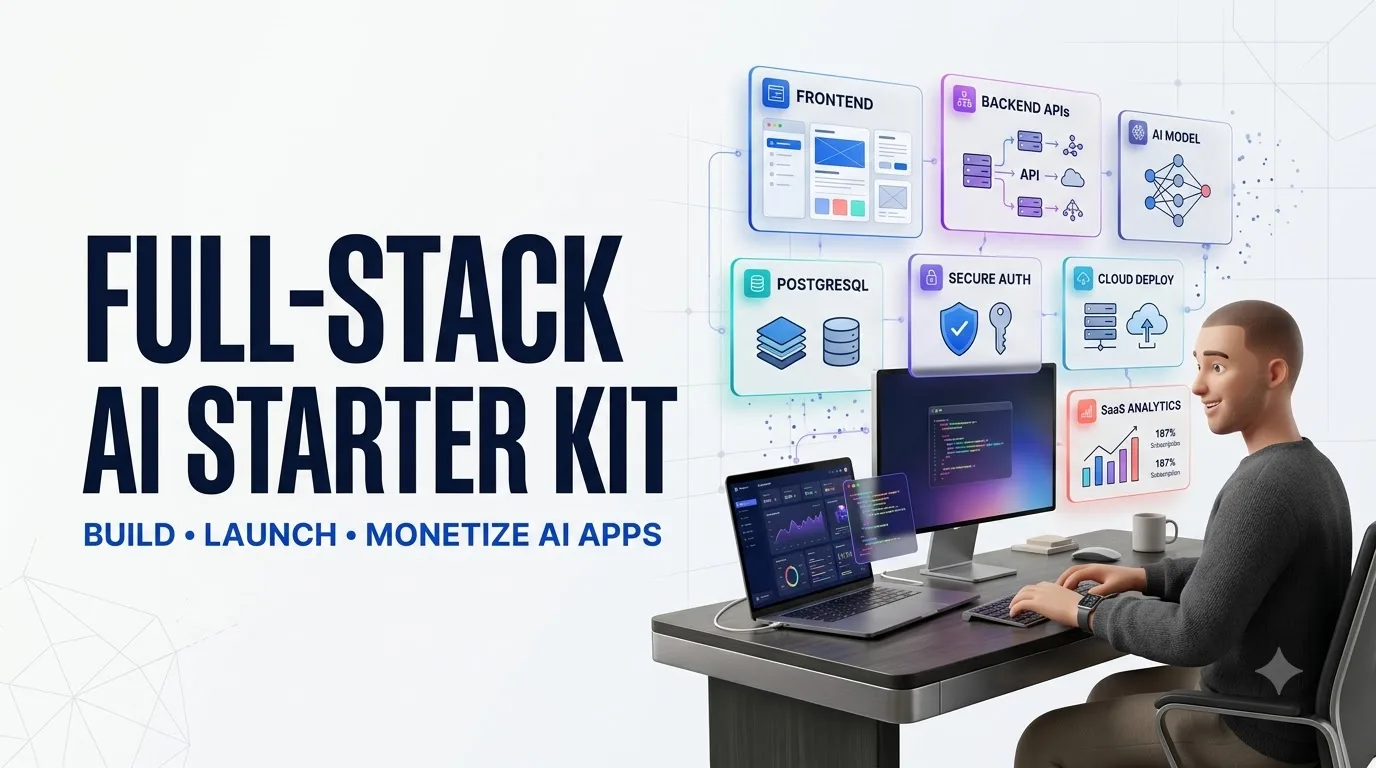
Full-Stack AI Starter Kit
From AI Product Idea to Scalable SaaS Application
Article Summary
Building an AI-powered application requires more than connecting a language model to a website. This article explains how a Full-Stack AI Starter Kit helps developers and entrepreneurs combine responsive frontend design, secure backend APIs, databases, user authentication, and AI integration into a practical software foundation.
It also explores subscription billing, API cost management, application security, testing, deployment, and strategies for validating and monetizing an AI SaaS product. The focus is on creating useful, maintainable applications rather than promising instant revenue or effortless development.
Article Description
Discover a practical roadmap for building modern AI applications using technologies such as Next.js, TypeScript, PostgreSQL, Supabase, OpenAI APIs, and Stripe. Learn how to select a suitable starter kit, develop a focused minimum viable product, protect customer information, manage AI usage, and prepare for a controlled launch.
Designed for developers, freelancers, startup founders, and digital entrepreneurs, this guide provides actionable steps, technology comparisons, monetization ideas, and essential considerations for building a dependable AI-powered business.
Full-Stack AI Starter Kit: Build, Launch & Monetize AI Apps Faster in 2026
You have an AI product idea. You understand the problem it could solve. But turning that idea into a secure, polished, revenue-ready web application requires much more than connecting a chatbot to an API.
A thoughtfully designed full-stack AI starter kit helps you assemble the essential building blocks: frontend, backend, database, authentication, AI integration, billing, security, and deployment. This guide explains how to choose those building blocks, avoid costly shortcuts, and bring a focused AI product to market.
For independent developers, US-focused SaaS founders, agencies, technical freelancers, and entrepreneurs evaluating AI starter templates.
What Is a Full-Stack AI Starter Kit?
A full-stack AI starter kit is a reusable software foundation that combines an application’s interface, backend services, data storage, authentication, and AI model integration. Depending on the package, it may also include subscription billing, admin dashboards, deployment configuration, automated tests, and documentation.
Consider an entrepreneur launching an AI-powered content planning tool. The distinctive product feature might be its ability to turn a business brief into a useful, editable, channel-specific publishing plan. But the business still needs accounts, project storage, AI request handling, usage limits, payments, and error recovery. Those common components are where a starter kit can help.
The important difference is between having a demo and operating a dependable product. A demo can generate text from a prompt. A real product must also protect user data, survive failed requests, prevent unauthorized access, manage costs, and explain clearly what customers are paying for.
Why Developers and Founders Consider AI Starter Kits
Less Repetitive Setup
Reuse familiar authentication, navigation, form, database, and deployment patterns instead of rebuilding each foundation for every idea.
Consistent Architecture
Keep application logic organized so new features, developers, and testing tools can be introduced without unnecessary confusion.
Commerce Foundations
Prepare for subscriptions, usage allowances, billing events, and customer account management.
Earlier Risk Awareness
Identify authorization, API usage, model reliability, and operational risks before they become expensive production problems.
Not every startup needs an elaborate boilerplate. A simple internal tool may work with a lightweight backend, while a customer-facing subscription service often requires a more complete architecture. The right decision depends on the product, team, and expected usage.
What Should a Complete AI SaaS Starter Kit Include?
Treat a starter kit as an engineering foundation, not a collection of attractive screenshots. The most useful packages include both working code and clear explanations of how the components fit together.
- Frontend: Responsive layouts, navigation, reusable components, accessible forms, and user-facing error states.
- Backend: Protected API endpoints, input validation, authentication checks, and business logic.
- Database: User profiles, project records, AI generation history, usage data, and migrations.
- Authentication: Login, logout, account recovery, session management, and authorization.
- AI integration: Provider SDKs, model configuration, prompt organization, structured outputs, and failure handling.
- Payments: Subscription workflows, checkout integration, webhook processing, and entitlement management.
- Operations: Error monitoring, configuration management, logging, backups, and deployment instructions.
- Documentation: Installation steps, environment variable descriptions, testing guidance, licensing terms, and update history.
The Recommended Full-Stack AI Technology Stack
For many JavaScript and TypeScript development teams, a practical starting point is Next.js, a component-based interface, managed authentication and PostgreSQL, a server-side AI integration, and a payment provider.
This is a recommended example architecture, not the only valid solution. Teams already experienced with Django, FastAPI, Laravel, Rails, or other frameworks may be more productive staying within their existing ecosystem.
| Layer | Suggested Tool | Primary Responsibility | Important Consideration |
|---|---|---|---|
| Application | Next.js + TypeScript | Web interface and server-side routes | Framework updates, caching, and runtime behavior |
| UI | Tailwind CSS | Responsive styling and reusable design patterns | Accessibility and visual consistency |
| Authentication | Supabase Auth | Identity, sessions, and user sign-in | Correct authorization and session validation |
| Database | PostgreSQL / Supabase | Accounts, projects, history, and usage records | Row-level permissions and backup strategy |
| AI | OpenAI API | Generation and AI-powered processing | Quality, latency, privacy, and token costs |
| Billing | Stripe | Checkout, subscriptions, and payment events | Webhook verification and entitlement accuracy |
| Hosting | Vercel or compatible cloud hosting | Deployment, HTTPS, runtime, and environment configuration | Function limits, pricing, and regional needs |
| Monitoring | Compatible error and analytics tools | Diagnose failures and observe usage | Consent, retention, and sensitive data handling |
How the Components Work Together
The most important architectural decision is the location of the trust boundary. Browsers are not trusted environments. API keys, billing decisions, private database operations, and privileged actions belong on the server.
Why Next.js Is a Practical Choice
Next.js supports server-rendered interfaces and Route Handlers, which can expose application-specific HTTP endpoints. This makes it possible to use one project for the customer-facing interface and many backend operations.
However, server functions must still verify the current user, enforce permissions, validate inputs, and control their external service calls. Using a server framework does not automatically make the application secure.
Why PostgreSQL and Authentication Matter
An AI application often needs to store much more than prompts: customer workspaces, saved outputs, templates, billing identifiers, and usage records all require reliable data modeling.
Supabase combines authentication with PostgreSQL-backed services. When browser-accessible tables are involved, developers should configure appropriate database grants and row-level security policies so customers cannot read or modify another customer’s data.
Choosing an AI Model Provider
Evaluate providers according to the job your application performs. Writing assistance, information extraction, code generation, image understanding, and automated workflows may have different requirements.
- Compare quality using real examples from your intended customers.
- Measure latency and actual API usage for typical requests.
- Review data handling, availability, and model usage policies.
- Check structured-output support where predictable results are important.
- Consider a provider abstraction when switching models may become valuable.
For new OpenAI text-generation integrations, the Responses API provides the main interface for model requests. Keep model names and provider settings configurable rather than hardcoding assumptions about future availability.
How to Build Your First Full-Stack AI App: Step by Step
The fastest useful launch process does not begin with writing code. It begins by defining one valuable workflow and deciding how you will determine whether it genuinely works.
Step 1: Choose One Specific Customer Problem
Avoid a broad promise such as “an AI assistant for everyone.” Start with one identifiable audience and one repeatable task.
Example: An AI proposal assistant for independent consultants that transforms approved client notes into an editable project proposal with milestones, deliverables, and assumptions.
Success criterion: A test user can finish the defined task and clearly explain why the tool saves effort.
Step 2: Define the Minimum Viable Product
Write down the shortest complete customer journey: create account, enter information, generate a useful result, edit it, save it, and return later.
Postpone advanced agents, complicated integrations, multiple subscriptions, and decorative dashboards until there is evidence that customers need them.
Step 3: Set Up the Repository and Environment
Choose a maintained project template, confirm dependencies, configure development and staging environments, and document required environment variables.
Never place secret AI provider keys in browser-accessible variables or commit them to public repositories. Use server-side environment configuration or a secret manager.
Step 4: Implement Identity and Data Ownership
Build the login experience, define account and project tables, then establish who may access each record. Test authorization failures as carefully as successful requests.
For an AI proposal application, user A must not be able to retrieve user B’s proposals by changing an identifier in an API request.
Step 5: Build One Protected AI Workflow
Accept a validated input, verify the authenticated user, check their usage entitlement, send an appropriately scoped request to the model provider, and validate the result.
A simplified server workflow looks like this:
POST /api/generate

1. Verify authenticated session
2. Authorize workspace access
3. Validate request schema
4. Check usage allowance
5. Apply rate and cost limits
6. Call configured AI model
7. Validate model output
8. Record billable usage safely
9. Save permitted results
10. Return response or safe error
Architecture illustration only. This is not executable code and does not replace server implementation, testing, or security review.
Step 6: Add Payments and Usage Entitlements
If your product uses paid subscriptions, connect a hosted checkout flow and process authenticated billing webhooks. Record the customer’s current entitlement on your backend.
Never unlock paid AI usage only because the browser reports that checkout succeeded. Handle asynchronous payment changes, webhook retries, and cancellations with idempotent processing.
Step 7: Test Failure Conditions
Verify what happens when the AI provider times out, returns malformed output, rejects a request, or costs more than expected. Also test mobile layouts, account deletion, payment failures, and interrupted connections.
Step 8: Deploy, Observe, and Improve
Configure HTTPS, production secrets, domain records, error monitoring, backups, and a rollback procedure. Invite a small test group before broad promotion.
Collect feedback on completed tasks rather than relying only on page views or sign-up counts.
Example Project Structure
A maintainable repository separates presentation, application logic, database access, and AI provider integration. The following is a conceptual folder layout for a Next.js application.
ai-starter/
  app/
    page.tsx
    dashboard/
    api/
      generate/
        route.ts
      billing/
        webhook/
          route.ts
  components/
    ui/
    forms/
  lib/
    ai/
    auth/
    billing/
    database/
    validation/
  tests/
  public/
  .env.example
  package.json
  README.md
The exact directory names are less important than clear boundaries, typed data, documented configuration, and tests that protect critical business rules.
What Can You Build With a Full-Stack AI Starter Kit?
AI Content Workflow Software
Generate structured drafts, editorial briefs, reusable content templates, and reviewable marketing assets.
Audience: marketers and agenciesDocument Analysis Assistant
Extract approved document information, organize summaries, and support source-linked search.
Audience: business teamsE-commerce Content Assistant
Help merchants prepare product descriptions, catalog attributes, and multilingual merchandising drafts.
Audience: online sellersPersonalized Learning Tool
Produce practice questions, study plans, and progress-oriented learning activities with appropriate safeguards.
Audience: educators and learnersEach opportunity involves different requirements. For example, a document assistant may need secure file storage and retrieval-augmented generation, while an e-commerce writing tool may prioritize batch jobs, editing workflows, and export integrations.
How to Monetize a Full-Stack AI Application
AI app monetization works best when pricing corresponds to measurable customer value while covering variable operating expenses. Do not assume that every subscription will be profitable.
Three Common Revenue Models
1. Recurring Subscriptions
Charge monthly or annually for access to a defined set of features and usage allowances.
Works well when: Customers rely on the product repeatedly.
2. Usage-Based Credits
Sell a set amount of processing capacity, document analysis, or generation credits.
Works well when: Demand varies substantially among customers.
3. Team or Agency Licensing
Charge for shared workspaces, additional seats, administrative control, or business-specific integrations.
Works well when: Multiple people collaborate inside the product.
4. Implementation Services
Offer customization, onboarding, migration, or integration services alongside the software.
Works well when: Customers need specialized configuration.
Example SaaS Pricing Structure
The following figures are illustrative product-design examples, not market-average prices or verified vendor offers. Real pricing should be based on validated demand and actual usage costs.
| Plan | Example Price | Possible Features | Ideal Customer |
|---|---|---|---|
| Free Trial | $0 | Small capped allowance, one workspace, basic workflow | Evaluating the product |
| Starter | $19/month | Higher allowance, saved history, exports | Independent professionals |
| Professional | $49/month | Advanced workflows, larger allowance, priority support | Regular business users |
| Team | Custom | Shared projects, seats, administration, integrations | Agencies and organizations |
Calculate Your Basic Unit Economics
Estimate monthly revenue per paying user and subtract the costs directly associated with serving that customer. Then account for shared operating costs and acquisition expenses when assessing the overall business.
Review heavy users separately. An allowance that works for an average customer may be unsustainable for an unusually intensive user.
Model providers, infrastructure platforms, and billing services can change their prices and policies. Verify current pricing on official provider websites before publishing cost comparisons or projecting profitability.
How to Evaluate a Paid AI SaaS Boilerplate Before Buying
Commercial starter kits can save setup work, but only when their code quality and supported features justify the price. A low-cost template with poor architecture can become more expensive than building a modest application from scratch.
- Inspect the demo: Look beyond the homepage and test actual workflows where possible.
- Check code access: Confirm exactly what source files and dependencies are included.
- Read the license: Understand commercial usage, redistribution, team usage, and resale restrictions.
- Check maintenance: Review update frequency, framework compatibility, and documented fixes.
- Verify billing: Confirm webhook handling, customer entitlements, and failure cases.
- Review security: Look for authorization enforcement and appropriate secret management.
- Examine deployment: Determine whether setup works on your intended hosting provider.
- Review support terms: Understand what support is promised and for how long.
Ask the seller one question: “Can you show me how the project prevents one logged-in customer from accessing another customer’s private data?” The answer often reveals more than a list of advertised features.
Thinking About Launching Your Own AI SaaS?
Start with one customer problem, one complete workflow, and an architecture you understand. Review the technology stack, validate the product concept, and select a starter kit only after confirming its technical and licensing details.
Review the Launch ChecklistAI Application Security, Privacy & Reliability
Security is one of the most important areas in which a starter kit can create false confidence. Attractive authentication screens and impressive AI features do not guarantee a secure application.
Critical Production Safeguards
- Protect secrets: Keep provider credentials on the server and rotate compromised keys.
- Authorize every operation: Validate user permissions independently of frontend controls.
- Enforce database permissions: Configure grants and row-level security where applicable.
- Control AI spending: Apply per-user limits, request-size limits, and monitoring alerts.
- Plan for prompt injection: Treat user content and retrieved documents as untrusted data.
- Constrain AI tools: Give automated systems only the minimum actions and permissions required.
- Validate outputs: Check structured responses before storing them or triggering other operations.
- Provide recovery: Build error states, backups, monitoring, and rollback procedures.
- Minimize sensitive data: Collect and retain only information needed for clearly disclosed purposes.
- Test accessibility: Support keyboards, clear labels, adequate contrast, and understandable error messages.
The OWASP guidance for large language model applications highlights risks including prompt injection and excessive autonomy. These concerns are especially relevant when an AI system can read private information or take actions in external services.
Why Human Review Still Matters
AI-generated output may be useful without being reliable enough for immediate publication or automated decision-making. For workflows involving contracts, finances, healthcare, employment, or other consequential information, implement domain-appropriate review and safeguards.
The goal is not to eliminate human oversight at any cost. It is to design a workflow in which automation handles suitable tasks while users retain meaningful control over important decisions.
Common Mistakes That Slow Down AI SaaS Launches
Building Too Many Features
Additional dashboards and integrations can delay learning whether customers value the core result.
Ignoring Operating Costs
Unlimited usage promises can be dangerous when each customer action triggers paid API processing.
Trusting the Frontend
Hidden buttons and client-side restrictions do not prevent unauthorized backend requests.
Skipping Real User Testing
Developers may understand a workflow that customers find confusing or unnecessarily complicated.
Your Practical Seven-Day AI App Launch Roadmap
The schedule below is an illustrative plan for a narrowly scoped prototype using familiar tools. Production readiness may take substantially longer depending on team experience, integration requirements, and regulatory risk.
| Day | Focus | Expected Deliverable |
|---|---|---|
| 1 | Customer problem and feature scope | One-page product brief and measurable success criteria |
| 2 | Repository and user interface | Usable application layout and development setup |
| 3 | Authentication and data | Account flow and authorized data access |
| 4 | AI workflow | Protected request flow with validation and failure handling |
| 5 | Usage controls and monetization | Plan rules, cost limits, and billing prototype |
| 6 | Testing and security review | Resolved critical defects and documented remaining risks |
| 7 | Controlled deployment | Limited beta with feedback collection and monitoring |
How to Turn First-Time Visitors Into Returning Users
Getting someone to try an AI product is only the beginning. Long-term retention depends on whether the product becomes useful in an ongoing workflow.
- Make onboarding outcome-focused: Help new users complete one useful task before presenting every feature.
- Save previous work: Provide projects, history, templates, and reusable settings where users value continuity.
- Use helpful notifications: Send relevant, consent-based reminders instead of repetitive promotional messages.
- Improve based on friction: Study where tasks fail, where users abandon the process, and which results require corrections.
- Publish educational updates: Share transparent release notes, practical tutorials, and product-specific use cases.
Measure more than sign-ups. Useful indicators include first-task completion, repeat use, customer-reported value, support issues, paid conversion, and retention by customer cohort.
How to Attract Search Traffic for an AI SaaS Product
A strong content strategy answers the questions potential customers ask before they are ready to subscribe. Helpful guides, implementation walkthroughs, product comparisons, and transparent tutorials support different stages of the buying journey.
Build a Relevant Topic Cluster
- Pillar: Full-Stack AI Starter Kit
- Supporting guide: How to Build an AI SaaS Application With Next.js
- Supporting guide: Secure AI API Integration for Web Developers
- Supporting guide: AI SaaS Subscription and Credit-Based Pricing
- Comparison: AI SaaS Boilerplate vs. Custom Development
- Tutorial: Common AI App Deployment and Authentication Mistakes
Link these pages naturally when they answer a related question. Use accurate headlines, identifiable authorship, meaningful updates, and original examples rather than producing large quantities of repetitive keyword-focused pages.
For Google Discover, prioritize useful storytelling, timely improvements, readable mobile layouts, and relevant high-resolution featured images. No headline formula, keyword set, or structured-data plugin can guarantee visibility.
Frequently Asked Questions About Full-Stack AI Starter Kits
1. Can beginners use a full-stack AI starter kit?
Yes, although a starter kit does not remove the need for foundational development knowledge. Beginners should understand basic JavaScript or TypeScript, HTTP requests, databases, authentication, deployment, and error handling. Start with one workflow and study each component before making it publicly accessible.
2. Is a full-stack AI starter kit better than building from scratch?
It can be more efficient when the included components match your requirements and are well maintained. Custom development may be preferable when you need specialized workflows, strict infrastructure controls, an uncommon technology stack, or highly specific security needs.
3. How much does it cost to launch an AI SaaS application?
Costs depend on development time, hosting, model consumption, database usage, third-party services, payment fees, testing, and support. A small prototype may use low-cost development resources, but costs can rise as usage grows. Estimate actual request volumes and check current vendor pricing instead of relying on a universal launch-cost figure.
4. Can I sell an AI SaaS application built from a commercial starter kit?
Often, yes, if the license permits commercial deployment. However, permission to operate a SaaS product does not necessarily include permission to redistribute its original source code, resell the template itself, or transfer licenses. Review all relevant software and asset licenses before purchasing or selling.
5. What is the most important feature of an AI SaaS starter kit?
There is no universal single feature, but dependable server-side authorization and a well-structured application foundation are especially important. A starter kit should make it straightforward to build a useful workflow without exposing customer information or creating uncontrolled AI service costs.
Quick Knowledge Quiz: Five AI Development Flashcards
Test your understanding before planning an AI product. Choose your answer mentally, then open each flashcard to reveal the explanation.
Flashcard 1 — Where should a secret AI API key be stored?
Frontend code is accessible to users. Private credentials must not be exposed in browser bundles or public repositories.
Flashcard 2 — What is the difference between authentication and authorization?
A logged-in user must still be checked for permission to access a particular workspace or resource.
Flashcard 3 — Why should an AI SaaS application enforce usage limits?
Usage restrictions should be applied on trusted server-side systems, not only displayed in the interface.
Flashcard 4 — Why are payment webhooks important?
Verified webhook events help synchronize application access with the billing provider’s records.
Flashcard 5 — What should you validate before adding advanced AI features?
Product validation reduces the risk of investing heavily in features customers do not need.
Self-assessment: Give yourself one point for each correct answer. These cards are learning aids, not an official certification.
Build an AI Product People Have a Reason to Keep Using
A full-stack AI starter kit can provide a useful head start, but it is not the product itself. The real value comes from solving a clear customer problem with an experience that is reliable, understandable, secure, and worth returning to.
For many founders, the most effective approach is to choose a familiar stack, validate one focused workflow, control usage costs, and earn trust through dependable behavior. Only then should the product expand into advanced automation, team features, and broader integrations.
A smaller application that consistently delivers a useful result is often a stronger business foundation than a feature-heavy platform that has not demonstrated customer demand.
Make Your Next Step a Working Prototype
Choose one target customer, write down their most frustrating repeatable task, and design the simplest AI workflow that could improve it. Then evaluate the starter kit, tools, and deployment requirements needed to build it responsibly.
Use the Step-by-Step Build GuideSources and Further Learning
The recommendations in this guide are informed by official developer documentation and established software-security guidance. Specifications and platform policies can change.
- OpenAI — Text Generation and Responses API
- OpenAI — Production Best Practices
- Next.js — Route Handlers
- Supabase — Authentication
- Supabase — Row Level Security
- Stripe — Subscription Webhooks
- OWASP — Top 10 for LLM Applications
- Google Search Central — Helpful, Reliable, People-First Content
- Google Search Central — Discover Best Practices
- W3C — WCAG 2.2 Accessibility Guidance
Editorial Standards and Trust Disclosure
This article is an educational overview based on published technical guidance, architecture analysis, and illustrative product scenarios. It does not claim that a particular commercial starter kit has undergone independent hands-on testing.
Readers should evaluate current documentation, licenses, security practices, and provider pricing before purchasing software or deploying customer-facing applications. Any future hands-on benchmarks or product reviews should identify the tested version, methodology, limitations, and evidence.
This article provides general technical, educational, and business information. It is not legal, tax, cybersecurity, financial, or professional compliance advice.
Businesses launching AI applications should evaluate applicable privacy and data-protection requirements, including relevant US state privacy laws; consumer protection and truthful advertising requirements; subscription billing, refund, and cancellation obligations; intellectual-property and open-source license terms; accessibility responsibilities; and age-related privacy rules.
Healthcare, financial, employment, children’s services, and other regulated applications may require additional safeguards, specialized assessments, and legal review. Requirements differ by jurisdiction, data type, product functionality, and business activity.
AI-generated content can be inaccurate. Human review remains important for consequential decisions. Earnings, launch timelines, customer acquisition, rankings, and profitability are not guaranteed.
If the publisher includes affiliate links, sponsored recommendations, or paid endorsements, disclose those relationships clearly and close to the relevant offers. Do not present hypothetical examples as actual customer experiences or verified results.
AMP compatibility depends on an AMP-capable WordPress configuration, compatible templates, appropriate component conversion, and successful validation.
Full-Stack AI Starter Kit Quiz
Test your knowledge of AI SaaS development, Next.js, databases, authentication, security, APIs and monetization. Answer 10 questions and discover your score.
Quiz Completed!
Review Your Answers
Educational self-assessment only. This quiz is not a professional certification. Results are calculated locally in your browser.
🎉 Congratulations! All 10 Steps Completed!
You've completed the Full-Stack AI Starter Kit preparation checklist. Review your implementation, verify security and performance, and continue improving your application using real customer feedback.
Your checklist progress is saved locally in this browser when browser storage is available. Checking an item records your own confirmation; it does not verify the implementation.
THE AI DEVELOPMENT EDITORIAL COLLECTION
Full-Stack AI
Starter Kit
10 Original Insights for Building Better AI Applications
A practical editorial guide to planning, developing, securing, launching, and monetizing modern AI-powered software products.
Editor's note: All ten entries are original educational analyses of common AI software-development challenges. Category labels describe the editorial perspective, not external endorsements, verified search-volume rankings, or independently tested products.
Start With One Customer Problem, Not Fifty AI Features
An AI application becomes commercially meaningful when it improves a specific task that people already need to complete. Before selecting a model or purchasing a starter template, identify one customer group, one recurring frustration, and one measurable outcome. A proposal-writing assistant for consultants, for example, has a clearer purpose than a general chatbot promising to perform every office task.
Define the minimum useful workflow, including its required inputs, expected outputs, and review process. Interview potential users and test a working example before adding advanced features. Early product validation reduces the risk of building impressive technology around a problem customers do not prioritize.
Choose a Full-Stack Architecture You Can Actually Maintain
A practical AI starter kit needs more than a modern frontend framework. It must connect presentation, authentication, business logic, database operations, AI services, and deployment into an understandable system. Each component should have a defined responsibility so that changes in one area do not unexpectedly affect the entire product.
Prefer tools that match your team's existing expertise and the application's actual requirements. A managed database may simplify operations, while a separate backend may be appropriate for intensive processing or specialized workloads. Maintain clear server-side boundaries for private credentials, customer records, and subscription permissions.
Design the AI Experience for Mobile Users First
An attractive dashboard can still fail when customers cannot complete their work comfortably on a phone. AI applications often involve lengthy prompts, uploaded documents, generated responses, and multi-step editing. Each interaction should remain clear on small screens without horizontal scrolling or complicated navigation.
Use readable typography, descriptive form labels, comfortable touch targets, visible loading states, and understandable error messages. Allow users to revise inputs and preserve work when a request fails. Accessibility and responsive design should be tested as functional requirements rather than treated as finishing touches.
Authentication Is Only the Beginning of Data Security
A login screen confirms identity, but it does not automatically protect everything stored in an application. A multi-customer AI platform must ensure that users can access only the workspaces, documents, saved prompts, and generated outputs they are permitted to see. These rules belong in trusted backend and database controls, not only in the interface.
Use server-side authorization checks and appropriate database access policies. Review file storage permissions, session handling, password recovery, and account deletion. Test whether changing a project identifier allows one account to retrieve another customer's information. Preventing cross-account data exposure is essential for maintaining trust.
Turn AI Model Requests Into Reliable Application Workflows
Connecting an AI model is relatively simple; making that connection dependable requires additional engineering. A production workflow should validate incoming requests, verify user permissions, apply usage controls, and define the expected response format. The application also needs a plan for invalid outputs, provider interruptions, and partial failures.
Use structured responses where a feature depends on predictable data. Separate model instructions from untrusted content and test representative customer inputs. Choose a model based on task quality, latency, operating cost, and data requirements, rather than assuming the most powerful option is always the best commercial choice.
Build Smarter Knowledge Assistants Without Overpromising Accuracy
Many business AI applications need to answer questions using customer documents rather than general model knowledge. A retrieval-based architecture can locate relevant passages and supply them as context for the model. This can improve grounding, but retrieved material may still be outdated, incomplete, misleading, or malicious.
Organize documents carefully, enforce permissions before retrieval, and preserve references to original source sections. Evaluate whether the assistant correctly identifies missing information instead of inventing an answer. A trustworthy knowledge assistant should communicate uncertainty and give users a practical way to verify important claims.
Give AI Automation Clear Boundaries and Human Oversight
AI systems become riskier when they can perform actions instead of simply generating information. An assistant that sends emails, changes account settings, or accesses private documents must operate within clearly defined permissions. Instructions found in retrieved webpages, uploaded files, or third-party content should never automatically gain authority over the application's safeguards.
Limit each automated workflow to the tools and data it genuinely needs. Require approval for consequential actions, log important operations, and provide a recovery path when something goes wrong. Sensible automation is not the elimination of human judgment; it is a disciplined way to reduce repetitive work without surrendering necessary control.
Control AI Usage Costs Before Offering Paid Subscriptions
AI SaaS economics differ from ordinary software because individual customer actions may generate variable processing costs. A subscription price that appears attractive can become unsustainable when users submit unusually large requests, trigger repeated generations, or rely on expensive models for routine tasks.
Estimate the cost of typical and high-usage customer behavior. Track requests and consumption by account, apply reasonable allowances, and monitor failed operations and retries. Design billing entitlements on the backend, verify payment events, and explain usage limits clearly so customers understand what their subscription includes.
Production Readiness Means Testing the Unexpected
A successful demonstration proves that a workflow can operate under favorable conditions. Production readiness requires evidence that the same application behaves responsibly when conditions deteriorate. External AI services may become unavailable, database connections may fail, payment events can arrive more than once, and users may submit unexpected inputs.
Add automated tests for core business rules, authorization failures, and billing events. Use staging environments, structured error monitoring, backups, and documented rollback procedures. Review logs without unnecessarily retaining personal or sensitive information. A controlled beta can reveal operational weaknesses before a wider public launch.
Build a SaaS Business Around Repeatable Customer Value
Launching an AI application does not automatically create a business. Sustainable growth depends on helping customers complete useful tasks often enough to justify ongoing payment. A strong product explains its benefits clearly, makes onboarding straightforward, and gives users a reason to return beyond curiosity about AI-generated content.
Measure first-task completion, repeat usage, customer feedback, paid conversion, and retention over time. Improve the workflow that delivers the strongest value before expanding your feature list. Make pricing, cancellation terms, privacy practices, and limitations easy to understand. Trust and practical usefulness are better long-term foundations than exaggerated claims.
📝 Key Takeaways & Action Notes
Jot down insights, next steps, or thoughts from this post. Your notes save automatically in your browser.
- What is the #1 breakthrough insight you took away today?
- What is one concrete action you will take in the next 24 hours?
- What questions or ideas do you want to research further?
Stay ahead with exclusive updates
Join our community. Get curated industry trends, actionable guides, and fresh resources delivered straight to your inbox.