
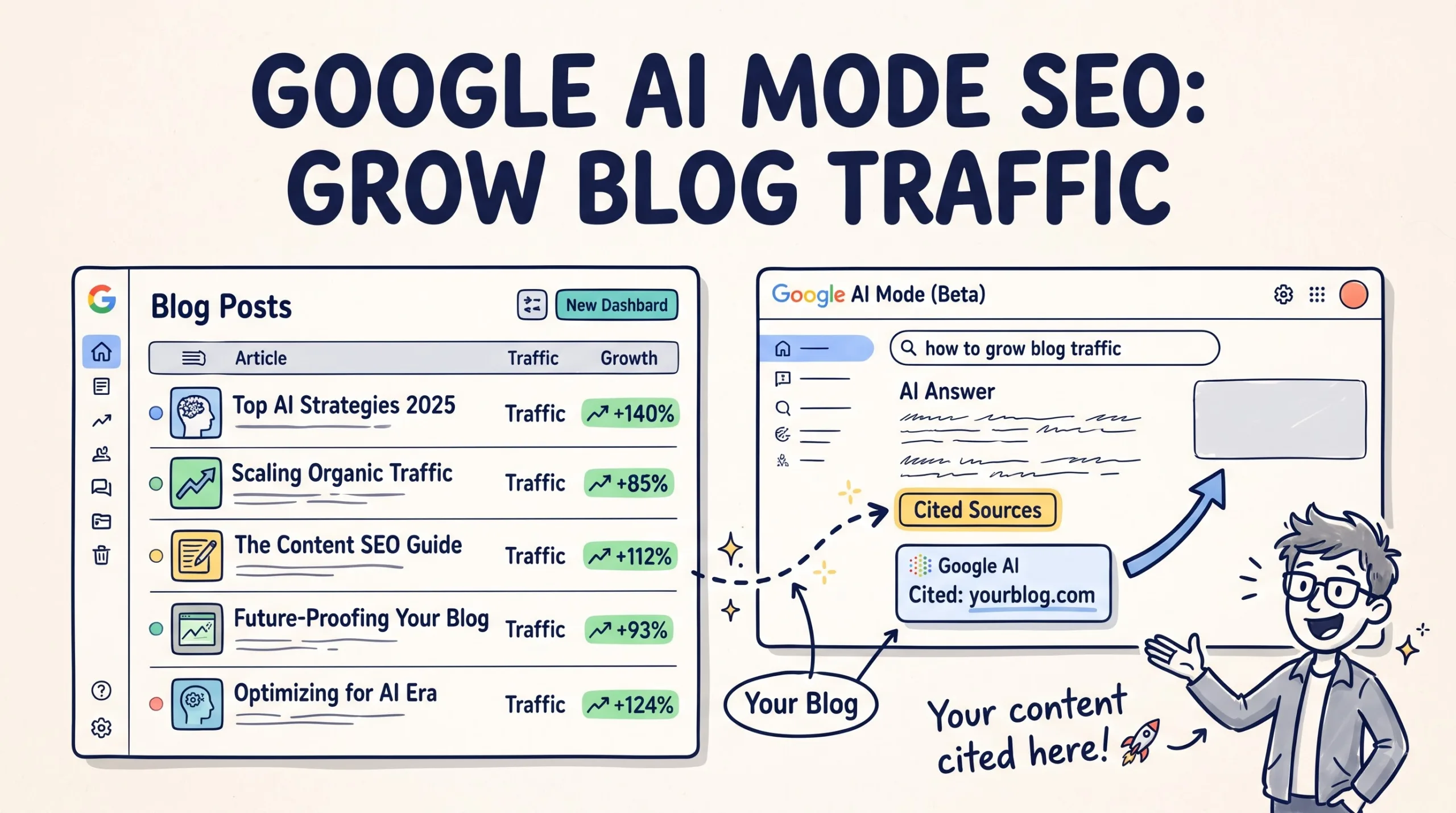
Google AI Mode SEO helps publishers grow blog traffic in 2026. Learn original content tips, internal link fixes, and visibility tracking steps that work now.
Google AI Mode SEO for blog traffic that still grows
Practical steps to get cited in AI answers without rewriting every old post from scratch.
Quick summary: Google AI Mode SEO
Google AI Mode SEO focuses on making your blog posts clear enough that Google’s generative answers can cite them as sources while still sending readers to your full page. In 2026 most AI Overviews pull short answers from pages that answer a specific question early, show first-hand details, and link to related posts on the same site. Publishers who treat every post as a potential citation source usually keep more organic traffic than those who only chase classic rankings. The practical path is simple: write original observations, fix internal links so AI can follow related ideas, and check Search Console for impression changes on queries that now trigger AI Mode. Skip keyword stuffing; it rarely helps and can make pages look thin.
What Google AI Mode SEO actually covers
Google AI Mode SEO is the set of habits that help a blog post appear as a cited source inside generative answers instead of only in the classic blue links. AI Overviews and AI Mode both pull short, direct replies from pages that answer the query early and support it with concrete details. A post about “how to fix a leaky faucet” gets cited more often when the first paragraph names the tools and the exact steps the writer used last month. Vague overviews rarely make the cut.
The system still relies on the same crawling and indexing Google has used for years. What changed is the display layer. Pages that once ranked only in position 6 or 7 can now supply a sentence or two that millions of people see first. That visibility does not always replace the click. Many readers still open the full post when they want the photos, the tool list, or the longer explanation.
One useful test is to search your main topic in an incognito window and note which pages get cited. The ones that appear usually have a specific claim backed by something the author did or saw, not a generic list of tips. I’d keep that test simple. Run it once a month on your top five topics. Anything more turns into busywork that does not change the posts.
Why Google AI Mode SEO matters for blogs in 2026
Traffic from classic organic results has flattened for many independent publishers since AI Overviews expanded. A gardening blog that ranked well for “best soil for tomatoes” may now see the short answer appear above the links. Readers still click through when the post includes soil test results from a real bed or photos taken over a season. Pages that only repeat advice found on five other sites lose both the citation and the click.
The shift favors sites that already publish original notes. A small software review site that tests one tool per week and records exact load times keeps more referral traffic than a larger site that rewrites manufacturer descriptions. The difference shows up in Search Console under “AI Mode” or similar labels when Google surfaces them. Check the performance report monthly. Look for queries where impressions rose while clicks stayed flat or fell. Those are the places where a clearer first paragraph or an added personal detail often recovers the click.
I’d skip heavy technical markup beyond basic schema for article and FAQ unless your analytics already show rich results. Extra code rarely moves the needle on citation rate and can break on mobile if you are not careful. Most gains come from clearer writing and better internal links.
Four practical angles for AI Overviews SEO
Write original observations first
AI Mode prefers pages that contain details not repeated across the top ten results. A post about travel packing that lists exact weights of items the writer carried on a 14-hour flight gets cited more than a generic packing checklist. Start with the observation, then add the standard advice around it.
- Record one measurement, date, or result from your own use
- Place that detail in the first paragraph
- Keep the rest of the post supporting that single claim
- Avoid copying structure from the current top result
Fix internal links for context
Generative answers sometimes pull from more than one page on the same site. A clear link from a beginner post to a detailed follow-up helps the system understand the relationship. Use descriptive anchor text that matches the question a reader would ask next.
- Link from the main post to two related posts
- Use the exact phrase a reader might search
- Add a short sentence that explains why the link exists
- Check that every linked post still answers its topic
- Remove links that point to outdated advice
Show first-hand experience signals
Pages that mention a specific tool, a date, or a result the author measured stand out. A review that says “I ran the export on a 2024 MacBook Air and the file finished in 42 seconds” is clearer than “the tool is fast.” The signal does not need to be long. One concrete sentence is often enough.
- Name the device or software version you used
- Include one number you recorded
- Add the month and year of the test
- Keep the rest of the advice general if needed
- Update the date when you retest
- Avoid claiming results you did not measure
Measure search visibility monthly
Search Console now surfaces data on queries that trigger AI features. Filter the performance report by query and look for rising impressions on terms that previously ranked lower. A drop in clicks with stable impressions often means the short answer is satisfying some readers.
- Export the last 28 days of query data
- Mark queries that show AI Mode in the interface
- Compare click-through rate before and after a content edit
- Note which pages gained impressions without ranking higher in classic results
Six content moves that help organic traffic
Lead with the answer
Place the direct reply in the first paragraph. A reader (and the AI) should know the main point before scrolling. For a post on image compression, state the tool and the typical file-size drop you saw.
Add one original photo
A single photo you took of the process or the result gives the page a signal other sites lack. Label it with a short caption that includes the date and the tool used. Stock images rarely help citation rate.
Cluster related posts
Group three posts around one topic and link them with clear anchors. The cluster helps AI Mode understand that your site covers the full question set. Update the oldest post in the cluster first.
Show the update date
Place a visible “Updated October 2026” line near the top. AI systems favor pages that signal current information. Refresh the date only after you change a factual detail, not just the timestamp.
Answer the follow-up
Add a short section that answers the next question a reader would ask. For a post on password managers, include how you migrated from the old tool. The extra section often supplies the second citation.
Check mobile layout
AI Mode results appear on phones. Make sure the first paragraph is fully visible without scrolling on a 390-pixel screen. Long intro paragraphs that push the answer down lose the citation slot.
I’d skip adding video embeds unless the video itself contains the original measurement. Most blogs see better results from clearer text and one supporting image. The trade-off is that video takes longer to produce and rarely changes citation rate on its own.
Step-by-step setup for generative AI search
- Pick three existing posts: Choose posts that already rank between positions 4 and 10 for their main query. These have the best chance of moving into a citation slot after a small edit.
- Rewrite the first paragraph: Open each post and replace the opening with one sentence that answers the query and includes one detail you observed. Keep the sentence under 30 words.
- Add two internal links: Place a link to a related post in the second paragraph and another near the end. Use anchor text that matches a real follow-up question.
- Insert one original detail: Add a short sentence with a measurement, date, or tool version from your own use. Place it where it supports the main claim.
- Update the visible date: Change the “Updated” line only if you altered a fact. Publish the post and note the exact time.
- Check Search Console after 14 days: Filter to the target query. Look for changes in impressions and whether the page appears in AI Mode results. Record the numbers in a simple spreadsheet.
- Repeat on the next three posts: Only expand to more posts after you see a pattern. Most sites get clearer results by refining a small set of pages than by touching everything at once.
The whole cycle takes about 40 minutes per post once you know the pattern. I’d do the first three posts in one sitting so the comparison stays consistent. Spreading the work over weeks makes it harder to see what actually changed.
🚀 Ready to build more original content?
Grab ready-made digital products and templates that save setup time.
Compare classic SEO and AI Mode approaches
| Approach | Main goal | Typical edit | Best for |
|---|---|---|---|
| Classic on-page SEO | Rank in blue links | Title, headings, keyword placement | New pages and competitive queries |
| Google AI Mode SEO | Get cited in generative answers | First paragraph + original detail | Existing posts already ranking 4-10 |
| AI Overviews SEO | Supply short answer text | Direct reply early + clear structure | How-to and definition queries |
| Internal linking focus | Help AI follow related ideas | Descriptive anchors between posts | Sites with 20+ posts on one topic |
Most blogs need both classic SEO and Google AI Mode SEO. The classic work still gets the page indexed and ranked. The AI Mode work increases the chance the page supplies a cited sentence. Fees and rules change, so check Google Search Console before you decide which queries to prioritize.
Common mistakes that cut visibility
- Opening with a long story: The first paragraph must answer the query. A 200-word introduction pushes the useful detail below the fold and reduces citation chance. Move the answer up and keep the story for later.
- Repeating the same advice as the top result: If your post says the same five steps as the current number-one page, AI Mode usually cites the older or higher-authority source. Add one detail only you recorded.
- Using generic anchor text: Links that say “click here” or “read more” give the system no context. Change them to the actual question the linked post answers.
- Updating the date without changing facts: A fresh timestamp on unchanged content does not help. Only change the date after you revise a measurement, tool version, or step.
- Ignoring mobile first-paragraph length: On a phone the AI Mode box appears first. If your answer sits under a long intro, readers never reach it. Shorten the opening to two sentences max.
- Adding schema for every possible type: Extra markup rarely improves citation rate and can cause validation errors. Stick to basic Article and FAQPage schema unless you already see rich results.
Frequently asked questions
Does Google AI Mode SEO replace classic SEO?
How long does it take to see citation changes?
Do I need schema markup for AI Mode?
Can small blogs get cited in AI Overviews?
What should I do if clicks drop but impressions rise?
Should I rewrite every old post?
Does AI Mode prefer longer posts?
How do I track AI Mode visibility?
Quick quiz on Google AI Mode SEO
1. Where should the direct answer appear?
- Anywhere in the post
- In the first paragraph
- Only in the conclusion
2. What helps a page get cited most?
- Repeating the top result
- One original measurement or date
- Adding more keywords
3. How many posts should you edit first?
- Every post on the site
- Three to five that already rank 4-10
- Only brand-new posts
4. What does rising impressions with flat clicks often mean?
- The page lost ranking
- The AI answer is satisfying some readers
- The site has a technical error
5. Which internal link style works better?
- “Click here”
- The exact follow-up question
- A single word
6. When should you update the visible date?
- Every week
- Only after changing a fact
- Never
7. Is extra schema required for citations?
- Yes, always
- No, basic Article schema is enough
- Only for product pages
8. What is a useful monthly check?
- Rewrite every title
- Filter Search Console for AI Mode queries
- Add more images
9. Do small sites get cited?
- Rarely
- Yes, when they include original details
- Only with high domain authority
10. What should you skip for most blogs?
- Clear first paragraphs
- Heavy technical markup beyond basics
- Internal links
Make your first move with Google AI Mode SEO today
Open the three posts that already rank between positions 4 and 10. Rewrite each first paragraph so it answers the main query in one sentence and includes one detail you observed. Publish the changes and set a reminder to check Search Console in 14 days.
- Pick the three posts: Choose ones that already appear in classic results for their target query.
- Rewrite the openings: Add the direct answer plus one original measurement or date in the first paragraph.
- Add the links and note the date: Place two descriptive internal links and record the publish time so you can compare results later.
✨ Need templates or tools to move faster?
Check ready-made digital products that handle the setup work.
Disclaimer & compliance note
Affiliate disclosure: Some links in this post are affiliate links. If you click and make a purchase we may earn a commission at no extra cost to you. We only link to products or pages we believe are useful for the topic.
No guarantee: Search results and AI Mode behavior change. Nothing in this post promises rankings, traffic numbers, or earnings. Always check current Google documentation for the latest rules.
AI use: This post was drafted with AI assistance and then reviewed and edited by a human. Contact support@digitalideatool.com with questions.
Please Note – Disclaimer
The content, news, topics, and ideas presented on this platform are collected and compiled from various websites, online sources, and digital platforms.
We do not guarantee the accuracy, authenticity, completeness, or reliability of any information, news, or sources mentioned.
Readers are strongly encouraged to independently verify all facts, claims, sources, and information through trusted and official channels before relying on or acting upon them.
This content is provided for general informational and educational purposes only.
✓ Reader Reminder: Always verify important information using trusted, authoritative, and official sources before making decisions or taking action.
📝 Key Takeaways & Action Notes
Jot down insights, next steps, or thoughts from this post. Your notes save automatically in your browser.
- What is the #1 breakthrough insight you took away today?
- What is one concrete action you will take in the next 24 hours?
- What questions or ideas do you want to research further?
Stay ahead with exclusive updates
Join our community. Get curated industry trends, actionable guides, and fresh resources delivered straight to your inbox.