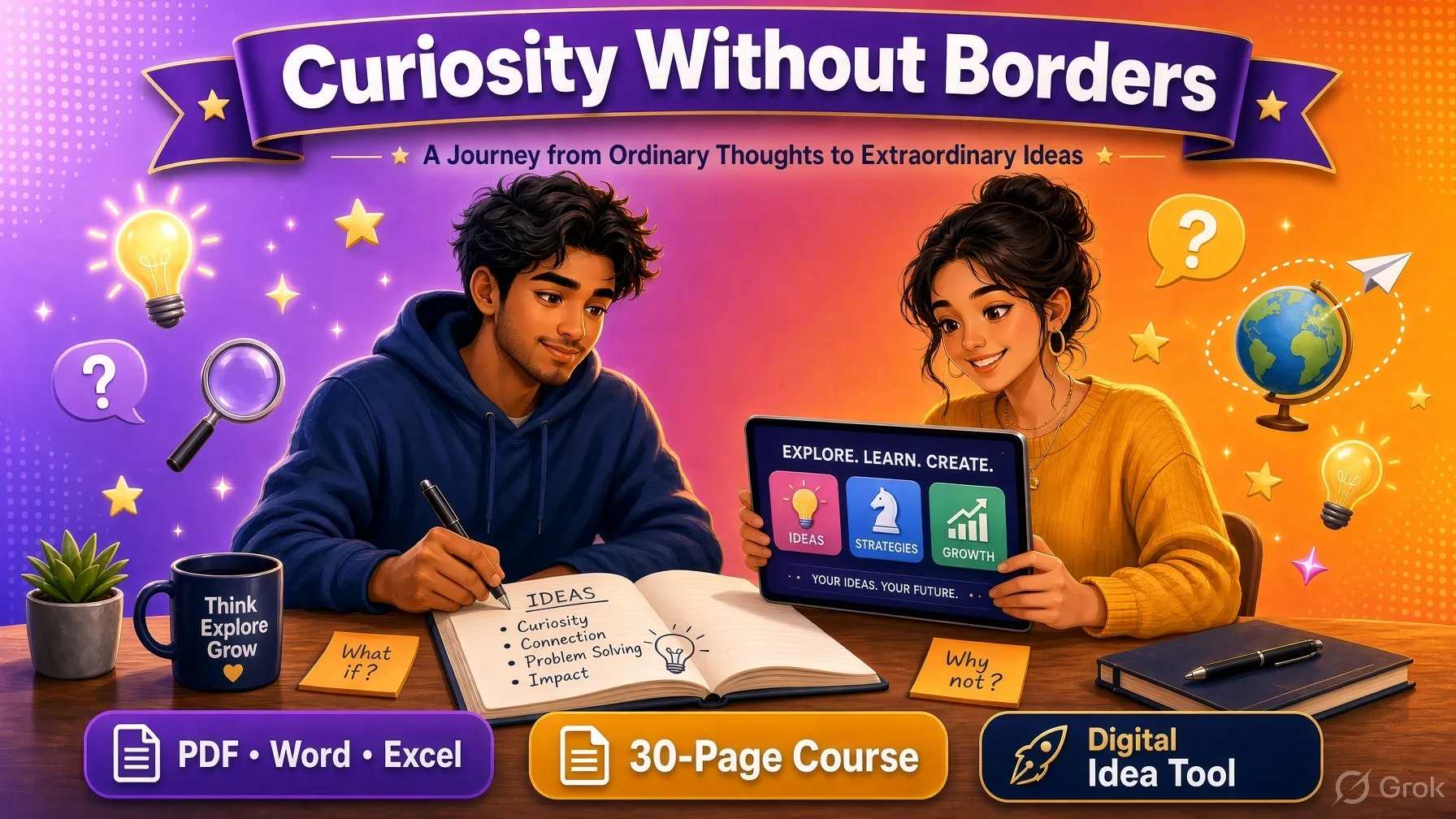
Curiosity Without Borders: A Journey from Ordinary Thoughts to Extraordinary Ideas
A 30-Day Beginner Learning Roadmap | 60 Minutes Daily | Personal Tutor Approach
Explore the power of questions, discover unexpected connections, strengthen creative thinking, and turn ordinary observations into extraordinary possibilities.
Introduction: Every Extraordinary Idea Begins with a Simple Question
Have you ever wondered why some people see exciting opportunities in ordinary situations while others overlook them? Why does a child ask endless questions about the world, yet many adults gradually stop questioning familiar things? What if one small thought could become the beginning of a remarkable discovery?
Welcome to Curiosity Without Borders: A Journey from Ordinary Thoughts to Extraordinary Ideas, a practical 30-day learning experience designed to help complete beginners develop curiosity, creative thinking, observation, imagination, and problem-solving skills.
You do not need advanced education, expensive equipment, artistic talent, or previous experience. All you need is an open mind, a notebook, and 60 minutes of daily practice.
Throughout this journey, I will act as your personal tutor, guiding you through one carefully selected topic each day. You will learn how to ask meaningful questions, recognize hidden opportunities, challenge assumptions, explore unfamiliar perspectives, and turn everyday observations into useful ideas.
The purpose is not simply to become more knowledgeable. It is to develop a lifelong habit of thinking beyond familiar boundaries.
Big discoveries often begin with little questions!
Each daily lesson follows a consistent 60-minute structure so that learning remains organized and manageable.
The first week focuses on understanding curiosity and developing the ability to notice things that usually escape attention.
What Is Curiosity?
Discover how curiosity encourages learning, exploration, and discovery. Write ten things you have always wondered about. Choose three questions to investigate.
Learning to Notice the Ordinary
Practice observation. Study your home, street, or workplace and identify fifteen interesting details you usually ignore.
The Power of Asking Why
Learn to move beyond surface explanations. Choose an everyday object and ask why it exists, how it works, and why its design matters.
Asking Better Questions
Explore open-ended questions beginning with how, what, and why. Transform five simple questions into deeper questions that invite exploration.
Overcoming the Fear of Not Knowing
Understand why uncertainty is a normal part of learning. Identify three unfamiliar subjects and explore one without worrying about mistakes.
Discovering Hidden Connections
Practice connecting unrelated ideas. Combine two ordinary objects and imagine a new product, activity, or useful solution.
Weekly Reflection and Curiosity Challenge
Review your notebook. Select your five most interesting discoveries and explain how your thinking changed during the week.
Curiosity becomes more powerful when you discover that a single situation can be understood from several perspectives.
Understanding Different Perspectives
Explore how personal experiences influence interpretation. Describe one everyday situation from three different viewpoints.
Challenging Everyday Assumptions
Identify common beliefs about studying, work, or daily routines. Question whether they are always true and explore alternatives.
Thinking Beyond Right and Wrong
Practice examining ideas before judging them. Compare two different approaches to solving the same problem.
The Art of Imagination
Explore how imagination helps us investigate possibilities. Redesign an ordinary classroom, kitchen, or public space.
What If Thinking
Create ten questions beginning with “What if?” Choose one and describe its possible benefits, difficulties, and consequences.
Learning Across Different Subjects
Discover connections between science, art, nature, technology, and culture. Explore how knowledge from one field can improve another.
Weekly Creative Exploration
Create a one-page mind map connecting at least five subjects. Explain three surprising relationships you discovered.
During the third week, you will transform questions and observations into ideas that can be tested, improved, and communicated.
How Extraordinary Ideas Begin
Study how useful ideas can emerge from small frustrations and everyday needs. Identify five problems worth solving.
Introduction to Brainstorming
Learn to generate possibilities before evaluating them. Produce twenty ideas for improving a common daily activity.
Combining Unrelated Concepts
Practice creative combinations. Connect two different industries, hobbies, or objects to develop five original concepts.
Identifying Real Problems
Distinguish interesting ideas from genuine needs. Interview or observe someone, with permission, to understand a recurring difficulty.
Researching Ideas with Evidence
Learn to compare sources, check factual claims, and recognize uncertainty. Research one proposed solution using reliable information.
Small Experiments and Prototypes
Choose a promising idea and create a simple sketch, paper model, checklist, or demonstration that explains how it might work.
Testing and Improving Your Ideas
Ask someone for feedback. Identify what works, what is confusing, and what should change. Revise your prototype.
The fourth week focuses on applying curiosity to your relationships, learning, decisions, and everyday challenges.
Curiosity in Everyday Problem-Solving
Choose one recurring difficulty in your routine. Explore its causes and suggest three realistic improvements.
Curiosity and Communication
Practice asking thoughtful questions during a conversation. Focus on listening carefully rather than preparing immediate replies.
Exploring Culture and Human Experiences
Learn about an unfamiliar cultural practice or historical tradition using respectful, reliable sources. Record what surprised you.
Curiosity in Science and Technology
Select an invention and investigate the problem it addresses, its limitations, and possible future improvements.
Curiosity for Personal Growth
Examine your own habits, interests, and learning challenges. Identify one assumption about your abilities that deserves reconsideration.
Evaluating Ideas Responsibly
Consider whether your proposed idea is practical, safe, accessible, and beneficial. Identify potential unintended consequences.
Designing Your Final Curiosity Project
Select your strongest idea. Prepare a project outline explaining the problem, research, proposed solution, and expected benefits.
Build and Present Your Final Curiosity Project
Use your observation notes, research findings, creative ideas, and prototype to prepare a short project presentation. Explain your original question, how your thinking developed, and what you learned from testing or feedback.
Final Review and Your Lifelong Curiosity Plan
Review all previous lessons. Compare your first-day questions with your current thinking. Identify your strongest skills, remaining challenges, and three curiosity habits you want to continue practicing.
Your final project should demonstrate how a small question can become a thoughtful, evidence-informed solution.
For example, you might begin with the question: Why do people forget important daily tasks? Through observation, brainstorming, and testing, you could develop a simple visual reminder system.
Your presentation should describe the original problem, the questions you explored, the alternative ideas you considered, your chosen concept, and any feedback you received.
The goal is not to produce a revolutionary invention within 30 days. It is to demonstrate a repeatable process that helps transform curiosity into constructive action.
One ordinary question. One new possibility. One meaningful idea.
Mark each lesson when you have completed its one-hour study session and practical activity.
Consistency matters more than perfection. Reserve one hour each day in a quiet, comfortable environment. Keep a dedicated curiosity notebook where you can record questions, sketches, observations, and discoveries.
Avoid trying to memorize everything. Instead, concentrate on understanding, exploring, and applying one concept at a time.
When an activity feels difficult, simplify it rather than abandoning it. When you discover an unfamiliar topic, write it down for future investigation instead of distracting yourself from the current lesson.
Most importantly, allow your ideas to evolve. Your first explanation may be incomplete. Your first design may need revision. This is a natural part of exploration.
Curiosity is not reserved for scientists, inventors, artists, or exceptionally talented individuals. It is a human capacity that can be strengthened through deliberate practice.
Over these 30 days, you will move from observing ordinary details to asking deeper questions, exploring unfamiliar perspectives, developing creative concepts, and evaluating real-world solutions.
The greatest achievement will not necessarily be your final project. It will be the development of a new habit: noticing possibilities where you previously saw only routine.
Your journey begins with one question. Your progress grows through daily exploration. And your next extraordinary idea may emerge from something surprisingly ordinary.
Start with Day 1. Ask a question. Follow the evidence. Explore the possibilities.
Written by Digital Idea Tool Team
Without Borders
Curiosity Without Borders: 10 Practical Examples That Turn Ordinary Thoughts into Extraordinary Ideas
Discover · Question · Imagine · Experiment
Explore ten everyday situations and discover how thoughtful questions can lead to useful ideas, simple inventions, better habits, and creative problem-solving.
Curiosity becomes powerful when we stop simply observing everyday life and begin asking, “Why does this happen, and how could I make it better?”
Here are ten original idea exercises for your 30-day learning roadmap. Each example includes an ordinary observation, a curiosity-driven question, a creative idea, and a practical experiment you can complete as a beginner.
Every ordinary moment may hide an extraordinary possibility!
I sometimes forget to drink water while working.
What if a water bottle could remind someone to take a break without needing an app?
Design a reusable bottle sleeve with movable time markers and simple visual reminders.
Draw a bottle with six reminder markers. Build a paper sleeve and test whether it helps you remember your planned water breaks during the day.
I have notebooks, but I rarely know what to write in them.
What if every notebook page helped me discover one interesting idea?
Create a notebook divided into four sections: Observe, Question, Imagine, and Experiment.
Choose one everyday object and fill in each section. For example, observe a chair, question its design, imagine improvements, and sketch one change.
Waiting in a queue can feel frustrating and confusing.
Could people feel more comfortable if they knew what was happening while waiting?
Design an easy-to-read queue information board showing the current number, approximate waiting range, and instructions.
Sketch two different waiting-area designs. Ask three people which layout they find easier to understand.
Small quantities of usable ingredients are sometimes forgotten in the refrigerator.
What if meal planning began with ingredients already available instead of a new shopping list?
Create a “Use First” recipe card system that matches available ingredients with simple meal ideas.
List five ingredients already in your kitchen. Research safe storage guidance and create three possible meals using those ingredients.
Studying the same subject for an hour sometimes feels repetitive.
What if every learning session started with a small mystery?
Create a “Question Quest” study method. Begin with an intriguing question, investigate possible answers, and finish by explaining a discovery in your own words.
Choose the question, “Why does ice float on water?” Spend 15 minutes predicting, 20 minutes researching reliable explanations, 15 minutes drawing a diagram, and 10 minutes summarizing what you learned.
Umbrellas are easy to forget in shops, classrooms, or offices.
How might someone notice that they are leaving an umbrella behind?
Design a bright, personalized umbrella handle tag with a detachable reminder card.
Make three paper tag designs. Ask friends which one they would notice most easily, and examine whether the tag interferes with holding the umbrella.
A small balcony often remains unused or cluttered.
Could one small corner serve several useful purposes?
Imagine a modular balcony corner combining seating, reading, and plant storage.
Measure the available space, sketch three arrangements, and use cardboard shapes to compare layouts. Consider drainage, safe loading, and clear access.
Some instruction manuals contain too much text and are difficult for beginners to follow.
Could simple pictures explain the same instructions more clearly?
Create a pictorial quick-start guide using numbered illustrations, arrows, and short captions.
Choose a simple, safe task, such as folding a paper box. Make a four-step illustrated guide and ask someone to follow it without your assistance.
It is easy to become distracted while studying or working.
What if the desk itself encouraged better concentration?
Design a three-zone desk arrangement: Focus Zone, Tools Zone, and Later Zone.
Organize your desk using paper labels. Complete a 20-minute study task, recording interruptions. Compare it with another session under similar conditions.
I walk past the same roads, signs, and public spaces without paying much attention.
What small change could make a familiar place easier or more pleasant to use?
Create a neighborhood improvement sketchbook with observations about signs, seating, shade, accessibility, or waste collection.
Walk through a familiar public area, safely record five observations, and select one problem. Develop two possible improvements and compare their feasibility.
Practice the Thinking Process Yourself
Your Personal Curiosity Idea Lab
Turn your own observation into a practical creative idea using the following four-step activity.
Your 60-Minute Practical Curiosity Challenge
| Time | Learning Activity |
|---|---|
| 10 minutes | Observe five ordinary problems around you. |
| 15 minutes | Ask three curiosity questions about one problem. |
| 15 minutes | Generate five possible solutions. |
| 10 minutes | Sketch your most promising idea. |
| 10 minutes | Plan a safe, simple test and record your reflections. |
Observe → Question → Imagine → Experiment → Improve
Final Thought: Extraordinary Ideas Begin with Ordinary Questions
An extraordinary idea does not have to be complicated or expensive. It can begin by making one ordinary experience simpler, clearer, safer, more enjoyable, or more useful.
When you develop the habit of observing, questioning, imagining, and experimenting, everyday experiences become opportunities for creative learning.
Start with one observation today. Write down your question, imagine a solution, and test your idea in a small, practical way.
Without Borders
5 Best Books About Curiosity, Creative Thinking and Turning Ordinary Thoughts into Extraordinary Ideas
Discover Inspiring Books · Learn Practical Thinking · Unlock New Ideas
Explore five published books that can help you develop curiosity, observation skills, creative confidence, innovative thinking, and a lifelong passion for learning.
These five real, published books are closely related to the topic “Curiosity Without Borders: A Journey from Ordinary Thoughts to Extraordinary Ideas.”
Each recommendation includes a short editorial review, a practical example of how to apply its ideas, and the key lesson for beginners. The examples are original exercises, not quotations or case studies taken directly from the books.
Open a book. Ask a question. Discover a new possibility!
Asking powerful questions and discovering innovative solutions.
This is an excellent starting point for beginners. Berger explores how thoughtful questions can challenge assumptions, uncover problems, and inspire creative breakthroughs. Its practical Why → What If → How approach closely matches your curiosity learning roadmap.
💡 Practical Example
Suppose students find traditional classroom lessons boring. Ask: Why do students lose interest? What if lessons included short experiments? How could teachers test this approach?
Observing everyday life and discovering overlooked opportunities.
This approachable, activity-oriented book encourages readers to pay greater attention to the world around them. It is particularly useful for developing observational skills, noticing small details, and finding creative inspiration in familiar environments.
🔍 Practical Example
During a walk, notice five overlooked details, such as unclear signs, unusual building designs, or crowded pathways. Choose one and sketch a possible improvement.
Building creative confidence and overcoming fear of failure.
This book challenges the belief that creativity belongs only to artists or inventors. Its emphasis on experimentation, human-centered problem-solving, and learning through action makes it especially useful for anyone who hesitates to share new ideas.
🚀 Practical Example
Imagine redesigning a school bag. Interview three students about their daily frustrations, sketch different improvements, and build a simple paper prototype.
Generating original ideas and solving problems creatively.
This practical handbook introduces structured creative-thinking techniques, puzzles, and exercises. It is useful for learners who want to move beyond inspiration and systematically develop possible solutions. Some exercises require patience, but the book makes an excellent ongoing reference.
🧩 Practical Example
Imagine a school wants to make its library more interesting. Generate ten ideas without judging them. Combine two promising suggestions, such as a book-exchange corner and a weekly mystery-book challenge, into one concept.
Understanding curiosity, deeper learning, and lifelong intellectual growth.
Leslie examines curiosity through psychology, history, and human behaviour. The book distinguishes between seeking novelty and pursuing deeper knowledge. It is more conceptual than the other recommendations, but particularly relevant to understanding why curiosity matters beyond collecting interesting facts.
🌍 Practical Example
Instead of merely asking, “Why is the sky blue?”, investigate how light interacts with the atmosphere, compare explanations, and draw a simple diagram explaining what you have learned.
Which Book Should You Read First?
Each book supports a different part of your 30-day curiosity learning journey. Use the following table to choose the right book for your current learning stage.
| Book | Main Learning Benefit | Roadmap Connection |
|---|---|---|
| A More Beautiful Question | Powerful questioning | Days 1–7 |
| The Art of Noticing | Observation and awareness | Days 2–8 |
| Creative Confidence | Imagination and experimentation | Days 9–14 |
| Thinkertoys | Generating and testing ideas | Days 15–21 |
| Curious | Deeper inquiry and lifelong learning | Days 22–30 |
Recommended Starting Point: Begin with A More Beautiful Question because its questioning framework connects directly with the curiosity learning roadmap.
Then read The Art of Noticing to develop practical observation skills and discover meaningful opportunities in everyday life.
Read with curiosity. Think with imagination. Act with creativity.
Without Borders
30 Smart Curiosity Tips & Tricks to Transform Your Daily Life
30 Days · 30 Practical Habits · Creative Thinking · Everyday Problem-Solving
Discover thirty simple daily habits that can help you ask better questions, notice hidden opportunities, improve everyday routines, and develop creative thinking.
Small changes in how you observe, question, and solve problems can make everyday life more interesting and productive. These thirty original practical tips are designed for beginners who want to develop curiosity, creativity, focus, and innovative thinking.
One curious question can change the way you see your entire day!
30 Daily Tips with Practical Examples
Start Your Day with One Question
Ask yourself, “What can I discover today?”
Use the 5-Why Technique
Ask “Why?” repeatedly to explore the cause of a problem.
Carry a Pocket Idea Notebook
Write down interesting thoughts before you forget them.
Observe Five New Details
Train yourself to notice things you normally ignore.
Turn Complaints into Questions
Replace frustration with a problem-solving question.
Try the Two-Minute Brainstorm
Generate quick ideas without judging them immediately.
Learn One New Word Daily
Expand your vocabulary and understanding.
Change Your Perspective
Imagine how someone else might experience the same situation.
Use the What-If Method
Explore unusual possibilities before deciding what is practical.
Make a Mini Mind Map
Connect ideas visually instead of keeping everything in your head.
Question One Assumption
Challenge a familiar habit respectfully and thoughtfully.
Explore One Unfamiliar Topic
Spend ten minutes learning something outside your usual interests.
Combine Two Ordinary Ideas
Mix familiar concepts to invent something useful.
Create a Learning Jar
Collect small questions on slips of paper.
Use a 20-Minute Focus Sprint
Work on one task without unnecessary interruptions.
Redesign One Small Thing
Imagine a simple improvement to an everyday object.
Ask Better Conversation Questions
Encourage deeper and more interesting discussions.
Take a Different View
Look at a familiar environment from a fresh perspective.
Turn Mistakes into Learning Notes
Record what went wrong and what you would change.
Practice Creative Recycling
Find useful purposes for safe, clean materials.
Make a Daily Curiosity List
Write three questions that arise naturally during your day.
Compare Two Solutions
Evaluate different approaches before selecting one.
Draw Before You Explain
Use a quick sketch to clarify a complicated idea.
Experiment with One Small Change
Test an improvement instead of relying only on guesses.
Use the Teach-Back Method
Explain something in simple words to check your understanding.
Look for Hidden Connections
Notice how ideas from different fields relate.
Make Technology More Useful
Use digital tools intentionally to support learning.
Ask Who Benefits
Consider whether an idea is useful and accessible to other people.
Celebrate Small Discoveries
Recognize progress without waiting for major achievements.
Finish with a Better Question
End the month by choosing a new question worth exploring.
Bonus: Your 30-Day Curiosity Habit Challenge
Complete one small curiosity activity each day. Check the box when you finish your practice and follow your progress through the interactive tracker.
Habits Completed
Overall Progress
Progress is saved in this browser when local storage is available. It may not be available across different devices or private browsing sessions.
Curiosity is not just about learning something new; it is about seeing something familiar in a new way.
Practise one tip daily, record your observations, and experiment with small improvements. You do not need an extraordinary invention every day. Developing the habit of asking better questions is already meaningful progress.
Observe More · Ask Better Questions · Discover New Possibilities!
Without Borders
Curiosity Without Borders: 20 Questions and Answers to Develop Creative Thinking, Discover New Ideas and Improve Everyday Life
Beginner-Friendly Q&A Learning Session
Learn how to observe ordinary situations, ask meaningful questions, generate original ideas, overcome creative barriers, and apply curiosity to everyday problem-solving.
Curiosity is the starting point of discovery, learning, and creative problem-solving. These 20 original questions and answers are designed to help beginners understand how ordinary observations can lead to meaningful ideas and practical improvements.
Each answer includes a simple explanation and a real-life example that readers can try themselves.
Ask a better question. Imagine a fresh possibility!
01Why is curiosity important for personal growth and everyday learning?
Curiosity encourages us to explore unfamiliar subjects, question assumptions, and discover information beyond our existing knowledge. Instead of accepting everything automatically, curious people seek explanations and examine different possibilities. This can support learning, adaptability, and better decision-making.
02How can a complete beginner develop curiosity in daily life?
Start by observing familiar things carefully and asking simple questions such as “Why does this happen?” or “How could this work differently?” You do not need special equipment or advanced knowledge. A notebook and a few minutes of focused attention can provide an excellent starting point.
03What is the difference between ordinary thinking and curiosity-driven thinking?
Ordinary thinking often relies on familiar routines and previously accepted explanations. Curiosity-driven thinking explores why something exists, whether it can be improved, and what alternatives might work. Both forms of thinking are useful, but curiosity helps us investigate possibilities that routine thinking might overlook.
04Why do adults sometimes become less curious as they grow older?
Responsibilities, time pressure, familiar habits, and fear of appearing inexperienced can discourage exploration. However, curiosity does not have to disappear with age. Making room for new experiences and deliberately asking questions can help adults rebuild their enthusiasm for learning.
05How can asking better questions lead to extraordinary ideas?
A useful question directs attention toward the underlying problem rather than immediately demanding a solution. Questions such as “Why?”, “What if?”, and “How might we?” encourage deeper investigation and creative alternatives. They can reveal needs that were previously unnoticed.
06How can observing ordinary objects help generate creative ideas?
Everyday objects contain design decisions, materials, functions, and limitations that are easy to ignore. Careful observation helps identify inconveniences and opportunities for improvement. Noticing these details can turn an ordinary experience into a practical design challenge.
07What is the easiest way to practise creative thinking without spending money?
Use free exercises such as brainstorming, mind mapping, sketching, and combining unrelated ideas. Choose one familiar problem, list possible solutions, and explore them without immediately rejecting unusual suggestions. Creativity develops through regular experimentation, not expensive tools.
08How does imagination help us solve real-world problems?
Imagination allows us to picture solutions that do not yet exist. It helps us explore different arrangements, experiences, and outcomes before investing time or resources. When imaginative concepts are combined with research and testing, they can become practical improvements.
09Can connecting two unrelated ideas produce useful innovations?
Yes. Combining concepts from different areas can reveal unexpected solutions. The important step is identifying how each idea contributes a useful function. A creative combination should eventually be evaluated for practicality, usability, and safety.
10How can the What-If technique improve curiosity and creative thinking?
The What-If technique temporarily removes familiar limitations so that you can investigate possibilities. It encourages flexible thinking by allowing unusual questions before evaluating their feasibility. Later, you can adapt the most promising ideas into practical experiments.
11How can curiosity help improve time management and productivity?
Curiosity encourages us to investigate why certain tasks consume more time than expected. By observing routines and experimenting with different approaches, we can identify distractions, unnecessary steps, or confusing schedules. Small improvements may make daily activities more manageable.
12How can everyday frustrations become creative problem-solving opportunities?
A frustration may reveal a need that has not been addressed effectively. Rather than concentrating only on the inconvenience, investigate its cause, consider who experiences it, and imagine possible solutions. Testing a small improvement helps determine whether your idea is useful.
13Why should we record interesting questions and ideas in a curiosity journal?
A journal provides a place to preserve observations, questions, sketches, and learning experiences. Reviewing previous entries may reveal recurring problems or connections between ideas. Writing also encourages you to explain your thoughts more clearly and notice how they develop.
14How can curiosity improve communication and relationships?
Genuine curiosity can encourage more attentive listening and a better understanding of other perspectives. Open-ended questions invite people to describe experiences rather than simply provide short answers. Respectful curiosity also involves recognizing privacy, boundaries, and differences of opinion.
15How can we use curiosity to make better decisions?
Curiosity helps prevent rushed conclusions by encouraging us to gather information, consider alternatives, and identify uncertainties. Instead of choosing the first available solution, we can compare its advantages, limitations, and consequences. This approach is useful for everyday decisions and larger projects.
16How can beginners overcome the fear of asking questions or making mistakes?
Begin by treating uncertainty as a natural part of learning. Ask questions in supportive environments, experiment with low-risk activities, and separate the value of an idea from your personal worth. Mistakes can reveal which assumptions need reconsideration.
17What daily habits can help develop long-term curiosity?
Useful habits include asking one meaningful question each morning, observing unfamiliar details, exploring a new subject, recording insights, and reflecting on what you learned. Consistency makes curiosity a regular part of life rather than an occasional activity.
18How can curiosity help people discover new interests and career possibilities?
Exploring unfamiliar subjects may reveal activities or skills that you find rewarding. Small projects help you understand what you enjoy, what you want to learn, and which areas deserve further investigation. Curiosity can guide exploration, although it does not guarantee a particular career outcome.
19How can someone transform a simple thought into a useful creative project?
Begin with a clear observation and identify the problem behind it. Research the people affected, brainstorm possible solutions, and choose one idea to prototype. Test the concept, collect feedback, and improve it. This turns curiosity into a structured learning and design process.
20What should we do after completing a 30-day curiosity and creative-thinking challenge?
Review your journal, identify the techniques you found most useful, and choose one interesting question for deeper investigation. Set a realistic next-month goal involving research, experimentation, and reflection. Continue practising curiosity while also developing the knowledge needed to evaluate your ideas.
Bonus: Interactive Curiosity Self-Assessment
Test how well you understand the main ideas from this Q&A session. Select one answer for each question and click the button to check your results.
1. What is the best first step when facing an everyday problem?
2. What is the main purpose of brainstorming?
3. How can you improve a creative idea after making a prototype?
4. Which habit best supports lifelong curiosity?
Final Learning Message
Curiosity is not simply the desire to collect information. It is the practice of asking meaningful questions, investigating possibilities, developing ideas, and learning from real experiences.
Remember this five-step creative-thinking method:
A single thoughtful question may not immediately produce an extraordinary invention, but it can begin a process of learning and discovery.
Explore Today. Imagine Tomorrow. Keep Asking Questions!
Without Borders
Disclaimer & Compliance Note
Curiosity Without Borders: 20 Questions and Answers
Please review the following educational, safety, accuracy, intellectual property, and responsible-use information before applying the ideas and activities discussed in this article.
1. Educational and Informational Purpose
The content published under Curiosity Without Borders is provided for general education, creative exploration, personal development, and informational purposes only. The questions, explanations, learning exercises, and practical examples are designed to encourage curiosity, observation, imagination, and problem-solving.
This material is not a substitute for professional instruction, accredited education, or specialist guidance where such support is required.
2. No Guaranteed Learning or Creative Results
Individual learning experiences and outcomes vary according to personal interests, available resources, prior knowledge, practice, motivation, and other circumstances.
Completing the activities does not guarantee improved academic performance, professional opportunities, original inventions, commercial success, or any specific personal achievement. Readers should establish realistic expectations and evaluate progress independently.
3. Practical Activities and Personal Safety
Some examples encourage readers to redesign household objects, test organisational methods, explore public environments, create prototypes, or conduct small experiments.
Readers are responsible for assessing the safety, practicality, and suitability of each activity. Avoid hazardous materials, unsafe modifications, electrical risks, dangerous tools, and unauthorised changes to public or private property.
Children and individuals requiring assistance should participate under suitable adult supervision. Obtain permission before observing, recording, or interviewing other people.
4. Information Accuracy and Independent Research
Digital Idea Tool aims to present useful and understandable educational content. However, information may be incomplete, simplified, subject to interpretation, or affected by developments after publication.
Readers should independently verify important facts, research findings, technical instructions, and other information using reliable and appropriate sources before relying on them for consequential decisions.
5. Creative Ideas, Originality and Intellectual Property
The article encourages readers to create, adapt, and improve their own ideas. Similar concepts may already exist in books, products, websites, research publications, or commercial applications.
Generating an idea does not automatically establish exclusive ownership, patentability, copyright protection, or freedom to use it commercially. Readers should respect applicable intellectual property rights and investigate relevant legal requirements before publishing, distributing, manufacturing, or selling a developed concept.
6. AI-Assisted Learning and Digital Tools
Where artificial intelligence or other digital tools are used to support writing, brainstorming, research, editing, or learning, their outputs should be reviewed critically.
AI-generated information may contain factual errors, omissions, misleading explanations, or similarities to existing material. Do not submit confidential personal information to third-party tools without understanding their privacy practices.
Readers remain responsible for checking accuracy, originality, suitability, and any applicable disclosure requirements.
7. Third-Party Resources and External References
References to books, websites, educational platforms, software, or other third-party resources are provided for informational purposes where relevant.
Such references do not automatically constitute sponsorship, endorsement, partnership, or affiliation. External products and services may have separate terms, privacy practices, pricing, and availability.
Any sponsored relationship or affiliate arrangement should be clearly disclosed wherever applicable.
8. Responsible Application and Individual Judgment
Curiosity and creativity should be practised with respect for other people, safety, accessibility, privacy, and the environment.
Readers should consider the likely benefits, limitations, costs, risks, and unintended consequences of a proposed idea before implementing it.
Important medical, legal, financial, engineering, or other specialised decisions require advice from appropriately qualified professionals.
Final Reader Responsibility Notice
By using this educational material, readers acknowledge that examples are illustrative and that applying an idea requires independent judgment, appropriate preparation, and suitable safety precautions.
Digital Idea Tool provides this content in good faith but does not make a guarantee concerning the completeness, accuracy, suitability, or results of any specific activity. Nothing in this notice excludes or limits any rights or responsibilities that cannot lawfully be excluded or limited.
Be Curious · Think Responsibly · Create Thoughtfully
Written by Digital Idea Tool Team
© Digital Idea Tool · Curiosity Without Borders Educational Series. This is a general disclaimer template and not a substitute for jurisdiction-specific legal advice.
📝 Key Takeaways & Action Notes
Jot down insights, next steps, or thoughts from this post. Your notes save automatically in your browser.
- What is the #1 breakthrough insight you took away today?
- What is one concrete action you will take in the next 24 hours?
- What questions or ideas do you want to research further?
Stay ahead with exclusive updates
Join our community. Get curated industry trends, actionable guides, and fresh resources delivered straight to your inbox.