
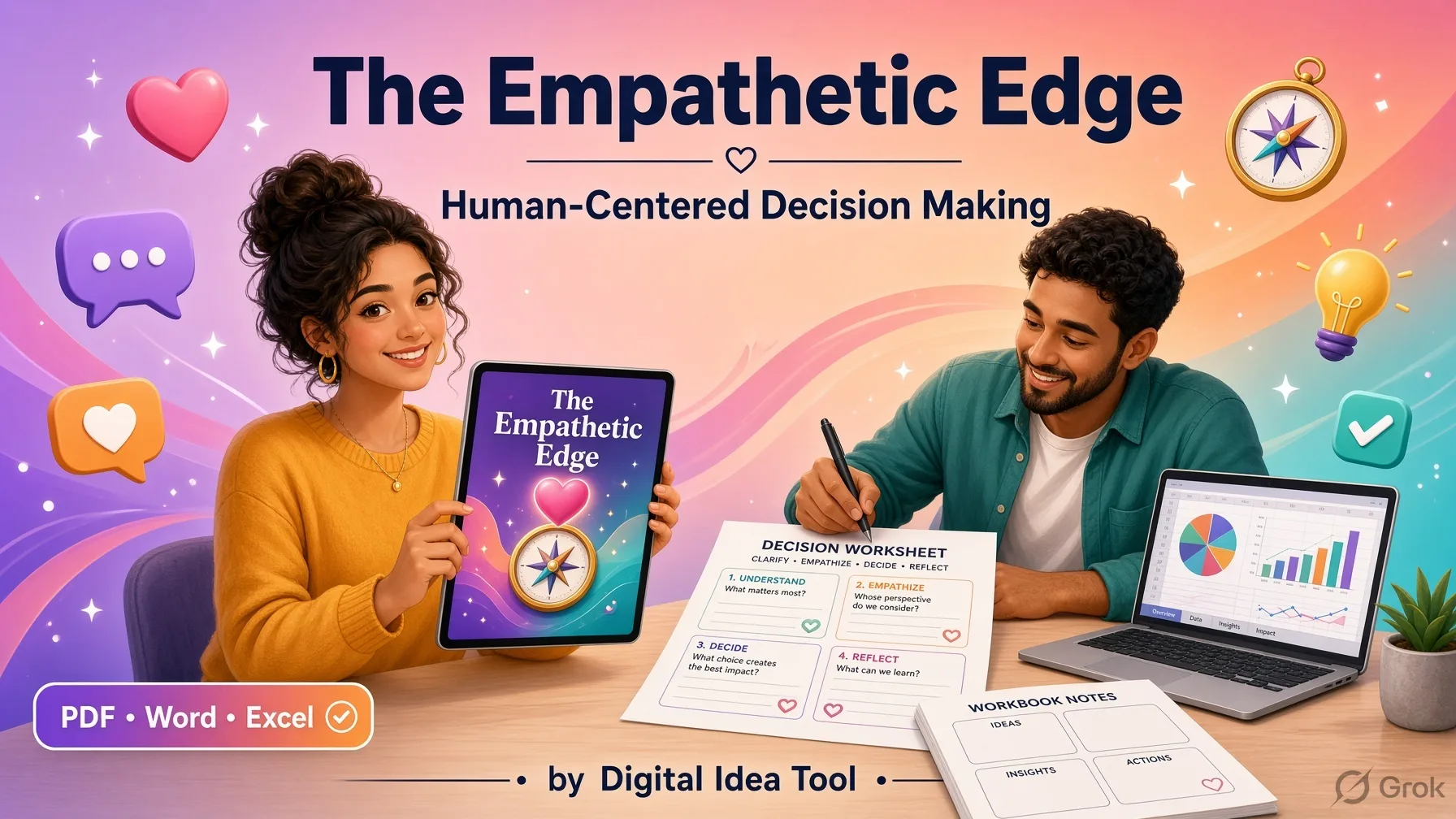
Learn human-centered decision making in 30 days with daily lessons on empathy, emotional intelligence, ethical leadership and practical decision-making skills.
The Empathetic Edge: Human-Centered Decision Making — A Complete 30-Day Learning Roadmap for Beginners
Learn Empathy, Emotional Intelligence, Ethical Thinking and Better Decision-Making Skills in Just 60 Minutes Daily
A complete beginner-friendly learning journey featuring 30 structured daily lessons, practical exercises, real-world applications, weekly reviews, and a final portfolio project.
Written by Digital Idea Tool Team
Introduction: Why Human-Centered Decision Making Matters
Every day, we make decisions that influence our relationships, careers, businesses, families, and communities. Some decisions appear logical on paper but fail because they ignore how people think, feel, communicate, and experience the consequences.
This is where The Empathetic Edge: Human-Centered Decision Making becomes valuable.
Human-centered decision making combines empathy, emotional intelligence, critical thinking, ethical awareness, and practical problem-solving. Rather than focusing exclusively on efficiency, numbers, or personal preferences, this approach considers the real needs, experiences, and well-being of everyone affected.
Imagine being a manager deciding how to improve employee performance. A traditional approach might focus only on productivity targets. A human-centered approach also considers workload, psychological safety, accessibility, motivation, and communication.
If you are a complete beginner, you do not need a psychology degree, management experience, or expensive training. With one focused hour daily, you can develop a strong foundation through a structured 30-day learning journey.
Your Personal Tutor: How the 30-Day Program Works
Your personal tutor will guide you through five progressive stages: understanding empathy, developing communication skills, practicing thoughtful judgment, applying human-centered approaches, and demonstrating your abilities.
Your Daily 60-Minute Learning Routine
| Duration | Activity |
|---|---|
| 10 minutes | Review yesterday’s learning |
| 15 minutes | Study today’s concept |
| 15 minutes | Explore practical examples |
| 15 minutes | Complete a hands-on exercise |
| 5 minutes | Reflect and record progress |
Keep a notebook or digital learning journal. Record one useful discovery, one challenge, and one improvement opportunity every day.
Week 1: Understanding Empathy and Human Behavior
DAYS 1–7 · FOUNDATION STAGE01Day 1: Introduction to Human-Centered Decision Making
Learning objective: Understand what makes a decision genuinely human-centered.
Learn the difference between decisions based entirely on efficiency and decisions that balance outcomes with human needs.
Practical exercise: Choose a recent personal decision. Identify who was affected and whether their perspectives were considered.
Daily outcome: Write your first definition of human-centered decision making.
02Day 2: Understanding Empathy
Learning objective: Recognize empathy as a practical life skill.
Study cognitive empathy, emotional empathy, and compassionate responses. Understand that empathy means attempting to understand another person’s experience, not necessarily agreeing with them.
Practical exercise: Consider a disagreement from two different perspectives.
Daily outcome: Create three statements demonstrating empathetic understanding.
03Day 3: Emotional Intelligence Fundamentals
Learning objective: Identify the role emotions play in decisions.
Explore emotional awareness, emotional regulation, social awareness, and relationship management.
Practical exercise: Track three emotional reactions during the day and identify what triggered them.
Daily outcome: Prepare a simple emotional-awareness journal.
04Day 4: Understanding Human Needs
Learning objective: Recognize that different people have different priorities.
Explore fundamental needs such as safety, respect, belonging, independence, accessibility, and recognition.
Practical exercise: Analyze a workplace or family situation involving competing needs.
Daily outcome: Create a human-needs checklist.
05Day 5: Recognizing Personal Bias
Learning objective: Understand how assumptions influence judgment.
Explore confirmation bias, stereotypes, first impressions, and unconscious assumptions.
Practical exercise: Write down three assumptions you commonly make and consider alternative explanations.
Daily outcome: Develop a personal bias-awareness checklist.
06Day 6: Perspective-Taking Skills
Learning objective: Practice understanding situations from different viewpoints.
Learn to consider another person’s experiences without assuming you know their thoughts or feelings.
Practical exercise: Describe one difficult situation from three stakeholder perspectives.
Daily outcome: Complete your first perspective map.
07Day 7: Weekly Review and Empathy Reflection
Learning objective: Consolidate your foundational knowledge.
Review empathy, emotional intelligence, human needs, bias, and perspective-taking.
Practical exercise: Analyze a real-life decision using all five concepts.
Weekly achievement: Complete your first empathy reflection report.
Week 2: Communication, Listening, and Trust
DAYS 8–14 · COMMUNICATION STAGE08Day 8: Active Listening Fundamentals
Learning objective: Learn to listen for understanding rather than preparing a response.
Practice attention, clarification, summarization, and avoiding interruptions.
Practical exercise: Hold a five-minute conversation focused entirely on understanding the speaker.
Daily outcome: Prepare an active-listening checklist.
09Day 9: Asking Better Questions
Learning objective: Discover how thoughtful questions reveal important information.
Study open-ended questions, neutral wording, and follow-up techniques.
Practical exercise: Convert five judgmental or leading questions into respectful, open-ended questions.
Daily outcome: Build a collection of ten empathy-based questions.
10Day 10: Understanding Nonverbal Communication
Learning objective: Recognize communication beyond spoken words.
Explore posture, facial expressions, tone, and personal space while remembering that nonverbal signals vary across people and cultures.
Practical exercise: Observe a conversation and identify possible signals without treating interpretations as facts.
Daily outcome: Create a nonverbal-awareness guide.
11Day 11: Building Trust and Psychological Safety
Learning objective: Understand why trust encourages honest communication.
Study reliability, confidentiality, respectful feedback, and opportunities for people to express concerns.
Practical exercise: Identify three behaviors that build trust and three that damage it.
Daily outcome: Develop a personal trust-building plan.
12Day 12: Handling Difficult Conversations
Learning objective: Communicate respectfully during disagreement.
Learn to separate observations from interpretations, acknowledge feelings, and discuss needs without personal attacks.
Practical exercise: Write a constructive response to a fictional workplace conflict.
Daily outcome: Create a difficult-conversation script.
13Day 13: Inclusive and Respectful Communication
Learning objective: Consider accessibility, cultural differences, and individual preferences.
Study clear language, inclusive participation, and communication methods that support different abilities and backgrounds.
Practical exercise: Rewrite an unclear workplace announcement so that it is easier to understand.
Daily outcome: Produce an inclusive communication checklist.
14Day 14: Weekly Communication Challenge
Learning objective: Combine listening, questioning, and trust-building skills.
Practical exercise: Conduct a voluntary, respectful conversation with someone about a small everyday challenge. Ask permission before recording notes and avoid collecting sensitive information.
Weekly achievement: Write a communication reflection identifying your strengths and improvement areas.
Week 3: Critical Thinking, Ethics, and Better Decisions
DAYS 15–21 · DECISION SKILLS STAGE15Day 15: Foundations of Critical Thinking
Learning objective: Distinguish evidence from assumptions.
Explore facts, opinions, reasoning, uncertainty, and reliable information.
Practical exercise: Select a common claim and identify what evidence would support or challenge it.
Daily outcome: Complete a critical-thinking worksheet.
16Day 16: Identifying Stakeholders
Learning objective: Recognize who may benefit or experience harm from a decision.
Learn to identify direct stakeholders, indirect stakeholders, and groups whose perspectives are often overlooked.
Practical exercise: Create a stakeholder map for a new community service.
Daily outcome: Produce a stakeholder influence-and-impact chart.
17Day 17: Ethical Decision-Making Principles
Learning objective: Understand fairness, responsibility, transparency, privacy, and respect.
Learn why a convenient decision is not automatically an ethical decision.
Practical exercise: Evaluate a fictional situation involving fairness and competing priorities.
Daily outcome: Build a five-question ethical review checklist.
18Day 18: Balancing Logic and Emotion
Learning objective: Integrate human experiences with objective information.
Practice evaluating measurable results alongside qualitative feedback.
Practical exercise: Compare two solutions using cost, effectiveness, accessibility, fairness, and human impact.
Daily outcome: Create a balanced decision matrix.
19Day 19: Managing Uncertainty and Risk
Learning objective: Make thoughtful decisions without complete information.
Explore possible consequences, reversibility, uncertainty, and precautionary actions.
Practical exercise: Identify three possible risks in a proposed change and ways to reduce them.
Daily outcome: Prepare a simple risk assessment.
20Day 20: Resolving Conflicting Needs
Learning objective: Address situations where stakeholders want different outcomes.
Study negotiation, compromise, prioritization, and constructive disagreement.
Practical exercise: Design a fair solution for a team with conflicting schedule preferences.
Daily outcome: Create a conflict-resolution framework.
21Day 21: Weekly Ethical Decision Challenge
Learning objective: Apply critical thinking and empathy together.
Practical exercise: Analyze a case involving a difficult choice, multiple stakeholders, and ethical trade-offs.
Weekly achievement: Write a one-page decision report explaining the evidence, alternatives, likely consequences, and rationale.
Week 4: Applying Human-Centered Decision Making
DAYS 22–28 · REAL-WORLD APPLICATION STAGE22Day 22: Introduction to Human-Centered Design
Learning objective: Understand how human-centered design improves practical solutions.
Explore five useful activities: empathize, define, ideate, prototype, and test. These can be repeated rather than followed as rigid steps.
Practical exercise: Choose an everyday problem and describe the people experiencing it.
Daily outcome: Write a clear problem statement.
23Day 23: Creating Empathy Maps
Learning objective: Organize observations about people’s experiences.
Explore what people say, do, think, and feel. Distinguish directly observed information from assumptions requiring verification.
Practical exercise: Create an empathy map for a fictional customer or learner.
Daily outcome: Complete a four-part empathy map.
24Day 24: Mapping the Human Experience
Learning objective: Understand problems across an entire experience.
Learn how journey maps reveal obstacles, emotional reactions, and opportunities for improvement.
Practical exercise: Map the experience of someone using an online learning platform.
Daily outcome: Produce a simple user journey map.
25Day 25: Generating Inclusive Solutions
Learning objective: Develop solutions for different people and circumstances.
Practice brainstorming, accessibility checks, and evaluating unintended consequences.
Practical exercise: Generate five solutions for a common community or workplace problem.
Daily outcome: Select two promising solutions with written reasoning.
26Day 26: Prototyping and Gathering Feedback
Learning objective: Test ideas before implementing them widely.
Learn to create rough prototypes such as sketches, sample messages, simple workflows, and checklists.
Practical exercise: Design a low-cost prototype and request constructive feedback.
Daily outcome: Complete a prototype feedback sheet.
27Day 27: Human-Centered Leadership
Learning objective: Apply empathy when supporting others.
Explore respectful delegation, shared decision making, constructive feedback, accountability, and fair expectations.
Practical exercise: Analyze how a leader could respond to an overwhelmed team member.
Daily outcome: Draft a human-centered leadership action plan.
28Day 28: Measuring Human Impact
Learning objective: Evaluate whether a decision actually helps people.
Explore satisfaction, accessibility, participation, fairness, task completion, and unintended harms.
Practical exercise: Define five indicators to evaluate your proposed solution.
Weekly achievement: Create a human-impact measurement dashboard on paper or in a spreadsheet.
Final Stage: Your Human-Centered Decision Project
DAYS 29–30 · PRACTICAL ASSESSMENT29Day 29: Build Your Personal Decision-Making Framework
Learning objective: Combine everything you have learned into a repeatable process.
Choose a realistic problem, such as improving customer support, making group decisions fairly, or creating a more accessible educational experience.
Develop your framework using these steps:
- Define the problem without assigning blame.
- Identify affected stakeholders and their needs.
- Gather reliable information and relevant feedback.
- Identify assumptions, risks, and ethical concerns.
- Compare possible solutions.
- Select an approach and explain your reasoning.
- Establish feedback and measurement methods.
Daily outcome: Complete a two-page human-centered decision project with an empathy map, stakeholder analysis, decision matrix, and improvement plan.
30Day 30: Final Assessment and Future Growth Plan
Learning objective: Demonstrate practical understanding and identify your next learning priorities.
Review all previous lessons and present your final project to a friend, mentor, colleague, or through a written self-evaluation.
Answer five final assessment questions:
- How does empathy improve decision quality?
- What is the difference between evidence and assumption?
- How can you balance conflicting stakeholder needs?
- Why are fairness and accessibility important?
- How will you measure whether your chosen solution works?
Final achievement: Create your personal Human-Centered Decision Making Portfolio, including your reflections, practical worksheets, project, and next-step goals.
Interactive 30-Day Learning Progress Tracker
Use the following checkboxes to mark your completed lessons. This simple tracker is designed to work without JavaScript. Save your progress separately in a notebook because the browser may not retain your selections.
Essential Skills You Will Develop
By completing this 30-day roadmap, you will have practiced emotional awareness, active listening, inclusive communication, stakeholder mapping, ethical analysis, critical thinking, conflict resolution, feedback collection, and practical decision evaluation.
These skills can be useful in business leadership, customer service, education, entrepreneurship, product design, teamwork, and everyday relationships.
How to Continue Learning After Day 30
Continue practicing with one real decision each week. Review the people affected, the evidence available, the ethical considerations, and the results.
Revisit decisions that did not work as expected. Identify what you overlooked and how your next approach could improve.
You can also study behavioral science, conflict mediation, accessibility, user experience research, and organizational psychology to deepen your understanding.
Above all, remember that empathy is not simply about being kind. It involves understanding real experiences while maintaining responsibility, fairness, clear boundaries, and good judgment.
Conclusion: Build Your Empathetic Edge
Human-centered decision making is an essential skill for anyone who wants to make thoughtful, responsible choices in an increasingly complex world.
Through this structured 30-day program, you can move from basic awareness to practical exercises, constructive communication, ethical analysis, and a complete personal decision-making project.
The goal is not to make perfect decisions every time. It is to develop a reliable process for understanding people, questioning assumptions, evaluating consequences, and learning from results.
Your empathetic edge begins with one decision: choosing to understand people before deciding what they need.
Disclaimer & Compliance Note
This article is intended for general education, personal development, and skill-building purposes only. It does not provide psychological diagnosis, therapy, legal advice, or professional ethical certification.
The scenarios and learning activities are illustrative, and outcomes depend on individual circumstances, commitment, and experience.
Respect privacy, obtain consent before gathering personal feedback, and seek qualified professional guidance when addressing sensitive psychological, legal, workplace, or high-stakes decisions.
Disclaimer & Compliance Note
Important information about educational purpose, responsible decision making, personal privacy, and the limitations of this learning roadmap. Learn Responsibly!
1. Educational Purpose Only
The Empathetic Edge: Human-Centered Decision Making — 30-Day Learning Roadmap is provided for general education, self-development, and practical skill-building. It is not an accredited qualification, certification, or substitute for formal professional training.
2. No Professional Advice
This material does not provide psychological diagnosis, mental health treatment, legal advice, medical guidance, or individualized professional counseling. Seek advice from an appropriately qualified professional when dealing with sensitive, complex, or high-stakes situations.
3. Privacy, Consent & Respect
All practical activities should respect personal boundaries, confidentiality, dignity, and informed consent. Do not collect, publish, or share another person’s sensitive information without appropriate authorization. Use fictional examples or anonymized scenarios whenever possible.
4. Results & Ethical Responsibility
The 30-day roadmap does not guarantee professional mastery, leadership success, improved relationships, or any particular result. Outcomes depend on practice, experience, context, and individual circumstances. Readers remain responsible for evaluating decisions, considering their consequences, and following applicable laws and policies.
Empathy should support—not replace—critical thinking, reliable evidence, fairness, and sound judgment. The suggested frameworks, exercises, and case studies are learning resources rather than universally applicable solutions. Adapt activities responsibly and remain open to feedback, uncertainty, and different perspectives.
Human-Centered Decision Making
Make decisions that are smart, fair and deeply human. A 30-page interactive course with the 4-step EDGE framework, fillable worksheets and a 30-day empathy challenge.
📥 Digital download only · Nothing will be shipped
📝 Key Takeaways & Action Notes
Jot down insights, next steps, or thoughts from this post. Your notes save automatically in your browser.
- What is the #1 breakthrough insight you took away today?
- What is one concrete action you will take in the next 24 hours?
- What questions or ideas do you want to research further?
Stay ahead with exclusive updates
Join our community. Get curated industry trends, actionable guides, and fresh resources delivered straight to your inbox.