The Micro-Publishing Strategy That Requires Zero Prior Followers
What if the knowledge you already have could become a digital product tonight—and be available for someone to purchase before you wake up tomorrow?
You don’t need to write a 300-page novel, spend six months building an audience, or invest thousands of dollars in a publishing business.
You might only need 20 useful pages, one clearly defined problem, and a simple way to reach people who are already searching for a solution.
Welcome to the world of micro-publishing, where practical knowledge becomes a compact, affordable digital product.
Instead of creating massive e-books covering everything about a subject, micro-publishers concentrate on solving one specific problem exceptionally well.
A freelance designer might create a 20-page guide explaining how to price a first client project. A job seeker might publish a practical interview preparation workbook. A small-business owner could turn a frequently requested spreadsheet into a mini e-book with instructions and examples.
These products don’t promise to teach everything.
They promise to help readers accomplish something specific.
And that difference can make a small digital guide more appealing than a lengthy book.
The most interesting part? You can begin even if you have no email subscribers, no established personal brand, and no social media following.
A mini e-book can realistically be created and listed for sale within 24 hours. Making your first sale in that period is possible, but never guaranteed. Your results depend on the problem you solve, the product’s quality, your offer, and whether you reach buyers with a genuine need.
Let’s explore how to build a micro-publishing business from one useful idea.
What Is Micro-Publishing, and Why Is It an Opportunity for Beginners?
Micro-publishing is the process of creating and distributing short, focused digital publications designed to address narrow reader needs.
Unlike traditional books, mini e-books typically concentrate on one question, task, or outcome.
For example, compare these two publishing ideas:
Traditional e-book: The Complete Guide to Starting an Online Business
Micro e-book: How to Set Up Your First Freelance Invoice and Payment Tracker
The first requires extensive research, writing, editing, and organization.
The second can be created using practical knowledge, an existing workflow, and a few carefully explained examples.
More importantly, the second title addresses an immediate problem.
Someone who needs an invoice system today may not want to read 300 pages of general business advice.
They want instructions that work.
That creates an opportunity for independent creators to compete through relevance, convenience, and specificity rather than publishing volume.
Why a 20-Page Guide Can Be More Useful Than a 300-Page Book
The value of an informational product isn’t determined by its page count.
It’s determined by what the buyer can accomplish after reading it.
A 20-page guide that helps a freelancer prepare a professional client proposal could provide more immediate practical value than a lengthy general book about freelancing.
Short guides offer several advantages:
- Readers can understand the core solution quickly.
- Authors can create and improve products without lengthy production cycles.
- Each publication can target a narrowly defined buyer.
- Templates, worksheets, and examples can make the product immediately actionable.
- Creators can test demand before investing in a larger publishing project.
However, short does not automatically mean valuable.
A rushed, repetitive PDF filled with generic advice is unlikely to earn trust.
The goal isn’t to produce fewer pages for the sake of convenience.
The goal is to eliminate unnecessary information while preserving everything the reader needs to succeed.
The Most Profitable E-Book Idea Might Be a Question You’ve Already Answered
Many first-time digital publishers make the same mistake.
They start by asking, “What should I write about?”
A better question is:
“What problem have people already asked me to solve?”
Think about your conversations with friends, colleagues, customers, classmates, or online communities.
Perhaps someone repeatedly asks you how to create a professional résumé, organize household expenses, write effective emails, prepare Instagram content, or use a particular software tool.
Each recurring question represents a possible publishing opportunity.
Why?
Because repeated questions may indicate confusion, inconvenience, or demand for better instructions.
But there is an important distinction: people asking for free advice doesn’t automatically mean they’re willing to pay for an e-book.
You still need to validate commercial interest.
The Three-Part Test for a Sellable Mini E-Book
Before writing anything, evaluate your idea using three simple criteria.
1. Is the problem specific?
“How to become successful” is too broad.
“How to write your first freelance proposal without previous client experience” is more focused.
2. Does the reader want a clear outcome?
Buyers should immediately understand what they can achieve.
For example, an e-book titled Set Up Your First Monthly Budget in One Hour communicates a practical result.
3. Can you provide something better than a generic internet search?
People can find enormous amounts of free information online.
Your product needs to offer additional convenience or value through organized instructions, original examples, a tested process, downloadable templates, or troubleshooting guidance.
If your idea meets these three requirements, it may be worth testing.
15 Mini E-Book Ideas You Can Create Without Writing a Full-Length Book
Here are practical micro-publishing ideas across different audiences.
| Audience | Mini E-Book Idea |
|---|---|
| Freelancers | How to Create Your First Client Proposal |
| Job seekers | A 7-Day Interview Preparation Workbook |
| Small businesses | How to Write 30 Days of Customer Follow-Up Emails |
| Content creators | The Beginner’s Short-Form Video Planning Guide |
| Online sellers | How to Write Better Digital Product Descriptions |
| Students | A Simple Exam Revision Planning System |
| Bloggers | How to Build an Editorial Calendar |
| Virtual assistants | Client Onboarding Templates for Beginners |
| Home bakers | How to Calculate Recipe Costs and Selling Prices |
| Photographers | A Client Photoshoot Preparation Checklist |
| Real estate agents | A New Listing Marketing Workflow |
| Digital designers | A Beginner’s Guide to Organizing Design Assets |
| Teachers | How to Create Printable Practice Worksheets |
| Local service providers | How to Set Up a Customer Appointment Tracker |
| Independent authors | How to Format a Short PDF Guide for Sale |
Notice what these ideas have in common.
They don’t attempt to teach an entire profession.
Instead, they focus on one repeatable task that readers may want to complete quickly.
For your first product, choose a topic you’ve personally worked with and can explain accurately.
Experience doesn’t always require impressive credentials. But the information must be reliable, original, and appropriately qualified.
The Overnight Micro-Publishing Method: From Idea to Digital Storefront
You don’t need an entire week to prepare a useful small guide when the subject is already familiar.
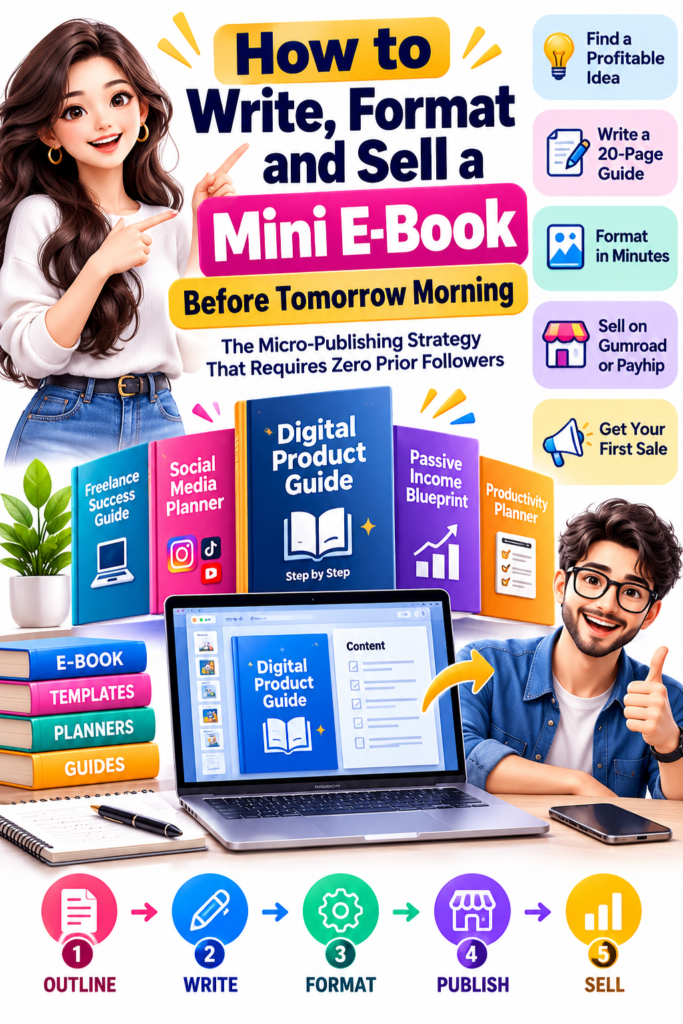
The following workflow is designed to help you create and publish a first mini e-book in one focused evening.
Treat these time allocations as planning targets, not guarantees. Research-intensive or regulated topics require more time.
Hour 1: Find One Problem Worth Solving
Start by writing down ten questions people have asked you.
Don’t judge the ideas immediately.
Next, narrow your list to problems that can be solved using approximately five to seven actionable steps.
Consider these examples:
- How do I organize client information without expensive software?
- How can I create an attractive invoice in Google Docs?
- What should I include in a beginner freelance portfolio?
- How do I prepare a weekly social media content calendar?
- How can I track digital product sales using a spreadsheet?
Now investigate whether other people experience the same difficulty.
Search relevant Reddit communities, Google Search, YouTube discussions, and niche forums.
Look for recurring questions and complaints.
Pay particular attention to phrases such as:
“I can’t figure out how to…”
“Does anyone have a template for…”
“Is there a simple way to…”
“I’ve tried several tools, but…”
These statements can reveal unmet informational needs.
You can also examine existing digital products on marketplaces to understand how competing publishers describe their offers.
Don’t copy their material. Identify what questions remain unanswered and where your own approach could add value.
Hour 2: Create a Simple 20-Page Outline
Once you’ve chosen a topic, build the structure before writing.
A practical mini e-book doesn’t need twenty chapters.
It needs a logical sequence.
Here is a reusable 20-page structure.
| Pages | Content |
|---|---|
| 1 | Cover and product title |
| 2 | Introduction and expected outcome |
| 3 | Who this guide is for |
| 4 | Tools and preparation checklist |
| 5–7 | Step 1: Understand and prepare |
| 8–10 | Step 2: Build the solution |
| 11–13 | Step 3: Apply the method |
| 14–16 | Step 4: Improve and troubleshoot |
| 17 | Realistic example or worked demonstration |
| 18 | Action checklist |
| 19 | Additional resources |
| 20 | Summary, next steps, and author information |
This structure works well for tutorials, productivity systems, beginner business guides, and template-based learning products.
You can adjust the sequence to fit the subject.
For example, a spreadsheet guide might require more screenshots and fewer paragraphs.
A writing guide might benefit from sample messages and fill-in-the-blank exercises.
Every page should contribute to the reader’s intended outcome.
Quick action: Choose your strongest idea and write the title, reader problem, promised outcome, and five main steps before beginning your draft.
Hours 3–4: Write the Guide Using the Explain–Show–Apply Method
One of the easiest ways to make a short e-book genuinely useful is to organize the content around three actions:
Explain: Tell the reader what to do and why it matters.
Show: Provide a realistic example or demonstration.
Apply: Give the reader an exercise, checklist, or template to use independently.
Imagine you’re writing a mini e-book about creating a freelance invoice.
A weak chapter might say:
“Always create professional invoices and include important information.”
That’s technically advice, but it doesn’t provide much assistance.
A stronger chapter would explain which fields to include, show a sample invoice layout, demonstrate how to calculate a payment total, and provide a reusable invoice checklist.
Now the reader has something practical.
This is the difference between informational content and an actionable digital product.
Can AI Help You Write a Mini E-Book Faster?
Yes, AI writing tools can assist with brainstorming, outlining, reorganizing information, improving readability, and checking whether instructions are clear.
However, AI-generated content shouldn’t be treated as automatically accurate, original, or ready to sell.
Use your own knowledge and verified references as the foundation.
You can use this sample prompt to organize an existing process:
“Act as an experienced instructional editor. Help me structure a practical 20-page mini e-book about [topic] for [specific audience]. The reader’s desired outcome is [result]. Organize the guide into clear, sequential steps. Suggest where examples, checklists, worksheets, and screenshots would make the instructions more useful. Identify facts that require verification. Do not invent statistics, testimonials, personal experiences, or guarantees.”
Then review and rewrite the output to reflect your actual knowledge and voice.
Your credibility depends on what you verify, not on how quickly text appears on a screen.
Hour 5: Format Your Mini E-Book Without Hiring a Designer
You don’t need sophisticated publishing software for your first digital guide.
Begin with tools you already know.
Google Docs, Microsoft Word, and Canva can all support straightforward PDF-based publishing workflows.
For beginner publishers, PDF is often a practical format because it preserves the page layout and is easy to distribute.
Keep Your E-Book Design Clean and Readable
Use a consistent typography system.
Choose one primary heading font and one comfortable body font, or use a single font family throughout.
Maintain generous spacing between sections.
Use headings to help readers scan the content.
Add screenshots only when they make the instructions easier to follow.
Avoid filling pages with decorative graphics that don’t improve comprehension.
For a professional finish, consider including:
- A descriptive cover title
- A clickable table of contents when appropriate
- Consistent headings and page numbering
- Readable body text and accessible contrast
- Clearly labeled examples or worksheets
- Working resource links
- An author or publisher information page
Export the document as a PDF and check it on both a computer and a phone.
This matters because a beautiful desktop layout can become frustrating when viewed on a small screen.
Large margins, tiny text, complicated tables, and oversized graphics can all reduce usability.
Before publishing, ask yourself one important question:
Could someone comfortably follow these instructions using only this document?
If the answer is yes, you’re moving in the right direction.
Hour 6: Create a Product Cover That Communicates the Result
A professional digital product cover doesn’t have to be complicated.
In fact, simple designs often communicate more clearly than overcrowded ones.
Your cover needs to answer three questions immediately:
What is this product?
Who is it for?
What problem will it help solve?
For example:
The Freelance Proposal Starter Kit
Write and Send Your First Professional Client Proposal
The title identifies the product.
The subtitle explains the expected outcome.
A small relevant icon, a clean background, and readable typography may be sufficient.
Remember that marketplace visitors may see your cover as a small thumbnail.
If the title becomes unreadable at that size, simplify the design.
Avoid exaggerated phrases such as “Guaranteed Overnight Income” or “Make $1,000 Tomorrow” unless you have a defensible basis for any factual claims—and even then, avoid implying that typical buyers should expect those results.
Your cover should sell the usefulness of the guide, not an unrealistic dream.
Hour 7: Sell Your Mini E-Book on Gumroad or Payhip
Once your PDF is ready, you need a digital storefront.
Two accessible options for independent creators are Gumroad and Payhip.
Both support digital downloads without requiring you to build a complete e-commerce website.
Gumroad vs. Payhip: Which Platform Should Beginners Choose?
| Feature | Gumroad | Payhip |
|---|---|---|
| Digital e-book sales | Supported | Supported |
| Monthly entry cost | No monthly charge | Free plan available |
| Direct-sale platform fee | 10% + $0.50 per transaction | 5% on free plan |
| Payment processing | Additional fees may apply | Payment processor fees apply |
| Marketplace discovery | Gumroad Discover available | Primarily creator-driven traffic |
| Best starting consideration | Simple digital storefront | Lower published platform fee on the free plan |
These reflect publicly published platform terms in October 2026. Fees, eligibility, payment availability, and tax handling can change. Review the platform’s current policies before selling.
Gumroad’s pricing page also identifies a separate 30% fee for transactions through its Discover marketplace.
Neither platform automatically guarantees buyers.
A storefront is a place where customers can complete a purchase. It isn’t a substitute for generating relevant traffic.
Before launching, check whether the platform supports seller onboarding, payment collection, payouts, and tax requirements in your country.
How Much Should You Charge for a 20-Page E-Book?
For a simple beginner guide, testing a price between $5 and $19 can be a reasonable starting experiment.
This is a suggested testing range, not an established market average.
A short, text-only beginner guide may start near the lower end.
A more specialized guide that includes original templates, calculators, checklists, or worked examples may justify a higher price.
Consider an illustrative $9 mini e-book.
At that price:
- 10 sales would generate $90 in gross revenue.
- 25 sales would generate $225 in gross revenue.
- 50 sales would generate $450 in gross revenue.
These figures are before platform fees, processing fees, taxes, refunds, marketing costs, and other expenses. They are arithmetic examples, not earnings forecasts.
Instead of simply asking how much competitors charge, consider the convenience and time your product provides.
A buyer may care less about the number of pages than whether your guide saves them effort and uncertainty.
Write a Product Description That Converts Curious Visitors into Buyers
Your product listing should focus on the outcome.
Avoid relying on generic statements such as:
“This is an amazing e-book containing valuable information.”
That doesn’t explain why someone should purchase it.
A better description answers the buyer’s immediate questions.
Example: Mini E-Book Product Description
The Freelance Proposal Starter Kit
Stop staring at a blank document every time a potential client asks for a proposal.
This practical mini e-book walks beginner freelancers through the process of preparing a clear, professional client proposal.
Inside, you’ll learn how to organize your project scope, explain deliverables, present pricing, create a project timeline, and prepare a proposal that’s easy for clients to understand.
The guide includes a reusable structure, examples, and a final review checklist.
Best for: New freelancers who want a straightforward proposal-writing process without purchasing expensive software.
What’s included: A downloadable PDF guide and the supporting resources specifically listed in the product package.
Ready to prepare your first proposal? Get the guide and follow the steps at your own pace.
The description works because it establishes the problem, identifies the buyer, communicates the contents, and introduces a clear next action.
Don’t promise bonuses, files, or outcomes that the buyer won’t actually receive.
Trust begins with an accurate listing.
The Zero-Follower Selling Strategy: Borrow Attention Without Spamming
One of the biggest misconceptions about selling digital products is that you must build a large social media following before publishing.
An established audience certainly helps.
But a large audience isn’t the only route to your first customers.
You can also participate in existing communities where people discuss the exact problem your product solves.
This is sometimes described as an audience-first or community-led distribution strategy.
The principle is straightforward.
Find people discussing a problem, contribute useful information, and make your paid resource available only when appropriate and permitted.
Step 1: Identify Communities With Relevant Questions
Depending on your subject, useful research and discussion spaces may include Reddit, niche professional forums, specialized Facebook groups, independent creator communities, and industry discussion boards.
For example, someone publishing a freelance proposal guide might investigate communities where new freelancers discuss client onboarding and pricing.
Someone creating an Excel expense tracker might look for communities focused on small-business administration or spreadsheet workflows.
The goal isn’t to enter every group and advertise a PDF.
It’s to discover where your intended readers already ask questions.
Step 2: Share the Real Story Behind Your Guide
People often respond better to genuine experiences than generic product pitches.
Instead of opening with a sales advertisement, explain the situation that motivated you to create the resource.
For example:
“I kept seeing beginners struggle with writing their first freelance proposals, so I organized the process I use into a simple step-by-step checklist. One mistake I noticed repeatedly was leaving project revisions undefined. Here’s the basic structure I recommend and why it helps.”
Continue by explaining the useful steps within the post itself.
If a community permits promotional links, you can disclose that you sell a more detailed guide and provide the link in accordance with its rules.
If promotional links are prohibited, contribute the useful explanation without adding a link, soliciting purchases, or trying to bypass the restriction.
On Reddit, community rules matter. Repeated promotional posting, unsolicited messaging, and disguised advertising can violate platform policies or local subreddit rules.
A valuable contribution should stand on its own even when nobody purchases anything.
Step 3: Make Transparency Part of Your Sales Strategy
Never pretend to be an independent customer recommending your own e-book.
Don’t create fake conversations, testimonials, or success stories.
Don’t hide your commercial relationship with the product.
A straightforward disclosure such as “I created a paid guide on this topic” is clearer and more credible.
When your marketing provides real value, honesty becomes an advantage rather than an obstacle.
Step 4: Use Helpful Answers to Test Demand
Pay attention to the questions people ask after reading your explanation.
Do they want a sample?
Are they confused about a particular step?
Would a worksheet improve the process?
Do they ask whether the instructions work for a different situation?
These responses can reveal what your audience actually values.
Use that feedback to improve your publication.
Community engagement should be a learning process, not merely a way to distribute links.
How to Improve Your Chances of a First Sale Within 24 Hours
Publishing quickly and selling quickly are two different challenges.
The first depends heavily on your execution.
The second depends on buyer demand and distribution.
There is no ethical method that guarantees a first sale within 24 hours.
But you can improve your chances by reducing uncertainty at each stage.
Focus on Buyers Who Already Have the Problem
A general audience may find your guide interesting.
A person struggling with the exact task today has a clearer reason to consider buying.
For example, someone browsing inspirational content about entrepreneurship may have little immediate purchase intent.
Someone specifically searching for a freelance proposal template is closer to an actionable need.
Position your product accordingly.
Show Buyers What They’re Purchasing
Include a small preview of your guide.
That could be a sample table of contents, one useful worksheet, a screenshot of a template, or a preview page.
A preview lowers uncertainty.
It helps buyers evaluate whether the product matches their expectations.
Offer a Clear Benefit Without Overpromising
Use realistic statements such as:
“Organize your first client proposal with a reusable checklist.”
“Build a simple monthly expense tracker.”
“Prepare a week’s worth of content ideas.”
These are more credible than broad promises of effortless business success.
Make the Purchasing Process Simple
A visitor shouldn’t have to search for important information.
Show the price, contents, format, intended reader, and refund terms clearly.
Provide a visible purchase button.
Make sure the storefront works on mobile devices.
Check that buyers understand how their digital download will be delivered.
And avoid aggressive countdown timers or artificial scarcity.
A buyer should feel informed, not pressured.
A Practical 24-Hour Mini E-Book Launch Schedule
Here is a simplified publishing schedule for someone who already understands the subject.
| Time | Task | Outcome |
|---|---|---|
| Hour 1 | Select and validate the idea | One clear problem |
| Hour 2 | Outline the guide | Defined page structure |
| Hours 3–4 | Write and verify content | Working draft |
| Hour 5 | Format and proofread | Readable PDF |
| Hour 6 | Create cover and preview | Product visuals |
| Hour 7 | Set up Gumroad or Payhip | Product listing |
| Hour 8 | Test checkout and delivery | Purchase-ready listing |
| Hours 9–12 | Prepare useful community content | Distribution materials |
| Hours 13–24 | Publish permitted posts, respond, and review performance | Initial market feedback |
Some tasks may take longer, especially if you need additional research, payment verification, original illustrations, or complex templates.
You also don’t need to stay awake for 24 hours. The schedule represents an overall launch window rather than continuous work.
Importantly, a newly created store may require payout verification or other onboarding steps. Those processes aren’t always immediate.
The most useful first milestone is a functioning, accurate product listing—not a guaranteed transaction.
Why Your First E-Book Should Be a Market Experiment
Think of your first guide as a small business experiment.
You are testing several things simultaneously:
Does the problem attract attention?
Do people understand the promise?
Does the preview make the product feel useful?
Is the asking price appropriate?
Are your distribution methods reaching the right audience?
Each result provides information.
Suppose your product receives 200 page visits and two purchases.
That would represent a 1% observed visitor-to-purchase conversion rate for that period.
It wouldn’t prove that 1% is your permanent conversion rate, nor that the guide is profitable.
But it would give you a starting point.
If many visitors arrive and few purchase, examine the product’s positioning, trust signals, price, audience fit, and checkout experience.
If hardly anyone visits, distribution or demand may be the bigger issue.
Avoid changing everything at once.
Test improvements methodically and evaluate performance across a meaningful number of visitors.
Turn One Mini E-Book into a Small Digital Product Collection
After your first guide is published, you don’t need to start an entirely unrelated project.
Look for logical companion products.
Imagine that your first product is a freelance proposal guide.
Your next publications might be:
- A Client Discovery Call Checklist
- A Freelance Project Pricing Workbook
- A Client Onboarding Email Template Pack
- A Simple Project Handover Guide
- A Freelancer Payment Tracking Spreadsheet
Together, these products address related needs.
A customer who benefits from your first guide may be interested in the next resource.
This is one way to turn a single publication into a focused digital product business.
Create Bundles Instead of Repeating Information
You could eventually combine several complementary guides into a beginner freelancer toolkit.
However, each component should add distinct value.
Don’t divide one basic tutorial into five thin products merely to sell the same information repeatedly.
Customers notice unnecessary duplication.
A strong bundle saves time by organizing genuinely complementary resources.
Use Customer Questions to Guide Your Next Publication
Instead of guessing what to create next, examine customer feedback.
Which instructions caused confusion?
Which examples were especially helpful?
What related problems remain unsolved?
Which resources do buyers request?
These questions can guide product updates and future e-books.
Successful micro-publishing can become a cycle of listening, creating, testing, and improving.
How to Attract Search Traffic to Your Mini E-Book Business
Community discussions can generate early interest, but organic search offers another way to reach people who need your guides.
Build helpful articles around specific questions related to your products.
For example, if you sell a freelance proposal guide, you could publish articles about:
“How to write a freelance proposal for a first-time client”
“What should a freelance project proposal include?”
“Common mistakes in beginner freelance proposals”
“How to explain project scope and revisions to a client”
Each article should independently help readers.
Then, where relevant, introduce your e-book as an optional resource for readers who want a reusable workflow or supporting templates.
This approach matches informational search intent while creating a natural path toward a commercial offer.
Write for Humans and Search Engines
Include descriptive headings, clear explanations, original examples, and direct answers.
Use natural language rather than repeating the same keyword unnecessarily.
A helpful article about selling mini e-books can organically address topics such as e-book formatting, beginner digital publishing, PDF products, Gumroad selling, Payhip stores, pricing, niche research, and digital product marketing.
Well-organized content is also easier for AI-powered search experiences and answer engines to interpret.
Concise explanations work particularly well for questions such as “What is micro-publishing?” or “How can I sell a PDF guide without a website?”
But visibility in Google Search, Google Discover, or AI-generated answers is never guaranteed.
Search performance depends on many factors, including relevance, originality, site quality, competition, and how search systems evaluate the content.
Make Your Blog Worth Returning To
Don’t end the relationship immediately after a visitor finishes reading.
Give readers a relevant next step.
For example:
Want to publish your first digital guide? Explore our practical resources on e-book creation, digital product pricing, beginner storefronts, and ethical online marketing.
You can also offer a free mini e-book planning worksheet in exchange for an optional newsletter subscription.
Be transparent about how subscriber information will be used and obtain appropriate consent.
A useful newsletter might deliver one publishing lesson, one practical example, and one creator checklist each week.
Returning visitors are more likely when your content consistently solves problems—not because every page pushes another purchase.
Seven Mistakes That Can Ruin a Mini E-Book Business
1. Choosing a Topic That’s Too Broad
A guide promising to teach everything about online business struggles to communicate a specific outcome.
Narrow your subject until readers can clearly picture the task they’ll complete.
2. Publishing Generic AI Content Without Verification
AI-generated material can contain inaccuracies, repetition, and invented details.
Check facts, add your own examples, and remove statements you cannot substantiate.
3. Focusing on Page Count Instead of Reader Results
Twenty excellent pages can be valuable.
Twenty pages of padding are not.
Make every section useful.
4. Overdesigning Before Testing Demand
An elaborate cover and complex page layout cannot compensate for a product nobody needs.
Prioritize usefulness, clarity, and accuracy before visual sophistication.
5. Assuming a Marketplace Automatically Provides Customers
Publishing on a marketplace makes your product purchasable.
It doesn’t establish demand or guarantee visibility.
You still need appropriate distribution and marketing.
6. Promoting Aggressively in Online Communities
Copy-and-paste promotional posts can damage your reputation and violate community rules.
Contribute useful advice, respect moderator policies, and disclose your commercial interest.
7. Quitting When the First Product Doesn’t Sell Immediately
No purchases on the first day doesn’t necessarily mean the product is worthless.
You may need more visibility, stronger positioning, a different price, or a better understanding of your audience.
Use evidence to decide what to improve rather than relying on assumptions.
Five Frequently Asked Questions About Selling Mini E-Books
1. Can I really write and publish a mini e-book in one day?
Yes. If you already know your subject, a focused mini e-book can be written, formatted, and listed in one day using tools such as Google Docs, Word, or Canva.
However, the timeline depends on the complexity of the material, the verification required, your editing experience, and marketplace onboarding.
Publishing within 24 hours does not guarantee sales within that period.
2. How many pages should a mini e-book have?
A mini e-book might contain 10–30 pages, although there is no universal rule.
Twenty pages is a useful planning target for a short practical guide.
Choose the length based on what readers need, not an arbitrary word or page count.
A concise guide with templates and examples can offer substantial value without being lengthy.
3. Do I need followers to sell an e-book on Gumroad or Payhip?
No. A pre-existing following isn’t technically required to create a listing or make a sale.
However, you still need a way for potential customers to discover your product.
That may involve search traffic, existing professional relationships, relevant online communities, referrals, or other permitted promotional methods.
Starting without followers is possible, but customer acquisition may take more effort.
4. What is the best price for a beginner mini e-book?
There’s no universal best price.
For a simple instructional guide, you can experiment with a $5–$19 range and adjust based on buyer feedback, production costs, and competitive alternatives.
Specialized templates or unusually valuable supporting resources may justify different pricing.
Always account for platform fees, processing charges, applicable taxes, refunds, and the time required to maintain the product.
5. Can a mini e-book generate passive income?
A digital e-book can generate revenue without requiring you to manually deliver every copy, because digital storefronts can automate payment and file delivery.
But that doesn’t make the business entirely passive.
You may still need to update information, answer customer questions, manage refunds, maintain listings, promote the product, and handle legal or tax responsibilities.
A more accurate description is a digital product business with automated fulfillment and the potential for recurring sales.
Start With One Useful Guide, Not a Publishing Empire
The appeal of micro-publishing is its simplicity.
You don’t need to create an enormous course, establish a large publishing company, or become a bestselling author before testing your knowledge in the marketplace.
You need to identify a problem, explain a useful solution, package that information professionally, and make it available to the people who need it.
A practical 20-page guide can be enough to test whether buyers value your approach.
Your first product might sell quickly.
It might take several weeks to attract a buyer.
Or it might reveal that the subject needs a different format or a more compelling offer.
Each outcome can teach you something.
The real opportunity isn’t a magical overnight income formula.
It’s the ability to transform useful knowledge into a digital asset without spending months preparing a traditional book.
Your first mini e-book doesn’t need to be your masterpiece. It needs to be accurate, useful, and complete enough to solve the problem it promises to address.
Think of one question you’ve answered repeatedly.
Write down the solution.
Organize it into a short guide.
Make it genuinely helpful.
Then publish it.
Tomorrow morning, you may not have a bestselling e-book—but you could have something that didn’t exist yesterday: your own digital publication, ready for real customers.
Ready to begin? Choose one problem, outline your 20-page guide, and take the first step toward launching your digital product today.
Compliance Note
This article is provided for general educational, informational, and business-planning purposes only. It does not constitute financial, legal, tax, publishing, or professional advice. Examples of digital product sales, pricing, revenue, and publishing timelines are illustrative and do not represent guaranteed or typical results. No income, first sale, profitability, Google ranking, Google Discover placement, or specific commercial outcome is promised. Actual results depend on audience demand, product quality, competition, marketing activity, platform requirements, and other factors.
Creators are responsible for ensuring that their publications comply with applicable copyright, intellectual property, advertising, consumer protection, privacy, accessibility, and tax requirements. Only publish content, images, templates, and other materials you own or have permission to use. Verify AI-assisted information, disclose material commercial relationships, avoid misleading testimonials or earnings claims, and accurately describe the products offered for sale.
Gumroad, Payhip, Reddit, Google, and other third-party services maintain their own terms, fees, community guidelines, and eligibility requirements, which may change. Sellers should review current policies, country-specific payment availability, refund obligations, and applicable tax rules before launching. This article is independent educational content and does not imply sponsorship, endorsement, or affiliation with any platform mentioned.
Stay ahead with exclusive updates
Join our community. Get curated industry trends, actionable guides, and fresh resources delivered straight to your inbox.