
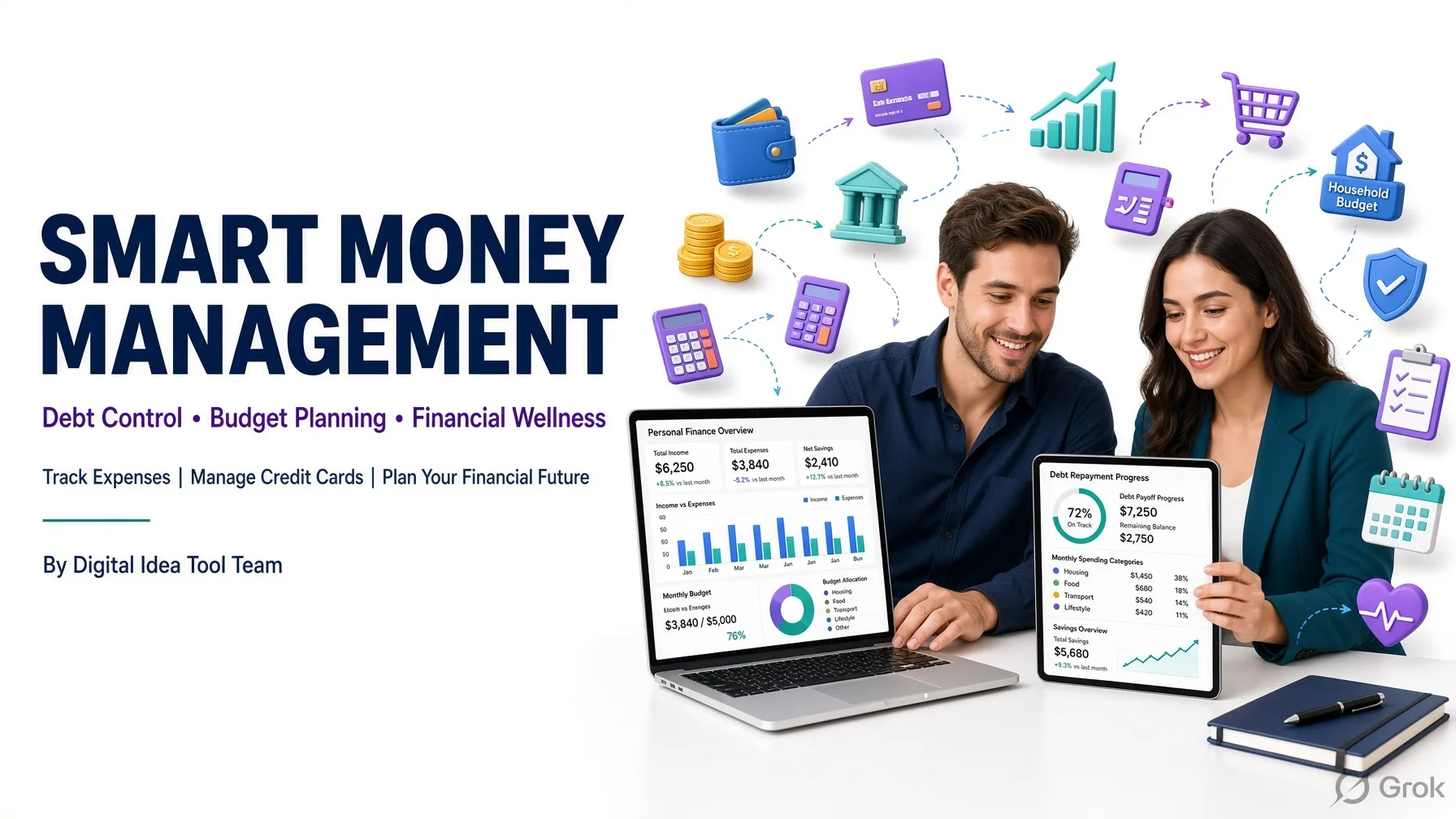
Learn smart money management with debt repayment strategies, inflation budgeting, credit card tracking, expense planning, and financial wellness tips.
Smart Money Habits Blueprint: Master Everyday Spending, Budget Control & Financial Clarity
Discover How to Track Daily Expenses, Build Smarter Budgets, Analyze Cash Flow and Develop Sustainable Savings Habits
Explore 10 essential personal finance questions with practical guidance on daily money management, monthly budgeting, financial dashboards, Excel expense spreadsheets and smarter financial organization.
Small money habits, big financial clarity!Welcome to MoneyFlow Command. Managing personal finances does not need to feel confusing. Whether you are a student, freelancer, salaried professional, entrepreneur or household budget planner, understanding your everyday money habits can help you make informed decisions. This guide explains practical ways to track spending, organize income, control avoidable expenses and review financial progress using digital budget planning tools.
10 Essential Questions for Smarter Everyday Money Management
Tap any colourful 3D card to explore the answer ↓
01Why Is Tracking Daily Income and Expenses Important for Better Money Management and Long-Term Financial Stability?
Tracking daily income and expenses is one of the most effective ways to develop financial awareness, improve personal budgeting habits, and build long-term financial stability. Many individuals earn money regularly but struggle to understand where their income disappears because small purchases, recurring subscriptions, food deliveries, transportation costs, and unexpected payments gradually accumulate.
A daily income and expense tracker helps individuals record financial transactions, categorize spending, and compare actual expenses against available income. Instead of relying on memory, users can maintain an organized financial record that reveals their spending patterns and highlights opportunities for improvement.
Using a personal finance dashboard with automated expense calculations and monthly cash-flow charts can make financial management easier. Visual reports allow users to identify unnecessary spending, monitor financial progress, and understand whether their monthly budget supports their lifestyle and savings goals.
For example, someone spending small amounts on daily convenience purchases may discover that these expenses represent a significant portion of their monthly income. Recognizing these patterns encourages informed purchasing decisions without requiring unrealistic lifestyle restrictions.
A smart budget planning template can also help users prepare for recurring bills, emergency expenses, seasonal purchases, and future financial responsibilities.
MoneyFlow Command supports this process through a daily spending log, income tracking system, monthly budget planner, and personal financial overview.
By consistently reviewing financial information, individuals can develop stronger money management habits, reduce avoidable expenses, and make more confident financial decisions. Effective financial stability begins with understanding everyday cash flow, creating realistic budgets, and monitoring progress toward meaningful personal financial goals.
02How Can I Track My Daily Spending, Monthly Income, and Personal Expenses in One Simple Budget Planner?
Managing daily spending, monthly income, and personal expenses becomes significantly easier when financial information is organized within one comprehensive budget planning system. Instead of maintaining scattered notebooks, payment notifications, receipts, and separate spreadsheets, individuals can use a digital income and expense tracker to manage everything centrally.
Begin by recording all income sources, including salaries, freelance earnings, business revenue, rental income, and occasional payments. Next, categorize expenses into essential and discretionary spending groups such as housing, groceries, utilities, transportation, subscriptions, entertainment, healthcare, and personal shopping.
A daily expense tracking spreadsheet allows users to enter transaction dates, payment descriptions, categories, and amounts. This information can be summarized automatically through spreadsheet formulas, helping users understand their total income, expenses, and remaining balance.
An effective monthly budget planner should also include planned spending limits for different categories. Comparing actual expenses with budget targets makes it easier to identify overspending before it becomes a recurring problem.
A personal finance dashboard with cash-flow visualization adds another useful layer by transforming financial records into understandable charts and summaries. Users can quickly recognize which spending categories require attention and whether their income comfortably covers monthly financial obligations.
MoneyFlow Command brings these essential tools together through structured financial logs, customizable budget categories, and a consolidated financial overview.
For beginners, reviewing the dashboard for a few minutes each evening can establish a practical financial organization routine. Consistent expense recording, realistic spending limits, and regular budget adjustments help individuals maintain financial visibility and develop sustainable personal money management habits.
03What Is the Best Way to Create a Realistic Monthly Budget That Helps Me Control Expenses and Save More Money?
Creating a realistic monthly budget begins with understanding your actual income, essential living costs, financial commitments, and personal priorities. A successful budget should support everyday needs while leaving reasonable flexibility for unexpected expenses, recreation, and long-term savings.
Start by calculating monthly take-home income from employment, freelance work, business activities, or other reliable sources. Individuals with irregular income can use a conservative income estimate based on recent earnings rather than assuming every month will be equally profitable.
Next, separate expenses into fixed costs and variable costs. Fixed expenses include rent, insurance premiums, loan payments, and regular subscriptions. Variable expenses include groceries, dining, transportation, shopping, and entertainment.
The popular 50/30/20 budgeting framework can provide an initial reference: approximately 50 percent for needs, 30 percent for wants, and 20 percent for savings or debt repayment. However, these percentages should be customized according to individual income, living costs, and financial obligations.
A digital monthly budget spreadsheet can help users assign category limits, calculate spending totals, and identify differences between planned and actual expenses.
MoneyFlow Command provides an organized environment for recording income, monitoring expenses, reviewing cash-flow charts, and adjusting monthly financial priorities.
For example, if restaurant spending consistently exceeds the allocated budget, users can reduce discretionary purchases or redistribute money from another category.
Effective budget planning requires regular evaluation rather than rigid restrictions. Reviewing results weekly, planning for annual expenses, and gradually increasing savings contributions can help build a practical financial management system that supports greater financial confidence and sustainable saving habits.
04How Can I Stop Overspending on Unnecessary Purchases and Build Better Daily Money Management Habits?
Reducing unnecessary spending requires understanding purchasing behavior, identifying emotional spending triggers, and developing practical daily money management habits. Overspending often results from multiple small decisions rather than one major purchase, making daily expense tracking especially valuable.
Begin by documenting every transaction, including digital payments, online shopping, takeaway meals, entertainment purchases, and recurring subscriptions. A spending tracker spreadsheet makes it easier to identify expenses that may otherwise go unnoticed.
Next, classify purchases as essential, optional, or avoidable. Essential spending covers necessities such as food, housing, transportation, and healthcare. Optional expenses include recreational activities and nonessential purchases. Avoidable expenses may include unused subscriptions, duplicate services, and impulse purchases that provide limited value.
Implementing a 24-hour waiting rule for nonessential purchases can reduce impulsive shopping. For expensive discretionary items, extending the waiting period may help users evaluate whether the purchase genuinely supports their priorities.
A smart personal budget planner can establish weekly spending allowances and monthly financial boundaries. Reviewing cash-flow charts helps identify categories where unnecessary purchases repeatedly exceed planned limits.
MoneyFlow Command supports spending awareness through organized daily expense records, monthly budget comparisons, and a visual personal finance dashboard.
Another effective strategy is setting specific savings goals. When users understand why they are saving, controlling discretionary spending often becomes more motivating.
Building financial discipline does not require eliminating every enjoyable purchase. The objective is to create balanced spending habits, prioritize meaningful expenses, and make intentional purchasing decisions. Small behavioral improvements, practiced consistently, can strengthen financial organization and support lasting money management confidence.
05How Do I Use a Personal Finance Dashboard to Monitor Income, Expenses, Savings, and Monthly Cash Flow?
A personal finance dashboard is a centralized financial monitoring system that transforms income records, spending transactions, budget targets, and savings information into understandable summaries. It helps individuals evaluate their overall financial position without manually reviewing multiple documents.
Begin by entering income transactions into a digital finance spreadsheet. Record salary payments, freelance earnings, business income, and other relevant sources. Then enter expenses with accurate transaction dates, descriptions, and spending categories.
A properly configured dashboard can calculate total monthly income, total monthly expenses, net cash flow, and the amount available for savings. Net cash flow represents income minus expenses during a selected period.
Visual cash-flow charts make financial information easier to interpret. Bar charts can compare monthly income and expenditure, while category-based charts help users recognize where most of their money is being spent.
A budget-versus-actual comparison is particularly useful for identifying categories that exceed planned spending limits. Users can review these differences and decide whether to adjust expenses or revise unrealistic budget targets.
MoneyFlow Command is designed around daily spending records, cash-flow visualization, monthly budget planning, and a consolidated personal financial overview.
To develop an effective financial review routine, update transactions regularly, examine the dashboard weekly, and evaluate savings progress at the end of each month.
Remember that a spending dashboard only reflects the information entered into it. Accurate records and regular updates are essential for reliable results.
Using a digital personal finance dashboard consistently can improve financial awareness, simplify monthly money reviews, and support more informed budgeting decisions for individuals and households.
06What Are the Most Common Personal Budgeting Mistakes That Cause People to Lose Track of Their Money Every Month?
Personal budgeting mistakes often develop when individuals underestimate expenses, overlook irregular payments, create unrealistic spending limits, or fail to monitor everyday transactions. Understanding these common problems is essential for improving financial organization and preventing repeated budget shortfalls.
One frequent mistake is tracking major bills while ignoring smaller daily purchases. Coffee, snacks, digital subscriptions, delivery fees, and convenience purchases can collectively represent a substantial monthly expense.
Another problem involves creating a monthly budget without reviewing historical spending. Arbitrary category limits may appear attractive but become difficult to maintain when they do not reflect actual living costs.
People also overlook annual or irregular expenses such as insurance renewals, vehicle maintenance, school fees, medical appointments, and holiday spending. Setting aside smaller monthly amounts for these costs can reduce unexpected financial pressure.
Confusing available bank balances with spendable money is another budgeting mistake. A bank account may contain funds that are already committed to upcoming bills or financial obligations.
A digital expense tracker and monthly budget spreadsheet help reduce these problems by organizing transactions, recurring commitments, and spending categories.
MoneyFlow Command offers a structured approach to daily expense logging, budget comparisons, cash-flow monitoring, and personal financial analysis.
Successful budgeting also requires flexibility. Unexpected events happen, and adjusting a spending plan is often more practical than abandoning it entirely.
Reviewing expenses weekly, checking recurring subscriptions, updating income information, and setting realistic financial targets can improve consistency.
Avoiding common budgeting mistakes is not about achieving perfect financial control. It involves creating dependable tracking habits, recognizing spending patterns, and using accurate financial information to guide everyday decisions.
07How Can I Organize My Bills, Subscriptions, Grocery Expenses, and Daily Purchases Without Missing Important Payments?
Organizing household bills, subscriptions, grocery expenses, and everyday purchases becomes easier when financial commitments are recorded in a centralized money management system. Without organized tracking, individuals may overlook payment deadlines, duplicate subscriptions, underestimate grocery spending, or struggle to understand their monthly financial obligations.
Start by listing all recurring payments, including rent, electricity, internet, mobile services, insurance, streaming subscriptions, and loan installments. Record the expected payment amount, frequency, and due date for each obligation.
Next, create separate categories for groceries, transportation, household supplies, dining, entertainment, and personal purchases. A categorized daily expense tracker helps maintain visibility across different spending areas.
For grocery budgeting, users can compare weekly shopping totals against a monthly grocery allowance. This makes it easier to notice unusually high spending and adjust future shopping plans.
Subscription management deserves particular attention. Reviewing recurring digital services can reveal unused memberships or overlapping subscriptions that unnecessarily reduce available income.
A digital monthly budget planner can also reserve money for upcoming bills before discretionary spending occurs. Calendar reminders or bank notifications can complement the budget tracker by helping users remember payment deadlines.
MoneyFlow Command supports financial organization through spending logs, budget categories, and a consolidated financial dashboard. Payment reminders and automated notifications would require separate functionality if they are not included in the template.
A practical routine involves reviewing upcoming commitments every weekend and reconciling completed payments with financial records.
Maintaining accurate expense information, allocating money for necessary bills, and checking recurring transactions can reduce payment-related confusion while making household budgeting more predictable, transparent, and manageable.
08How Can I Use an Editable Excel Budget Spreadsheet to Automatically Calculate Expenses, Track Savings, and Visualize Spending Trends?
An editable Excel budget spreadsheet can simplify personal financial management by using formulas, structured transaction tables, and visual charts to calculate income, expenses, savings, and spending trends. It is especially useful for individuals who want a customizable alternative to complicated financial applications.
Start by creating columns for transaction date, description, category, income, expense, and payment method. Each financial transaction should occupy a separate row to maintain accurate records.
Excel formulas can automatically calculate financial totals. For example, the SUM, SUMIF and SUMIFS functions can calculate overall totals and spending within selected categories or date ranges.
A monthly budget worksheet can include planned spending, actual spending, and budget variance. Subtracting actual expenses from allocated amounts helps users identify categories where spending remains within or exceeds their targets.
To visualize financial trends, create bar charts comparing income and expenditure across months. Category charts can show how spending is distributed among housing, groceries, transportation, and discretionary purchases.
Savings tracking can be managed through a separate section containing financial goals, current savings, target amounts, and progress percentages.
MoneyFlow Command can serve as an organized personal finance template for daily expense logging, monthly budget planning, cash-flow analysis, and financial overview reporting.
When using spreadsheets, regularly verify formulas, avoid deleting calculation cells accidentally, and maintain backup copies of financial records.
Users should also protect files containing sensitive financial information and avoid storing account passwords or security credentials in ordinary spreadsheets.
An organized Excel personal finance dashboard provides flexibility, visibility, and practical tools for developing consistent budgeting and savings habits.
09How Can Beginners Build a Simple Daily Expense Tracking Routine to Improve Financial Discipline and Reach Their Savings Goals?
Building a daily expense tracking routine does not require advanced financial knowledge or complicated accounting software. Beginners can develop better money management habits by recording transactions consistently, reviewing spending patterns, and establishing realistic personal savings objectives.
The first step is choosing a simple digital expense tracker or monthly budget spreadsheet. Select a system that makes it easy to enter transaction amounts, descriptions, dates, and spending categories.
Begin by recording daily purchases immediately or reviewing all transactions at the end of each evening. Include cash payments, card transactions, online purchases, digital wallet spending, and automatic deductions.
Next, identify essential monthly expenses and calculate the amount of income available after meeting necessary obligations.
Create one achievable savings goal, such as building an emergency fund, preparing for an upcoming expense, or saving toward a planned purchase. Divide the target into manageable monthly contributions based on available income.
A personal finance dashboard with spending charts can make progress more visible and encourage users to continue maintaining financial records.
MoneyFlow Command provides a structured approach to expense tracking, budget planning, monthly cash-flow analysis, and personal financial monitoring.
Beginners should initially focus on consistency rather than perfection. Missing an occasional transaction does not invalidate the entire system; simply update the records when accurate information becomes available.
A weekly financial review can help identify unnecessary purchases, evaluate budget limits, and recognize positive improvements.
Over time, daily tracking can become a dependable routine that supports stronger financial discipline, informed spending decisions, greater savings awareness, and confidence in managing personal financial responsibilities.
10How Can I Analyze My Monthly Spending Patterns, Identify Hidden Expenses, and Make Smarter Financial Decisions Using Cash-Flow Charts?
Analyzing monthly spending patterns helps individuals understand how income is distributed, which expenses consume the largest share of their budget, and where opportunities for improved financial management may exist.
Start by collecting accurate financial records for several consecutive months. Include salary payments, supplementary income, regular household expenses, subscription charges, shopping purchases, and occasional financial commitments.
Organize transactions into consistent spending categories. A digital expense tracking spreadsheet makes comparisons easier by keeping similar purchases grouped together.
Next, use monthly cash-flow charts to compare total income with total expenses. This can reveal whether spending is increasing, decreasing, or remaining relatively stable over time.
Category-based spending charts help identify hidden expenses. For example, numerous low-cost delivery charges, transaction fees, or unused digital subscriptions may become noticeable when their monthly totals are calculated.
Budget-versus-actual charts provide another useful perspective. If transportation or entertainment spending repeatedly exceeds planned limits, users can investigate the underlying causes and make appropriate adjustments.
MoneyFlow Command brings daily expense records, monthly budget monitoring, and financial overview charts into one structured money management workflow.
When interpreting spending trends, consider seasonal changes and unusual events. Higher expenses during holidays, travel, or medical emergencies may not represent normal monthly behavior.
A useful financial review involves examining spending totals, identifying avoidable costs, checking savings progress, and selecting one or two realistic improvements for the following month.
Making smarter financial decisions requires accurate information rather than assumptions. Regular cash-flow analysis helps individuals prioritize essential expenses, improve financial visibility, and develop more sustainable budgeting practices.
The Ultimate Money Planning Playbook: Build Emergency Savings, Control Variable Income & Forecast Your Financial Future
10 Practical Strategies for Financial Organization, Flexible Budgeting, Smart Savings and Long-Term Money Planning
Learn how to handle unpredictable earnings, create emergency reserves, manage household expenses, use modern budgeting methods, measure financial progress and prepare for future financial commitments.
Welcome to MoneyFlow Command. Managing money requires more than recording purchases. It involves preparing for irregular income, organizing shared expenses, developing emergency savings, measuring financial progress and planning for future responsibilities. This educational guide explores ten practical personal finance strategies designed to make everyday budgeting more organized, understandable and manageable.
Explore 10 Advanced Money Management Questions
Tap a colourful 3D tab to read the full answer!
11 How Can I Manage an Irregular Monthly Income from Freelancing, Side Hustles, or Self-Employment Without Running Out of Money?
Managing irregular monthly income requires a flexible budgeting system that accounts for fluctuating earnings, essential expenses, and unexpected financial changes. Freelancers, self employed professionals, online creators, and side hustle entrepreneurs often receive payments at different times, making traditional fixed income budgeting difficult.
The first step is calculating your average monthly income using earnings from the previous six to twelve months. However, a conservative estimate based on lower earning months may provide a safer foundation for essential spending decisions.
Next, identify unavoidable financial commitments, including housing, groceries, utilities, transportation, insurance, and minimum debt payments. These expenses should receive priority before allocating money toward entertainment, shopping, or optional purchases.
A digital irregular income budget planner helps organize incoming payments, expected expenses, and available cash. Recording every transaction provides greater visibility into financial conditions throughout the month.
Creating a financial buffer is particularly valuable. During higher earning months, consider transferring additional money into a dedicated reserve that can support essential expenses when income decreases.
MoneyFlow Command offers a structured approach to monitoring income sources, tracking spending patterns, and reviewing monthly cash flow through visual dashboards.
Freelancers should also account for taxes, business operating costs, and delayed client payments when calculating available personal income.
Reviewing financial records weekly allows individuals to adjust spending based on actual earnings rather than optimistic projections.
Ultimately, sustainable freelance money management depends on conservative planning, financial flexibility, regular expense tracking, and maintaining reserves that reduce dependence on unpredictable monthly payments during challenging periods.
12 How Much Money Should I Set Aside Each Month for an Emergency Fund, and How Can I Track My Progress Using a Savings Planner?
Building an emergency fund is an important personal finance strategy because unexpected expenses can disrupt even carefully organized monthly budgets. Medical bills, urgent home repairs, employment interruptions, and essential vehicle maintenance may require immediate financial resources.
A commonly suggested emergency savings target is three to six months of essential living expenses. However, the appropriate amount depends on employment stability, household responsibilities, insurance coverage, and personal circumstances.
Begin by calculating necessary monthly costs, including housing, food, utilities, transportation, insurance, and minimum debt obligations. Multiply this amount by your preferred number of months to estimate an emergency savings target.
For example, if essential expenses total $2,000 monthly, a three month reserve would equal $6,000. This calculation provides a clear starting point rather than a universal requirement.
Next, determine a realistic monthly savings contribution. Even small automatic transfers can help establish consistency without placing excessive pressure on everyday financial responsibilities.
An emergency fund savings tracker makes progress easier to monitor by recording deposits, withdrawals, remaining targets, and completion percentages.
MoneyFlow Command can support this process through expense tracking, budget planning, and financial overview reporting. A dedicated savings worksheet can provide additional progress monitoring.
Emergency savings should generally remain accessible, secure, and separate from money intended for routine purchases.
Review the target periodically as living expenses and financial responsibilities change.
The objective is not reaching an arbitrary amount quickly. It is creating a dependable financial cushion through consistent contributions, responsible spending habits, and realistic planning that supports greater resilience during unexpected financial challenges.
13 What Is Zero-Based Budgeting, and How Can I Use This Method to Give Every Dollar a Purpose Before the Month Begins?
Zero based budgeting is a personal money management approach in which every dollar of planned income receives a specific purpose before the budgeting period begins. Instead of spending first and saving whatever remains, individuals intentionally allocate money across expenses, savings, debt payments, and other priorities.
The fundamental principle is simple: planned income minus planned allocations equals zero. This does not mean spending every dollar. Money assigned to emergency savings, investments, or future expenses also counts as allocated.
Begin by estimating your monthly take home income. Next, identify essential financial obligations such as rent, groceries, utilities, insurance, transportation, and minimum debt payments.
After covering necessities, distribute remaining income among savings goals, discretionary purchases, debt reduction, and planned future expenses.
For example, someone earning $3,000 monthly might allocate $1,700 toward essentials, $500 toward savings, $300 toward debt repayment, and $500 toward discretionary spending. The complete allocation equals available income.
A zero based budget spreadsheet simplifies this process by displaying income, category allocations, actual expenses, and unassigned money.
MoneyFlow Command provides useful financial tracking foundations through daily expense logs, monthly budget planning, and cash flow summaries.
During the month, compare actual spending with planned allocations and adjust categories when necessary. Unexpected expenses may require transferring money between budget categories rather than abandoning the entire plan.
Zero based budgeting works best when spending limits remain realistic and financial records are updated regularly.
This method encourages intentional decisions, greater spending awareness, and stronger alignment between personal financial priorities and everyday money habits.
14 How Can Couples and Families Create a Shared Household Budget to Manage Joint Expenses, Individual Spending, and Savings Goals?
Creating a shared household budget helps couples and families coordinate financial responsibilities while respecting individual spending preferences and long term goals. Without clear communication, disagreements may arise over grocery costs, subscriptions, housing payments, personal purchases, and savings contributions.
Begin with an open discussion about household income, existing financial commitments, outstanding debts, and common financial priorities. Both partners should understand the overall financial picture before establishing spending limits.
Next, separate household expenses into shared and individual categories. Shared costs commonly include rent, mortgage payments, utilities, groceries, childcare, transportation, and family insurance.
Individual spending categories may include personal hobbies, clothing, entertainment, and discretionary purchases.
Couples can divide shared expenses equally or proportionally according to income. Neither arrangement is universally superior; the appropriate choice depends on financial circumstances and mutual agreement.
A shared household budget spreadsheet makes spending responsibilities visible and helps prevent accidental duplication or overlooked payments.
MoneyFlow Command can support household financial organization through categorized expense records, monthly budget planning, and consolidated cash flow reporting.
Families should also establish joint savings goals, such as emergency reserves, education expenses, travel plans, or necessary home improvements.
Scheduling a short monthly financial meeting creates opportunities to review spending patterns, discuss upcoming commitments, and adjust financial expectations.
Importantly, financial transparency should not eliminate personal autonomy. Agreeing on reasonable individual spending allowances can reduce unnecessary conflict.
Successful family budgeting depends on communication, consistent financial tracking, equitable arrangements, and flexibility as household income, priorities, and responsibilities evolve over time.
15 How Can I Plan for Unexpected Medical Bills, Car Repairs, Annual Insurance Payments, and Other Irregular Expenses Without Breaking My Monthly Budget?
Planning for irregular expenses is essential because many financial obligations occur outside normal monthly payment schedules. Medical appointments, vehicle repairs, insurance renewals, annual memberships, home maintenance, and seasonal purchases can create budget pressure when money has not been reserved.
A practical solution is establishing sinking funds. These are dedicated savings categories for expenses that are expected eventually but may not occur every month.
Begin by listing irregular financial responsibilities and estimating their annual costs. Divide each expected yearly expense by twelve to calculate a manageable monthly contribution.
For example, an annual insurance payment of $1,200 can be prepared for by reserving $100 monthly. Similarly, a vehicle maintenance allowance can reduce the disruption caused by routine servicing and predictable replacement costs.
A sinking funds budget spreadsheet helps track savings categories, contribution amounts, target balances, and upcoming payment dates.
MoneyFlow Command provides a useful foundation through monthly budget organization, daily expense tracking, and personal cash flow monitoring.
Separate predictable irregular costs from genuine emergencies. Insurance renewals and scheduled maintenance generally belong in sinking funds, while unexpected job loss or urgent essential repairs may require emergency savings.
When estimated expenses change, adjust monthly contributions instead of continuing with outdated assumptions.
Reviewing annual financial obligations during monthly budget planning can reduce the likelihood of sudden cash shortages.
A reliable irregular expense management system helps transform large occasional payments into smaller planned contributions, supporting financial stability, spending confidence, and more predictable household money management throughout the year ahead.
16 What Is the Difference Between Cash Flow and Profit, and How Can I Monitor Both When Managing Personal Income and Side Business Earnings?
Understanding the difference between cash flow and profit is important for individuals earning money through freelancing, online businesses, consulting, digital products, or other side ventures. Although these financial measures are related, they describe different aspects of financial performance.
Cash flow represents money entering and leaving an account during a particular period. Positive cash flow occurs when cash received exceeds cash paid, while negative cash flow indicates more money leaving than arriving.
Profit measures revenue remaining after business expenses are deducted under the applicable accounting method. A profitable business can experience cash shortages when customers delay payments or major expenses require immediate settlement.
For example, a freelancer might complete $4,000 worth of client projects and incur $1,500 in expenses. However, if customers have paid only $2,000, actual cash availability may be considerably lower than reported earnings.
A personal cash flow tracker helps monitor received payments, outgoing expenses, and available balances.
Meanwhile, a business income and expense spreadsheet can summarize revenue, operating costs, and estimated profit.
MoneyFlow Command supports transaction tracking, monthly budget monitoring, and financial dashboard reporting. Business profit analysis may require additional accounting categories and appropriate treatment of unpaid invoices.
Individuals managing side businesses should distinguish personal withdrawals from business expenses to avoid misleading financial calculations.
Regularly reconciling transactions with bank records can improve reporting accuracy.
Monitoring cash flow alongside profit provides a more complete picture of financial health, helping individuals plan expenses, manage payment delays, and avoid confusing business earnings with immediately available personal spending money.
17 How Can I Create a Weekly Spending Limit Based on My Monthly Budget to Avoid Running Out of Money Before Payday?
Creating a weekly spending limit can help prevent excessive purchases during the early part of a month and reduce financial pressure before payday. This approach divides available discretionary money into smaller, manageable spending allowances.
Begin by calculating monthly take home income and subtracting essential obligations such as rent, utilities, groceries, insurance, minimum debt payments, and planned savings contributions.
The remaining amount represents money potentially available for flexible spending, including dining, entertainment, shopping, and nonessential purchases.
Next, divide the discretionary budget across the weeks covered by your pay period. For greater accuracy, use the actual number of days rather than assuming every month contains exactly four weeks.
For example, a $400 discretionary allowance across a twenty eight day period provides approximately $100 weekly.
A weekly spending tracker spreadsheet can help monitor purchases against the remaining allowance while identifying categories where spending increases unexpectedly.
MoneyFlow Command supports this budgeting approach through daily expense recording, monthly spending comparisons, and financial overview reports.
Consider carrying forward unused weekly allowances when appropriate, particularly if a planned expense occurs later in the month.
Alternatively, allocate remaining funds toward savings or upcoming essential purchases.
For individuals paid biweekly or irregularly, budgeting according to actual payment dates may be more practical than following calendar months.
Review spending progress several times weekly and adjust carefully when unexpected necessities arise.
Weekly spending limits create smaller decision making boundaries, helping individuals recognize financial patterns, avoid premature budget exhaustion, and maintain greater control over available money until the next scheduled payday.
18 How Can I Use the Cash Envelope Budgeting Method with a Digital Expense Tracker to Control Spending Without Carrying Physical Cash?
The cash envelope budgeting method is a traditional spending management technique that assigns specific amounts of money to individual expense categories. Digital envelope budgeting applies the same principle without requiring physical envelopes or cash withdrawals.
Begin by identifying flexible spending categories such as groceries, dining, entertainment, transportation, clothing, and personal shopping.
Next, assign a monthly spending allowance to each category based on available income and realistic purchasing habits.
For example, someone might allocate $450 for groceries, $150 for dining, and $100 for entertainment. These amounts become virtual envelope balances within a digital budget planner.
Whenever a purchase occurs, record the expense under the appropriate category. Subtracting spending from its allocated balance shows how much remains available.
A digital cash envelope tracker can use spreadsheet formulas to calculate remaining category balances automatically.
MoneyFlow Command provides daily spending logs and budget monitoring features that can support this system when configured with suitable spending categories.
Unlike physical cash envelopes, digital tracking allows users to continue paying through debit cards, mobile wallets, or online payment systems.
However, users must record transactions accurately because digital payments do not automatically reduce spreadsheet balances unless an integration exists.
When an envelope reaches zero, users can stop discretionary purchases in that category or consciously transfer funds from another allocation.
Reviewing envelope balances weekly makes spending decisions easier and helps prevent category overspending.
Digital envelope budgeting combines traditional spending discipline with modern spreadsheet convenience, offering a flexible approach to organizing money, maintaining financial awareness, and controlling everyday purchasing behavior.
19 How Can I Calculate My Personal Savings Rate, Understand My Spending-to-Income Ratio, and Measure Financial Progress Every Month?
Measuring personal financial progress requires more than checking an account balance. Financial ratios can help individuals understand spending behavior, savings performance, and changes in their overall budgeting habits.
One useful indicator is the personal savings rate, which measures the proportion of income saved during a particular period.
For a simple take home income calculation, divide monthly savings by monthly net income and multiply by one hundred.
For example, saving $400 from $2,500 in take home income produces a sixteen percent savings rate.
The spending to income ratio measures how much income is consumed by expenses. Divide total monthly spending by monthly net income and multiply by one hundred.
If monthly expenses equal $2,000 against $2,500 of income, the spending ratio is eighty percent.
These simplified calculations should use consistent definitions. Transfers between accounts are not necessarily new savings, and debt principal payments may require separate treatment depending on the financial measurement being used.
A personal finance dashboard can display savings rates, expense ratios, monthly cash flow, and budget comparisons.
MoneyFlow Command supports the underlying transaction organization and monthly financial reporting needed for these calculations.
Compare results across several months rather than judging financial progress from one unusual period.
Consider seasonal expenses, changes in income, emergencies, and major planned purchases when interpreting fluctuations.
No single savings percentage suits everyone. Financial responsibilities and priorities vary considerably.
Consistent ratio tracking can improve financial awareness, reveal gradual spending changes, and help individuals establish realistic targets that support their longer term money management goals.
20 How Can I Build a 12-Month Personal Financial Forecast to Prepare for Major Purchases, Seasonal Expenses, and Future Savings Goals?
A twelve month personal financial forecast helps individuals anticipate future income, spending requirements, and potential savings opportunities. Unlike a monthly budget focused primarily on current transactions, a financial forecast estimates how money may move across the coming year.
Begin by creating a spreadsheet containing twelve monthly columns and categories for income, essential expenses, discretionary spending, debt payments, and savings contributions.
Estimate reliable income using employment arrangements, existing contracts, or historical earnings. Individuals with variable income should consider preparing conservative, expected, and optimistic scenarios.
Next, include recurring financial obligations such as housing, insurance, utilities, transportation, subscriptions, and household expenses.
Add seasonal or irregular costs, including holiday purchases, educational fees, insurance renewals, travel expenses, vehicle maintenance, and planned celebrations.
A twelve month cash flow forecast calculates projected income minus projected spending for each month, revealing periods when financial resources may become limited.
MoneyFlow Command provides daily transaction records and monthly budget information that can inform future estimates. A dedicated forecasting worksheet may be needed for advanced scenario planning.
For major purchases, establish estimated costs, target purchase dates, and monthly savings requirements.
For example, accumulating $2,400 toward a planned purchase over twelve months requires approximately $200 in monthly contributions, assuming no withdrawals or interest.
Review forecasts monthly and replace outdated estimates with actual financial results.
Because future earnings and expenses remain uncertain, financial forecasts should be treated as planning tools rather than guarantees.
Consistent forecasting improves preparation, encourages realistic financial expectations, and helps individuals balance current responsibilities with important future purchasing and savings priorities.
Build Your Financial Future One Smart Decision at a Time
Financial organization becomes more effective when daily expense tracking is combined with realistic budgeting, emergency preparation, irregular expense planning, and future financial forecasting.
MoneyFlow Command focuses on developing better money visibility through income records, expense management, cash-flow charts, and monthly financial summaries.
Every smart money habit starts with one simple decision!
Written by Digital Idea Tool Team
Financial Freedom Navigator: Smarter Debt Control, Inflation-Ready Budgets & Everyday Money Wellness
Learn Practical Strategies for Debt Repayment, Credit Card Tracking, Financial Stress Reduction, Digital Payments and Better Monthly Money Reviews
Explore ten essential financial questions covering responsible borrowing, rising living costs, multi-account expense tracking, major life changes, financial wellness and smarter budget decisions.
Small money decisions can create big financial clarity!Welcome to MoneyFlow Command. Good personal financial management means understanding your spending, organizing debt, adjusting to changing living costs, and making thoughtful decisions about your future. This educational guide explains ten practical methods for strengthening money awareness, planning household expenses and developing more organized financial habits.
10 Essential Questions About Financial Control, Debt Management & Money Wellness
Explore the colourful 3D tabs below!
21 How Can I Create a Personal Debt Repayment Plan Using a Budget Spreadsheet to Pay Off Credit Cards, Personal Loans, and Other Debts Faster?
Creating a personal debt repayment plan begins with understanding exactly how much money you owe, the interest charged, and the minimum payments required. A debt repayment planner spreadsheet helps organize these details while connecting debt management with your monthly household budget.
Start by listing every outstanding obligation, including credit cards, personal loans, education loans, and other borrowed amounts. Record each balance, annual interest rate, minimum monthly payment, and payment due date.
Next, calculate your available repayment budget after covering essential living expenses and maintaining an appropriate emergency reserve. Avoid committing more money than your financial circumstances comfortably allow.
Two popular debt reduction strategies are the debt snowball method and debt avalanche method. The snowball approach prioritizes smaller balances to encourage motivation, while the avalanche approach focuses on higher interest rates to reduce interest costs.
A digital debt payoff tracker can help estimate repayment timelines, monitor declining balances, and identify opportunities for additional payments.
MoneyFlow Command supports financial organization through daily expense recording, monthly budgeting, and cash flow monitoring. A dedicated debt worksheet can extend these capabilities with repayment calculations.
Consider directing occasional extra income toward expensive debt when appropriate, while checking whether early repayment fees apply.
Review your repayment plan monthly and update outstanding balances using lender statements rather than estimates.
Successful debt management depends on consistent payments, realistic spending limits, and avoiding unnecessary additional borrowing.
A structured personal debt repayment spreadsheet makes financial obligations easier to understand and supports informed decisions about reducing debt while protecting essential household financial responsibilities.
22 How Can I Adjust My Monthly Household Budget When Inflation, Rising Grocery Prices, and Increasing Utility Bills Reduce My Purchasing Power?
Adjusting a household budget during inflation requires understanding how rising prices affect essential expenses and identifying practical ways to protect purchasing power. Grocery costs, electricity bills, transportation expenses, housing payments, and household necessities may increase faster than income.
Begin by comparing spending records from recent months. Identify which expense categories have experienced the largest increases and distinguish genuine price changes from higher consumption.
A monthly household expense tracker makes these comparisons easier by organizing transactions into consistent categories.
Next, update your budget using current prices instead of outdated estimates. If groceries previously required $400 monthly but now cost $460, the budget should reflect this new financial reality.
Prioritize essential costs before discretionary spending. Review entertainment subscriptions, restaurant purchases, unused memberships, and nonessential shopping to identify manageable reductions.
Smart grocery budgeting strategies include meal planning, comparing unit prices, purchasing suitable discounted items, and minimizing food waste.
For utility expenses, monitor electricity consumption, review available service plans, and consider practical energy efficiency improvements.
MoneyFlow Command supports inflation aware budgeting through spending records, category comparisons, monthly financial planning, and cash flow visualization.
If income remains unchanged while essential expenses increase, savings targets may require temporary adjustments. Maintaining financial stability is more important than following unrealistic budgeting percentages.
Consider building flexibility into the household budget for future price changes and irregular costs.
Regular financial reviews help individuals adapt spending decisions without sacrificing essential needs.
An inflation adjusted budget should remain practical, flexible, and focused on maintaining financial awareness while responding to changing economic conditions and everyday living expenses.
23 What Is the Best Way to Track Credit Card Spending, Payment Due Dates, and Outstanding Balances Without Falling Into Unnecessary Debt?
Managing credit card spending requires accurate transaction records, awareness of repayment deadlines, and a clear understanding of outstanding balances. Without consistent monitoring, multiple purchases and recurring charges can create unexpected monthly financial pressure.
Begin by recording every credit card account in a dedicated spreadsheet. Include the current statement balance, payment due date, interest rate, credit limit, and minimum required payment.
Next, track purchases by date, merchant, spending category, and amount. This helps identify whether credit card spending remains consistent with your monthly budget.
A credit card expense tracker should distinguish new purchases from payments. Repaying a credit card balance is generally a transfer that settles previously recorded spending, so counting both as expenses can distort financial reports.
Review monthly statements carefully to identify incorrect charges, forgotten subscriptions, or unfamiliar transactions.
Paying the full statement balance by the due date can generally help avoid purchase interest when the applicable grace period remains available. Terms vary by issuer, and carrying balances can create substantial interest costs.
A digital credit card payment planner may also include calendar reminders and upcoming payment schedules.
MoneyFlow Command supports spending categorization, budget monitoring, and personal cash flow analysis. Dedicated credit account fields or external reminders may be necessary for complete card management.
Avoid using available credit limits as indicators of affordable spending. Borrowing capacity does not represent disposable income.
Review card activity weekly and reconcile transactions with official statements.
Consistent credit card tracking encourages responsible borrowing, stronger spending awareness, and better financial organization while reducing the risk of overlooked payments and unnecessary interest charges.
24 How Can I Organize Multiple Bank Accounts, Digital Wallets, UPI Payments, and Cash Transactions in One Personal Finance Tracking System?
Managing financial activity across multiple bank accounts, digital wallets, UPI applications, debit cards, and cash payments can become confusing without a centralized transaction recording system. A unified personal finance tracker helps individuals understand their complete financial activity.
Begin by creating a list of financial accounts and payment methods. Assign recognizable labels such as salary account, savings account, household account, digital wallet, and cash.
Next, record transactions using consistent columns for date, description, payment method, account, category, income, and expense amount.
For digital payments, include UPI purchases, mobile wallet transactions, online transfers, subscription charges, and merchant payments.
A multi account expense tracking spreadsheet should distinguish genuine income or spending from transfers between your own accounts. Moving money from one bank account to another does not create additional income or an expense.
For example, transferring ₹5,000 from a salary account into savings changes account balances but does not increase total personal wealth.
MoneyFlow Command can support centralized financial monitoring through daily transaction logs, monthly budget planning, and cash flow reporting.
Individuals requiring detailed account reconciliation may need additional spreadsheet columns or separate account balance worksheets.
Review bank statements and transaction histories regularly to confirm that recorded information matches actual account activity.
Avoid storing passwords, payment PINs, authentication codes, or sensitive banking credentials inside an ordinary spreadsheet.
A centralized financial dashboard can improve spending visibility, reduce duplicate transaction recording, and make budgeting easier across different payment methods.
Consistent account organization supports more accurate financial reporting and informed household money management decisions.
25 How Can I Create a Budget for Major Life Changes Such as Moving to a New City, Starting a Family, Changing Jobs, or Becoming Financially Independent?
Major life changes can significantly affect income, expenses, savings requirements, and everyday financial responsibilities. Creating a life transition budget helps individuals estimate costs before making important decisions.
Begin by identifying the specific transition and preparing a detailed list of expected financial changes.
Moving to a new city may involve relocation expenses, rental deposits, transportation, furnishing costs, and differences in local living expenses.
Starting a family can introduce childcare, healthcare, insurance, education, and household supply costs.
Changing employment may affect salary timing, benefits, commuting expenses, and income stability during the transition.
A life change budget planner should separate one time expenses from ongoing monthly commitments. This distinction helps prevent large initial costs from distorting long term budgeting expectations.
Next, calculate expected income and compare it against the revised monthly cost of living.
Consider maintaining an emergency reserve and additional transition savings when employment or housing arrangements remain uncertain.
MoneyFlow Command supports life transition planning through income tracking, expense categorization, monthly budget organization, and financial overview reporting.
For more detailed planning, create alternative budget scenarios showing expected, higher cost, and lower income outcomes.
Avoid assuming that every projected expense will occur exactly as estimated. Moving costs, childcare arrangements, and employment circumstances may change.
Review financial assumptions before committing to major purchases or contractual obligations.
A realistic life transition budget provides greater visibility into financial requirements and helps individuals prepare for unfamiliar responsibilities.
Careful financial planning can reduce avoidable surprises and support more confident decisions during significant personal and household changes.
26 How Can I Identify and Reduce Financial Stress by Creating a Simple Money Management Routine That Improves My Confidence and Financial Well-Being?
Financial stress often develops when individuals feel uncertain about expenses, upcoming bills, debt obligations, or their ability to meet essential needs. Developing a simple money management routine can improve financial awareness and reduce some sources of uncertainty.
Start by identifying specific financial concerns rather than treating every money problem as equally urgent.
For example, concerns may involve overdue bills, irregular income, credit card balances, insufficient savings, or frequent overspending.
Next, organize financial information in a daily expense tracking spreadsheet. Record income, essential payments, discretionary purchases, and outstanding obligations.
A clear financial overview helps transform vague concerns into measurable information.
Create a manageable budgeting routine that requires only a few minutes each day. Record transactions, check available spending money, and identify upcoming commitments.
Once weekly, review budget performance and choose one realistic improvement.
Avoid setting excessively restrictive financial targets. Unrealistic expectations may increase frustration and make budgeting habits harder to maintain.
MoneyFlow Command provides structured income and expense tracking, monthly budget planning, and financial dashboard summaries.
Financial wellness also involves understanding when outside support may be useful. Qualified financial counselors can assist with complicated debt situations, while mental health professionals may help when financial anxiety becomes persistent or overwhelming.
Comparing personal finances with carefully curated social media lifestyles can create unnecessary pressure.
Instead, focus on individual progress, essential responsibilities, and achievable financial priorities.
Regular money management cannot eliminate every financial challenge, but better organization can support clearer decisions, improved confidence, and a healthier relationship with everyday financial responsibilities.
27 How Can I Calculate My True Monthly Cost of Living and Determine How Much Income I Need to Cover Essential Expenses Comfortably?
Calculating your true monthly cost of living involves identifying both regular expenses and less frequent financial commitments that affect your overall household budget. Many individuals underestimate living costs because they focus only on rent, groceries, and utility payments.
Begin by recording essential expenses such as housing, food, electricity, water, transportation, insurance, healthcare, and minimum debt payments.
Next, include irregular obligations such as annual insurance renewals, necessary vehicle maintenance, school fees, and expected household repairs.
Convert annual expenses into monthly equivalents by dividing estimated yearly costs by twelve.
For example, if recurring essential expenses total $1,800 monthly and necessary annual costs equal $2,400, your estimated monthly living cost becomes $2,000.
This calculation provides a more complete picture of the income needed to maintain basic financial responsibilities.
A cost of living calculator spreadsheet can organize expense categories, calculate monthly equivalents, and compare estimated costs with actual income.
MoneyFlow Command supports these calculations through daily expense tracking, monthly budgeting, and cash flow monitoring.
To determine a comfortable income target, consider adding realistic allowances for emergency savings, personal goals, and moderate discretionary spending.
For employees, calculations should generally use take home income rather than gross salary. Self employed individuals may need to separately account for taxes and business expenses.
Review living costs when housing arrangements, family responsibilities, or local prices change.
No universal income level guarantees financial comfort because circumstances vary considerably.
Accurate cost of living analysis helps individuals evaluate affordability, plan financial transitions, and understand whether their earnings adequately support present obligations and future priorities.
28 How Can I Use a Budget Spreadsheet to Compare Different Spending Scenarios and Understand How Lifestyle Changes Affect My Monthly Savings?
Budget scenario analysis allows individuals to explore how changes in income, housing, transportation, subscriptions, and lifestyle spending could affect their financial position. A spreadsheet makes these comparisons easier by organizing different financial possibilities.
Begin by creating a baseline monthly budget showing current income, essential expenses, discretionary spending, debt payments, and savings contributions.
Next, duplicate the budget into alternative scenarios.
For example, one scenario might reduce restaurant spending by $100 monthly, while another might increase housing expenses by $250.
A third scenario could evaluate the financial impact of additional freelance income or reduced transportation costs.
Use spreadsheet formulas to calculate projected remaining cash and savings under each scenario.
A what if budget analysis spreadsheet helps individuals compare alternatives without immediately changing their actual financial behavior.
MoneyFlow Command provides useful baseline financial records through expense logs, monthly budgets, and cash flow summaries.
A separate scenario planning worksheet can extend these records into more detailed financial comparisons.
Consider evaluating both optimistic and conservative possibilities. Income increases may not occur as expected, while expenses can exceed initial estimates.
Avoid making decisions based solely on projected savings. Quality of life, time commitments, accessibility, and essential personal needs also matter.
Review whether lifestyle changes are sustainable rather than relying on unrealistic spending reductions.
Scenario analysis becomes particularly valuable before changing housing arrangements, purchasing vehicles, accepting new employment, or adjusting household priorities.
Comparing multiple financial outcomes encourages informed decisions and helps individuals understand potential tradeoffs between current lifestyle choices and longer term savings goals.
29 How Can I Organize My Personal Finances After Receiving a Salary Increase, Bonus, Tax Refund, or Unexpected Extra Income Without Lifestyle Inflation?
Receiving additional income creates an opportunity to strengthen personal finances, but it can also encourage lifestyle inflation. Lifestyle inflation occurs when spending increases alongside earnings, leaving limited improvement in overall financial stability.
Begin by determining how much extra money is actually available after applicable taxes and other obligations.
For a salary increase, calculate the change in monthly take home income rather than relying on the gross salary difference.
Next, review existing financial priorities, including emergency savings, expensive debt, upcoming bills, and long term financial goals.
A salary increase budget planner can help allocate additional income intentionally before regular spending habits change.
Consider dividing extra income among financial priorities, future savings, and reasonable lifestyle improvements.
For example, someone receiving an additional $300 monthly might allocate $150 toward savings, $100 toward debt repayment, and $50 toward personal enjoyment.
These allocations are illustrative and should reflect individual circumstances.
MoneyFlow Command supports financial organization through income records, monthly budget planning, expense tracking, and cash flow analysis.
For one time payments such as bonuses or tax refunds, avoid assuming the additional amount will recur. Treat these funds separately from reliable monthly income.
Large unexpected payments may also involve tax or reporting obligations depending on their source and jurisdiction.
Review financial progress after incorporating extra income into your budget.
Lifestyle improvements are not inherently negative, especially when they address important needs or improve well being.
The goal is to ensure that additional earnings support deliberate financial decisions instead of automatically becoming permanent spending commitments that reduce future flexibility.
30 How Can I Conduct a Complete Monthly Financial Review to Evaluate Debt, Savings, Spending Habits, Budget Performance, and Overall Financial Progress?
A monthly financial review is a structured process for evaluating income, expenses, savings, debts, and progress toward personal financial goals. Regular reviews help individuals recognize financial patterns and make adjustments before small problems become larger challenges.
Begin by gathering bank statements, digital payment histories, credit card records, and expense tracking information.
Confirm that transactions have been recorded accurately and identify missing or duplicated entries.
Next, calculate total monthly income and compare it with actual spending.
A monthly budget performance dashboard can highlight categories where expenses exceeded planned limits and identify areas where spending remained below expectations.
Review outstanding debts, minimum payment requirements, repayment progress, and upcoming due dates.
Then evaluate savings contributions and compare current balances against emergency fund or other financial goals.
MoneyFlow Command supports monthly financial reviews through categorized spending logs, cash flow charts, budget planning, and consolidated financial summaries.
Consider checking recurring subscriptions, annual payment obligations, and irregular expenses that may affect the following month.
A useful review should also include one positive financial observation and one realistic area for improvement.
For example, reducing unused subscriptions or maintaining consistent savings contributions may represent meaningful progress.
Avoid evaluating financial health through account balances alone. Consider income stability, debt obligations, necessary expenses, and available financial reserves.
Finish by updating the next month’s spending limits and noting upcoming commitments.
A consistent monthly financial review strengthens money management awareness, supports better budgeting decisions, and creates a clearer record of personal financial progress over time.
Turn Everyday Financial Awareness Into Better Money Decisions
Better financial organization comes from understanding income, recording spending, managing debt, monitoring living expenses, and reviewing financial progress regularly.
MoneyFlow Command encourages practical financial habits through daily income and expense tracking, monthly budget planning, cash flow visualization, and personal finance monitoring.
Track smarter. Plan better. Build a clearer financial future!
Written by Digital Idea Tool Team
Disclaimer & Compliance Note
Please review the following important information before using the financial education content, budgeting examples, spreadsheets, or templates associated with MoneyFlow Command.
Learn responsibly. Plan thoughtfully. Make informed decisions!1. Educational Purpose Only
All MoneyFlow Command articles, guides, examples, and digital templates are provided for general educational and informational purposes. They are intended to support financial awareness, personal organization, expense tracking, and budgeting knowledge. They do not constitute personalized financial recommendations.
2. No Professional Financial Advice
Digital Idea Tool is not representing itself as a licensed financial adviser, investment professional, credit counselor, accountant, tax adviser, or legal practitioner. Content should not replace advice from suitably qualified professionals familiar with your circumstances and jurisdiction.
3. Debt, Credit & Loan Information
Debt repayment methods, credit card examples, interest calculations, and loan management discussions are illustrative. Interest rates, credit terms, penalties, grace periods, and repayment conditions differ by provider. Always verify obligations using official agreements and account statements.
4. Budget & Spreadsheet Accuracy
Calculations, spreadsheet formulas, financial charts, projections, and sample budgets may depend on user-entered information and assumptions. Accuracy is not guaranteed. Check formulas, balances, transaction categories, tax treatments, and results before relying on them for important decisions.
5. No Guaranteed Financial Results
Using MoneyFlow Command does not guarantee increased income, reduced debt, improved credit scores, financial independence, specific savings amounts, or investment returns. Outcomes depend on personal circumstances, financial behavior, market conditions, and other factors.
6. Financial Data & Privacy
Protect financial spreadsheets and documents using appropriate access controls and secure storage. Never include account passwords, card PINs, authentication codes, or private banking credentials. Review the privacy practices of any third-party software or cloud service you choose to use.
7. International Use & Local Laws
Content may be accessed internationally, but banking rules, consumer protection laws, lending regulations, tax obligations, and financial reporting requirements vary by country. Users are responsible for verifying locally applicable requirements and adapting examples to their own currency and circumstances.
8. Digital Products & Third Parties
Where downloadable templates, affiliate links, or external services are offered, applicable product specifications, pricing, platform terms, and disclosures should be reviewed before purchase or use. Any material affiliate relationship should be disclosed clearly near the relevant recommendation or link. A disclosure in this section alone may not be sufficient.
📝 Key Takeaways & Action Notes
Jot down insights, next steps, or thoughts from this post. Your notes save automatically in your browser.
- What is the #1 breakthrough insight you took away today?
- What is one concrete action you will take in the next 24 hours?
- What questions or ideas do you want to research further?
Stay ahead with exclusive updates
Join our community. Get curated industry trends, actionable guides, and fresh resources delivered straight to your inbox.