Discover smart ways to learn new skills in 30 days using AI study tools, deep work, microlearning, practical projects, and digital knowledge management.
SkillSprint Revolution: The Smart Learning Blueprint for Building Real-World Skills in 30 Days
Learn Smarter • Practice Daily • Build Confidence • Track Your Growth
Discover how to build valuable skills from scratch with a structured 30-day learning roadmap, AI-powered study techniques, focused daily practice, practical projects, and measurable progress tracking. Designed for beginners, students, professionals, and lifelong learners.
Your next 30 days can change how you learn! ✨Build Your Skills With a Smarter 4-Week Learning System
Learning a new skill becomes easier when you organize your journey into clear stages. This practical framework combines foundational education, hands-on exercises, independent projects, and continuous improvement. Thirty days can build meaningful progress, although advanced expertise often takes longer.
Learn essential concepts, terminology, tools, and foundational techniques.
Complete daily exercises, guided activities, and beginner projects.
Explore more demanding tasks and develop independent problem-solving skills.
Finish a practical project, assess progress, and plan your next learning stage.
10 Essential Questions About Learning Any Skill in 30 Days
Explore these ten practical questions to understand how to create an effective learning routine, use AI study tools, avoid beginner mistakes, and develop real-world skills. Select any colourful question tab to read its detailed answer.
Tap a question to unlock your learning tips! 👇01 How Can I Learn Any New Skill From Zero to Advanced Level in Just 30 Days Without Previous Experience?
Learning a new skill from scratch within 30 days is possible when you follow a structured learning roadmap, practice consistently, and focus on measurable improvement. Although becoming an advanced expert usually requires more time, a well-designed 30-day skill development challenge can help beginners build foundational knowledge, practical abilities, and confidence.
Start by identifying one specific skill you want to develop, such as digital marketing, graphic design, communication, coding, artificial intelligence, or financial literacy. Avoid learning multiple complex subjects simultaneously. Instead, develop a personalized beginner-to-advanced learning plan that matches your experience, available time, and long-term goals.
During the first seven days, understand essential concepts, common terminology, and basic techniques. Use beginner-friendly online courses, educational videos, interactive tutorials, and AI-powered learning assistants to simplify difficult topics.
During the second week, concentrate on practical exercises and small projects. Active learning, repetition, and real-world application help transform theoretical knowledge into useful abilities.
In the third week, explore intermediate concepts, solve increasingly difficult problems, and experiment with independent projects. Use a digital skill progress tracker to identify weaknesses and measure achievements.
During the final week, complete a practical project that demonstrates your new capabilities. Evaluate your performance and establish future learning objectives.
Modern techniques such as microlearning, spaced repetition, active recall, and AI-assisted personalized education can make your study sessions more effective.
The key is consistency rather than unrealistic expectations. Thirty days can establish a strong foundation for lifelong learning, continuous improvement, and future professional development.
02 What Is the Best Step-by-Step 30-Day Learning Plan for Complete Beginners Who Want to Master a New Skill?
The best 30-day learning plan combines clearly defined goals, manageable daily lessons, practical challenges, and measurable progress tracking. Beginners benefit from a structured skill development system because it reduces confusion, prevents unnecessary distractions, and encourages consistent improvement.
Begin by defining your primary learning objective. Rather than writing a general goal such as becoming good at technology, choose a specific target like creating a professional website, understanding spreadsheet formulas, or developing basic graphic design skills.
Divide your personalized learning roadmap into four weekly stages.
Week One: Foundation Building. Learn essential terminology, introductory concepts, basic techniques, and frequently used tools. Complete simple exercises to establish understanding.
Week Two: Practical Skill Development. Apply your new knowledge through daily assignments, guided tutorials, and small projects. Identify mistakes and improve through feedback.
Week Three: Intermediate Learning. Explore more challenging techniques, strengthen problem-solving abilities, and complete tasks with less assistance.
Week Four: Real-World Application. Create a portfolio project, demonstrate your understanding, and evaluate your achievements against your original learning goals.
Use an AI-powered study planner to organize daily activities, recommend practice questions, and generate personalized learning exercises.
Include short revision sessions using active recall and spaced repetition. These approaches can strengthen your ability to remember important information.
A digital learning dashboard can track completed lessons, practice hours, project milestones, and assessment results.
Most importantly, adjust the difficulty according to your progress. A realistic 30-day beginner learning schedule prioritizes skill development over rushing through educational materials.
03 How Can I Use AI Tools and Smart Learning Techniques to Learn Difficult Skills Faster in 30 Days?
Artificial intelligence can support faster, more personalized learning by explaining complicated concepts, generating practice exercises, providing feedback, and helping learners organize educational resources.
An AI-powered learning assistant can act as an interactive study partner, making difficult subjects easier to understand through simplified explanations, examples, and guided exercises.
Start by selecting a skill and describing your current knowledge level to an AI tool. Ask it to create a personalized 30-day learning roadmap with beginner lessons, intermediate challenges, daily assignments, and weekly assessments.
Use AI tutoring to break complex information into manageable learning modules. For example, someone studying programming can request simple code explanations, debugging exercises, and progressively challenging projects.
Apply smart learning techniques such as active recall, spaced repetition, microlearning, and project-based education. Instead of passively reading lessons, answer questions, explain concepts in your own words, and practice independently.
AI-generated quizzes and flashcards can help identify knowledge gaps. Adaptive learning techniques allow study activities to become more challenging as your understanding improves.
Use a digital skill development tracker to record your performance, completed assignments, and areas requiring additional practice.
However, AI-generated information is not always accurate. Verify important facts through trusted educational sources, official documentation, and qualified instructors.
Avoid allowing artificial intelligence to complete every assignment for you. Independent thinking and practical application are essential for meaningful skill development.
Combining AI-assisted education with deliberate practice can improve learning efficiency while strengthening problem-solving, creativity, and digital literacy.
04 What Should I Learn First When Starting a New Skill From Scratch, and How Can I Avoid Beginner Mistakes?
When starting a new skill from scratch, your first priority should be understanding foundational concepts before attempting advanced techniques. A beginner-friendly learning strategy prevents unnecessary frustration and helps establish a reliable foundation for future improvement.
Begin by identifying the purpose of the skill. Understand what problems it solves, where it is used, and how it connects to your personal or professional goals.
Next, identify the essential terminology, fundamental principles, basic tools, and introductory techniques required to perform simple tasks.
For example, someone learning digital marketing should first understand target audiences, content creation, search engine optimization, and basic analytics before exploring advanced advertising strategies.
Create a structured beginner learning checklist that organizes essential concepts into manageable daily activities.
One common beginner mistake is consuming too much educational content without practicing. Watching tutorials alone does not guarantee practical understanding.
Another mistake is choosing advanced materials before mastering basic concepts. This can create confusion and reduce motivation.
Avoid frequently switching between unrelated learning resources. Select a few reliable educational platforms, tutorials, or courses and follow a consistent learning sequence.
Use AI-powered study assistance to explain difficult topics, generate beginner exercises, and recommend additional practice activities.
After each lesson, complete a small assignment and record what you learned in a digital study journal.
Review mistakes without becoming discouraged. Errors provide information about which concepts require more attention.
A successful 30-day learning challenge begins with clarity, consistency, and achievable goals. Strong foundations make intermediate learning more effective and support long-term skill mastery.
05 How Many Hours Should I Practice Every Day to Develop a New Skill in 30 Days Without Feeling Overwhelmed?
The ideal daily practice time depends on the complexity of the skill, your existing knowledge, personal responsibilities, and ability to concentrate. For many beginners, 30 to 90 minutes of focused daily learning offers a manageable starting point.
Instead of studying continuously for several hours, divide your learning schedule into smaller sessions. A practical daily skill development routine might include 15 minutes of revision, 25 minutes of learning, 30 minutes of practical exercises, and 10 minutes of progress evaluation.
This approach combines microlearning, active practice, and reflection without creating unnecessary mental pressure.
If you have limited time, begin with 20 to 30 minutes and gradually increase your practice duration as your confidence improves.
For complex subjects such as programming, data analysis, or foreign languages, additional practice may be necessary to achieve meaningful progress.
Use focused learning techniques such as time blocking or the Pomodoro method to reduce distractions and improve concentration.
A digital learning planner can help schedule lessons, organize assignments, and monitor completed practice sessions.
AI-powered productivity tools may also assist with creating personalized study schedules and recommending activities based on available time.
Prioritize quality over quantity. One hour of active problem-solving can be more valuable than several hours of distracted content consumption.
Include adequate sleep, regular breaks, and occasional lighter learning sessions to support long-term consistency.
At the end of each week, review your progress and adjust your schedule according to your performance.
The most effective 30-day learning routine is one you can maintain consistently while balancing other responsibilities.
06 What Are the Most Effective Daily Learning Habits That Help Beginners Become Confident and Skilled in One Month?
Developing effective daily learning habits is one of the most important parts of a successful 30-day skill development challenge. Consistent routines help beginners improve their knowledge, strengthen practical abilities, and gradually build confidence.
Start by setting a specific learning goal every morning. Your objective should describe a measurable achievement, such as completing one lesson, solving five exercises, or practicing a technique independently.
Establish a regular learning schedule to make studying part of your daily routine.
Use microlearning to divide complicated subjects into short, manageable lessons. Follow each lesson with practical exercises to strengthen understanding.
Practice active recall by explaining concepts without consulting your notes. Use spaced repetition to review important information at increasing intervals.
Another valuable habit is maintaining a personal learning journal. Record completed activities, useful discoveries, mistakes, and questions requiring further investigation.
Use an AI-powered learning assistant when you need additional explanations, practice questions, or suggestions for improving your study routine.
Develop a distraction-free learning environment by silencing unnecessary notifications and avoiding unrelated online activities.
At the end of each day, evaluate your progress through a digital skill tracker or simple checklist.
Celebrate small achievements, such as completing your first independent project or understanding a previously difficult concept.
Consistency matters more than perfection. Missing one learning session does not eliminate previous progress.
After 30 days, these habits can become the foundation of lifelong learning, continuous upskilling, personal growth, and professional development.
07 How Can I Create a Personalized 30-Day Skill Development Roadmap With Daily Goals, Weekly Challenges, and Progress Tracking?
Creating a personalized 30-day skill development roadmap begins with understanding your current abilities, selecting a specific learning objective, and organizing manageable activities around your available time.
First, conduct a simple self-assessment. Identify what you already know, which concepts you find difficult, and what practical abilities you want to develop.
Next, define a measurable 30-day outcome. For example, instead of planning to learn graphic design, aim to create five original social media graphics using basic design principles.
Divide your learning journey into four weekly milestones: foundational knowledge, guided practice, intermediate challenges, and independent project completion.
Break these milestones into daily learning tasks. Each task should include a clear objective, required resources, estimated practice duration, and measurable result.
Use a digital skill development planner to organize assignments, record achievements, and monitor upcoming deadlines.
AI-powered personalized learning tools can generate practice questions, suggest educational resources, and adjust activities according to your performance.
Introduce weekly skill challenges to evaluate how effectively you can apply new knowledge.
For example, a beginner learning spreadsheet management might complete a simple budget during the first week and create an interactive dashboard during the final week.
Track useful indicators such as task completion, quiz accuracy, practical independence, and project quality.
Review your results every seven days. Identify weaknesses, adjust future lessons, and repeat difficult exercises when necessary.
A personalized learning roadmap provides structure without sacrificing flexibility.
The ultimate objective is measurable improvement, practical confidence, and a repeatable self-learning system that supports future development beyond the initial 30 days.
08 Why Do Most People Fail to Learn New Skills, and How Can I Stay Motivated, Focused, and Consistent for 30 Days?
Many people struggle to learn new skills because they begin without clearly defined goals, realistic expectations, structured routines, or effective progress tracking.
One common problem is attempting to master a complicated subject too quickly. When results do not appear immediately, beginners may become discouraged and abandon their learning plans.
Another difficulty is information overload. Unlimited online courses, videos, tutorials, and educational platforms can make choosing the right learning resources challenging.
To overcome these obstacles, begin with one specific objective and create a realistic 30-day learning schedule.
Divide the learning process into achievable daily tasks. Completing small activities regularly can provide visible evidence of improvement.
Use a habit tracker, learning checklist, or digital progress dashboard to monitor your achievements.
Apply focused productivity techniques such as time blocking, microlearning, and distraction-free practice sessions.
Build motivation through practical goals rather than relying entirely on enthusiasm. A consistent routine makes progress possible even on days when motivation is limited.
Consider joining an online learning community or finding an accountability partner who can provide encouragement and constructive feedback.
AI-powered learning assistants can help simplify difficult lessons, recommend additional exercises, and organize personalized study schedules.
Review your achievements weekly and celebrate meaningful milestones.
When mistakes occur, identify the underlying problem and adjust your approach instead of giving up.
Remember that learning progress is rarely perfectly consistent. Some concepts require more repetition than others.
Success in a 30-day skill development challenge comes from persistence, deliberate practice, flexibility, and a sustainable commitment to improvement.
09 How Can I Turn My 30-Day Learning Experience Into Real-World Skills, Portfolio Projects, Freelance Opportunities, or Career Growth?
A 30-day learning experience becomes more valuable when you transform theoretical knowledge into practical projects that demonstrate your abilities.
Begin by identifying how your chosen skill applies to real-world problems. For example, graphic design can support marketing materials, spreadsheet knowledge can improve financial organization, and basic coding can help automate repetitive tasks.
During your learning challenge, complete small assignments that resemble realistic professional responsibilities.
By the final week, combine your knowledge into a portfolio project. Your project should demonstrate the techniques you practiced, the problem you addressed, and the results you achieved.
Create a digital portfolio using a personal website, professional networking profile, or relevant portfolio platform.
Explain your learning process clearly. Describe the original objective, tools used, difficulties encountered, and improvements made.
If your skill supports freelance services, research suitable opportunities and examine the quality standards expected by potential clients.
Start with manageable assignments that match your actual experience. Avoid claiming advanced expertise before you can demonstrate the necessary abilities independently.
AI-powered productivity tools can assist with brainstorming project ideas, organizing portfolios, and preparing professional descriptions.
Develop complementary workplace skills such as communication, time management, analytical thinking, and problem-solving.
Seek constructive feedback from experienced professionals or potential users.
Continue improving your projects after the initial learning period.
A single 30-day challenge does not guarantee employment or freelance income, but it can provide tangible evidence of learning.
Practical experience, a credible portfolio, and continuous upskilling create a stronger foundation for future career development.
10 How Can I Measure My Skill Improvement After 30 Days and Continue Learning From Beginner to Advanced and Expert Levels?
Measuring skill improvement after 30 days requires more than counting completed lessons or watching educational videos. Meaningful progress should reflect your ability to understand concepts, solve problems, and perform practical tasks independently.
Begin by comparing your current knowledge with your initial self-assessment.
Review the goals established at the beginning of your learning journey and identify which outcomes you achieved.
Use practical assessments, quizzes, timed exercises, and portfolio projects to evaluate your abilities.
A digital skill progress dashboard can track indicators such as assessment scores, completed projects, accuracy, consistency, and task independence.
For example, someone learning graphic design might compare their first design with their final project to identify improvements in layout, typography, and visual communication.
Seek feedback from instructors, experienced professionals, peers, or relevant communities.
AI-powered assessment tools may help generate practice questions and identify potential weaknesses, but important evaluations should include independent performance.
After reviewing your results, categorize your abilities into foundational, developing, proficient, or advanced competencies based on clear criteria.
Create a new 30-day learning roadmap focused on unresolved weaknesses and more challenging practical assignments.
Explore advanced tutorials, specialized courses, professional certifications, and collaborative projects when appropriate.
Continue applying spaced repetition, deliberate practice, and project-based learning to maintain previously developed abilities.
True expertise generally requires sustained experience beyond a single month.
The purpose of ZeroToMastery 30 is to establish a measurable improvement cycle that supports continuous learning, greater independence, and progressive skill development throughout your personal and professional life.
Written by Digital Idea Tool Team • Educational Content & Skill Development
BrainPower NextGen – Unlock Smarter Learning, AI Study Skills & Future-Ready Thinking
Boost Memory • Discover Your Strengths • Learn With AI • Build Future Skills
Explore practical strategies for learning difficult subjects, improving memory, using AI-powered study assistants, discovering hidden talents, strengthening independent thinking, and combining valuable skills for personal and professional growth. This guide brings together ten essential questions covering brain training, personalized education, confidence, skill stacking, and career development.
Think smarter. Learn creatively. Grow confidently! ✨Upgrade the Way You Learn, Think and Develop Skills
Effective learning involves more than completing online lessons. It combines focused attention, reliable information, practical exercises, independent reasoning, and continuous skill improvement.
Whether you are a student, beginner, job seeker, freelancer, working professional, or lifelong learner, these ten questions explore practical methods for building useful skills in an increasingly digital world.
Improve recall, understanding, and learning efficiency.
Explore personalized tutorials and interactive study support.
Develop analytical skills and practical problem-solving.
Combine complementary skills for long-term growth.
10 Smart Learning Questions Every Modern Learner Should Explore
Select any colourful 3D question tab below to explore its complete educational answer.
Open a tab and discover your next learning breakthrough! 👇11 How Can I Train My Brain to Understand Complex Topics Faster and Remember Everything I Learn During a 30-Day Skill Development Challenge?
Training your brain to learn complex subjects faster requires effective study techniques, consistent practice, and strong memory-building habits. Although remembering everything perfectly is unrealistic, a structured 30-day brain training and skill development plan can improve understanding and long-term knowledge retention.
Begin by dividing difficult topics into small, manageable learning modules. This technique, known as microlearning, helps reduce information overload and allows beginners to concentrate on one concept at a time.
Practice active recall by closing your books and explaining what you remember without assistance. Combine this with spaced repetition, reviewing important information after progressively longer intervals.
Use visual learning techniques such as mind mapping, diagrams, flashcards, and concept illustrations to connect related ideas.
AI-powered personalized learning tools can generate practice questions, simplify technical explanations, and create customized revision schedules.
During your first week, identify your current learning strengths and weaknesses. In the second week, practice memory techniques through short daily exercises. During the third week, apply your knowledge to practical problems. Finally, test your understanding through independent assignments.
Maintain healthy learning habits, including adequate sleep, regular physical activity, and distraction-free study sessions.
Avoid multitasking when studying complicated subjects. Focused attention helps you process information more effectively.
A digital learning progress tracker can measure quiz results, retention performance, and completed revision activities.
The ultimate goal is not memorizing every detail but developing stronger comprehension, reliable recall, and practical problem-solving abilities through consistent, evidence-informed learning strategies.
12 What Are the Best Free Online Learning Platforms, AI Tutors, and Digital Resources for Developing Valuable Skills From Scratch?
Free online learning platforms provide valuable opportunities for beginners who want to develop practical skills without investing heavily in expensive training programs. A structured self-learning strategy can help you combine educational resources, AI-powered tutoring, and real-world exercises.
Start by identifying the specific skill you want to learn, such as programming, digital marketing, graphic design, communication, financial literacy, or data analysis.
Platforms including Khan Academy, MIT OpenCourseWare, freeCodeCamp, and selected Coursera courses offer educational materials covering numerous subjects. Free access, certificate availability, and course conditions may vary.
YouTube educational channels, official software documentation, and open educational resources can provide additional explanations and demonstrations.
AI learning assistants such as ChatGPT can help explain complicated topics, generate quizzes, develop practice exercises, and organize personalized study schedules.
However, AI-generated explanations should be verified against reliable educational materials, particularly when learning technical or professional subjects.
Create a personalized 30-day free online learning roadmap. Spend your first week understanding fundamental concepts and exploring trustworthy resources.
During the second week, complete guided exercises. In the third week, develop independent projects. Use the final week to assess your abilities and identify areas requiring further practice.
Avoid collecting too many learning resources without completing practical assignments.
Maintain a digital learning notebook to record important concepts, useful links, and personal observations.
The most effective free learning system combines structured lessons, active practice, reliable feedback, and continuous progress tracking.
13 How Can I Identify My Hidden Talents, Natural Strengths, and Most Valuable Skills to Learn for My Future in Just 30 Days?
Discovering your natural strengths and potential talents begins with self-reflection, experimentation, and a willingness to explore unfamiliar activities. A personalized 30-day talent discovery challenge can help you recognize interests and abilities that deserve further development.
Start by listing activities you enjoy, problems you naturally attempt to solve, and subjects that capture your attention.
Consider feedback from teachers, colleagues, friends, or mentors. Their observations may reveal strengths you have overlooked.
During the first week, complete a personal skills assessment covering communication, creativity, analytical thinking, organization, technical confidence, and problem-solving.
In the second week, experiment with different learning activities, such as writing, graphic design, coding, public speaking, data analysis, or digital content creation.
Record your experiences in a digital self-discovery journal. Evaluate your enthusiasm, learning progress, task performance, and willingness to continue practicing.
During the third week, focus on activities where your interest and demonstrated improvement overlap.
Use AI-powered career exploration tools to research related skill paths, educational requirements, and possible professional applications.
However, avoid treating personality tests or AI recommendations as definitive measurements of talent.
In the final week, select one or two promising skills and create a longer-term development roadmap.
Consider market relevance alongside personal interest, but remember that valuable skills differ across industries and individual circumstances.
Your goal is not to discover a predetermined perfect career in 30 days. Instead, build self-awareness, identify promising opportunities, and establish a practical foundation for lifelong skill development.
14 How Can I Use the 80/20 Rule, the Feynman Technique, and Science-Backed Learning Methods to Make Faster Progress With Less Study Time?
Learning efficiently requires choosing high-value activities and using study techniques that strengthen understanding rather than simply increasing study hours.
The 80/20 rule, also known as the Pareto principle, encourages learners to identify the relatively small number of concepts and activities that produce substantial practical value. It is a useful prioritization guideline, not a guaranteed mathematical relationship.
Begin by identifying the most frequently used fundamentals of your chosen skill.
For example, beginners learning spreadsheet management might prioritize formulas, data organization, formatting, and basic charts before exploring specialized features.
Next, apply the Feynman technique by explaining a concept using simple language, as though teaching someone with no previous knowledge.
When your explanation becomes unclear, return to the original material and improve your understanding.
Combine this approach with active recall, spaced repetition, and deliberate practice.
Use project-based learning to apply important concepts to realistic problems rather than memorizing isolated definitions.
AI-powered study assistants can help identify foundational topics, generate self-assessment questions, and provide alternative explanations.
Create a 30-day smart learning schedule that emphasizes daily practice, regular review, and measurable achievements.
Track completed exercises, learning difficulties, and practical outcomes using a digital progress dashboard.
Avoid interpreting faster learning as a reason to skip essential concepts or rush through difficult material.
The most effective approach combines strategic prioritization, independent explanation, repeated retrieval, and meaningful application.
These techniques can improve learning efficiency while supporting deeper comprehension and long-term development.
15 What Is the Best Way to Learn Multiple Related Skills Together Without Confusion, Information Overload, or Losing Focus?
Learning multiple related skills can be effective when the subjects complement each other and follow a carefully organized study schedule. However, attempting several unrelated advanced subjects simultaneously may create confusion and reduce learning efficiency.
Begin by identifying one primary skill and one or two supporting skills.
For example, someone interested in content marketing could combine writing, basic graphic design, and search engine optimization.
These complementary abilities contribute to a shared practical objective, making their connections easier to understand.
Create a personalized skill development roadmap that identifies which concepts must be learned first.
During the first week, concentrate on essential knowledge associated with your primary skill.
In the second week, introduce a supporting skill and explore how both subjects connect.
During the third week, complete integrated exercises that require applying multiple techniques.
Use the fourth week to create a practical project demonstrating your combined abilities.
Apply time blocking to allocate separate study sessions for different subjects.
Interleaving practice can be useful when reviewing related concepts, but beginners should avoid switching tasks so frequently that concentration suffers.
AI-powered learning planners can organize study schedules, generate integrated challenges, and recommend revision activities.
Maintain separate notes for individual subjects while documenting connections between them.
Evaluate progress through practical assignments rather than measuring only the number of completed lessons.
The goal is not simultaneous mastery of numerous skills. It is developing a coordinated set of practical abilities through structured learning, consistent application, and manageable daily objectives.
16 How Can I Overcome Fear of Failure, Low Self-Confidence, and Learning Anxiety When Trying Something Completely New?
Starting an unfamiliar learning journey can create uncertainty, especially when beginners compare their abilities with experienced professionals. Developing confidence requires realistic expectations, supportive learning environments, and repeated opportunities to practice.
Begin by accepting that mistakes are a normal part of skill development.
Instead of expecting immediate excellence, establish small, achievable learning objectives.
For example, someone learning public speaking might first practice introducing themselves before attempting a lengthy presentation.
Use a beginner-friendly 30-day confidence-building learning challenge to gradually increase task difficulty.
During the first week, concentrate on understanding fundamental concepts without judging your performance harshly.
In the second week, complete simple independent activities.
During the third week, attempt more challenging exercises and request constructive feedback.
During the final week, demonstrate your progress through a practical assignment.
Maintain a learning journal documenting completed tasks, improvements, and challenges overcome.
Replace unhelpful comparisons with evidence of personal development.
AI-powered tutoring assistants may provide additional explanations and low-pressure practice opportunities, but they should not replace meaningful human support when needed.
Apply manageable productivity habits, including short study sessions, realistic deadlines, and regular breaks.
If learning-related anxiety becomes persistent or seriously interferes with daily activities, consider seeking support from an appropriate qualified professional.
Building confidence does not mean eliminating every uncomfortable emotion.
It means developing the willingness to attempt challenging activities, learn from mistakes, and continue improving.
Consistent practice gradually creates a stronger foundation for independent learning and personal growth.
17 How Can I Build Critical Thinking, Creative Problem-Solving, and Independent Decision-Making Skills Through a 30-Day Learning Challenge?
Critical thinking and creative problem-solving are transferable abilities that help individuals evaluate information, explore alternatives, and make better-informed decisions.
A structured 30-day critical thinking development challenge can introduce practical exercises that strengthen these abilities through repeated application.
Begin by learning to distinguish facts, assumptions, interpretations, and opinions.
When encountering new information, ask questions about its source, supporting evidence, possible limitations, and alternative explanations.
During the first week, practice analyzing short articles, everyday situations, or simple case studies.
In the second week, focus on identifying problems accurately before suggesting solutions.
Use brainstorming techniques, mind maps, and structured questioning to generate several possible approaches.
During the third week, evaluate the advantages, disadvantages, costs, and risks associated with different solutions.
Practice independent decision-making by explaining why one option appears more suitable than another.
During the final week, complete a practical project involving a realistic challenge.
For example, examine an inefficient daily routine and design an improved productivity system.
AI-powered brainstorming assistants can suggest alternative viewpoints and generate hypothetical scenarios.
However, avoid accepting AI-generated recommendations without verification or independent evaluation.
Maintain a problem-solving journal documenting your reasoning, assumptions, decisions, and outcomes.
Seek constructive feedback to identify weaknesses in your arguments.
The purpose of this learning challenge is not to eliminate mistakes but to improve reasoning quality.
Developing critical thinking, creativity, and independent judgment can support academic learning, workplace performance, personal decisions, and lifelong professional development.
18 How Can I Create a Personalized AI Learning Coach That Explains Difficult Concepts, Tests My Knowledge, and Gives Daily Feedback?
Creating a personalized AI learning coach is an accessible way to organize educational activities, practice difficult concepts, and receive interactive study support.
Begin by selecting a suitable AI assistant that supports conversational learning and educational prompts.
Provide your chosen subject, current knowledge level, learning objectives, available study time, and preferred explanation style.
Ask the assistant to create a customized 30-day learning roadmap with daily lessons, practice exercises, revision sessions, and weekly assessments.
Your AI-powered personal tutor can explain complex concepts using simple examples and gradually introduce more difficult material.
Request interactive quizzes after each lesson rather than immediately asking for correct answers.
Use a practice-first approach that encourages independent reasoning before reviewing AI-generated feedback.
Ask your learning coach to identify possible knowledge gaps and recommend targeted revision exercises.
For subjects involving coding, mathematics, writing, or analytical thinking, request practical assignments that demonstrate understanding.
Maintain a separate learning progress tracker because AI conversations do not always reliably preserve or assess your complete learning history.
Review important educational information using trusted textbooks, official documentation, or qualified instructors.
Protect your privacy by avoiding unnecessary sharing of sensitive personal information.
Remember that an AI assistant may generate incorrect explanations or inaccurate feedback.
During the final week, complete an independent project and evaluate it against clear assessment criteria.
A personalized AI learning coach works best as a supplementary educational tool that supports active practice, structured learning, and continuous skill improvement.
19 Which Future-Proof Skills Should Students, Job Seekers, Freelancers, and Working Professionals Prioritize in the AI-Driven Digital Economy?
Preparing for an AI-driven digital economy requires a balanced combination of technical knowledge, human-centered abilities, and a willingness to continuously update professional skills.
Although no skill is completely future-proof, several transferable competencies can support adaptability across changing industries.
Artificial intelligence literacy is a valuable starting point. Understanding AI capabilities, limitations, responsible use, and practical applications can help individuals work more effectively with emerging technologies.
Digital literacy, cybersecurity awareness, data interpretation, and basic automation knowledge are also relevant across many professional environments.
However, technical skills alone are insufficient.
Critical thinking, communication, creativity, collaboration, adaptability, and problem-solving remain important because they support complex human decisions and teamwork.
Students may benefit from developing research abilities, analytical thinking, and foundational technology knowledge.
Job seekers can focus on demonstrable workplace skills supported by practical projects and credible qualifications.
Freelancers may prioritize digital marketing, client communication, content development, project management, and specialized service delivery.
Working professionals can identify opportunities to improve existing workflows through responsible technology adoption.
Create a personalized 30-day future-ready skills development roadmap based on your career objectives.
Start with one high-priority ability and practice its application through realistic assignments.
Use AI-powered learning tools to organize lessons, generate exercises, and explore professional scenarios.
Monitor employment trends and industry requirements through credible career research rather than relying on exaggerated predictions.
The strongest long-term strategy is combining adaptable human capabilities with practical digital expertise and continuous professional learning.
20 How Can I Combine Two or More Complementary Skills to Build a Unique Personal Skill Set and Stand Out in a Competitive Career Market?
Combining complementary abilities, often called skill stacking, can help individuals develop a distinctive professional profile without requiring expert-level mastery of every subject.
The process begins by identifying one primary skill that connects to your interests, experience, or career objectives.
Next, select supporting skills that increase its practical usefulness.
For example, combining graphic design with copywriting and digital marketing can support creative promotional projects.
Similarly, spreadsheet analysis combined with business communication and basic automation can strengthen administrative and analytical capabilities.
Create a personalized 30-day skill stacking roadmap focused on understanding how these abilities work together.
During the first week, identify your core competency and review its essential principles.
In the second week, develop a complementary skill through guided exercises.
During the third week, practice combining both abilities in realistic assignments.
Use the final week to create an integrated portfolio project demonstrating your work.
AI-powered learning assistants can help brainstorm suitable skill combinations, organize educational resources, and generate practical challenges.
However, assess every proposed skill combination against real industry requirements and your personal objectives.
Avoid collecting unrelated certificates without developing the ability to perform meaningful tasks.
Build a portfolio that clearly explains the problems you can solve through your combined capabilities.
Seek feedback from experienced professionals and improve your work based on demonstrated weaknesses.
A successful personal skill development strategy emphasizes complementary expertise, adaptability, and practical outcomes.
Skill stacking does not guarantee employment or financial success, but it can strengthen professional differentiation and support continued career development.
Written by Digital Idea Tool Team | Education • AI Learning • Skill Development • Personal Growth
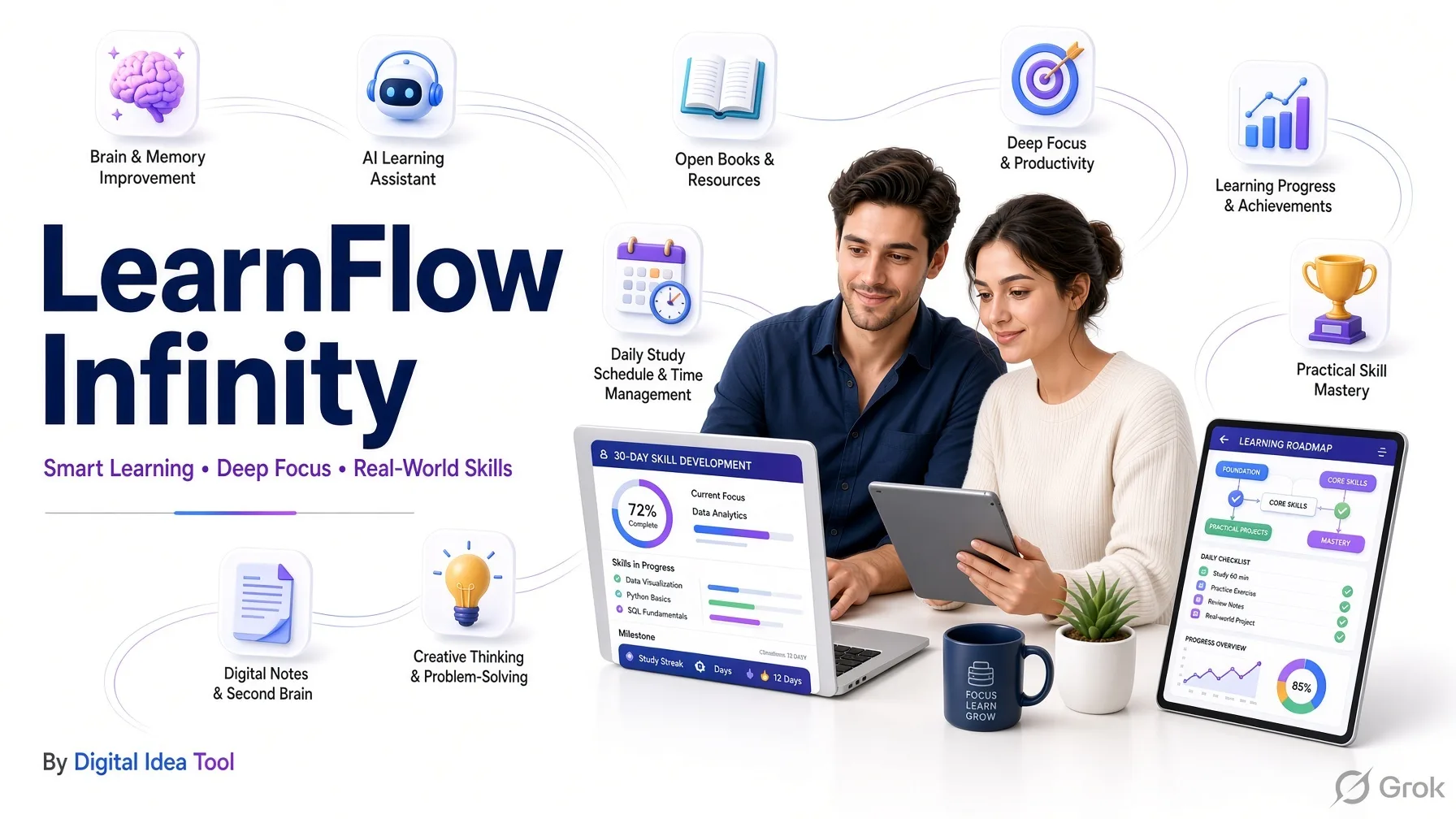
LearnFlow Infinity – Master Smarter Study Habits, Deep Focus & Real-World Skills
Learn Independently • Build Practical Skills • Improve Focus • Organize Knowledge
Discover ten practical strategies for learning without expensive courses, developing real-world abilities through hands-on projects, building powerful daily learning habits, improving knowledge retention, reducing digital distractions, and organizing information with modern AI-powered knowledge management systems.
Learn a little. Practice a lot. Keep growing! ✨Build a Learning System That Works in Real Life
Modern skill development is not only about completing courses. It also requires self-directed practice, practical projects, effective time management, reliable knowledge retention, and the ability to evaluate your own progress.
This guide explores ten essential questions about independent learning, microlearning, gamification, attention management, practical skill assessment, and digital knowledge organization. Each answer provides actionable techniques for beginners, students, busy professionals, and lifelong learners.
Choose one skill and organize reliable resources into daily tasks.
Apply new concepts through meaningful hands-on activities.
Use time management, active recall, and targeted revision.
Evaluate practical abilities and maintain a useful knowledge system.
10 Essential Questions About Modern Learning, Productivity & Practical Skill Development
Open any colourful 3D question tab to explore its detailed answer, practical learning techniques, and related long-tail SEO keywords.
Your next smart learning strategy is one click away! 👇21 How Can I Learn a New Skill Without a Teacher, Mentor, or Paid Course Using a 30-Day Self-Directed Learning System?
Learning a new skill without a teacher, mentor, or paid course is achievable through a structured self-directed learning system, reliable free educational resources, and consistent practical exercises. Modern digital education provides numerous opportunities for beginners to develop valuable abilities independently.
Start by choosing one specific skill and defining a realistic 30-day learning objective. Instead of attempting complete mastery immediately, focus on building foundational knowledge and completing practical beginner projects.
During the first week, research essential concepts using free online tutorials, educational videos, official documentation, and open learning platforms. Create a personalized learning roadmap that organizes important topics into manageable lessons.
In the second week, begin practicing independently. Complete small exercises, follow guided demonstrations, and record mistakes in a digital learning journal.
During the third week, explore intermediate concepts and attempt increasingly challenging activities. AI-powered learning assistants can explain difficult subjects, generate practice questions, and suggest improvements.
In the fourth week, complete an independent project demonstrating your newly developed abilities.
Use active recall, spaced repetition, and project-based learning to strengthen understanding and knowledge retention.
A digital skill progress tracker can monitor completed assignments, practice time, assessment results, and learning milestones.
Seek feedback from trustworthy online communities when possible. Independent learning does not require avoiding collaboration.
The most effective free self-learning strategy combines clear objectives, carefully selected resources, regular practice, and measurable progress.
Thirty days can establish valuable foundational skills and stronger independent learning habits, while advanced expertise generally requires additional experience.
22 How Can I Apply Project-Based Learning and Real-World Challenges to Develop Practical Skills Instead of Just Watching Tutorials?
Project-based learning helps beginners transform theoretical information into practical abilities by completing meaningful tasks and solving realistic problems. Unlike passive tutorial watching, hands-on learning requires active participation, independent thinking, and continuous improvement.
Begin by selecting a practical project that matches your current knowledge level. For example, someone learning digital marketing could create a simple promotional campaign, while a spreadsheet beginner might develop a personal budget dashboard.
Divide your project into manageable stages with clear objectives, deadlines, and measurable outcomes.
During the first week, study fundamental concepts and examine examples of completed projects.
In the second week, create a basic working version using guided exercises and reliable educational resources.
During the third week, improve your project by solving problems independently, testing alternatives, and incorporating constructive feedback.
Use the final week to complete, review, and present your finished work.
AI-powered project learning tools can help generate ideas, explain unfamiliar concepts, and suggest practice challenges. However, avoid allowing artificial intelligence to complete every important task.
Maintain a digital project journal documenting decisions, mistakes, improvements, and lessons learned.
Use real-world skill simulations to practice situations similar to professional responsibilities.
Evaluate your progress by examining project quality, practical independence, accuracy, and problem-solving ability.
The most effective 30-day project-based learning strategy emphasizes completing useful work rather than consuming unlimited educational content.
Practical projects can strengthen confidence, demonstrate developing competencies, and provide valuable material for future portfolios.
23 What Is the Best Way to Break Down a Difficult Skill Into Small, Achievable Daily Learning Tasks Using a 30-Day Microlearning Strategy?
Breaking a difficult skill into smaller learning activities makes complex subjects more approachable and helps beginners maintain consistent progress. A structured 30-day microlearning strategy organizes essential knowledge into manageable daily lessons, practical exercises, and regular assessments.
Begin by defining the overall skill you want to develop. Identify its most important components and arrange them from foundational concepts to increasingly challenging techniques.
For example, learning web development might involve understanding basic page structure, styling, responsive design, and introductory programming.
Divide each major component into short lessons that can be completed within approximately fifteen to thirty minutes.
During the first week, concentrate on essential terminology, basic principles, and simple exercises.
In the second week, apply foundational concepts through short practical assignments.
During the third week, connect related techniques and solve moderately challenging problems.
Use the final week to complete an integrated project and evaluate your progress.
AI-powered microlearning platforms can help generate bite-sized lessons, personalized revision questions, and adaptive practice activities.
Combine microlearning with active recall and spaced repetition to strengthen long-term knowledge retention.
Maintain a digital daily learning checklist to monitor completed lessons, unfinished assignments, and difficult topics.
Avoid dividing subjects into such small fragments that you lose sight of their practical connections.
Include regular opportunities to combine individual concepts into meaningful tasks.
The objective of a personalized 30-day microlearning roadmap is to reduce learning barriers while developing practical competence, confidence, and sustainable study habits.
24 How Can I Stop Forgetting What I Learn and Transfer New Knowledge Into Long-Term Memory Through Practical Daily Activities?
Forgetting newly learned information is common, particularly when learners consume large amounts of educational content without reviewing or applying it. Effective long-term memory development requires active retrieval, meaningful understanding, and repeated practice.
Begin by replacing passive rereading with active recall. After completing a lesson, close your notes and explain the main concepts using your own words.
Use spaced repetition to review important information across increasing time intervals rather than repeating everything during one study session.
Create flashcards containing questions, definitions, formulas, or practical examples. Digital flashcard applications can help organize revision activities.
Apply new information immediately through exercises, realistic examples, or small projects.
For example, someone learning a foreign language could practice newly acquired vocabulary by writing sentences and participating in conversations.
Use elaborative learning techniques by connecting unfamiliar concepts to information you already understand.
During a 30-day knowledge retention challenge, schedule daily review sessions alongside new lessons.
AI-powered study assistants can generate personalized quizzes, practice questions, and explanations for difficult concepts.
Maintain a digital learning notebook summarizing essential ideas without copying entire lessons.
Prioritize adequate sleep, manageable study sessions, and focused attention.
Evaluate retention through delayed quizzes rather than relying only on immediate understanding.
When you forget something, revisit the material and practice retrieving it again.
The most effective memory improvement system combines active recall, spaced repetition, practical application, and consistent revision.
Although perfect memory is unrealistic, these strategies can strengthen knowledge retention and help learners apply information more confidently.
25 How Can I Use Gamification, Daily Rewards, Learning Streaks, and Interactive Challenges to Make Skill Development More Enjoyable?
Gamification makes learning more engaging by introducing game-inspired elements such as points, challenges, achievement badges, progress levels, and rewards into educational activities.
A gamified 30-day skill development challenge can encourage consistent participation while making daily learning goals more enjoyable.
Begin by selecting one skill and defining specific achievements you want to complete during the month.
Create a simple points system that rewards meaningful learning activities, including completed exercises, successful practice sessions, and independent projects.
For example, award points for finishing lessons, solving difficult problems, or reviewing previously learned concepts.
Use digital learning streak trackers to monitor consecutive days of participation. However, avoid treating a broken streak as failure.
Introduce weekly learning challenges that gradually increase in difficulty.
During the first week, reward consistency and completion of foundational lessons.
In the second week, introduce interactive quizzes and practical mini-challenges.
During the third week, create achievement badges for completing increasingly demanding assignments.
Use the final week to complete a larger project and celebrate measurable improvement.
AI-powered gamified learning tools can generate personalized quizzes, scenario-based exercises, and creative educational challenges.
Choose rewards that support motivation without distracting from the learning objective.
Track practical performance alongside points because game scores do not necessarily demonstrate genuine competence.
Consider friendly accountability groups or collaborative challenges when appropriate.
The most effective gamification strategy balances enjoyment, meaningful feedback, and educational progress.
By connecting achievement systems with practical learning outcomes, beginners can develop stronger routines and maintain enthusiasm.
26 How Can I Learn Effectively With a Full-Time Job, College Studies, or Family Responsibilities Using a Flexible 30-Day Learning Schedule?
Learning new skills while managing employment, academic studies, or family responsibilities requires realistic time management and a flexible educational routine.
The most effective 30-day learning schedule for busy people emphasizes consistent progress rather than demanding several uninterrupted study hours every day.
Begin by reviewing your weekly responsibilities and identifying available learning periods.
You might have fifteen minutes before work, thirty minutes during an evening break, or longer sessions on weekends.
Select one priority skill and establish a specific learning objective that matches your available time.
Use microlearning to divide lessons into short activities that fit naturally into your daily schedule.
For example, dedicate ten minutes to reviewing concepts, fifteen minutes to studying new material, and twenty minutes to practical exercises when possible.
Create a flexible weekly learning calendar that includes essential activities, optional practice sessions, and catch-up periods.
AI-powered time management assistants can help organize lessons around changing schedules and suggest personalized learning tasks.
Use weekends or less demanding days for longer projects requiring focused attention.
Avoid sacrificing sleep or important responsibilities simply to maintain an unrealistic learning streak.
Track your progress through completed tasks and demonstrated abilities rather than total study hours alone.
When unexpected responsibilities interrupt your schedule, adjust your learning plan without abandoning your goals.
Review your achievements weekly and identify opportunities to improve efficiency.
A successful 30-day learning challenge for working professionals and busy students should support sustainable growth, practical skill development, and a healthy balance between education and everyday responsibilities.
27 How Can I Recognize and Overcome Learning Plateaus When My Skill Improvement Slows Down Despite Regular Practice?
A learning plateau occurs when progress becomes less noticeable despite continued study or practice. This experience can happen during many skill development journeys and does not necessarily indicate a lack of ability.
Recognizing a learning plateau begins with examining measurable performance rather than relying entirely on feelings.
Review recent assessments, completed assignments, practical accuracy, and task completion times.
If improvement has slowed, identify whether you are repeating familiar exercises without addressing more challenging weaknesses.
One effective strategy is deliberate practice, which focuses on specific abilities that require improvement.
Instead of repeating an entire activity, isolate the difficult component and practice it with focused attention.
For example, someone learning programming might concentrate on debugging techniques rather than repeatedly completing similar introductory tutorials.
Request constructive feedback from instructors, experienced peers, or knowledgeable communities.
AI-powered learning assistants can suggest alternative explanations, generate targeted exercises, and help organize personalized revision plans.
Introduce varied practice activities to strengthen adaptability and prevent excessive dependence on familiar tasks.
Review foundational concepts if advanced exercises reveal gaps in your understanding.
Include adequate rest and manageable learning sessions, particularly when fatigue affects concentration.
During a 30-day learning plateau recovery challenge, establish small performance goals and track gradual improvements.
Avoid comparing your progress directly with learners who have different backgrounds or experience levels.
Remember that skill development is rarely perfectly linear.
Overcoming learning plateaus requires thoughtful evaluation, appropriately challenging practice, reliable feedback, and patience.
28 How Can I Use Digital Detox, Deep Work, and Attention Management Techniques to Improve My Learning in a World Full of Distractions?
Digital distractions can interrupt focused learning and make it difficult to understand complicated subjects. Notifications, social media feeds, unnecessary multitasking, and frequent application switching may reduce study efficiency.
A structured digital detox and deep work learning strategy can help beginners establish a more focused educational environment.
Start by identifying your most common distractions, including mobile notifications, entertainment applications, and unrelated browsing habits.
Create a dedicated learning space that supports concentration and minimizes unnecessary interruptions.
Before studying, silence nonessential notifications and close unrelated browser tabs.
Use time blocking to reserve specific periods for focused educational activities.
Begin with twenty-five to thirty minutes of uninterrupted learning, followed by a short break.
Gradually extend your sessions when longer concentration periods become comfortable.
During deep work sessions, prioritize challenging tasks such as problem-solving, writing, analytical exercises, or practical projects.
Use website blockers, focus timers, or digital wellbeing settings when necessary.
AI-powered productivity assistants can help create learning schedules and organize assignments, but avoid constantly interacting with tools when independent work would be more useful.
Schedule separate periods for checking messages and browsing online resources.
Maintain a distraction journal to identify recurring interruptions and evaluate possible improvements.
Track completed learning tasks, concentration quality, and practical outcomes.
Remember that digital detox does not require abandoning useful technology.
The objective is intentional technology use that supports learning rather than competing for attention.
Consistent attention management can strengthen study habits, improve task completion, and support meaningful skill development.
29 How Can I Test My Skills Through Real-World Simulations, Practical Assessments, and Competency-Based Learning Without Formal Exams?
Testing skills without formal examinations is possible through practical assignments, realistic simulations, structured self-assessments, and competency-based learning activities.
Traditional tests often measure knowledge recall, while performance-based assessments can provide additional evidence of how effectively learners apply their abilities.
Begin by defining the specific competencies required for your chosen skill.
For example, someone learning spreadsheet management might evaluate data organization, formula accuracy, chart creation, and reporting capabilities.
Create practical challenges that resemble real-world situations.
A beginner studying digital marketing could design a sample content campaign and explain the reasoning behind selected strategies.
Use project-based assessments to evaluate completed work against clearly defined criteria.
Develop a scoring rubric that considers accuracy, completeness, creativity, independence, and problem-solving quality.
AI-powered skill assessment tools can generate hypothetical scenarios, practice questions, and feedback suggestions.
However, important performance judgments should be verified independently because automated feedback may contain inaccuracies.
During a 30-day competency-based learning challenge, complete smaller assessments weekly.
Compare your initial performance with later assignments to identify measurable improvement.
Consider peer reviews or feedback from experienced professionals when suitable.
Maintain a digital skills portfolio containing completed projects, reflections, and assessment results.
Use realistic simulations to practice tasks safely before applying them in professional environments.
Remember that self-assessment does not replace formal qualifications when certifications or licenses are legally required.
The purpose of practical skill testing is to demonstrate developing competence, identify weaknesses, and guide future learning.
30 How Can I Design a Personal Knowledge Management System Using Digital Notes, AI Search, and Second Brain Techniques to Organize Everything I Learn?
A personal knowledge management system helps learners collect, organize, retrieve, and apply useful information without depending entirely on memory.
The second brain approach involves building a reliable external system for storing important ideas, educational notes, project resources, and personal insights.
Begin by selecting a digital note-taking platform that matches your preferred workflow and technical experience.
Create a simple organizational structure containing learning subjects, active projects, reference materials, and completed work.
Avoid developing an overly complicated folder system before you have useful information to organize.
Use concise notes that explain important concepts in your own words.
Connect related ideas through links, tags, or topic references.
For example, a student learning digital marketing might connect notes about content writing, search engine optimization, audience research, and analytics.
AI-powered knowledge management tools can help summarize documents, organize information, and search connected notes when supported.
However, verify AI-generated summaries against original materials to prevent misunderstandings.
Apply second brain techniques by capturing useful ideas, organizing important resources, and regularly reviewing information.
Create a weekly knowledge review routine to remove outdated material and identify topics requiring further study.
Combine digital note-taking with active recall and practical projects rather than treating information collection as learning itself.
During a 30-day personal knowledge management challenge, gradually build an organized educational library.
Evaluate your system based on how quickly you can find relevant information and apply it effectively.
A successful digital second brain should simplify learning, support creative thinking, and improve long-term knowledge accessibility.
Written by Digital Idea Tool Team | Education • Productivity • AI Learning • Skill Development
Disclaimer & Compliance Note
LearnFlow Infinity provides general educational information about independent learning, AI-assisted study techniques, digital productivity, memory improvement, project-based learning, and practical skill development. Please read the following important information before applying any recommendations.
Learn responsibly. Practice independently. Grow realistically! ✨📚 01. Educational & Informational Purpose
All information in this article is intended for general educational, informational, and personal development purposes. It does not constitute individualized academic, psychological, legal, financial, medical, or professional advice. Readers should evaluate the suitability of each learning method according to their circumstances and consult appropriately qualified professionals when necessary.
🎯 02. No Guaranteed 30-Day Mastery
The 30-day learning framework is a suggested planning approach, not a guarantee of mastering any skill within a fixed period. Outcomes depend on previous experience, skill complexity, available study time, learning resources, practice quality, and individual circumstances. Advanced competence or professional expertise may require months or years of additional education and practical experience.
🤖 03. AI Tools & Accuracy Disclosure
AI-powered learning assistants, automated study planners, and digital knowledge tools may generate incomplete, inaccurate, outdated, or misleading content. Verify important information through reliable sources, official documentation, qualified educators, and independent testing. Do not rely exclusively on AI-generated advice when making significant decisions.
🧠 04. Memory, Focus & Learning Claims
Memory improvement, deep work, digital detox, gamification, and other learning techniques may produce different results for different individuals. No specific improvement in memory, concentration, productivity, intelligence, or cognitive performance is guaranteed. These methods are educational suggestions and are not treatments for learning difficulties or medical conditions.
💼 05. Career, Employment & Income Disclaimer
Completing learning exercises, developing digital skills, or building a portfolio does not guarantee employment, promotions, freelance clients, business success, or financial earnings. Career outcomes depend on market conditions, qualifications, practical competence, competition, and many other factors. Any examples of professional applications are illustrative.
🔗 06. Third-Party Resources & External Links
References to online courses, educational platforms, websites, software, and third-party applications are provided for informational convenience. Their pricing, availability, features, privacy policies, and terms of service may change without notice. Unless expressly stated, references do not imply sponsorship, endorsement, or affiliation with Digital Idea Tool.
🔐 07. Privacy & Data Protection
Readers should avoid uploading confidential documents, passwords, sensitive personal information, or private business data into AI tools and third-party learning applications without understanding their privacy practices. Review the relevant platform’s data handling policies, permissions, and security settings before use.
©️ 08. Intellectual Property & Responsible Use
Educational examples, templates, digital notes, and AI-assisted projects should be used in accordance with applicable copyright laws, licensing conditions, and academic integrity requirements. Readers remain responsible for checking ownership, permissions, attribution, and usage rights before publishing, sharing, or selling their work.
🛠️ 09. Digital Templates & Tool Compatibility
Any accompanying learning planner, worksheet, dashboard, or downloadable template is intended as an organizational aid. Software compatibility, editability, device support, and included file formats depend on the specific product description. Digital resources do not replace certified training, formal assessments, or required professional qualifications.
🌍 10. Regional Rules & Individual Responsibility
Educational, professional, consumer protection, privacy, and intellectual property requirements vary across countries and regions. Readers are responsible for checking relevant local rules, course requirements, professional licensing obligations, and platform policies. Use educational recommendations with independent judgment and appropriate care.
✅ Final Transparency Statement
Digital Idea Tool aims to provide useful, clear, and responsible educational content. We do not promise specific learning outcomes, guaranteed skill mastery, professional advancement, improved cognitive performance, or financial results.
Readers are encouraged to use reliable resources, verify AI-generated information, practice consistently, protect their privacy, and set achievable learning goals. The information in this article may be updated as educational methods, technologies, and professional requirements evolve.
Content Publisher: Digital Idea Tool Team
Published by Digital Idea Tool Team • Educational Transparency • Responsible Learning
📝 Key Takeaways & Action Notes
Jot down insights, next steps, or thoughts from this post. Your notes save automatically in your browser.
- What is the #1 breakthrough insight you took away today?
- What is one concrete action you will take in the next 24 hours?
- What questions or ideas do you want to research further?
Stay ahead with exclusive updates
Join our community. Get curated industry trends, actionable guides, and fresh resources delivered straight to your inbox.