
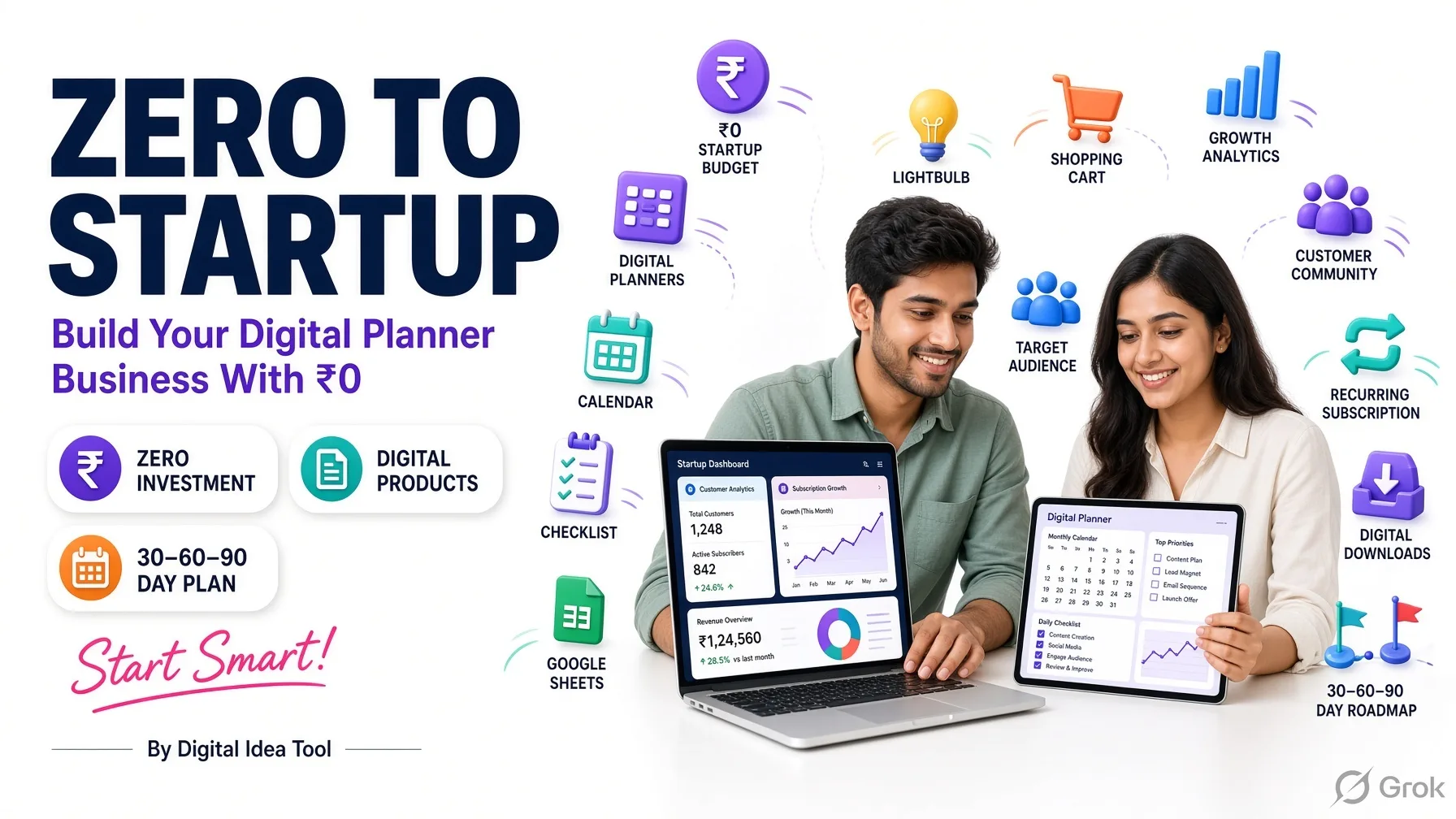
Learn how to start a digital planner business with ₹0 investment. Discover free tools, first-customer strategies, tracking templates and a 90-day plan.
Zero to Startup: Build Your First Digital Planner Business With ₹0
A Practical Beginner’s Roadmap to Digital Products, First Customers & Monthly Membership Income
Start small. Learn fast. Build smart!
No business experience? No mentors? No startup capital? This guide shows how to research a niche, validate a digital planner idea, create useful templates, attract potential buyers, track results and test a subscription business using free-first tools.
💡 What Is a Niche Digital Planner Subscription?
A niche digital planner subscription is a membership business that provides new digital planners, trackers, checklists, worksheets and printable resources to a specific audience every month.
Instead of trying to sell random templates to everyone, you focus on one audience with a recurring problem. For example, teachers may regularly need lesson planners, fitness coaches may need client-progress trackers, and students may need revision schedules.
One audience + one problem + one useful solution.
🚀 How to Start a Business With Absolutely No Money
The first step is not creating a company logo, purchasing software or building a complicated website. The first step is understanding a problem that someone wants solved.
Five beginner-friendly steps
- Choose an audience: Select teachers, students, new parents, fitness coaches or another focused group.
- Research their problems: Find repetitive tasks that consume time or create frustration.
- Create a free sample: Design one simple worksheet or tracker.
- Test a paid offer: Introduce a small starter bundle before building a large subscription library.
- Improve from feedback: Develop a membership only after confirming recurring customer demand.
Free-first business tools
| Task | Free-first tool | Practical use |
|---|---|---|
| Template design | Canva Free | Planner layouts and product previews |
| Spreadsheets | Google Sheets | Budgets, progress and analytics |
| Documents | Google Docs | Instructions and printable pages |
| Surveys | Google Forms | Customer research |
| Website | Google Sites | Simple product landing page |
| Checkout | Gumroad or Payhip | Digital product sales; transaction fees apply |
| Marketing | Pinterest / Instagram | Organic discovery and demonstrations |
| Organization | Notion Free | Daily tasks and project management |
What should you learn first?
📘 Week 1
Learn basic customer research. Speak with 10 possible customers.
🎨 Week 2
Learn simple product design. Build three useful planner pages.
📣 Week 3
Learn sales messaging. Write a clear product description.
📊 Week 4
Learn basic finance and analytics. Build your tracking spreadsheet.
💡 Discover Profitable-Looking Ideas Without Guessing
A broad audience is not always a useful niche. Instead of targeting every teacher, focus on new primary-school teachers who need weekly lesson-planning resources.
Four membership ideas to test
🍎 Teacher Planning Club
Lesson planners, attendance sheets, student progress reports and activity calendars.
Example test price: ₹199/month👶 New Parent Planner Club
Routine calendars, household trackers, feeding logs and appointment lists.
Example test price: ₹149/month💪 Fitness Coach Toolkit
Workout calendars, client check-ins, scheduling sheets and progress logs.
Example test price: ₹299/month🎓 Student Success Club
Study schedules, exam revision sheets, assignment trackers and weekly planners.
Example test price: ₹99/monthPrices are examples for testing, not verified market averages. Health-related tracking resources should not be presented as medical advice.
Score your niche before building
| Research question | Score (1–5) |
|---|---|
| Do I understand this audience? | 1–5 |
| Can I reach them without advertising? | 1–5 |
| Do they face recurring problems? | 1–5 |
| Is there evidence they may pay? | 1–5 |
| Can I produce a reliable solution? | 1–5 |
| Total | Maximum 25 |
A score of 20 or higher may suggest a promising niche to investigate, but scoring cannot replace customer interviews and actual sales evidence.
Free validation method
- Identify 20 possible customers.
- Interview at least 10 people.
- Ask about problems they recently experienced.
- Show five people a simple prototype.
- Offer a small paid starter pack.
- Record purchases, objections and feedback.
Real purchases matter more than likes!
✨ Smart Startup Habits That Save Time and Money
What beginners should do
- Focus on usefulness: Make every template solve a clear problem.
- Create original designs: Avoid copying other sellers’ intellectual property.
- Validate before expanding: Confirm demand before making dozens of files.
- Use organic marketing: Share helpful tips and relevant examples.
- Keep expenses visible: Track platform fees and payment deductions.
- Promise realistic delivery: A membership involves continuing obligations.
Common mistakes and better alternatives
| Beginner mistake | Better action |
|---|---|
| Creating 100 templates first | Create one useful sample and test it |
| Buying unnecessary software | Start with free tools |
| Marketing to everyone | Choose one focused audience |
| Ignoring customer feedback | Review requests every week |
| Confusing revenue and profit | Deduct costs, fees and taxes |
| Making unrealistic income promises | Use measurable, honest claims |
📅 Daily, Weekly and Monthly Founder Planning Templates
Use these templates to organize daily work and monitor your business without paid software.
Daily founder tracker
| Day | Main goal | Task | Minutes | Status | Learning / problem | Win |
|---|---|---|---|---|---|---|
| 1 | Choose niche | Research 3 audiences | 45 | Done | Need clear niche | 3 ideas |
| 2 | Research | Interview 3 people | 60 | Planned | — | — |
| 3 | Create | Build sample template | 75 | Planned | — | — |
Weekly founder review
| Review question | Example answer |
|---|---|
| Main weekly goal | Interview 10 customers |
| Completed tasks | 8 interviews, 1 sample |
| Time invested | 7 hours |
| What worked? | Direct conversations |
| What failed? | Generic promotional posts |
| Next improvement | Better product preview |
Monthly goal-setting sheet
| Goal | Target | Actual | Next step |
|---|---|---|---|
| Customer interviews | 20 | 0 | Find participants |
| Free sample downloads | 50 | 0 | Publish a sample |
| First purchases | 5 | 0 | Test paid offer |
| New templates | 5 | 0 | Research requests |
| Gross revenue | ₹1,000 | ₹0 | Test starter bundle |
Templates contain illustrative information. Paste into Google Sheets or Excel and replace the examples with your actual results.
📊 Simple Business Tracking Report for Beginners
At the beginning, a small number of meaningful metrics is more valuable than a complicated dashboard.
| Metric | Meaning | Tracking method |
|---|---|---|
| Visitors | People viewing your offer | Platform analytics |
| Leads | Interested people who opt in | Forms / email list |
| Customers | Completed purchases | Payment reports |
| Revenue | Gross sales received | Sales export |
| Expenses | Fees and operating costs | Expense sheet |
| Hours | Working time | Daily planner |
| Active members | Current paying subscribers | Membership dashboard |
| Cancellations | Subscribers leaving | Membership records |
Weekly report example
| Metric | Week 1 | Week 2 | Week 3 | Week 4 |
|---|---|---|---|---|
| Visitors | 40 | 65 | 100 | 150 |
| New leads | 5 | 9 | 15 | 24 |
| New buyers | 0 | 1 | 2 | 3 |
| Gross sales (₹) | 0 | 199 | 398 | 597 |
| Hours worked | 8 | 9 | 10 | 10 |
| Expenses (₹) | 0 | 35 | 60 | 85 |
Spreadsheet formulas
Set columns B through F as Visitors, Leads, New Customers, Gross Revenue, and Fees Plus Expenses.
Format conversion as a percentage. For subscriptions, track existing-member revenue separately from new-customer sales.
📈 Free Analytics: Discover What’s Working
Four basic calculations
Lead Conversion
New leads ÷ Visitors × 100
Sales Conversion
Buyers ÷ Visitors × 100
Monthly Recurring Revenue
Active monthly members × Monthly price
Member Churn
Members lost during month ÷ Members at start × 100
Interactive startup revenue calculator
Enter example or real business numbers to calculate monthly performance.
MRR assumes all members pay the same monthly price without discounts. Net result subtracts only the costs entered. Taxes and unentered expenses are not included.
How to decide what to change
| Result | Possible explanation | Next test |
|---|---|---|
| Few visitors | Low visibility | Improve audience targeting |
| Visitors but few leads | Weak free offer | Improve sample and landing page |
| Leads but no sales | Value or trust concern | Interview interested people |
| High cancellations | Weak recurring usefulness | Improve monthly resources |
| Repeat product requests | Potential strong demand | Expand that product category |
100-point founder review
| Performance area | Maximum points |
|---|---|
| Customer research | 20 |
| Product quality and delivery | 20 |
| Marketing consistency | 20 |
| Sales validation | 25 |
| Finance and customer service | 15 |
| Total | 100 |
Score your actions honestly each month. This system measures execution, not guaranteed business success. Customer demand, profit and retention must be reviewed separately.
💰 A Realistic Strategy for Your First ₹1,000
Instead of immediately launching a large membership, try selling one small, useful starter pack.
Example starter bundle
- Weekly lesson planner
- Homework progress tracker
- Student attendance sheet
- Classroom activity calendar
- Simple instructions and examples
Get your first customers
- Find communities where your audience is active.
- Answer relevant questions helpfully.
- Share a useful free sample with interested people.
- Collect feedback and improve your files.
- Offer your paid bundle clearly and honestly.
- Ask buyers what else they need.
📣 Build Your Online Presence Without Paid Advertising
Publish searchable planner previews, practical tips and product demonstrations.
Share quick tutorials, examples, carousel tips and template walkthroughs.
💬 WhatsApp Business
Communicate with people who have opted in and provide product support.
🌐 Free Website
Explain your product, show previews, answer questions and link to checkout.
Weekly free marketing calendar
| Day | Content idea |
|---|---|
| Monday | Useful planning tip |
| Tuesday | Template demonstration |
| Wednesday | Customer problem and solution |
| Thursday | Free sample |
| Friday | Starter pack walkthrough |
| Saturday | Audience feedback question |
| Sunday | Analytics and planning |
Begin with one or two relevant channels. Avoid unsolicited messages and follow community promotion rules.
🔁 Turn Your Best Templates Into a Monthly Membership
A subscription should provide ongoing value, not just a new collection of decorative pages. Test whether customers really need fresh resources every month.
Example membership tiers
| Membership | Included resources | Test price |
|---|---|---|
| Free | Samples and occasional tips | ₹0 |
| Starter | 4 new monthly resources | ₹149/month |
| Pro | 8 resources, editable files and archive access | ₹299/month |
Begin with one paid tier. Introduce more pricing options only after proving that customers value your recurring releases.
Monthly release schedule
- Week 1: Weekly planning template
- Week 2: Monthly tracking sheet
- Week 3: Specialized checklist
- Week 4: Requested bonus resource
⏰ Run a Small Startup Alongside a Job or Studies
You do not need eight uninterrupted hours every day. If your schedule allows only one hour, use it deliberately.
| Activity | Daily minutes |
|---|---|
| Customer research | 15 |
| Product creation | 25 |
| Marketing and outreach | 15 |
| Tracking progress | 5 |
| Total | 60 |
💳 Reinvest Early Earnings Without Wasting Them
Do not automatically spend your first earnings on subscriptions, branding packages or advertising.
Example allocation of ₹5,000 in earnings available after operating costs and required tax provisions:
| Purpose | Illustrative amount |
|---|---|
| Cash reserve | ₹2,000 |
| Product improvement | ₹1,250 |
| Marketing experiments | ₹750 |
| Education | ₹500 |
| Flexible reserve | ₹500 |
| Total | ₹5,000 |
Earn first. Improve next. Spend carefully!
⚖️ Understand the Legal and Tax Basics
Legal requirements differ by country, business structure, product type and selling arrangement.
Important considerations for an India-based creator
- Business structure: Understand whether sole proprietorship or another structure is suitable.
- Udyam: Review eligibility for free official MSME registration.
- GST: Check applicable registration thresholds, compulsory-registration rules, marketplace arrangements and interstate supplies.
- Income tax: Maintain accurate business income and expense records.
- Copyright: Use original content and review design-asset licenses.
- Customer rights: State billing, cancellation, access and refund policies accurately.
- Privacy: Collect only necessary customer information and handle it responsibly.
Official India resources
🗺️ Your 30–60–90 Day Journey From Idea to Business
🚀 Days 1–30
Research and validation
- Choose one audience.
- Interview potential customers.
- Create a free prototype.
- Test a small paid bundle.
📣 Days 31–60
Sales and improvement
- Improve product quality.
- Publish helpful content.
- Collect buyer feedback.
- Test recurring demand.
🔁 Days 61–90
Membership testing
- Finalize delivery plans.
- Launch if demand is validated.
- Deliver the first monthly pack.
- Measure retention and costs.
🎯 Day 90 Review
Determine which products sell, which customers return, what costs you incur and whether a subscription is sustainable.
90-day progress targets
| Metric | Day 30 | Day 60 | Day 90 |
|---|---|---|---|
| Customer research | 10–15 interviews | 20+ total | Ongoing |
| Sample | Published | Improved | Updated |
| Paid product | Tested | Refined | Evaluated |
| Membership | Not required | Possible pilot | Review first delivery |
| Financial tracking | Started | Weekly | Monthly review |
These are planning milestones, not guaranteed financial results.
🧠 Extra Lessons New Digital Entrepreneurs Need
Customer support
Explain how to download, open, edit, print and use each product. Provide clear troubleshooting instructions.
Original product licensing
State permitted uses and restrictions. Review third-party asset licenses before reselling editable templates.
International compatibility
Consider both A4 and US Letter layouts, understandable date formats, accessible fonts and clearly marked currencies.
When a subscription is not suitable
If customers only need a product once, a one-time bundle may be better than a recurring membership.
Customer feedback cycle
After each group of buyers, review what they use, what they dislike and what they repeatedly request.
✅ Your First-Day Startup Action Checklist
Complete as many of these free tasks as your schedule allows.
0 of 8 tasks completed
Your first action is the beginning!
❓ Questions Every First-Time Founder Asks
Can I start a digital product business with ₹0?
You can begin researching customers, designing samples and testing offers with free-first software. Actual sales may involve transaction fees, taxes and other operational costs.
Do I need coding skills?
No. Many planners can be created using Google Sheets, Google Docs and free graphic design tools.
Which niche should I choose?
Choose a narrow audience you can reach, understand and help. Confirm that its problems occur repeatedly and that there is evidence of willingness to pay.
How quickly can I earn my first income?
There is no guaranteed timeline. Results depend on customer demand, product usefulness, reach, trust, pricing and execution.
Should I launch a subscription immediately?
Usually, it is simpler to test a small paid starter pack first. Expand into a subscription when customers demonstrate recurring needs.
What should I track every week?
Track visitors, interested leads, conversations, sales, active subscribers, cancellations, gross revenue, expenses and hours worked.
What if my first product does not sell?
Investigate whether the problem, audience, offer, presentation, price or distribution is wrong. Ask potential customers and test a specific improvement before abandoning the business.
Can I sell internationally?
Potentially, yes, subject to payment platform support, local regulations, product licensing and tax obligations. Verify requirements before accepting international payments.
🌟 Start Small Today. Build Something Valuable Tomorrow.
Dream. Research. Create. Test. Improve.
You do not need to create a huge digital product store on your first day. Start with one audience, one meaningful problem and one useful solution. Build your business using customer evidence instead of guesses.
🚀 Begin Your Free Startup Checklist⚖️ Disclaimer & Compliance Note
This content is provided for general educational and informational purposes only. It does not constitute professional financial, legal, investment, accounting or tax advice.
All prices, revenue calculations, conversion examples, growth targets and business scenarios are illustrative. Actual earnings are not guaranteed.
Product demand, customer acquisition, software availability, platform fees and regulatory obligations may vary by country and individual circumstances. Verify applicable requirements and seek qualified professional advice when appropriate.
Names of third-party platforms are used for informational purposes only. No sponsorship, endorsement or formal affiliation is implied.
Respect intellectual property, customer privacy, consumer protection requirements and applicable digital commerce rules.
✍️ Written by Digital Idea Tool Team
Disclaimer & Compliance Note
Zero-Budget Startup, Digital Planner Business & Subscription Entrepreneurship Guide
This guide is published by Digital Idea Tool to provide general educational information about starting and managing a small digital product business. Please review the following limitations, responsibilities and important disclosures before relying on its content.
Learn responsibly. Build confidently!📘 01. Educational Information Only
All articles, examples, templates, checklists, business strategies, startup roadmaps and educational materials are provided for general information and learning purposes.
The content is not personalized business, financial, legal, accounting, investment or tax advice.
Readers should evaluate their individual circumstances and consult qualified professionals when necessary.
💰 02. No Earnings or Success Guarantee
Any references to earning ₹1,000, generating monthly subscription income, gaining customers or achieving business milestones are examples or planning targets, not promises or guarantees.
Actual business results depend on market demand, skills, product quality, pricing, competition, customer behavior, marketing and other circumstances.
You may earn less than projected, earn nothing or experience losses.
🆓 03. Zero-Budget Business Limitations
A zero-budget approach means beginning with free or no-upfront-cost resources wherever feasible.
It does not mean every part of operating a business will remain free.
Payment processing, marketplace fees, taxes, refunds, internet access, optional upgrades and legal compliance may involve costs.
📊 04. Financial Figures & Analytics
Prices, projected revenue, conversion rates, sales targets, member counts and financial examples are hypothetical unless specifically identified as verified historical information.
Gross revenue is not the same as profit or the final amount received.
Readers must account for transaction charges, expenses, cancellations, applicable taxes and other deductions.
🔁 05. Subscription & Recurring Billing
Selling a monthly membership creates ongoing responsibilities toward paying subscribers.
- Clearly display the subscription price.
- Disclose renewal frequency.
- Explain included digital resources.
- State delivery and access conditions.
- Provide understandable cancellation instructions.
- Honor applicable refund and consumer rights.
🛒 06. Third-Party Platforms & Fees
References to Gumroad, Payhip, Canva, Google Sheets, Pinterest, Notion and other services are provided for informational purposes.
Features, free plans, fees, payout availability and platform rules may change without notice.
Readers should check each provider's official terms before relying on a particular service.
Mentioning a third-party company does not imply an endorsement, partnership or sponsorship.
⚖️ 07. Business Registration & Taxes
Registration, licensing, invoicing, indirect taxes and income-tax obligations vary by location and business activity.
For India-based entrepreneurs, requirements relating to GST, income tax, Udyam registration and cross-border payments should be verified using official sources or qualified professional advice.
A small business or low level of revenue does not automatically guarantee exemption from every applicable law or obligation.
🎨 08. Copyright & Digital Product Licensing
Entrepreneurs are responsible for ensuring that products, illustrations, fonts, photographs and templates they distribute have appropriate commercial-use permissions.
Do not copy, repackage or resell third-party creative works without the necessary rights.
Review applicable design-tool licenses, including restrictions on redistributing licensed assets inside editable templates.
🔐 09. Privacy & Customer Information
Customer names, email addresses, survey responses and payment-related information should be collected only for legitimate purposes.
Provide appropriate privacy notices, obtain required consent and follow applicable data-protection laws.
Do not sell, expose or misuse customer information.
📢 10. Advertising & Marketing Ethics
Business owners should avoid fake testimonials, misleading results, deceptive discounts, spam, fabricated reviews and unsupported performance claims.
Explain the actual contents and limitations of each product. Identify sponsored or affiliate relationships when disclosure is legally required.
Respect platform community rules and recipients' marketing preferences.
🧩 11. Template Accuracy & Suitability
Digital planners, spreadsheets and tracking systems should be checked for usability, accessibility, formula accuracy and compatibility.
No template should be treated as a guaranteed solution for every user or situation.
Fitness, medical, parenting or financial trackers should not replace qualified professional guidance where such guidance is needed.
🌍 12. International Sales & Compliance
International digital sales may involve different consumer protection rules, tax treatment, payment restrictions, accessibility requirements and digital service regulations.
Sellers should verify the rules applicable to their location, selling platform and customer markets.
A platform handling a particular tax does not necessarily eliminate all seller reporting obligations.
🛡️ Independent Decisions & Business Risk
Readers are responsible for evaluating whether any business idea, pricing strategy, marketing method or subscription model is appropriate for their circumstances.
No particular commercial outcome is represented as certain. Business activities involve risk, including possible financial losses, unexpected costs and lack of demand.
Digital Idea Tool makes reasonable efforts to present useful educational material, but does not warrant that every example, third-party feature, regulatory reference or strategy will remain current or be suitable for every reader.
Nothing in this notice is intended to exclude or limit rights, responsibilities or liabilities that cannot legally be excluded under applicable law.
📥 Digital Product Delivery & Customer Rights
Any accompanying paid digital planner, tracker, workbook or downloadable template is supplied electronically as described in its individual product listing.
Digital Download Only – No Physical Product. Where a product is sold as a digital download, no physical item will be shipped. File delivery and access timing are governed by the relevant checkout and product terms.
Refund, cancellation and exchange conditions must be communicated clearly and must comply with applicable consumer protection law. Statutory consumer rights are not waived by labeling a purchase non-refundable.
✅ Responsible Learning. Informed Decisions.
Use this guide as a starting point for research, skill development, customer validation and careful business experimentation.
Verify important information, protect customer interests, monitor financial risk and obtain professional guidance when necessary.
Build with creativity, clarity & responsibility!✍️ Published by Digital Idea Tool Team
📝 Key Takeaways & Action Notes
Jot down insights, next steps, or thoughts from this post. Your notes save automatically in your browser.
- What is the #1 breakthrough insight you took away today?
- What is one concrete action you will take in the next 24 hours?
- What questions or ideas do you want to research further?
Stay ahead with exclusive updates
Join our community. Get curated industry trends, actionable guides, and fresh resources delivered straight to your inbox.