
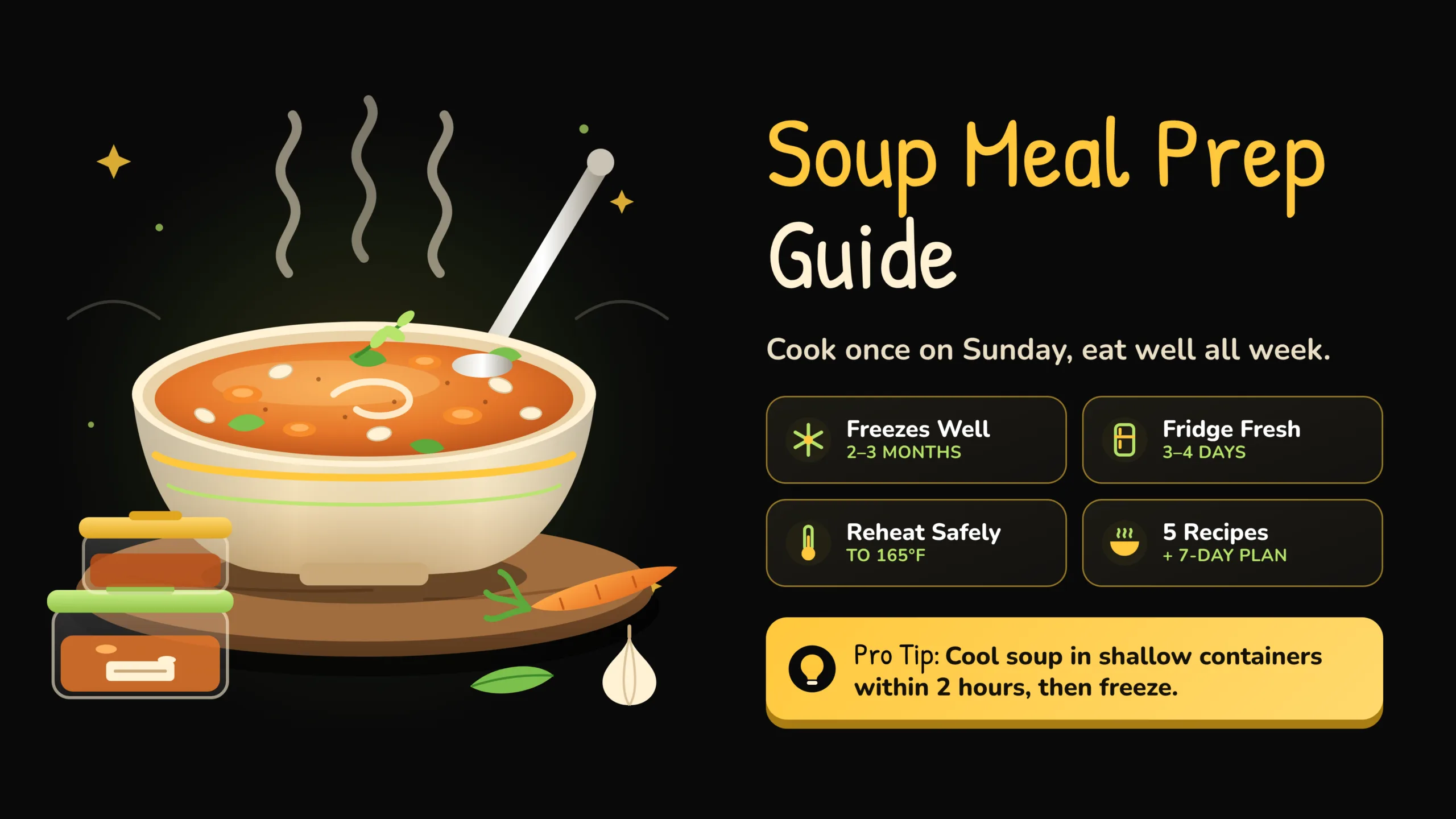
Master soup meal prep with freezer-friendly recipes, safe storage times, the best containers, and a 7-day plan. Cook once and eat well all week.
Soup meal prep is one of the most efficient habits a busy household can adopt: a single afternoon at the stove yields a week of balanced, budget-friendly meals that reheat beautifully and travel well to the office. Unlike many prepped dishes that turn soggy or dry by Wednesday, a well-built soup often tastes better on day three, because the aromatics continue to mingle and the broth deepens.
This guide is written for American home cooks who want a dependable system rather than a single recipe. You will learn which soups freeze gracefully and which do not, how to cool a large pot quickly enough to satisfy USDA food safety guidance, which containers survive the freezer and microwave, and how to turn five base recipes into a rotating week of lunches and dinners. Every recommendation is grounded in practical kitchen experience and established food safety standards.
Why Soup Meal Prep Works So Well for Busy Weeks
Meal prep succeeds or fails on a simple question: will you actually want to eat this food on Thursday? Grilled chicken and steamed broccoli rarely pass that test. Soup does, and for reasons that are partly culinary and partly logistical.
Soup improves as it rests
Broth-based dishes are forgiving in a way few other foods are. As soup sits in the refrigerator, starches from beans, grains, and potatoes gently thicken the liquid, while garlic, onion, herbs, and spices continue to infuse the broth. The result is a deeper, rounder flavor than the soup had when it first came off the stove. Chili, lentil soup, and minestrone are classic examples of dishes that cooks often describe as tasting better the next day.
One pot, many portions
A standard 6- to 8-quart Dutch oven or stockpot produces roughly 10 to 14 one-and-a-half-cup servings. That is a full work week of lunches for one person, or several family dinners, from a single cooking session and one pot to wash. Scaling up costs very little extra time: chopping two onions instead of one adds a minute, not an hour.
Reheating is forgiving
Proteins such as chicken breast and fish dry out when microwaved a second time, but in soup they are surrounded by liquid, which protects their texture. Vegetables that would turn limp on a sheet pan simply become part of the broth. This is why soup is one of the few prepped foods that tolerates both the office microwave and the stovetop with equal grace.
Built-in portion control and nutrition
Because soups are high in water and can be loaded with vegetables and legumes, they tend to be filling relative to their calorie content. A bowl that combines lean protein, fiber-rich beans or grains, and several cups of vegetables can satisfy the vegetable-forward pattern recommended by the USDA’s MyPlate guidelines without feeling like a diet meal.
Pro insight: If you already follow a weekly recipe rotation, soup slots in naturally as your “anchor” dish. Our Swiss Chicken & Chestnut Barley Soup is a strong first candidate because barley holds its shape well through several days of storage.
Essential Equipment and the Best Containers for Freezing Soup
You do not need a professional kitchen to prep soup at scale, but a few well-chosen tools make the process faster, safer, and far less messy. Think of this list as an investment you make once and use every week.
The cooking essentials
🍲 Heavy-bottomed pot
A 6- to 8-quart enameled Dutch oven or stainless stockpot distributes heat evenly and prevents scorching during long simmers. Thin pots create hot spots that burn beans and dairy.
🔪 Sharp chef’s knife
Most soup prep time is chopping. A sharp 8-inch knife and a large cutting board shave minutes off every session and make uniform cuts that cook evenly.
⚡ Immersion blender
Essential for creamy, dairy-free soups such as butternut squash or potato leek. You can purée directly in the pot instead of ladling hot liquid into a countertop blender.
🌡️ Instant-read thermometer
The only reliable way to confirm that reheated soup has reached a safe internal temperature. It is inexpensive and removes all guesswork.
Choosing storage containers
Container choice determines whether your soup survives the freezer gracefully or emerges with freezer burn and cracked lids. Each material has distinct strengths.
- Glass containers with locking lids: Oven- and microwave-safe, stain-resistant, and ideal for refrigerator storage. For freezing, choose tempered glass and leave generous headspace, because liquid expands as it freezes.
- BPA-free plastic deli containers: Inexpensive, stackable, and lightweight. The 16-ounce and 32-ounce sizes are perfect single and double portions. Transfer soup to a microwave-safe bowl before reheating if the container is not labeled microwave-safe.
- Silicone freezer trays: These portion soup into neat 1-cup or 2-cup blocks. Once frozen, pop the blocks out and store them in a labeled freezer bag, which frees the tray for the next batch.
- Zip-top freezer bags: The most space-efficient option. Fill, squeeze out the air, and freeze flat on a sheet pan. Frozen “soup bricks” stack vertically like files in a drawer.
Headspace rule: Leave about one inch of space at the top of rigid containers before freezing. Liquids expand roughly 9 percent as they freeze, and an overfilled jar can crack or pop its lid.
Labeling: the overlooked step
Every container should carry three pieces of information: the name of the soup, the date it was cooked, and the number of servings. A roll of masking tape and a permanent marker work perfectly. Unlabeled frozen soup tends to become a mystery that sits in the back of the freezer far past its prime. If you enjoy organizing your kitchen systems on paper or a tablet, the printable and digital planners in our Digital Idea Tool product collection include meal-planning and inventory templates that pair well with a freezer log.
The Balanced Soup Formula: Building a Complete Meal in One Bowl
A soup that keeps you full until dinner is built with intention. Rather than memorizing dozens of recipes, learn a flexible framework and you can improvise with whatever is on sale at the grocery store.
The five building blocks
- Aromatic base (about 2 to 3 cups chopped): Onion, carrot, celery, garlic, leeks, or bell pepper sautéed in olive oil or butter. This foundation, known in French cooking as mirepoix, supplies most of the soup’s underlying depth.
- Protein (about 1 to 1.5 pounds per 8 servings): Chicken thighs, lean ground turkey, beef chuck, sausage, or plant proteins such as lentils, chickpeas, and white beans. Legumes double as fiber sources.
- Vegetables (4 to 6 cups): Hearty options such as sweet potatoes, squash, cabbage, and green beans hold up through storage. Add delicate greens such as spinach or kale near the end.
- Starch or grain (1 to 1.5 cups dry, optional): Barley, farro, wild rice, potatoes, or small pasta. These add body and satiety but behave differently in the freezer, as explained in the next section.
- Liquid and seasoning (8 to 10 cups): Low-sodium broth, canned tomatoes, coconut milk, or water, plus herbs, spices, and a finishing acid such as lemon juice or vinegar.
Season in layers, finish with brightness
Professional cooks season at several stages: a pinch of salt with the aromatics, more after the liquid is added, and a final adjustment before serving. Because flavors can mellow during storage, it is wise to slightly under-season the batch and correct each portion as you reheat it. A squeeze of lemon, a splash of sherry vinegar, or a spoonful of fresh herbs revives prepped soup instantly.
Texture contrast keeps soup interesting
Monotony is the quiet enemy of meal prep. Store crunchy toppings separately and add them at serving time: toasted pumpkin seeds, croutons, crushed tortilla chips, a dollop of Greek yogurt, or a drizzle of chili oil. A crisp side dish also helps. Our Paneer Patra Rolls with Yogurt Dip and high-protein Brazilian pão de queijo waffles both make excellent protein-rich companions to a vegetable soup.
Which Soups Freeze Well, and Which Ones Don’t?
One of the most frequently searched questions in meal prep is simply “what soups freeze well?” The answer depends on the ingredients, not the recipe name. Water-heavy vegetables, dairy, and starches each respond to freezing in predictable ways.
- Bean and lentil soups
- Chili (beef, turkey, or vegetarian)
- Puréed vegetable soups without cream
- Brothy chicken and vegetable soup
- Beef stew and split pea soup
- Pasta soups: freeze without pasta
- Rice soups: undercook grains slightly
- Potato soups: purée before freezing
- Cream soups: add dairy after thawing
- Soups thickened with cream or cheese
- Soups with large chunks of potato
- Delicate seafood bisques
- Cold soups such as gazpacho
Why dairy separates
When milk, cream, or cheese freezes, ice crystals disrupt the emulsion of fat and water. After thawing, the soup can look grainy or curdled. The solution is straightforward: prepare and freeze the soup base without dairy, then stir in cream, half-and-half, or shredded cheese during reheating. Coconut milk and puréed white beans freeze more reliably and can create creaminess without dairy.
Why potatoes turn grainy
Cubed potatoes often become spongy or mealy after freezing because ice crystals rupture their cell walls. Waxy varieties such as Yukon Gold fare better than russets, and puréed potato soups freeze far more gracefully than chunky ones. If you love a chunky potato soup, consider refrigerating that batch rather than freezing it.
Why pasta and rice go mushy
Starches keep absorbing liquid in storage. Pasta added to a big batch of minestrone will be bloated by day two. Cook pasta separately and add it to individual portions as you reheat, or substitute sturdier grains such as barley, farro, or wild rice, which keep their bite much longer. The nutty wild rice in our Wild Rice Stuffed Cabbage Bake demonstrates exactly how well that grain withstands make-ahead cooking.
A Step-by-Step Sunday Soup Prep Workflow (Two Soups in Two Hours)
The most efficient way to meal prep soup is to cook two contrasting recipes in parallel: one brothy and one hearty, or one meat-based and one plant-based. This gives you variety across the week without doubling your effort, because the chopping, sautéing, and cleanup overlap.
- Plan and shop (15 minutes, done earlier in the week): Choose two recipes that share aromatics, such as onions, carrots, celery, and garlic. Write one consolidated grocery list sorted by store section to avoid backtracking through the aisles.
- Clear and stage your kitchen (5 minutes): Empty the dishwasher, clear the counters, and set out both pots, a large cutting board, a bowl for scraps, and all your containers with lids matched.
- Batch-chop all aromatics at once (15 minutes): Dice every onion, carrot, and celery stalk for both recipes in one session, then divide them into two bowls. Mince all the garlic together.
- Start the longest-cooking soup first (5 minutes): Bean soups, beef stews, and chili benefit from extended simmering. Sauté the aromatics, brown the protein, add liquid, and bring to a gentle simmer.
- Prep and start the second soup (20 minutes): While the first pot simmers, prepare the faster recipe, such as a chicken vegetable soup or a red lentil soup, which is ready in about 30 minutes.
- Cook grains or pasta separately (15 minutes, optional): If either soup will be served with rice, pasta, or noodles, cook them in a third pot, cool, and store separately.
- Clean as you go: Wash cutting boards and knives while the soups simmer. By the time the soup is done, the sink should be nearly empty.
- Cool rapidly and portion (20 minutes): Divide hot soup into shallow containers to cool quickly, as explained in the safety section below. Label everything, then refrigerate what you will eat in the next three to four days and freeze the rest.
Rule of thirds: A simple distribution that works for most households is to refrigerate about one-third of each batch for the coming days, freeze one-third for next week, and freeze the final third for a busy week later in the month. Within a month you will have a rotating library of soups to choose from.
Plan your prep like a project
Treating meal prep as a recurring weekly appointment, rather than a vague intention, is what makes the habit stick. Many readers find that the same time-blocking principles in our Anti-Burnout Study Planner translate perfectly to the kitchen: protect a fixed two-hour window, plan the tasks in advance, and keep the session sustainable rather than exhausting.
How Long Does Soup Last? Cooling, Storing, and Reheating Safely
Food safety is where casual meal prep and responsible meal prep part ways. A large pot of soup is dense and holds heat for hours, which can keep it in the temperature range where bacteria multiply most rapidly. Following a few evidence-based rules eliminates nearly all of that risk.
The two-hour rule
The USDA Food Safety and Inspection Service advises refrigerating perishable cooked food within two hours, or within one hour if the surrounding temperature is above 90°F. Its guidance on leftovers and food safety also recommends dividing large quantities into smaller, shallow containers so they chill quickly and evenly. Never leave a full stockpot on the stove overnight to cool.
Fast-cooling techniques
- Divide and conquer: Portion soup into containers no more than a few inches deep. Shallow volumes release heat far faster than a deep pot.
- Use an ice bath: Set the pot in a sink filled with ice water and stir every few minutes. This can cut cooling time dramatically.
- Leave lids ajar briefly: Let steam escape for the first few minutes in the refrigerator, then seal containers once the soup has cooled.
- Don’t overcrowd the fridge: Leave space between hot containers so cold air can circulate around them.
Storage timelines at a glance
🧊 Refrigerator (40°F or below)
Cooked soups and stews keep for 3 to 4 days. Plan to eat refrigerated portions early in the week and pull frozen portions for later days.
❄️ Freezer (0°F)
Food kept constantly frozen at 0°F stays safe indefinitely, but for best quality, the federal FoodSafety.gov cold storage chart suggests eating soups and stews within 2 to 3 months.
Thawing the right way
The safest thawing methods are in the refrigerator overnight, in a sealed bag submerged in cold water that you change every 30 minutes, or in the microwave using the defrost setting. Soup thawed in cold water or the microwave should be reheated immediately. Avoid thawing on the counter, because the outer layer can warm into the danger zone while the center is still frozen. In a pinch, a frozen block of brothy soup can go straight into a saucepan over low heat with a splash of water.
Reheating to a safe temperature
The USDA recommends reheating leftovers to an internal temperature of 165°F, and advises bringing soups, sauces, and gravies to a boil when reheating. In the microwave, cover the bowl loosely, stir halfway through, and let it stand for a minute so heat distributes evenly, since microwaves heat unevenly and leave cold spots. Reheat only the portion you plan to eat rather than repeatedly warming and cooling the whole batch.
When in doubt, throw it out. Off odors, a sour taste, unusual cloudiness, or a bulging container lid are all signals to discard the soup. Many harmful bacteria produce no visible signs at all, which is exactly why following the time and temperature guidelines matters more than a sniff test.
Five Freezer-Friendly Soup Recipes for Meal Prep
These five recipes were chosen to cover a range of proteins, cuisines, and textures, so that a week of soup never feels repetitive. Each yields roughly 8 servings of about 1.5 cups and freezes well when the noted adjustments are followed.
1. Tuscan White Bean, Sausage, and Kale Soup
A rustic, savory soup with Italian roots that relies on pantry staples. The beans thicken the broth naturally as it rests.
- 1 lb mild Italian sausage, casings removed (or chicken sausage)
- 1 large onion, 2 carrots, and 2 celery stalks, diced
- 4 cloves garlic, minced; 1 tsp dried oregano; pinch of red pepper flakes
- Two 15-oz cans cannellini beans, drained and rinsed
- One 14.5-oz can diced tomatoes; 8 cups low-sodium chicken broth
- 1 bunch lacinato kale, stemmed and chopped; Parmesan rind (optional)
- Brown the sausage in a Dutch oven over medium-high heat, breaking it apart. Remove with a slotted spoon.
- Sauté the onion, carrot, and celery in the drippings for 7 to 8 minutes, then add garlic and spices for 1 minute.
- Return the sausage, add beans, tomatoes, broth, and Parmesan rind. Simmer for 25 minutes.
- Stir in kale during the last 5 minutes. Remove the rind and season with salt, pepper, and lemon juice.
Prep tip: Kale holds up far better than spinach in the freezer. If you love the creamy flavor of beans, our Cannellini Bean and Artichoke Frittata Roll is a smart way to use the second can on another day.
2. Chicken Tortilla Soup
A Tex-Mex favorite across the United States, with a smoky, gently spiced tomato broth and tender shredded chicken.
- 2 lbs boneless, skinless chicken thighs
- 1 onion, 1 red bell pepper, 1 jalapeño, all diced
- 3 cloves garlic; 2 tsp cumin; 1 tsp chili powder; 1 tsp smoked paprika
- One 15-oz can black beans, drained; 1.5 cups frozen corn
- One 14.5-oz can fire-roasted tomatoes; 7 cups chicken broth
- Juice of 2 limes; toppings: tortilla strips, avocado, cilantro, cheese
- Sauté onion, pepper, and jalapeño in oil for 6 minutes. Add garlic and spices and cook until fragrant.
- Add tomatoes, broth, and whole chicken thighs. Simmer 20 minutes until the chicken reaches 165°F.
- Remove the chicken, shred with two forks, and return it to the pot with the beans and corn.
- Simmer 5 minutes more and finish with lime juice.
Prep tip: Freeze the soup plain and store toppings separately. Avocado and tortilla strips should always be added fresh.
3. Red Lentil and Sweet Potato Soup (Vegan)
Red lentils dissolve as they cook, creating a velvety, protein-rich soup without any cream. It is budget-friendly and naturally plant-based.
- 2 cups red lentils, rinsed
- 2 medium sweet potatoes, peeled and cubed
- 1 onion, 2 carrots, 4 cloves garlic, 1 tbsp grated ginger
- 2 tsp curry powder; 1 tsp ground turmeric; 1 tsp cumin
- One 13.5-oz can light coconut milk; 7 cups vegetable broth
- 2 cups baby spinach; juice of 1 lemon
- Sauté onion and carrot until soft. Add garlic, ginger, and spices and toast for 1 minute.
- Add lentils, sweet potatoes, and broth. Simmer 20 minutes until the lentils break down.
- Stir in coconut milk. Blend partially with an immersion blender for a thick but textured soup.
- Wilt in spinach and finish with lemon juice.
Prep tip: This soup thickens considerably in storage. Thin each portion with a splash of broth or water when reheating.
4. Hearty Beef and Barley Soup
A deeply comforting soup that belongs on every cold-weather rotation. Barley keeps its pleasantly chewy texture through refrigeration and freezing.
- 1.5 lbs beef chuck, cut into 3/4-inch cubes
- 1 onion, 3 carrots, 2 celery stalks, 8 oz mushrooms, all chopped
- 3 cloves garlic; 2 tbsp tomato paste; 1 tbsp Worcestershire sauce
- 3/4 cup pearl barley; 9 cups low-sodium beef broth
- 2 bay leaves; 1 tsp dried thyme; chopped parsley to finish
- Season and brown the beef in batches in a hot Dutch oven. Set aside.
- Sauté vegetables and mushrooms until browned, then stir in garlic and tomato paste.
- Return beef, add broth, Worcestershire, bay leaves, and thyme. Simmer covered for 45 minutes.
- Add barley and simmer 35 to 40 minutes more until the beef is tender and barley is cooked.
Prep tip: Barley continues to absorb broth. Add extra liquid when reheating to restore the original consistency.
5. Freezer-Smart Minestrone
A vegetable-packed Italian classic designed specifically for meal prep: the pasta is cooked separately so every bowl tastes freshly made.
- 1 onion, 2 carrots, 2 celery stalks, 2 zucchini, all diced
- 2 cups green beans, trimmed and cut; 3 cloves garlic
- One 28-oz can crushed tomatoes; 8 cups vegetable broth
- One 15-oz can kidney beans, drained; 1 tsp Italian seasoning
- 1 cup ditalini or small shells (cooked separately); fresh basil
- Sauté onion, carrot, and celery for 8 minutes. Add garlic and seasoning.
- Add tomatoes, broth, green beans, and kidney beans. Simmer 15 minutes.
- Add zucchini and simmer 5 more minutes so it stays slightly firm.
- Cook pasta separately, toss it with a little olive oil, and store it in its own container.
Prep tip: Add a small handful of pasta to each bowl as it reheats. For a lighter Scandinavian-style side, try our Danish Herring Potato Salad.
Want hundreds more soup and meal-prep ideas? Explore our cooking planners and recipe collections, including SmartCooking Genius, KitchenConfidence Master, and the 50,000+ Premium Recipe Ideas bundle.
Browse Digital Products →A Sample 7-Day Soup Meal Plan for Lunches and Dinners
This plan uses two soups cooked on Sunday (Chicken Tortilla and Red Lentil) plus one frozen soup from a previous session (Beef and Barley). It assumes soup for lunch on weekdays and as a component of several dinners, leaving room for flexibility and nights out.
A grocery strategy that reduces waste
Build your shopping list around ingredients that appear in both recipes. In the plan above, onions, carrots, garlic, broth, cumin, and canned tomatoes serve double duty. Buy aromatics in bulk, choose store-brand canned beans and tomatoes, and use frozen corn and spinach, which are picked and frozen at peak ripeness and never wilt in the crisper drawer.
Keep a running “freezer inventory” list on the refrigerator door or in a digital planner. Note each soup, its date, and its remaining portions, and cross them off as you eat them. This small habit prevents duplicated cooking and ensures older portions are eaten first, following the restaurant principle of “first in, first out.” If you prefer a structured format, the meal planners in our digital planner and template shop are designed for exactly this kind of weekly tracking.
Budget-Friendly and Healthy Soup Meal Prep Strategies
Soup is one of the most economical meals a household can make. Legumes, root vegetables, and broth are inexpensive, and a modest amount of meat can be stretched across many servings when it is one ingredient among several rather than the centerpiece of the plate.
How to lower your cost per serving
- Make your own stock: Save onion ends, carrot peels, celery leaves, and chicken bones in a freezer bag. When it is full, simmer the contents with water for a rich, nearly free broth.
- Lean on dried legumes: Dried beans and lentils typically cost considerably less per serving than canned. Lentils need no soaking and cook in under 30 minutes.
- Buy chicken thighs over breasts: Thighs are usually less expensive, more flavorful, and stay more tender through reheating.
- Shop seasonally: Squash and root vegetables are at their most affordable in fall and winter, while zucchini and tomatoes peak in summer.
- Use “use-it-up” soup nights: Wilting vegetables, a half bag of rice, or leftover roast chicken can become a clean-out-the-fridge soup that prevents food waste.
Making soup genuinely nourishing
Many store-bought soups and broths are high in sodium, so homemade soup gives you full control. Start with low-sodium or unsalted broth and build flavor with herbs, spices, citrus, vinegar, and umami-rich ingredients such as mushrooms, tomato paste, miso, or a Parmesan rind. Aim for each serving to include a meaningful source of protein, at least one or two cups of vegetables, and some fiber from beans or whole grains. This combination supports steady energy and lasting fullness through a long afternoon.
For readers who want to deepen their cooking skills beyond soup, the guided programs in CookingLife Elite build kitchen confidence one technique at a time, and our earlier recipe from the Swiss Chicken & Chestnut Barley Soup post shows how a few premium ingredients can elevate an inexpensive base.
Smart pairing: Soup plus a protein-rich side makes a complete, satisfying meal. Baked items such as our Baked Turkey & Cassava Bolinhos can be prepped alongside soup and reheated in an air fryer for a crisp contrast.
Seven Common Soup Meal Prep Mistakes and How to Avoid Them
Even experienced home cooks fall into a few predictable traps when they begin prepping soup in volume. Recognizing them early saves time, money, and more than a few disappointing lunches.
1. Overcooking vegetables
Vegetables keep softening every time the soup is reheated. Cook them until just tender on prep day, and add quick-cooking items such as zucchini, peas, and greens at the very end so they retain color and bite.
2. Over-salting the batch
Liquid reduces during simmering and reheating, which concentrates salt. Season conservatively in the pot and adjust each bowl individually when you serve it.
3. Freezing in one giant container
A single gallon tub forces you to thaw everything at once. Freeze in one- and two-serving portions so you can pull exactly what you need.
4. Skipping the labels
Frozen soups look surprisingly alike. Without a name and date, older portions linger past their best quality and newer ones get eaten first.
5. Making only one flavor
Eating the same soup ten times in a row is the fastest route to abandoning meal prep. Two contrasting soups per week keep the habit enjoyable.
6. Forgetting the finishing touch
Prepped soup can taste flat after a few days. A squeeze of citrus, fresh herbs, or a spoonful of pesto restores brightness in seconds.
7. Ignoring air exposure in the freezer
Freezer burn occurs when moisture escapes from the surface of food and leaves dry, discolored patches with a stale taste. It is not a safety issue, but it does compromise flavor and texture. Press as much air as possible out of freezer bags, choose containers that match the volume of soup, and consider placing a small piece of plastic wrap directly on the surface of soup in rigid containers before sealing. Keeping your freezer at a steady 0°F and avoiding frequent temperature swings also helps preserve quality over the two-to-three-month window.
A quick quality checklist before you freeze
- Has the soup cooled within the recommended two-hour window?
- Have dairy, pasta, and delicate greens been held back for later?
- Is there about one inch of headspace in every rigid container?
- Is each container labeled with the soup name, date, and number of servings?
- Have you recorded the new portions on your freezer inventory list?
Running through these five questions takes less than a minute and reliably separates soup that tastes freshly made after six weeks from soup that tastes tired after six days. Once the checklist becomes second nature, your weekly session will feel less like a chore and more like a satisfying ritual that sets up the entire week.
Soup Meal Prep: Frequently Asked Questions
How long does homemade soup last in the refrigerator?
Homemade soup keeps for 3 to 4 days in a refrigerator set at 40°F or below, according to USDA guidance. If you will not finish a batch within that window, freeze the extra portions on the day you cook them.
Can you freeze soup with pasta or rice in it?
You can, but the pasta or rice will absorb liquid and turn soft. For the best texture, freeze the soup base on its own and cook pasta or rice fresh, or store it separately, adding it to each portion as you reheat. Barley and wild rice hold up better than pasta.
What is the best container for freezing soup?
Flat zip-top freezer bags are the most space-efficient, while BPA-free deli containers and tempered glass containers are convenient for single portions. Whichever you choose, leave about one inch of headspace, because soup expands as it freezes.
Can you freeze soup that contains milk or cream?
Dairy-based soups often separate and turn grainy after freezing. Freeze the soup base without the dairy, then stir in milk, cream, or cheese while reheating. Coconut milk and puréed white beans are more freezer-stable sources of creaminess.
How do you cool a large pot of soup quickly and safely?
Divide the soup into shallow containers, set the pot in an ice-water bath while stirring, and refrigerate within two hours of cooking. Avoid leaving a full stockpot to cool on the stove or placing it whole in the refrigerator, where it can stay warm for many hours.
What temperature should reheated soup reach?
Reheat soup until it reaches 165°F on an instant-read thermometer. The USDA also recommends bringing soups and sauces to a boil when reheating. Stir during microwaving to eliminate cold spots.
How many soups should I make for a week of meal prep?
Two different soups per week is the sweet spot for most people. It provides enough variety to prevent fatigue while keeping the prep session to about two hours. Over time, freezing extra portions builds a rotating library of several soups to choose from.
Turning Your Freezer into a Weeknight Pantry
The real reward of soup meal prep is not any single recipe; it is the quiet confidence of opening the freezer on a demanding Wednesday and finding a wholesome, home-cooked meal waiting. With a sturdy pot, a stack of labeled containers, and a two-hour weekly rhythm, you replace last-minute takeout with nourishing bowls that cost a fraction of the price.
Begin modestly. This weekend, choose one brothy soup and one hearty soup from the recipes above, follow the cooling and storage guidelines, and freeze a few extra portions. Within a month you will have a varied rotation that makes healthy eating feel effortless rather than effortful. As the system matures, experiment with new cuisines, refine your seasoning, and keep a simple freezer log so nothing is forgotten.
When you are ready to organize your recipes, grocery lists, and weekly plans in one place, explore the planners and cooking guides in the Digital Idea Tool digital product library, and browse more make-ahead dishes in the Easy Recipes collection. Your future self, tired and hungry at 6 p.m., will be grateful.
Ready to plan your first soup prep week? Grab a meal planner, choose two recipes, and block out two hours this Sunday.
Explore Planners & Guides →Sources: USDA Food Safety and Inspection Service, Leftovers and Food Safety; FoodSafety.gov, Cold Food Storage Charts; USDA, MyPlate.
📝 Key Takeaways & Action Notes
Jot down insights, next steps, or thoughts from this post. Your notes save automatically in your browser.
- What is the #1 breakthrough insight you took away today?
- What is one concrete action you will take in the next 24 hours?
- What questions or ideas do you want to research further?
Stay ahead with exclusive updates
Join our community. Get curated industry trends, actionable guides, and fresh resources delivered straight to your inbox.