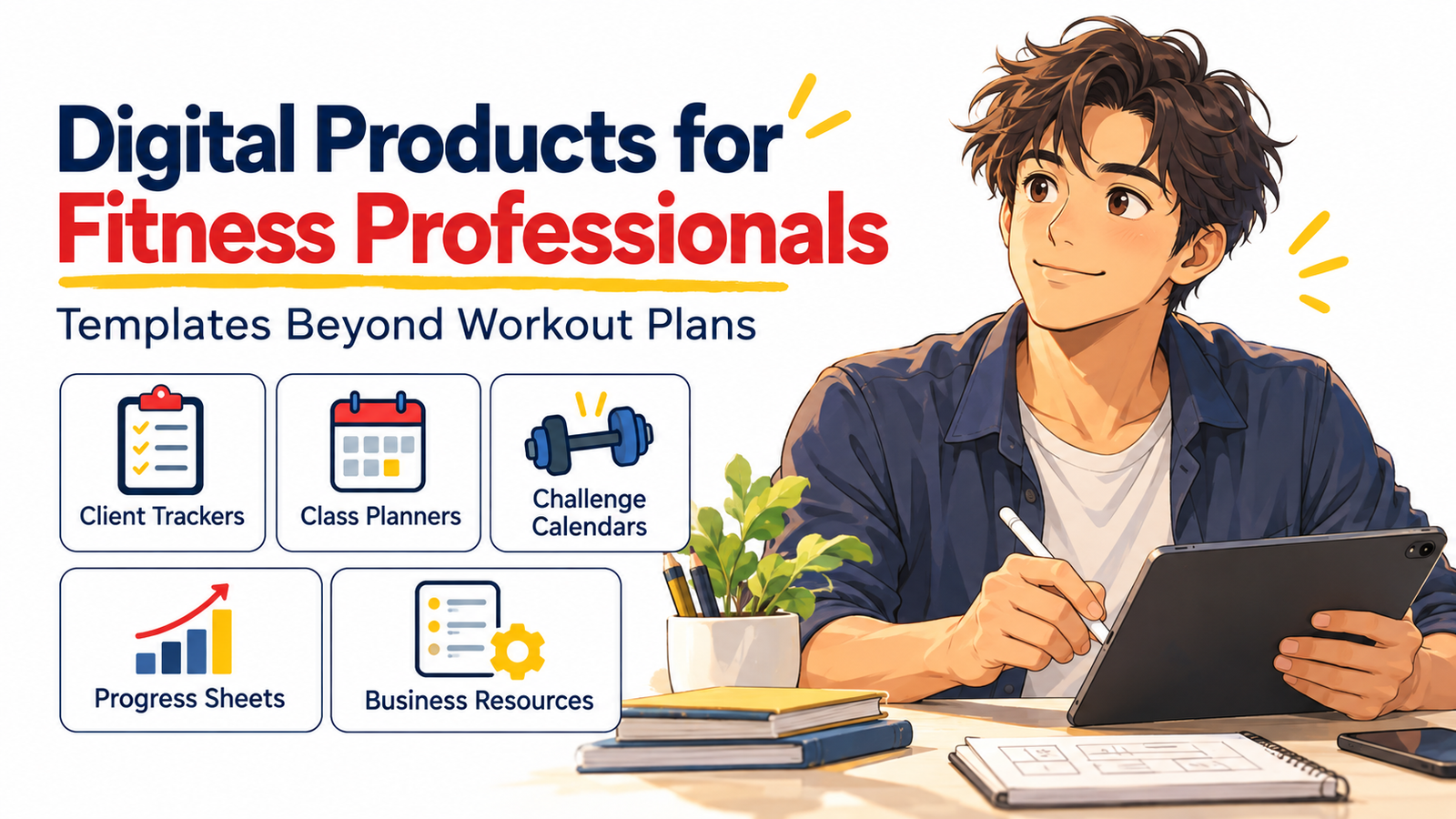
Templates Beyond Workout Plans
Fitness professionals have traditionally built their services around one central product: the workout plan.
But a successful fitness business needs much more than sets, repetitions, exercise demonstrations, and weekly training schedules.
Personal trainers, online coaches, fitness instructors, studio owners, wellness professionals, and strength coaches manage client information, monitor progress, organize classes, communicate goals, run challenges, schedule appointments, collect feedback, maintain business records, and keep clients engaged between sessions.
Every one of those activities creates an opportunity for a useful digital product.
That is why some of the most practical fitness digital products are not workout programs at all. They are systems that make coaching easier, improve organization, help clients understand their progress, and reduce repetitive administrative work.
From professionally designed personal trainer templates to editable client trackers, challenge calendars, progress dashboards, class-planning systems, assessment sheets, and complete fitness business templates, there is a large product category waiting beyond the traditional PDF workout guide.
For fitness professionals who want to diversify their digital product range, this is an especially relevant direction in 2026. Wearable technology remains the American College of Sports Medicine’s leading fitness trend for 2026, while mobile exercise applications and data-driven technology also remain prominent. These trends point toward a fitness environment in which clients increasingly expect progress information, accessible resources, personalization, and organized digital experiences.
Why Fitness Digital Products Are Moving Beyond Workout Plans
Workout plans solve an important problem: they tell someone what exercises to perform.
They do not solve every problem involved in coaching.
A client may still need to know what happened during the previous session, whether their consistency has improved, which habits they are working on, when their next assessment takes place, what equipment they need for an upcoming class, or how their measurements have changed over time.
The trainer has similar needs.
They may need to organize dozens of clients, record session notes, plan group classes, prepare onboarding materials, manage leads, schedule content, create challenges, track payments, and maintain repeatable operating systems.
This is where digital templates become valuable.
A well-designed template converts a repeated task into a repeatable process.
Instead of rebuilding the same progress sheet for every client, a trainer can use one carefully structured template. Instead of creating a new challenge calendar every month, they can customize a reusable system. Instead of keeping scattered notes in multiple applications, they can work from one organized client dashboard.
The product is not simply a document.
It is a tool that helps someone work more efficiently.
Client Trackers: One of the Most Useful Personal Trainer Templates
Client tracking is one of the strongest categories for fitness professionals because progress rarely comes from a single measurement.
Different coaching situations may involve attendance, repetitions, load, mobility, cardiovascular performance, sleep patterns, habits, perceived effort, recovery observations, body measurements, or goal completion.
A personal trainer client tracker template can organize the information that is appropriate to the trainer’s scope of practice and coaching model.
A simple tracker might include the client’s goal, baseline information, session dates, exercises completed, training observations, milestones, consistency record, and next review date.
A more advanced digital version could include monthly dashboards and progress summaries.
The important point is clarity.
Clients generally do not benefit from being surrounded by dozens of unexplained numbers. A professional template should make information easier to understand rather than merely collecting more of it.
The growing use of wearable and data-driven technology also creates opportunities for templates that help trainers discuss client-generated fitness information without pretending that every wearable metric is perfectly accurate. ACSM notes both the growing importance of wearable data and the need for professionals to interpret such information thoughtfully.
A useful product concept could therefore be a Wearable Data Review Sheet for Personal Trainers, with spaces for trends such as activity, training consistency, recovery observations, client-reported energy, and coaching notes.
The goal would not be medical interpretation. The goal would be better conversations between trainer and client.
Progress Sheets That Make Improvement Visible
One reason clients stop training is that progress can be difficult to notice.
A person may feel stronger before seeing a dramatic physical transformation. Their balance may improve. They may complete more sessions per month. They may recover better between exercises. They may become more comfortable using equipment.
A good progress sheet makes small improvements visible.
This can be turned into several valuable fitness digital products, including a strength progress tracker, monthly training review, personal-best record, consistency tracker, mobility check-in, goal milestone sheet, fitness habit tracker, and 12-week progress journal.
Progress sheets can work particularly well as companion products.
For example, someone purchasing a 12-week fitness challenge could receive a matching weekly progress sheet. A personal trainer selling an online coaching package could provide clients with a digital progress dashboard.
This creates a more complete product experience than handing the buyer a workout schedule and leaving them to interpret everything else themselves.
Fitness Challenge Calendars for Engagement and Accountability
Challenges remain useful because they provide a clear beginning, a defined time period, and an achievable structure.
But fitness professionals do not need to limit challenges to extreme exercise targets.
In fact, simple consistency-based challenges can be more flexible and approachable.
A trainer might create a 21-day movement challenge, 30-day mobility calendar, beginner strength consistency challenge, walking challenge, stretching calendar, core stability challenge, hydration-and-movement planner, active-aging movement calendar, or workplace wellness challenge.
The calendar itself can become the central digital product.
Each day could contain a simple action, progress checkbox, reflection prompt, or training reminder.
A commercial product bundle might combine the calendar with an introduction guide, progress tracker, completion certificate, daily check-in sheet, weekly review page, and coach instructions.
This is where fitness challenge templates become useful not only to individual consumers but also to personal trainers, gyms, corporate wellness providers, instructors, and online communities.
Class Planners for Group Fitness Instructors
Group instructors face a different organizational challenge.
They may teach multiple sessions every week while adjusting activities for class length, participant ability, available equipment, room capacity, and session goals.
A fitness class planner template can help structure that process.
The planner could provide dedicated areas for the class objective, warm-up, main activity, transitions, equipment, time allocation, coaching cues, modifications, cooldown, playlist notes, safety considerations, and post-class observations.
Templates could be developed specifically for strength classes, circuit training, mobility sessions, indoor cycling, low-impact classes, older-adult fitness, functional training, Pilates-inspired sessions, or other areas appropriate to the creator’s qualifications.
Fitness professionals can also create a complete instructor planning system containing monthly schedules, class attendance records, substitute instructor notes, equipment checklists, member feedback sheets, and session review pages.
That transforms one template into an expandable digital product collection.
Client Onboarding Kits
The first few days of a trainer-client relationship can involve a surprising amount of information.
New clients may need instructions about booking, cancellations, equipment, communication, progress reviews, training expectations, preparation, and general program procedures.
A digital onboarding kit can organize this experience.
A professional kit might include a welcome guide, goal-setting worksheet, training preferences questionnaire, appointment preparation checklist, communication guide, progress review schedule, FAQ page, and links to any forms that must be completed through the trainer’s approved business systems.
These personal trainer templates can save time while creating a more consistent client experience.
They can also be sold as editable business resources to other trainers.
A Canva-based Personal Trainer Welcome Pack, for example, could allow purchasers to customize branding, policies, colors, contact information, and coaching procedures.
The value comes from giving the buyer a professional starting point rather than forcing them to design every page from scratch.
Goal-Setting and Accountability Templates
People often begin fitness programs with broad goals:
“I want to get fit.”
“I want to become stronger.”
“I want to exercise consistently.”
“I want more energy.”
Those goals may be meaningful, but they are difficult to manage until they are translated into smaller actions.
Fitness professionals can create goal-setting templates that help clients clarify what they want to accomplish, why it matters, what actions support it, what obstacles might interfere, and how progress will be reviewed.
Related products can include weekly accountability sheets, habit planners, monthly review templates, consistency scorecards, milestone maps, training reflection journals, and coaching check-in forms.
A strong template should help users think rather than simply give them more boxes to complete.
For example, instead of only asking “Did you exercise today?”, a weekly review could ask what made training easier, what created difficulty, and what adjustment might make the coming week more realistic.
That makes the template useful for coaching conversations as well as self-reflection.
Active-Aging Fitness Templates
Fitness programs for older adults rank among the leading ACSM fitness trends for 2026, reflecting continued interest in strength, independence, balance, mobility, and appropriate activity for aging populations.
That creates opportunities for fitness professionals qualified to serve this market.
Potential digital resources include an active-aging movement calendar, balance practice log, strength consistency tracker, mobility journal, class attendance planner, exercise confidence worksheet, functional movement progress sheet, and simple weekly activity organizer.
Accessibility should influence the design.
Templates intended for older users can benefit from larger type, strong contrast, generous spacing, simple instructions, uncluttered pages, and straightforward navigation.
A beautiful template that is difficult to read is not a successful product.
Fitness Assessment and Review Templates
Assessments can become another digital-product category when they remain within the professional’s qualifications and scope.
A trainer might need structured forms for reviewing training goals, session consistency, exercise technique observations, fitness milestones, movement confidence, or program satisfaction.
Templates could include an initial coaching goal worksheet, four-week review form, 12-week training summary, client feedback survey, exercise preference form, or program completion review.
The important distinction is between fitness coaching documentation and medical evaluation.
Digital products should not encourage trainers or consumers to diagnose injuries, diseases, nutritional deficiencies, or medical conditions unless the person using them is appropriately qualified and the resource is designed for that professional context.
Good fitness templates support organization.
They should not create false authority.
Business Templates for Personal Trainers
Some of the most valuable products in the fitness niche may have very little to do with exercise programming.
Running a fitness business requires marketing, administration, lead management, customer communication, scheduling, financial organization, and content planning.
This opens a large market for fitness business templates.
A personal trainer business dashboard might help organize inquiries, consultations, active clients, follow-up dates, package information, renewals, and business goals.
A marketing template system might contain a monthly content calendar, promotional campaign planner, referral tracker, testimonial request workflow, social media idea bank, blog planner, and email campaign calendar.
An instructor could use a class profitability worksheet to compare attendance, room costs, instructor time, pricing, and other business inputs.
A gym could use a membership follow-up tracker.
An online coach could use a client renewal dashboard.
A new trainer might need a simple business launch checklist.
These products solve real operational problems, which often gives them stronger long-term usefulness than decorative printables.
Social Media Content Systems for Fitness Professionals
Many fitness professionals know what they want to teach but struggle to decide what to post every day.
That creates another digital product opportunity.
Instead of selling generic “100 Instagram posts,” create a structured fitness content planning system.
It might organize content into educational posts, exercise demonstrations, client questions, behind-the-scenes content, myth clarification, service information, community stories, FAQs, and promotional content.
A trainer could purchase the template once and reuse it monthly.
A more advanced version might include headline formulas, Reel planning pages, video shot lists, caption frameworks, content repurposing worksheets, and a monthly analytics review.
This type of fitness business template is particularly attractive because it connects fitness expertise with business growth.
Lead Management and Consultation Templates
A fitness business can lose potential customers simply because follow-up is inconsistent.
Someone sends an inquiry.
The trainer responds.
A consultation is discussed.
Then the conversation disappears beneath dozens of messages.
A simple lead-management template can help.
Useful fields might include inquiry date, prospective client’s stated goal, service of interest, consultation date, follow-up status, next action, and outcome.
The template can be created in Google Sheets, Excel, Notion, Airtable-style layouts, or printable PDF format depending on the intended buyer.
It can also become part of a larger Personal Trainer Business Toolkit containing a client tracker, lead dashboard, consultation planner, marketing calendar, session planner, and monthly business review.
Bundling connected resources can often create more practical value than selling unrelated templates together.
Monthly and Annual Fitness Business Planners
Fitness businesses experience cycles.
January may bring new-year demand.
Spring may increase interest in outdoor activity.
Summer schedules can change because of holidays.
September may bring routine-focused clients back.
December may involve renewals, gift packages, planning, and reduced availability.
A fitness business planner can help professionals organize these cycles.
The planner might include monthly goals, expected promotions, class launches, client review periods, content campaigns, professional development, financial targets, administrative tasks, and seasonal offers.
The purpose is not to predict revenue.
It is to encourage deliberate planning.
This can be especially valuable for solo trainers who do not have a separate operations or marketing team.
Digital Fitness Journals With a Specific Purpose
The fitness-journal market is crowded, so another generic workout notebook may struggle to stand out.
Specificity creates stronger positioning.
Instead of “Fitness Journal,” consider products such as a Beginner Gym Confidence Journal, Strength Progress Journal, 12-Week Training Consistency Journal, Mobility Practice Journal, Active Aging Movement Journal, Group Fitness Challenge Journal, or Return-to-Routine Fitness Planner.
Each product serves a more identifiable audience.
That makes the benefit easier to communicate on a product page.
Someone searching for a generic fitness journal has thousands of possibilities.
Someone searching for a structured journal to rebuild an exercise routine after a long break has a more specific problem.
Specific problems create clearer products.
Editable Templates Versus Ready-to-Use Printables
Fitness professionals can sell both.
A ready-to-use printable is designed primarily for the end user.
An editable template is often designed for another business owner.
These are different audiences.
For example, a printable 30-day walking calendar may be sold directly to consumers.
An editable 30-day fitness challenge template might be sold to trainers who want to add their own logo, instructions, exercises, and branding before sharing it with clients.
The second product can potentially carry higher perceived business value because it becomes part of the buyer’s own service system.
Sellers should make licensing terms extremely clear.
Tell buyers whether the template is for personal use, business use, client use, resale, commercial modification, or another defined license.
Never make the buyer guess.
What Makes a Fitness Template Worth Buying?
Design alone is not enough.
A professional fitness template should solve a recognizable problem.
It should be easy to understand within a few seconds. The sections should follow the way the task actually happens. Instructions should be short and useful. Pages should not contain unnecessary decorative elements that compete with the information.
Good templates also leave enough flexibility for different coaching styles.
A trainer should not have to delete half the document before it becomes useful.
Think about the user journey.
What information do they need first?
What will they enter repeatedly?
What should they review weekly?
What needs to be visible at a glance?
What information should remain private?
Those questions lead to better template design than starting with colors and fonts.
Privacy Matters When Creating Client Templates
Fitness professionals may handle personal information, so template design should include privacy thinking from the beginning.
Avoid encouraging buyers to collect information they do not need.
Be careful with sensitive medical or health information.
If a template will be used digitally, buyers should understand that the security of the platform where information is stored matters just as much as the design of the template itself.
Creators selling templates internationally should also avoid presenting a generic downloadable template as automatically compliant with every privacy law, health regulation, insurance requirement, or professional standard.
Compliance depends on jurisdiction, business practices, data collection, storage systems, professional role, and other factors.
Templates can support organization.
They do not replace professional legal, medical, regulatory, or data-protection advice.
Build Product Ecosystems Instead of Isolated Downloads
One of the strongest commercial strategies for fitness digital products is to create products that naturally connect with one another.
Imagine starting with a Client Progress Tracker.
That product could lead to a Weekly Check-In Template.
The weekly check-in could connect with a 12-Week Goal Planner.
The goal planner could become part of a Client Coaching Bundle.
The coaching bundle could eventually expand into a complete Personal Trainer Business System.
You are no longer creating dozens of unrelated PDFs.
You are building a product ecosystem.
This can improve the customer experience because someone who likes one resource can quickly understand which product they may need next.
It also creates natural opportunities for internal linking across your website.
An article about client retention can link to your check-in template.
An article about running fitness challenges can introduce your challenge calendar.
A guide to starting a personal training business can connect to your business dashboard.
Content and products begin supporting one another.
How to Position Fitness Digital Products for Search
Search optimization begins with understanding what the buyer is actually trying to accomplish.
Someone typing fitness digital products may be researching the overall category.
Someone searching personal trainer templates for clients probably has stronger product intent.
Someone searching fitness progress tracker PDF may want a ready-to-use download.
Someone searching editable fitness business templates for personal trainers may be looking for customizable professional resources.
Product titles and descriptions should reflect these differences naturally.
Use specific language where it helps the reader understand the product, but avoid repeating the same keyword unnaturally.
Google’s current guidance emphasizes helpful, original, people-first material rather than pages created around endless keyword variations. It also notes that its systems can understand relevant language even when every possible search phrase is not repeated word for word.
In practical terms, explain what the template does, who it is for, what format it uses, what is included, how it can be customized, and what problem it helps organize.
That is useful for humans and search systems at the same time.
Search-Friendly Fitness Product Opportunities for 2026
Current fitness trends provide useful clues about where template creators can develop relevant resources.
Wearable technology creates opportunities for data-review sheets and progress dashboards.
Active-aging programs create opportunities for accessible movement planners and class-management tools.
Weight-management programs create demand for professionally appropriate progress and coaching resources without making medical promises.
Mobile exercise apps reinforce demand for digital-first materials that work easily on phones and tablets.
Balance, mobility, core training, functional fitness, and data-informed coaching can all inspire more specialized templates.
The goal is not to create a product simply because a topic is trending.
The better approach is to identify where a trend creates an actual organizational problem that a template can solve.
Turn Expertise Into a Useful Digital Resource
The best personal trainer templates frequently begin with something the professional already does repeatedly.
Ask yourself what document you recreate every week.
What information do clients repeatedly ask for?
What process currently lives inside your head?
What spreadsheet do you wish someone had already built?
What part of onboarding takes too much time?
What information would make your classes easier to prepare?
Your answer may already contain the foundation of your next digital product.
Create the resource for usefulness first.
Then improve the design.
Then make it editable where appropriate.
Then test whether another trainer or client can understand it without your explanation.
A template that genuinely reduces work or creates clarity has a much stronger reason to exist than one created only because “digital products are popular.”
Frequently Asked Questions
1. What are the best digital products for fitness professionals besides workout plans?
Strong options include client progress trackers, onboarding kits, class planners, fitness challenge calendars, goal-setting worksheets, coaching check-in forms, habit trackers, business dashboards, lead-management systems, content calendars, session planners, and client review templates. The best choice depends on the specific problem your audience needs to solve.
2. Can personal trainers sell templates online?
Yes. Personal trainers can create and sell original templates such as client trackers, business planners, class-planning systems, coaching worksheets, and editable resources, provided they own the content and follow applicable professional, privacy, licensing, platform, and business requirements. Templates should also avoid presenting general fitness resources as medical diagnosis or treatment tools.
3. What format is best for fitness digital products?
The best format depends on how the product will be used. PDFs work well for printable resources. Canva can be useful for editable branded templates. Google Sheets and Excel are suitable for trackers and dashboards. Notion-style systems can work well for databases, business organization, and client workflows. Many products can also be offered in multiple formats.
4. How can I make fitness templates more valuable?
Solve a specific problem, keep the layout simple, include useful instructions, make repeated tasks faster, provide relevant examples, design for the intended audience, and bundle complementary resources when they genuinely belong together. Usability usually creates more value than adding more pages.
5. Are fitness business templates profitable digital products?
They can become commercially useful products when they solve real problems for a clearly defined buyer. A well-designed lead tracker, client-management system, class planner, onboarding kit, or marketing dashboard may save fitness professionals significant administrative time. Commercial results will vary based on quality, positioning, audience, pricing, competition, marketing, and licensing, so no particular income level can be guaranteed.
Build a Fitness Product Library Clients Actually Use
The opportunity in fitness digital products is much larger than workout PDFs.
Fitness professionals need systems for tracking, planning, communicating, reviewing, organizing, and running their businesses.
Clients need clearer ways to understand goals, record progress, build consistency, and stay engaged.
That creates room for useful personal trainer templates, editable coaching resources, progress trackers, challenge calendars, class planners, client-management tools, and complete fitness business templates.
Start with one repeated problem.
Build the simplest resource that solves it well.
Make it clear enough that someone can use it without constant explanation.
Then connect it to the next logical resource.
Over time, a single template can become a coordinated digital product library supporting clients, trainers, instructors, studios, and fitness businesses.
That is the real opportunity beyond workout plans: turning everyday fitness processes into practical digital tools people have a reason to keep using.
Stay ahead with exclusive updates
Join our community. Get curated industry trends, actionable guides, and fresh resources delivered straight to your inbox.