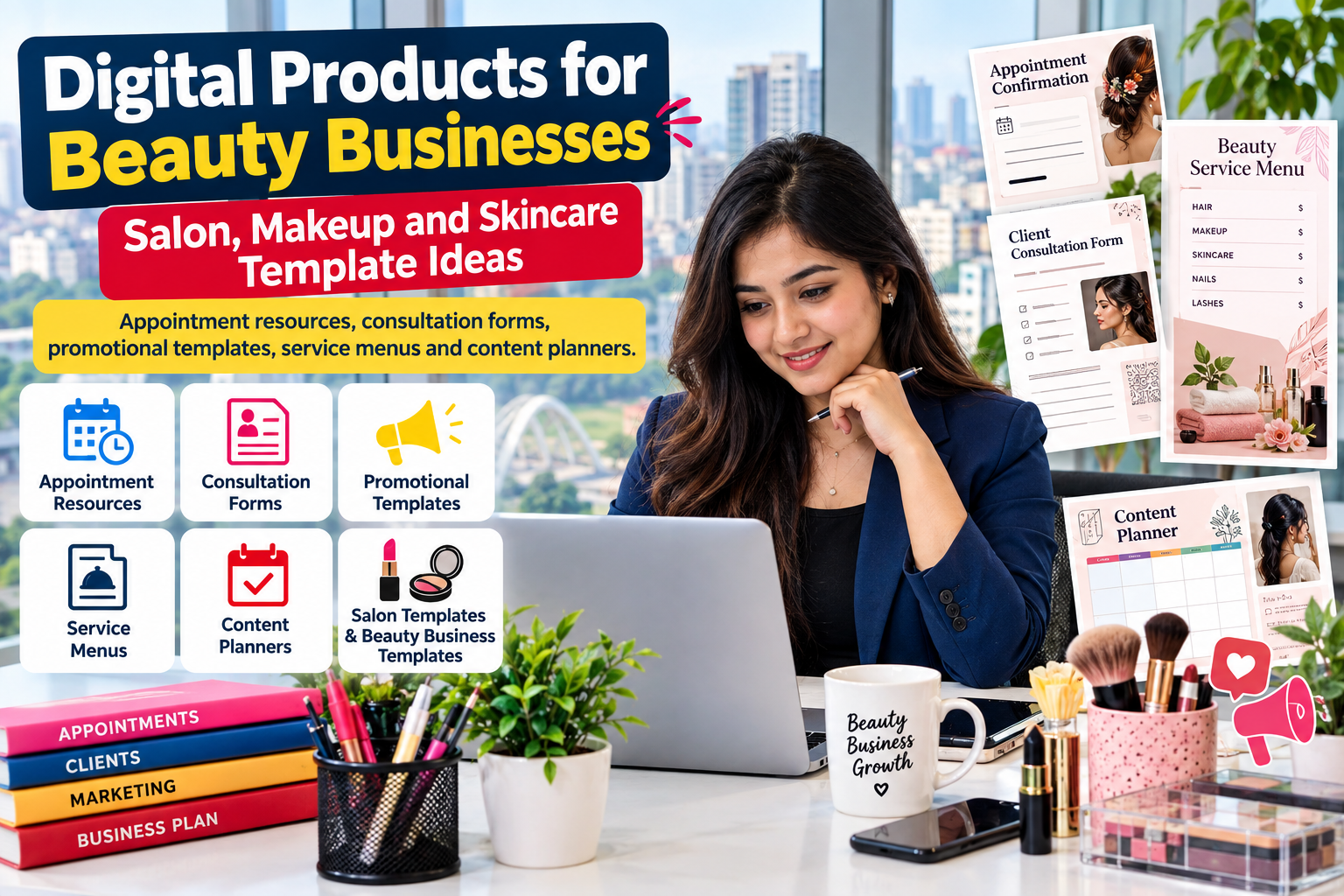
Salon, Makeup and Skincare Template Ideas
Digital Products for Beauty Businesses: Practical Templates for Salons, Makeup Artists and Skincare Professionals
Running a beauty business involves much more than delivering a great haircut, facial, makeup look or skincare treatment.
Behind every appointment is another layer of work: answering client questions, collecting consultation information, confirming bookings, explaining services, sharing aftercare instructions, posting on social media, announcing offers, tracking clients and keeping the brand visually consistent.
That creates a valuable opportunity for digital products.
Well-designed digital products for beauty businesses can turn repetitive administrative and marketing tasks into simple, reusable systems. A salon owner might need an editable service menu. A makeup artist may want a bridal consultation form. An esthetician could use a skincare intake questionnaire. A nail technician might need an appointment policy template, while an independent beauty professional may be looking for an entire content-planning system.
These products are useful because they are connected to real workflow problems rather than being decorative files with no clear purpose.
For designers, digital sellers, beauty educators and beauty-business owners, this opens the door to a wide range of practical beauty business templates that can be created, customized, bundled and reused.
What Are Digital Products for Beauty Businesses?
Digital products for beauty businesses are downloadable or online resources created to help beauty professionals organize operations, communicate with clients, promote services or manage their brands.
They may be supplied as editable Canva templates, PDFs, spreadsheets, digital forms, printable documents, presentation files, planners or compatible templates for other business tools.
A strong beauty-business digital product usually solves one specific problem.
Instead of simply creating a file called “Salon Planner,” for example, it is more useful to create a resource that helps a salon manage weekly appointment preparation, client follow-up and promotional planning.
That difference matters.
Beauty professionals generally do not need more files. They need resources that make their work easier.
Why Beauty Businesses Are a Strong Market for Digital Templates
Beauty businesses operate in a highly visual industry, but they also depend heavily on organization and communication.
Clients want clear information before booking. Businesses need accurate intake information. Service providers need easy ways to explain prices and policies. Marketing requires a continuous flow of content. Promotions have to be created quickly, and branding needs to remain recognizable across websites, social media, booking pages and printed materials.
Reusable templates can reduce the amount of time spent recreating the same information repeatedly.
A solo makeup artist may reuse the same bridal questionnaire for dozens of clients. A salon can update one editable price-list design whenever prices change. A skincare professional can maintain a structured client consultation process rather than relying on informal messages.
This makes salon templates and related resources especially suited to businesses where the same workflows occur again and again.
Appointment Resources for Salons and Beauty Professionals
Appointments are at the center of most service-based beauty businesses, which makes appointment-related resources an excellent starting point.
Salon Appointment Information Template
An appointment information sheet can explain what clients need to know before arriving.
It might cover arrival time, preparation requirements, payment methods, cancellation policies, rescheduling procedures and contact details.
A hair salon could customize the template for coloring appointments, while an esthetician might create separate preparation instructions for facials, peels or other services.
The value comes from reducing repetitive questions while giving clients a more consistent experience.
Appointment Confirmation Template
Beauty professionals often confirm bookings through email, text messages or direct messages.
An editable appointment confirmation template can include the service, date, time, location, preparation instructions and cancellation information.
Creating versions for email, WhatsApp, SMS and social messaging can make the product more useful.
Appointment Reminder Templates
Reminder designs can be created for different situations, such as upcoming appointments, appointment changes, deposit reminders or preparation reminders.
These can work especially well as part of a larger salon business template bundle rather than as isolated files.
Cancellation and Rescheduling Policy Template
Clear policies help businesses communicate expectations before problems arise.
A customizable cancellation-policy template can give beauty businesses a professional structure while allowing them to insert their own terms.
Template sellers should avoid presenting generic policy language as legal advice. Businesses should adapt policies to their operations and applicable local requirements.
Beauty Consultation Forms
Consultation resources are among the most practical digital products for beauty businesses because many services require professionals to gather information before beginning work.
General Beauty Client Consultation Form
A general consultation form can collect client contact information, service goals, relevant preferences and notes.
The design should prioritize clarity over decoration.
Beauty professionals often need to review forms quickly, so sections should be easy to scan on both phones and printed pages.
Skincare Consultation Form
A skincare consultation form can help skincare professionals collect information about a client’s routine, concerns, product use, sensitivities and treatment goals.
Because skincare can involve health-related information, templates should leave room for businesses to add the disclosures, consent language and professional requirements appropriate to their services and jurisdiction.
A template should support professional documentation rather than attempting to diagnose skin conditions or replace qualified medical advice.
Makeup Consultation Form
Makeup artists can use consultation templates for weddings, photoshoots, events and private appointments.
Useful sections might include preferred makeup style, event information, skin-preparation notes, desired finish, inspiration references, timing and additional services.
Bridal makeup professionals could create a more detailed version covering trials, wedding-day schedules and members of the bridal party.
Hair Consultation Form
Hair consultation templates can organize discussions around desired style, color goals, hair history, routine preferences and maintenance expectations.
For higher-value services such as transformations or color appointments, an organized consultation process can make communication much clearer.
Service Menu Templates
A service menu is one of the most visible pieces of communication in a beauty business.
Clients often want three answers quickly:
What services are available?
What do they include?
What do they cost?
A strong beauty service menu template should make those answers easy to find.
Salon Service Menu
Salon templates can include categories for cuts, styling, coloring, treatments and special services.
Businesses should be able to change names, descriptions, durations and prices without redesigning the entire document.
Makeup Artist Price Guide
Makeup professionals can use separate price guides for bridal makeup, party makeup, photoshoots, lessons or group bookings.
Adding short descriptions can help potential customers understand why different services are priced differently.
Skincare Treatment Menu
Estheticians, facial studios and skincare businesses can organize treatments by client goal, treatment style, session duration or service level.
Clear descriptions are more useful than complicated beauty terminology that new clients may not understand.
Nail Salon Menu Template
Nail businesses can organize services such as manicures, extensions, nail art and maintenance appointments into an easy-to-read format.
Mobile-friendly versions are particularly useful because many customers first encounter these menus through social media or messaging apps.
Client Welcome Guides
A client welcome guide can bring multiple pieces of information into one polished resource.
Instead of sending clients several disconnected messages, a beauty professional can provide one digital guide covering booking expectations, location information, service preparation, policies, payment methods and frequently asked questions.
For premium services such as bridal makeup, luxury hairstyling or specialized skincare packages, this type of resource can strengthen the overall customer experience.
A beauty template seller could create individual welcome guides for salons, makeup artists, nail technicians, lash technicians, brow artists and skincare professionals.
Pre-Appointment Preparation Guides
Preparation instructions can directly affect a client’s experience.
A salon might provide hair-color preparation guidance. A makeup artist may explain how clients should prepare their skin. A facial studio could provide pre-appointment instructions specific to a treatment.
The design should be concise enough to read quickly.
A preparation guide that becomes a five-page essay may be less useful than a clear one-page resource that highlights the essential information.
Beauty Aftercare Templates
Client communication does not need to stop when the appointment ends.
Aftercare cards and digital guides can help businesses provide consistent post-service information.
Examples include hair-color care guides, lash aftercare resources, brow-care instructions, nail-maintenance guides and general skincare follow-up resources.
For treatment-related aftercare, businesses should review the content carefully and ensure instructions are appropriate for their professional scope and services.
Promotional Templates for Beauty Businesses
Beauty businesses regularly run campaigns around new services, seasonal appointments, special occasions and business announcements.
Creating every promotional graphic from scratch consumes time.
Editable beauty marketing templates can make that process much faster.
New Service Announcement
A salon launching a new treatment could replace the service name, image, description and booking information inside an existing branded template.
Appointment Availability Templates
“Appointments Available” graphics are simple but frequently useful.
Create variations for last-minute availability, weekend appointments, holiday schedules and newly opened booking slots.
Seasonal Promotion Templates
Beauty demand can change around weddings, holidays, graduations, festivals, vacations and other seasonal occasions.
Instead of creating a generic “sale template,” design campaigns around realistic customer moments.
Examples might include bridal season, holiday glamour appointments, summer hair preparation, festive nail inspiration or winter skincare consultations.
Gift Card Promotion Templates
Gift cards provide another useful theme for salon and beauty templates.
Businesses may need promotional posts, gift certificate designs, email graphics and printable counter signs.
A coordinated mini-kit gives the buyer more value than a single social graphic.
Social Media Templates for Beauty Businesses
Beauty is naturally suited to visual platforms.
Transformation photos, tutorials, educational content, service demonstrations and behind-the-scenes material can all help prospective customers understand a business.
Recent salon-marketing guidance from Mindbody also highlights short-form platforms such as TikTok for demonstrating treatments, transformations and professional expertise.
However, constantly designing new posts can become another full-time job.
A reusable social media template system can include formats for transformations, service education, product information, client testimonials, appointment availability, FAQs and business announcements.
The goal should not be to make every post look identical.
A good system creates consistency while still leaving room for photography, personality and real client stories.
Beauty Content Planner
One of the most valuable digital products may not be a graphic at all.
A beauty content planner helps businesses decide what to publish and when.
Instead of staring at an empty social-media calendar, a salon owner could rotate between educational posts, transformations, service explanations, team introductions, customer questions, behind-the-scenes content and booking reminders.
A useful planner could provide space for content topic, target customer, platform, visual idea, call to action, publication date and performance notes.
It becomes even more valuable when combined with a content-idea library.
Monthly Beauty Marketing Calendar
A marketing calendar goes beyond individual social posts.
It can help beauty businesses plan launches, promotions, seasonal campaigns, email messages and booking pushes throughout the month.
Templates can include areas for promotional themes, campaign dates, important local events, content deadlines and service priorities.
For digital-product sellers, this is an opportunity to create evergreen calendars that do not become obsolete after one year.
Client Follow-Up Templates
Following up can help a beauty business maintain relationships without requiring every message to be written from the beginning.
Templates might cover post-appointment check-ins, rebooking reminders, service feedback requests and general thank-you messages.
The wording should feel natural rather than automated.
Customers are more likely to appreciate a brief, relevant follow-up than a message that reads like an aggressive sales script.
Beauty Business Email Templates
Email remains useful for businesses that want direct communication with clients.
A beauty email-template collection could cover new-service announcements, booking reminders, seasonal updates, educational newsletters, re-engagement messages and appointment availability.
The most effective templates leave enough flexibility for the business’s own voice.
Beauty professionals should sound like themselves rather than like every other salon using the same digital template.
Testimonial and Review Request Templates
Reviews can influence how prospective clients evaluate local beauty businesses.
A professional follow-up template can politely invite satisfied customers to share their experience.
The request should remain transparent and voluntary.
Avoid building products around misleading reviews or undisclosed incentives. Google updated its review-related guidance in 2026 with additional emphasis on transparency around fake and undisclosed incentivized reviews.
Beauty Business Forms and Administrative Templates
Not every profitable digital product has to be visually exciting.
Administrative resources can be extremely valuable because they address recurring operational tasks.
Potential products include client records, inventory sheets, appointment trackers, expense logs, retail-product trackers, staff checklists, daily opening procedures and weekly business review sheets.
A simple spreadsheet that saves a salon owner time every week can sometimes provide more practical value than a beautiful but rarely used social graphic.
Beauty Business Branding Templates
New beauty businesses frequently need multiple branded materials at once.
This creates an opportunity for coordinated template collections.
A visual branding pack could bring together a service menu, appointment card, social-media templates, promotional graphics, welcome guide and basic presentation materials.
Keeping the layouts visually connected allows the buyer to establish a recognizable look faster.
Template creators should still encourage users to customize the resources instead of leaving every customer with an identical brand identity.
Bundle Templates Around a Specific Beauty Customer
One of the strongest approaches to creating beauty digital products is specialization.
A broad package called “Beauty Business Templates” may be useful, but a focused product such as a “Bridal Makeup Artist Client Experience Kit” immediately tells buyers who it is designed for.
The same principle can be applied to salon owners, freelance hairstylists, estheticians, nail technicians, lash artists, brow professionals, mobile beauty businesses and independent makeup artists.
A product built around a defined workflow is easier for a potential buyer to understand.
Think in Systems Instead of Individual Files
The biggest opportunity in beauty business templates is often not one template.
It is the complete journey surrounding a particular service.
Consider a bridal makeup client.
The business may need an inquiry response, consultation questionnaire, price guide, trial information sheet, appointment confirmation, wedding-day schedule and follow-up message.
Those resources naturally belong together.
The same strategy can be used for a salon color appointment or skincare consultation.
When related templates work together, the product becomes a small operating system rather than a random folder of designs.
Make Beauty Templates Easy to Customize
Beauty professionals have very different branding styles.
One salon may use minimal black-and-white branding. Another may prefer soft neutrals. A makeup artist might choose luxury typography, while a skincare studio may use a clean clinical aesthetic.
Digital templates should therefore make customization easy.
Fonts, photographs, colors, logos, service information and contact details should be simple to replace.
Design complexity should never make a business resource difficult to use.
Design for Mobile Users
Many beauty professionals manage their businesses from their phones.
Their customers also browse services, open links, check prices and book appointments on mobile devices.
Templates should therefore remain readable at smaller sizes.
Service descriptions should not require zooming. Forms should have adequate spacing. Social graphics should avoid tiny text. Download pages should clearly explain file formats and editing requirements.
Google’s current page-experience guidance also recommends ensuring content works well on mobile devices and avoiding intrusive experiences that interfere with the main content.
How to Create Beauty Digital Products People Actually Use
Start with the workflow rather than the design.
Ask what the beauty professional is trying to accomplish.
If the goal is onboarding a new skincare client, map the process from initial inquiry through consultation, appointment preparation, treatment and follow-up.
Then identify where reusable documents could reduce work.
This approach produces stronger products because each template has a clear purpose.
Visual design can then make the system easier and more enjoyable to use.
How to Sell Salon Templates and Beauty Business Templates
A product page should demonstrate what the template actually helps the buyer accomplish.
Instead of relying on a title such as “50 Beautiful Salon Templates,” explain the practical use.
A stronger description might tell buyers that the package helps them organize client consultations, present services clearly, communicate appointment policies and plan promotional content.
Show realistic previews.
Explain what software is required.
State whether files are editable.
List page sizes or formats.
Clarify whether fonts, photography or premium design elements are included.
Explain licensing conditions in plain language.
Reducing uncertainty can be more persuasive than adding exaggerated sales claims.
Build Different Product Levels
A digital-product shop can serve customers with different needs.
An entry-level product might be one editable consultation form.
A larger package might combine client forms, service menus and appointment resources.
A premium business system could add marketing templates, content planners, workflow resources and multiple brand styles.
This creates a natural product range without forcing every buyer into one oversized bundle.
Use Content Marketing to Attract Beauty Business Buyers
Educational content can help potential customers discover the products before they are ready to purchase.
A seller offering salon templates could publish articles about organizing salon consultations, improving service menus, preparing new clients or planning salon content.
A seller targeting makeup artists could cover bridal-client workflows, portfolio planning or consultation organization.
These articles can naturally connect readers to appropriate templates.
This creates a healthier SEO strategy than repeatedly publishing product pages targeting slightly different versions of the same keyword.
Google’s current guidance emphasizes content created primarily to help an intended audience rather than content produced mainly to manipulate search rankings. It also encourages original experience, accuracy, depth and a satisfying reader experience.
SEO and AEO Strategy for Beauty Digital Products
Search optimization should begin with real customer questions.
Someone searching for “salon templates” may be exploring many possibilities.
A search for “editable salon consultation form template,” however, reveals a more specific need.
Build content around both broad topics and these detailed problems.
Use clear headings that answer questions directly. Define unfamiliar concepts early. Include concise explanations before deeper sections. Connect related articles and products through meaningful internal links.
For AI-assisted and answer-oriented discovery, clearly state what a product is, who it is for, what it contains, how it is used and any important limitations.
Machine-readable information is useful, but clarity for humans comes first.
Creating Content With Google Discover in Mind
No publisher can guarantee that an article will rank or appear in Google Discover.
Google states that indexed content meeting Discover policies is automatically eligible and that no special tag or structured data is required for eligibility. Google recommends accurate headlines, helpful and timely content, original insights, strong page experience and compelling relevant imagery instead of clickbait or sensational tactics.
Images deserve particular attention.
Google’s current Discover guidance recommends relevant high-quality images that are at least 1200 pixels wide, more than 300,000 total pixels, suitable for landscape presentation, and enabled for large previews through max-image-preview:large or AMP. Google also advises against making the preferred Discover image overly text-heavy.
In its February 2026 Discover core update, Google said its systems were moving toward more locally relevant content while reducing sensational material and surfacing more original, timely and in-depth content from sources demonstrating expertise in the subject.
For this beauty-business topic, that means a useful Discover strategy is not simply putting “2026” into the headline.
A stronger approach is to add genuine current value: original template examples, emerging client-workflow ideas, real screenshots, visual before-and-after organization examples, seasonal salon marketing insights or updated beauty-business practices.
Use Article Structured Data Correctly
Publishers can also use Article or BlogPosting structured data to help Google understand information such as the article headline, images, publishing dates and author.
Google currently recommends providing representative, high-resolution article images and, for best results, multiple image versions suitable for 16:9, 4:3 and 1:1 presentation.
In March 2026, Google also clarified that both schema.org metadata and the og:image meta tag can help it determine preferred thumbnails for Search and Discover.
Structured data can improve Google’s understanding of a page, but it does not guarantee visibility or a particular Search or Discover treatment.
Keep Your Featured Image Useful, Not Clickbait
For an article about beauty-business templates, the featured image should clearly reflect the subject.
For example, it could show a beauty professional working with a digital dashboard surrounded by recognizable visual references to appointments, consultation forms, service menus and marketing planning.
Keep the composition clean enough to remain understandable when shown as a small Discover preview.
Avoid shocking claims, misleading imagery or exaggerated text such as “MAKE $10,000 TODAY.”
Google specifically advises publishers to avoid clickbait, misleading previews and sensational tactics when creating content intended for Discover.
Refresh the Article When the Information Actually Changes
Beauty-business tools, marketing channels and customer behavior evolve.
Updating a useful article when you have new information can make sense.
Changing the date simply to make old content appear fresh does not.
Google’s people-first guidance specifically cautions against changing publication dates when content has not been substantially updated.
Add meaningful improvements instead: new template examples, updated screenshots, new workflow recommendations or genuinely relevant industry developments.
A Better Digital Product Starts With a Better Business Problem
The strongest digital products for beauty businesses are not created by asking, “What template can I design today?”
They are created by asking, “What task does a beauty professional repeat every week that I could make easier?”
That question can lead to appointment resources that reduce confusion, consultation forms that organize information, service menus that improve clarity, promotional templates that accelerate marketing and content planners that make consistent communication easier.
For beauty professionals, these resources can turn scattered administrative tasks into repeatable systems.
For digital-product creators, they offer a broad niche with opportunities to specialize by profession, service and workflow.
Start with one problem.
Build a useful template around it.
Then look at what happens immediately before and after that task.
That is often where the next product idea is waiting.
Ready to Build a Beauty Business Template Collection?
Choose one clearly defined customer—such as a salon owner, bridal makeup artist or skincare professional—and map one complete client journey.
Create the resources that simplify that journey before expanding into larger bundles.
Useful products earn attention by making work easier, not simply by increasing the number of files inside a download.
Frequently Asked Questions
1. What are the best digital products for beauty businesses?
Some of the most practical options include appointment resources, client consultation forms, service menus, welcome guides, aftercare resources, promotional templates, content planners, client follow-up templates and administrative trackers. The strongest choice depends on the workflow and type of beauty professional being served.
2. What salon templates can I create and sell?
You can create salon consultation forms, service menus, appointment-information sheets, booking-policy templates, client welcome guides, promotional graphics, social-media templates, marketing calendars and business trackers. More specialized products can be created for hair salons, nail salons, lash studios and other beauty services.
3. Are Canva beauty business templates useful?
Editable Canva templates can be useful because many small beauty-business owners want to change colors, photographs, fonts, pricing and contact details themselves. Templates should remain easy to edit and should clearly state whether any premium Canva assets or third-party resources are required.
4. How can a skincare professional use digital templates?
Skincare professionals can use templates to organize client consultations, treatment information, appointment preparation, aftercare communication, service menus, educational content and marketing plans. Any template dealing with health-related information should be reviewed and adapted to the professional’s qualifications, services and applicable requirements.
5. How can I make salon templates easier to find on Google?
Create useful pages that clearly answer the buyer’s search intent, use descriptive titles and headings, demonstrate the actual product, write original supporting content, improve mobile usability and connect related resources through internal links. For Discover, use relevant high-quality imagery and avoid misleading or sensational headlines. Google does not guarantee Search or Discover placement, so focus on useful content and a strong customer experience rather than trying to manufacture rankings.
Stay ahead with exclusive updates
Join our community. Get curated industry trends, actionable guides, and fresh resources delivered straight to your inbox.