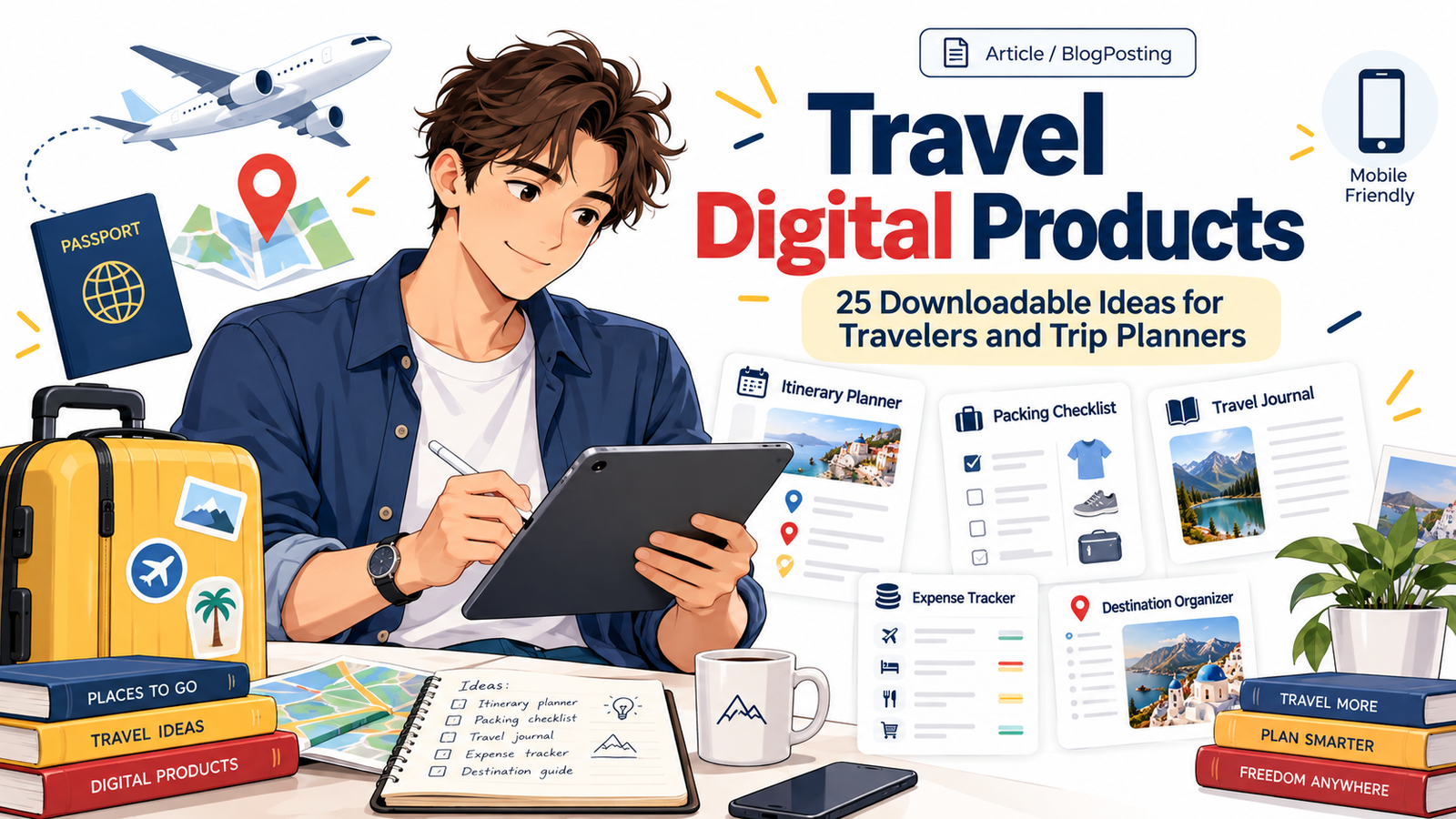
25 Downloadable Ideas for Travellers and Trip Planners
Travel planning can be exciting, but it can also become surprisingly complicated. Flights, hotel confirmations, packing lists, reservations, budgets, transportation details, attraction tickets, restaurant ideas and daily schedules can quickly end up scattered across emails, screenshots, notes and browser tabs.
That creates a useful opportunity for digital product creators.
Well-designed travel digital products help travelers organize information before a trip, stay on schedule while traveling and preserve memories afterward. Instead of selling another decorative printable, creators can build practical tools that solve specific travel problems.
The opportunity is especially relevant in 2026 as travelers increasingly look for trips tailored to their individual interests. Booking.com’s 2026 travel research, based on more than 29,000 travelers across 33 countries and territories, points toward increasingly personalized travel experiences, while Expedia research indicates demand for managing multiple parts of a trip together.
That means a printable travel planner, editable itinerary, packing organizer or digital travel journal can be positioned around something buyers genuinely need: making a trip easier to plan and easier to enjoy.
This guide explores 25 downloadable travel product ideas, from travel planner templates and itinerary systems to budget trackers, journals and destination organizers.
Why Travel Digital Products Have Strong Product Potential
Travel products work particularly well as digital downloads because the customer usually has a clear goal and a deadline.
Someone preparing for a vacation may already be searching for phrases such as “travel planner template,” “printable vacation planner,” “travel itinerary PDF,” “packing checklist printable,” “trip budget planner,” or “digital travel journal.”
That is valuable commercial intent.
The customer is not simply looking for inspiration. They often want something they can use immediately.
Digital travel products can also be adapted into several formats. A single planning system might become a printable PDF, editable Canva template, tablet planner, Goodnotes file, Google Sheets budget tracker or Notion travel dashboard.
The strongest products focus on one clear traveler problem before adding decorative elements.
A beautiful planner may attract attention.
A planner that helps someone remember documents, control spending, organize reservations and avoid missing an important booking is much more likely to become part of the trip.
Travel Planning in 2026 Is Becoming More Personal
Personalization is one of the most useful themes for creators to understand.
Recent travel research from Booking.com and Skyscanner describes travelers building increasingly individual trips around their interests, lifestyles and priorities.
At the same time, AI is becoming part of travel discovery and planning. Expedia reported in 2026 that travelers are increasingly comfortable using AI tools for inspiration and planning, although trust remains important when they move toward bookings and transactions.
For digital product sellers, this suggests an important direction.
Do not create only generic “vacation planners.”
Create organizers for identifiable situations.
A family road-trip planner.
A first international trip organizer.
A solo female travel planner.
A honeymoon organizer.
A digital-nomad travel dashboard.
A cruise planner.
A theme-park vacation organizer.
A backpacking budget workbook.
The more clearly the customer recognizes their situation, the easier it becomes to understand why the product exists.
25 Travel Digital Products You Can Create and Sell
1. Complete Travel Itinerary Planner
A complete itinerary planner can become the foundation of an entire travel product collection.
Design it so travelers can organize dates, destinations, flights, accommodation, transportation, activities, restaurants and important notes in one place.
Useful sections might include daily schedules, booking references, check-in times, addresses and emergency information.
Offer both printable and digital versions so customers can choose how they prefer to plan.
A strong search-focused product title could naturally include terms such as travel itinerary planner, vacation itinerary template and printable trip planner.
2. Daily Vacation Schedule Template
Some travelers do not need a complete travel binder. They simply want an easy way to plan each day.
A daily travel schedule can include morning, afternoon and evening sections alongside reservation times, transportation details, meal plans and notes.
You could create minimalist, family, luxury and adventure versions.
This also works well as an inexpensive entry-level product that introduces customers to larger planner bundles.
3. Printable Packing Checklist
Packing lists are among the simplest travel products to understand and use.
However, avoid creating one enormous generic checklist.
Create categories such as clothing, toiletries, electronics, medication reminders, documents, children’s items and destination-specific essentials.
Consider separate variations for beach trips, winter trips, cruises, camping holidays, international travel and weekend getaways.
Customers should also have blank spaces to add their own items.
4. Smart Packing System
Take the standard packing checklist further by turning it into a complete packing workflow.
Include sections for what to pack, what to purchase, what goes in carry-on luggage, what goes in checked luggage and what must be prepared immediately before leaving home.
You could add outfit planning pages and a “do not forget” section.
This turns a simple checklist into a more valuable travel organization system.
5. Travel Budget Planner
Travelers frequently underestimate the number of spending categories involved in a trip.
A travel budget planner can organize transportation, accommodation, meals, entertainment, shopping, insurance, visas, local transportation and emergency funds.
Add planned cost, actual cost and remaining budget columns.
Consider offering both a printable version and spreadsheet version with automatic calculations.
6. Travel Expense Tracker
A budget planner helps before the trip.
An expense tracker helps during it.
Create a simple system where travelers can record the date, expense category, description, payment method, currency and amount.
A spreadsheet version could automatically total spending by category.
This can be particularly useful for long trips, business travel, group travel and digital nomads.
7. Vacation Savings Tracker
Many people begin planning months before they travel.
A vacation savings tracker gives them a visual way to monitor progress toward a travel fund.
Include the trip target, savings goal, amount saved, amount remaining and milestone sections.
You can bundle it with a travel budget planner to create a “Save + Plan + Travel” package.
8. Travel Journal
Travel journals combine practical organization with memory keeping.
Pages might include daily highlights, places visited, meals tried, memorable conversations, favorite moments and lessons from the trip.
Leave generous space for photographs, tickets or sketches.
Digital journal versions can include clickable navigation for tablet users.
9. Travel Memory Book
A memory book focuses more heavily on preserving the story of the trip.
Instead of scheduling pages, include prompts such as favorite destination, funniest moment, unexpected discovery, best meal, favorite photo and something you would do differently next time.
Couples and families can complete pages together.
This makes the product valuable after the vacation has ended.
10. Destination Research Planner
Research is one of the most time-consuming parts of travel planning.
A destination organizer can help users collect information about neighborhoods, transportation, attractions, restaurants, opening hours, local customs, weather, safety information and useful phrases.
Avoid filling the template with destination facts that may become outdated.
Give customers a structured place to record their own research.
11. International Travel Planner
International trips usually involve more preparation than domestic travel.
Build a planner specifically around passport checks, visa requirements, travel insurance, currency, international roaming, transportation, entry requirements, emergency contacts and important documents.
Include reminders encouraging travelers to verify current requirements through appropriate official sources.
This keeps the product useful without presenting potentially outdated regulations as permanent facts.
12. First-Time Traveler Organizer
First-time international travelers may not know what they need to organize.
Create an easy, step-by-step planner covering documents, bookings, packing, airport preparation, money, communication and arrival-day planning.
Use simple language rather than assuming travel experience.
The value of this product comes from reducing uncertainty.
13. Road Trip Planner
Road trips create a completely different planning challenge.
Include daily driving distances, departure times, fuel stops, accommodation, meal stops, attractions, parking notes and vehicle preparation.
Add pages for emergency supplies and roadside information.
A map-style planning worksheet can help users organize major stops without requiring complicated software.
14. Family Vacation Planner
Family travel involves multiple schedules, preferences and packing requirements.
Create sections for each family member, children’s activities, medication reminders, meal planning, entertainment, accommodation and important contact information.
Parents may especially appreciate individual packing checklists for children.
A family travel organizer can also include a shared vacation budget.
15. Kids Travel Activity Pack
Parents often need ways to keep children occupied during long journeys.
Create downloadable travel games, scavenger hunts, drawing pages, travel bingo, observation challenges and simple journaling prompts.
Offer different age ranges instead of trying to make one activity pack suitable for everyone.
A destination-themed series could create repeat purchases.
16. Solo Travel Planner
Solo travelers have different planning needs.
Build sections around personal itinerary organization, emergency contacts, accommodation details, transportation, daily expenses and backup plans.
A reflection journal can also make the planner feel more personal.
Avoid presenting safety guarantees. Instead, provide organization tools that help travelers record and access important information.
17. Couples Travel Planner
Travel planning often requires two people to coordinate preferences.
Create pages where partners can record destination ideas, activity preferences, budgets, restaurant choices and shared priorities.
Add a “must do,” “would like” and “optional” planning system.
A couples edition can work for ordinary vacations, anniversaries or romantic getaways.
18. Honeymoon Planner
Honeymoon customers may be willing to purchase a dedicated planning product rather than using a generic vacation template.
Include wedding-to-honeymoon timelines, accommodation bookings, flight information, romantic activities, restaurant reservations, packing and travel documents.
Add memory pages so the planner becomes part organizer and part keepsake.
This product can also be cross-sold alongside wedding planners.
19. Cruise Vacation Planner
Cruise travelers manage a unique collection of details.
A cruise planner might cover embarkation, cabin information, excursions, dining reservations, port days, sea days, packing and onboard spending.
Provide a separate section for each port.
You can create versions for couples, families or first-time cruise travelers.
20. Camping Trip Planner
Camping requires equipment planning as well as itinerary planning.
Organize the template around shelter, cooking equipment, food, clothing, lighting, sleeping gear, weather preparation and campsite information.
Include a meal planning section and campsite setup checklist.
This can be adapted into versions for tent camping, RV travel or family camping.
21. Digital Nomad Travel Dashboard
Long-term travelers and remote workers need more than a vacation planner.
Create a digital dashboard for destinations, accommodation, travel days, work schedules, expenses, internet information, coworking spaces, subscriptions and important documents.
Notion or spreadsheet formats can work particularly well here.
A digital nomad product can also include monthly cost-of-living tracking.
22. Group Trip Planner
Group travel becomes difficult when information is spread across messages and multiple people are making decisions.
Create a central organizer containing participants, responsibilities, bookings, shared costs, transportation, room assignments and activity voting.
Include a shared-expense tracker.
This idea works well for friend trips, reunions, bachelor or bachelorette trips and extended family vacations.
23. Travel Bucket List Planner
Not every travel product needs to focus on an immediate vacation.
A travel bucket list planner helps customers collect future destination ideas.
Include destination, reason for visiting, ideal season, estimated budget, activities, priority and research notes.
Users can gradually turn dream destinations into realistic travel goals.
This gives the product longer-term usefulness.
24. Weekend Getaway Planner
Short trips often require fast planning rather than large travel binders.
Design a compact one-page or four-page planner containing transportation, hotel, packing, itinerary, meals and budget.
This can appeal to buyers who find large vacation planners overwhelming.
A lightweight product also works well as a low-cost download or email lead magnet.
25. All-in-One Travel Planner Bundle
Once you have developed several individual travel templates, combine related pages into a premium bundle.
A comprehensive bundle might contain itinerary planning, destination research, packing, budgeting, expense tracking, reservation organization, travel journaling and memory keeping.
Do not simply combine unrelated files.
Build a logical planning sequence so the customer knows what to use before, during and after the trip.
A clearly structured bundle can become the flagship product in a travel digital product shop.
What Makes a Travel Planner Worth Buying?
The difference between a useful travel planner and a collection of decorative pages usually comes down to usability.
Travelers are buying organization.
Every page should therefore answer a practical question.
What do I need to book?
What do I need to pack?
How much am I spending?
Where am I staying?
What happens tomorrow?
Where did I save that reservation?
When a template answers these questions quickly, it becomes valuable.
Keep layouts easy to scan. Use enough writing space. Avoid filling every area with illustrations. Test printable pages in black and white as well as color. Check whether tablet versions are comfortable to write on.
The customer should spend more time planning the trip than figuring out how the planner works.
Printable Travel Planner or Digital Travel Planner?
There is room for both.
A printable travel planner works well for customers who enjoy handwriting, travel binders and physical checklists.
A digital planner works well for tablet users who prefer reusable pages, hyperlinks and digital handwriting.
Editable Canva templates can be attractive to customers who want personalization.
Google Sheets or Excel work well for budgets and expenses.
Notion works well for interconnected trip databases and dashboards.
Instead of deciding that one format is universally better, think about the job the customer wants the product to perform.
Packing checklist: printable PDF.
Expense calculator: spreadsheet.
Interactive itinerary: tablet planner or Notion template.
Travel memory journal: printable or digital notebook.
Premium bundle: multiple formats.
Offering several practical formats can also increase the perceived usefulness of the product.
Design Travel Products Around Real Search Intent
SEO begins before you write the product listing.
Someone searching for “travel planner” is expressing a broad need.
Someone searching for “printable international travel planner PDF” is expressing a much clearer one.
Create product pages around the actual problem rather than repeating keywords.
For example, a page selling a family travel planner can naturally discuss family packing, children’s checklists, vacation schedules, family budgeting and reservation organization.
Those related concepts help explain the product to both readers and search systems.
Useful keyword themes include travel digital products, travel planner templates, printable travel planner, vacation planner printable, trip itinerary template, travel itinerary planner, packing list printable, travel budget planner, travel expense tracker, digital travel journal, vacation organizer, trip planner PDF, travel checklist template, itinerary planner printable and travel planning downloads.
Use these only where they genuinely fit.
Google’s current guidance continues to emphasize useful, original, people-first content rather than pages written mainly to attract search traffic.
Make Your Product Easy to Understand Before Purchase
A buyer should know exactly what they are receiving.
Show several preview pages.
Explain the file type.
State whether the product is printable, editable or hyperlinked.
Mention compatible software when relevant.
Show page dimensions.
Explain whether buyers can reuse the planner for multiple trips.
If fonts or third-party apps are required, make that clear before purchase.
For printable products, showing a photograph or realistic mockup of printed pages can help customers visualize the experience.
For tablet planners, show the navigation system and a few completed-page examples.
Clarity builds confidence.
Create Products for Specific Travel Moments
One way to expand a travel digital product store is to organize products around stages of the customer journey.
Before travel, customers need research planners, savings trackers, itineraries and packing systems.
During travel, they need schedules, reservation organizers, expense trackers and quick-reference information.
After travel, they may want journals, photo books, memory prompts and trip review pages.
This approach can help you develop related products rather than random downloads.
It also creates natural opportunities for product bundles and internal links between your store pages.
Build Product Collections Around Traveler Types
Another useful strategy is specialization.
Instead of competing only for broad searches such as travel planner templates, build collections around specific audiences.
A family travel collection could contain a family itinerary, children’s packing lists and travel activities.
A road-trip collection could contain route planning, vehicle checks, fuel tracking and stop planning.
A honeymoon collection could combine itinerary organization with memory journaling.
A digital nomad collection could include accommodation tracking, work schedules and monthly travel expenses.
Specialization makes it easier to explain who the product is for.
Use Trends as Product Inspiration, Not as a Shortcut
Travel interests change.
In 2026, major industry reports are highlighting highly personalized travel, experience-driven trips, family travel and journeys built around personal interests. Skyscanner’s U.S. research, for example, reported family and multigenerational travel among the travel patterns its respondents were planning for 2026.
That can inspire new planner categories.
However, do not build a product simply because a topic appears temporarily popular.
Ask whether the traveler actually needs a planning tool for the trend.
A specialized planner becomes valuable when it simplifies a real task.
How to Give Travel Digital Products More Commercial Value
The easiest way to increase value is not necessarily to add more pages.
Add better organization.
A 150-page planner full of nearly identical worksheets can feel overwhelming.
A 30-page system that moves logically from destination research to booking, budgeting, packing, itinerary planning and memory keeping may be far more useful.
You can also create several product levels.
A starter product might solve one problem.
A complete planner might solve the full trip-planning process.
A premium bundle could add multiple formats, additional traveler types or destination-specific modules.
The buyer should always understand why the larger package costs more.
Travel Digital Products and AI-Assisted Trip Planning
AI tools are increasingly becoming part of travel discovery and planning. Expedia’s 2026 research suggests travelers are becoming comfortable using AI to explore and organize travel ideas while still placing importance on trusted sources and providers when making bookings.
Digital product creators can design around this behavior.
For example, a destination research planner could include spaces where travelers record AI-generated ideas and then verify important details.
An itinerary worksheet could help users convert a long list of suggestions into realistic morning, afternoon and evening plans.
A travel budget template could turn inspiration into an actual cost estimate.
AI can generate possibilities.
A well-designed planner helps the traveler make decisions.
Make the Article and Product Pages Discover-Friendly
There is no guaranteed method for appearing in Google Discover.
Google says eligible content can appear automatically without special tags, but recommends compelling, relevant, high-quality imagery. Its current Discover documentation recommends images at least 1200 pixels wide, high resolution and suitable for landscape presentation, with max-image-preview:large enabled or AMP used.
For an article like this, choose a representative travel-planning image rather than an exaggerated promotional graphic.
A useful featured image might show a traveler organizing an itinerary on a tablet alongside a passport, luggage or travel planning materials.
Keep the headline descriptive.
Avoid misleading promises such as “These 25 Products Will Make You Rich.”
A title such as Travel Digital Products: 25 Downloadable Ideas for Travelers and Trip Planners tells readers exactly what they will receive.
Google also recommends people-first content that provides substantial, useful information instead of content created mainly because a topic is trending.
SEO Title and Meta Description
Suggested SEO Title: Travel Digital Products: 25 Downloadable Planner Ideas
Suggested Meta Description: Discover 25 travel digital products you can create, including itinerary planners, packing lists, travel journals, expense trackers, budget templates and printable travel planners.
Suggested URL Slug: /travel-digital-products/
Primary Keyword: travel digital products
Secondary Keyword Themes: travel planner templates, printable travel planner, digital travel planner, travel itinerary template, vacation planner printable, travel budget planner, trip planner PDF, packing list printable, digital travel journal
Frequently Asked Questions
1. What are travel digital products?
Travel digital products are downloadable resources designed to help people plan, organize or remember a trip. Examples include itinerary planners, packing checklists, vacation budget sheets, travel journals, destination research templates, expense trackers and digital travel dashboards.
They may be delivered as printable PDFs, editable templates, spreadsheets, tablet planners or workspace templates.
2. What travel digital products are easiest to create for beginners?
Simple packing checklists, daily itinerary templates, weekend trip planners and travel budget sheets are good starting points because their purpose is easy to understand.
After learning what customers find useful, creators can expand these into more complete travel planning systems.
3. Are printable travel planners still useful when travelers have planning apps?
Yes, because the formats solve different problems.
Apps may handle bookings or maps, while a printable or digital planner can give travelers one personalized place to organize priorities, budgets, schedules, packing and notes.
The goal is not to replace every travel app. It is to organize the information that matters to the traveler.
4. What should be included in a travel planner template?
A comprehensive travel planner can include destination research, trip dates, transportation, accommodation, reservation information, daily itineraries, packing lists, budgets, expenses, emergency contacts and travel notes.
Not every planner needs every section. The contents should match the type of trip and customer.
5. How can I make my travel digital products different from competitors?
Start by narrowing the audience or travel situation.
Instead of creating another generic vacation planner, consider a road-trip organizer, family vacation planner, first international trip planner, honeymoon organizer, cruise planner or digital nomad dashboard.
Then improve usability through clear navigation, thoughtful page structure, practical prompts and useful file formats.
Turn One Useful Travel Tool Into a Complete Product Collection
You do not need to create 25 products at once.
Start with one travel problem.
Maybe travelers need help packing.
Maybe they need a better way to organize reservations.
Maybe families need one place to coordinate schedules.
Maybe budget travelers need to understand where their money is going.
Solve that problem well.
Then look at what happens immediately before and after it.
A packing checklist can grow into a complete pre-trip organizer.
A travel budget spreadsheet can expand into an expense tracker and savings planner.
An itinerary template can become a complete destination planning system.
A travel journal can become a memory-book collection.
That is how individual travel digital products can gradually become a coherent store rather than a collection of unrelated downloads.
The strongest travel planner templates do something simple but important: they turn scattered travel information into a system people can actually use.
Build for that moment, keep the design intuitive and give the traveler a tool that makes the journey feel easier before the suitcase is even packed.
Stay ahead with exclusive updates
Join our community. Get curated industry trends, actionable guides, and fresh resources delivered straight to your inbox.